


The complete buying guide for founders, CTOs, and operations leaders evaluating AI implementation partners.
Six months. Two hundred thousand dollars. Zero production AI agents.
That’s what a mid-market logistics company ended up with after hiring a generalist software agency that promised to build their AI agents. The agency had a great website, case studies from other industries, and a sales team that said all the right things. But they had never built a production AI agent before. They had never dealt with enterprise data governance. They had never integrated an AI agent into a live CRM workflow.
The result? A prototype that worked in a demo environment but fell apart under real customer data. Hallucinations in production. Security gaps in the data pipeline. An integration that broke every time the CRM updated.
The CEO told me: “We thought AI was the easy part. We learned the hard way that building an AI agent that actually works for your business is fundamentally different from building a mobile app.”
This guide exists so you don’t make the same mistake.
Key Takeaways
Domain expertise beats general AI hype. The best AI agent development company for your business has deep experience in your industry’s specific workflows, data patterns, and compliance requirements, not just generic LLM knowledge.
Implementation methodology matters more than the model. Any agency can call an API. The difference is in how they design, test, deploy, and govern production AI agents that behave reliably in real business environments.
Security and governance are non-negotiable decision criteria. If a vendor can’t articulate their data handling, access control, and agent governance approach in your first meeting, they’re not ready for enterprise work.
Pricing transparency reveals vendor maturity. The best AI solution providers give you clear pricing models, not “it depends” or “we’ll scope it after the discovery phase.” Opaque pricing usually means inexperienced scoping.
Post-launch support separates AI partners from AI agencies. Production AI agents need ongoing monitoring, retraining, prompt tuning, and incident response. If a vendor’s engagement ends at deployment, keep looking.
The right partner combines platform, builder, and governance. Look for an AI implementation partner that offers a complete ecosystem, not just custom code, but the tools to manage, monitor, and improve your agents over time.
Your evaluation process is your first test of the vendor. Pay attention to how they handle discovery, how they ask questions, and whether they challenge your assumptions. A vendor who agrees with everything you say isn’t doing their job.
Portable AI Agents In Seconds, Use Everywhere
Prompt, Test, and Deploy AI Agents Across Social Platforms and LLMs. Automate Everything.
What Makes a Great AI Agent Development Company
Not every development firm that claims to build AI agents is actually equipped to do so. The AI agent development company you choose will shape your entire AI strategy for the next 12 to 24 months. The wrong choice means wasted budget, delayed timelines, and internal skepticism that kills future AI initiatives. The right choice creates a foundation you can build on.
The Three Layers of AI Agent Expertise
A truly capable AI development company operates at three levels.
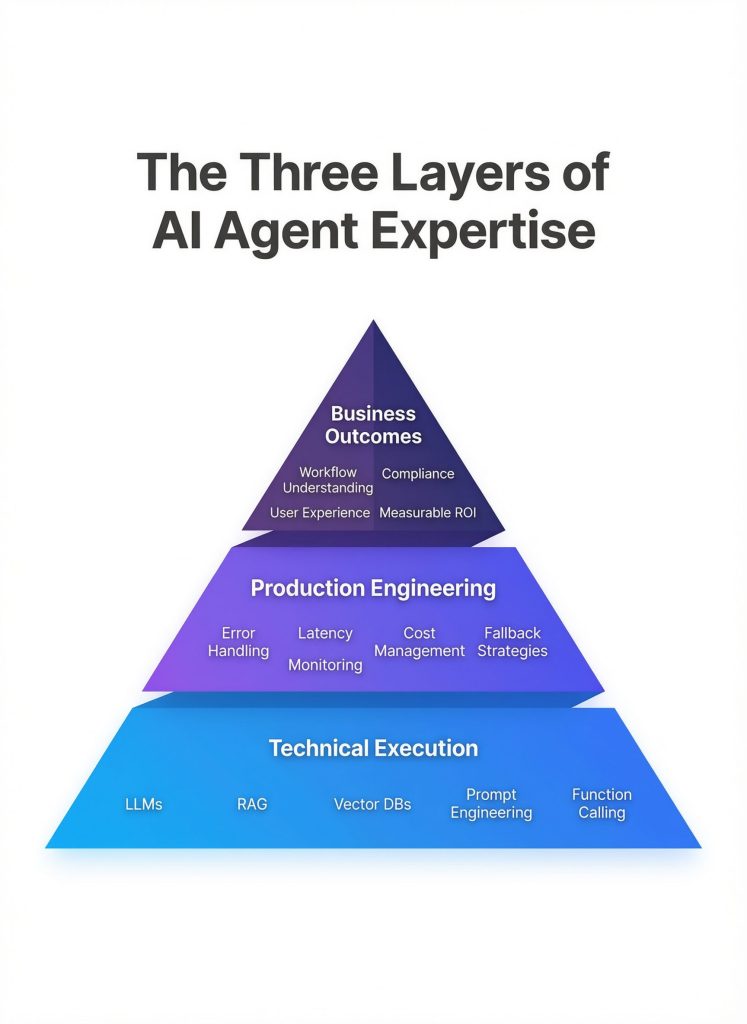

Layer 1: Technical Execution
Can they build? This is the baseline. They should demonstrate proficiency with LLMs, RAG architectures, vector databases, prompt engineering, function calling, and AI Agent Orchestration frameworks that coordinate tools, decisions, and business logic. But technical execution alone is table stakes.
Layer 2: Production Engineering
Can they ship something that works at scale? This includes error handling, latency optimization, cost management, monitoring, logging, and fallback strategies. It’s the difference between a demo and a deployed product.
Layer 3: Business Outcomes
Can they solve your actual business problem? This means understanding your workflows, your data, your compliance requirements, and your user experience needs.
Experienced teams also map AI Agent Workflows before development begins, ensuring the agent follows consistent business processes instead of improvising decisions.It’s the difference between a technically impressive agent and one that actually saves your team time. The objective is to create an effective AI Workforce where agents automate repetitive work while employees focus on higher-value decisions.
Most vendors claiming to be an AI agency operate at Layer 1. A few operate at Layer 2. The ones worth hiring operate at Layer 3.
The Experience Gap: Why It Matters
The AI agent landscape evolves weekly. New models, new frameworks, new best practices emerge constantly. A vendor who built their first AI agent last month has fundamentally different judgment than one who has shipped ten production agents across different industries.
That experience shows up in subtle ways. The experienced AI implementation partner knows when to use a smaller, faster model instead of the latest flagship. They know how to design evaluation frameworks that catch edge cases before they reach users. They know which integration patterns are reliable and which are fragile. They’ve seen agents fail and know why.
The AI Agent Landscape: Why Experience Matters
The market for AI agents is growing explosively, and so is the number of companies claiming to build them. But the gap between a capable enterprise AI partner and a generalist agency is enormous. This shift toward Agentic AI is changing how businesses automate work, moving beyond simple chatbots toward systems that can reason, act, and collaborate across multiple tools.
What an AI Agent Actually Requires
Before you evaluate vendors, make sure you understand what you’re asking them to build. A modern AI agent isn’t a chatbot. It’s a system that combines:
- AI Agent Requirements – goal definition, success criteria, decision boundaries, and escalation paths
- Data integration – connecting to CRMs, databases, APIs, and document stores with proper access controls
- Orchestration logic – how the agent decides what to do, in what order, and when to ask for help
- Memory and context management – maintaining state across conversations and tasks. A well-designed AI Agent Memory strategy ensures the agent remembers relevant context without exposing outdated or sensitive information.
- Guardrails and governance – preventing harmful outputs, enforcing business rules, and maintaining audit trails
- Monitoring and observability – tracking performance, cost, accuracy, and failure modes
Each of these is a discipline in itself. A vendor who treats AI agent development as “just prompt engineering” is underselling the complexity.
The Evolution of AI Agent Development Services
The market has matured rapidly. Early AI development was about experimenting with models. Today’s AI agent development services encompass the full lifecycle: requirements discovery, architecture design, prompt engineering, integration development, testing and evaluation, deployment, monitoring, and ongoing optimization.
The best vendors don’t just build agents. They help you design the operating model around them, who oversees them, how they escalate, how you measure their impact, and how you improve them over time.
Core Evaluation Criteria for Enterprise AI Partners
When you evaluate an AI consulting company or AI implementation partner, use these seven criteria as your framework. Each one separates serious vendors from the rest.
1. Technical Architecture and Model Strategy
The right AI solution provider doesn’t just pick the latest model and call it done. They make deliberate architectural decisions based on your specific use case.
Questions to ask:
- What model evaluation framework do you use to select the right model for each task?
- How do you handle model fallbacks when a primary model fails or degrades?
- What is your approach to cost optimization across different model tiers?
- How do you design for latency requirements in real-time vs. batch scenarios?
Expert tip: Beware of vendors who always recommend the most expensive model for every task. Experienced partners use a tiered approach, small models for simple classification, medium models for structured tasks, and large models only when reasoning complexity demands it.
2. Security, Compliance, and Governance
Enterprise AI agents handle sensitive data. If your vendor can’t articulate a clear security model, you’re exposing your organization to significant risk.
What to look for:
- Clear data handling policies (what data enters the LLM, what stays local, what is logged)
- Role-based access control for agent management
- Audit logging for all agent decisions and actions
- Compliance alignment with your industry (SOC 2, HIPAA, GDPR, etc.)
- A mature approach to AI Agent Governance, how agents are monitored, constrained, and improved over time
Red flag: If a vendor says “don’t worry, the model handles security”, run. LLMs have no inherent security model. Governance is something you build, not something you get from an API.
3. Implementation Process and Methodology
How a vendor approaches implementation tells you everything about their maturity. A structured methodology reduces risk and improves outcomes.
The hallmarks of a mature implementation process:
- A structured discovery phase that maps workflows, identifies data sources, and defines success criteria
- Iterative development with clear milestones and checkpoints
- A testing framework that includes unit tests, integration tests, and human evaluation
- A staged rollout plan that starts with limited scope and expands based on results
- Documentation throughout the process, not just at the end
Ask for their AI Agent Implementation Checklist. A mature vendor has one. It should cover every phase from requirements through post-launch monitoring. If they don’t have a documented process, they’re making it up as they go.
4. Integration Capabilities
An AI agent is only as useful as the systems it connects to. Your AI development company must demonstrate deep experience with the specific integrations your use case requires.
Key integration areas:
- CRM platforms (Salesforce, HubSpot, Dynamics)
- Communication channels (Slack, Teams, WhatsApp, web chat)
- Data sources (databases, APIs, document stores, data lakes)
- Business process tools (Jira, Asana, ERP systems)
- Authentication and identity providers
AI agent integration is where most AI projects succeed or fail. A vendor who can show you integration patterns from past projects, including how they handle authentication, rate limiting, error recovery, and data synchronization, is worth serious consideration. Successful AI agent integration should be resilient enough to handle API failures, authentication changes, and growing business requirements without disrupting operations.
5. Post-Launch Support and Optimization
The launch of your first AI agent is the beginning, not the end. Production AI agents degrade over time as models change, data shifts, and user behavior evolves. This is why every organization should manage the AI Agent Lifecycle continuously rather than treating deployment as the finish line.
What a mature support model looks like:
- Ongoing monitoring dashboards for agent performance, cost, and accuracy
- Regular evaluation cycles to catch regressions
- Prompt tuning and optimization as usage patterns emerge
- Incident response for agent failures or unexpected behavior
- A roadmap for continuous improvement based on real usage data
Question to ask: “What happens six months after launch when the model our agent uses is deprecated or replaced?” The answer should be detailed and specific, not “we’ll figure it out then.”
6. Pricing Transparency
Pricing reveals a lot about vendor maturity. The best AI consulting companies like Logix Built give you clear, predictable pricing tied to value delivered.
Pricing models to expect:
- Fixed-price scoping for well-defined use cases
- Time-and-materials with clear boundaries for exploratory work
- Outcome-based pricing for mature, proven use cases
- Platform subscription plus implementation fees for platform-based solutions
Red flag: Vague pricing language like “it depends on complexity” without a clear framework for how complexity is assessed. Experienced vendors can give you a ballpark range based on similar past projects.
7. Industry Experience
Domain expertise dramatically reduces implementation risk. A vendor who has built AI agents for your industry understands the data models, compliance requirements, workflow patterns, and user expectations specific to your domain.
What to look for:
- Case studies from your industry or adjacent verticals
- Understanding of industry-specific compliance requirements
- Familiarity with the tools and platforms your team already uses
- References you can actually call
The Vendor Evaluation Framework
Use this comparison table as a starting point when evaluating potential AI partners.
Vendor Comparison Matrix
| Criteria | Generalist Software Agency | Specialized AI Agency | Enterprise AI Partner |
| Model Expertise | Basic API integration | Multi-model strategy | Tiered model architecture |
| Security Posture | “We’ll figure it out” | Basic data handling | Formal governance framework |
| Implementation Process | Ad-hoc, no methodology | Light process | Structured methodology with checklist |
| Integration Depth | REST API basics | Common integrations | Deep integration patterns |
| Post-Launch Support | Warranty period only | Limited monitoring | Ongoing optimization |
| Pricing | Vague, varies widely | Scoped projects | Transparent, predictable |
| Industry Experience | General | Some vertical focus | Deep domain expertise |
| Platform Capability | Custom code only | Custom code plus some templates | Platform plus builder plus governance |
Where to Invest Your Budget
Not all evaluation criteria carry equal weight. Based on common failure patterns, here’s how to prioritize:
- Implementation process (weight: 25%) – Most AI projects fail during implementation, not discovery
- Security and governance (weight: 20%) – Failures here are expensive and hard to fix
- Post-launch support (weight: 20%) – Long-term value depends on ongoing optimization
- Integration capabilities (weight: 15%) – Integration complexity is consistently underestimated
- Industry experience (weight: 10%) – Important but less critical with strong methodology
- Technical architecture (weight: 10%) – Should be solid but most modern architectures are comparable
Red Flags: When to Walk Away From an AI Agency
Not every vendor is worth your time. Here are the warning signs that should end your evaluation immediately.
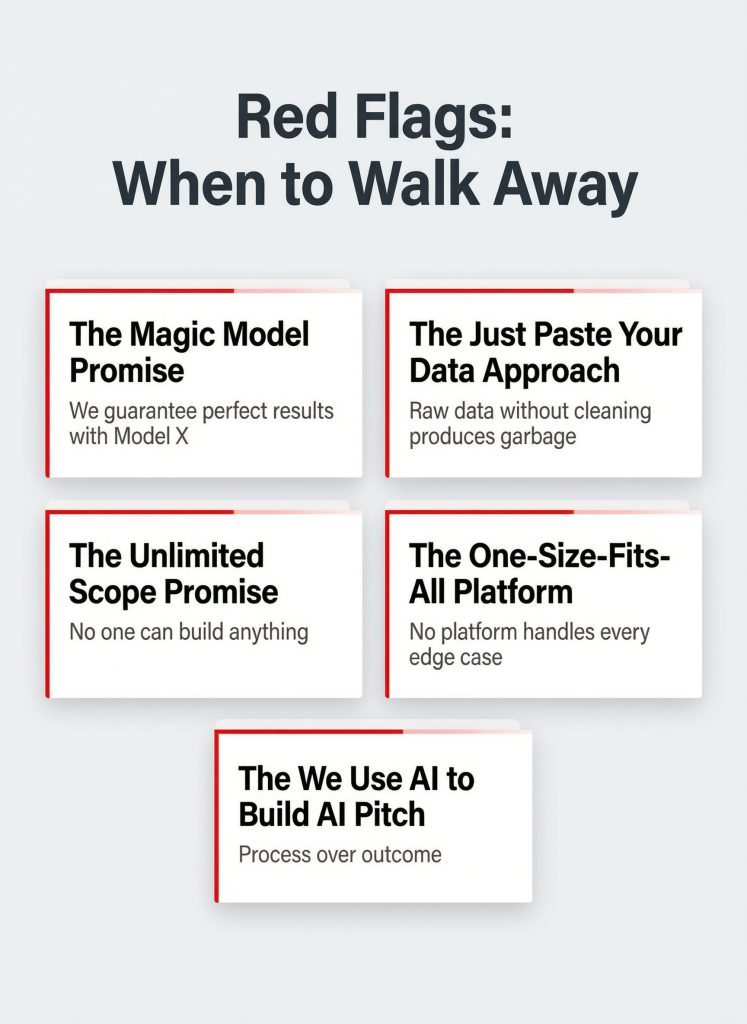
The “We Use AI to Build AI” Pitch
Some vendors claim they use AI tools to accelerate development. That’s fine. But if they can’t articulate what they’re building for you, if the pitch is about their process rather than your outcome, you’re talking to a company that doesn’t understand your business problem.
The Magic Model Promise
“I guarantee our solution will work perfectly because we’re using Model X.”
No model works perfectly. Every production AI agent has failure modes. A vendor who doesn’t acknowledge this hasn’t shipped enough production agents. The right answer is: “Here’s how we design for reliability, here’s how we handle failures, and here’s how we monitor for degradation.”
The “Just Paste Your Data” Approach
“We’ll take your data, throw it into a vector database, and you’ll have an AI agent.”
This approach has failed more AI projects than any other. Raw data ingestion without careful cleaning, chunking, indexing, and evaluation produces garbage. A serious vendor talks about data quality, evaluation frameworks, and iterative improvement, not just “paste and go.”
The Unlimited Scope Promise
“We can build anything you need.”
No one can build anything. The best AI development companies are honest about what they do well and where their limits are. A vendor who doesn’t set boundaries during discovery will set them during delivery, and you won’t like where they draw the line.
The One-Size-Fits-All Platform
“It’s our platform, it works for every use case.”
Platforms are powerful, but no single platform handles every edge case. A good AI Agent Platform provides a strong foundation for common patterns while supporting custom development for unique requirements. Be wary of vendors who treat their platform as a silver bullet.
Build vs. Buy: The Decision Framework
One of the first questions you’ll face is whether to build in-house or partner with an AI development company. This is a topic we’ll explore in depth in our upcoming guide on Build In-House vs Development Partner, but here’s a framework to start thinking about it.
When to Build In-House
- AI is core to your product or competitive advantage
- You have existing AI/ML engineering talent
- You need deep, ongoing customization
- Your data security requirements make external access impractical
When to Partner with an AI Agent Development Company
- AI is a tool to improve operations, not your core product
- You need to move faster than hiring allows
- You lack in-house AI expertise
- You want to learn from proven patterns and avoid common mistakes
- Your use case is well-understood but has specific integration requirements
- You need Custom AI Agents designed around your workflows without the overhead of building a full internal AI team.
The Hybrid Approach
Many organizations succeed with a hybrid model: partner with an AI implementation partner for the first implementation, build internal capability through the partnership, and take over maintenance and expansion after the initial engagement.
Implementation: What a Good Partnership Looks Like
A mature AI development company follows a structured implementation process. Here’s what you should expect.
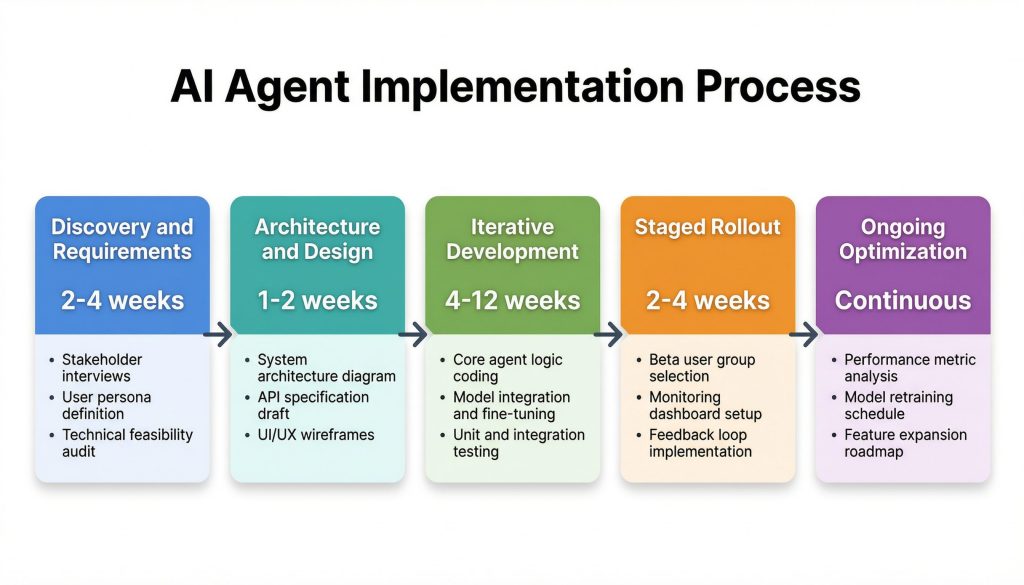

Phase 1: Discovery and Requirements
Duration: 2-4 weeks
This phase is about understanding your business before writing any code. The vendor should:
- Interview stakeholders across your organization
- Map current workflows and identify bottlenecks
- Define success criteria and key performance indicators
- Identify data sources and assess data quality
- Document AI Agent Requirements, what the agent should do, what it should not do, and how it should escalate
What good looks like: You’ll learn something about your own process during this phase. A great vendor asks questions you hadn’t thought of.
Phase 2: Architecture and Design
Duration: 1-2 weeks
- Design the agent architecture, including model selection, retrieval strategy, and integration patterns. Choosing the right AI Agent Platform during this stage also makes future scaling, monitoring, and governance significantly easier.
- Outline the governance framework, including guardrails, monitoring, and escalation paths
- Define the testing and evaluation approach
- Create a detailed implementation roadmap
AI Agent Implementation Roadmap: this is what you’ll get from this phase. It should be specific enough to estimate effort and generic enough to accommodate discoveries during development.
Phase 3: Iterative Development
Duration: 4-12 weeks depending on scope
- Build in sprints with demonstrable increments
- Test against real data, not synthetic data
- Run human evaluation loops with your team members
- Document as you go
Common pitfall: Vendors who disappear for weeks and reappear with a “finished” product. Development should be transparent. You should see progress regularly.
Phase 4: Staged Rollout
Duration: 2-4 weeks
- Deploy to a limited user group first
- Monitor performance, accuracy, and user feedback
- Iterate based on real usage patterns
- Expand access gradually
This is where AI agent deployment mistakes become visible. But with a staged rollout, they’re manageable discoveries rather than catastrophic failures. We’ll cover these patterns in detail in a future guide.
Phase 5: Ongoing Optimization
Duration: Continuous
- Regular evaluation cycles to catch regressions
- Prompt tuning based on usage patterns
- Model updates as new options become available
- Feature expansion based on user feedback
How to Begin Your Evaluation
Step 1: Define Your Requirements First
Before you talk to any vendor, write down your own requirements. What problem are you solving? What does success look like? What data is involved? What are your constraints on budget, timeline, and security? Documenting clear AI agent requirements before vendor discussions leads to better proposals, more accurate estimates, and fewer surprises during implementation.
Step 2: Ask for Their Process
In your first conversation, ask about their implementation methodology. A vendor who can describe their process clearly and confidently is worth a second conversation. A vendor who gives vague answers is not.
Step 3: Evaluate Their Platform
The best AI implementation partners have a platform that accelerates development and reduces risk. An AI Agent Platform provides the infrastructure for building, deploying, and managing agents. An AI Agent Builder gives you and your team visibility into how agents are configured and how they make decisions. Together, these tools reduce reliance on individual developers and make your AI program sustainable.
Platforms such as Botsify, a White Label AI Agent Platform, combine infrastructure, agent management, deployment, and governance in one environment, making it easier to scale AI initiatives without stitching together multiple tools.
Step 4: Check References Thoroughly
Don’t just call the references the vendor provides. Ask for:
- A reference from a similar use case
- A reference from a similar industry
- A reference where things went wrong (and how they handled it)
It’s also worth comparing multiple vendors, including established platforms and Botsify Alternatives, to understand how different implementation approaches, pricing models, and platform capabilities align with your business goals.
Step 5: Run a Pilot
Never commit to a large engagement without a pilot. A small, well-scoped project, 2-4 weeks, focused on a specific use case, tells you everything you need to know about how the vendor works. It’s the best investment you can make in your evaluation process.
The Buyer’s Checklist
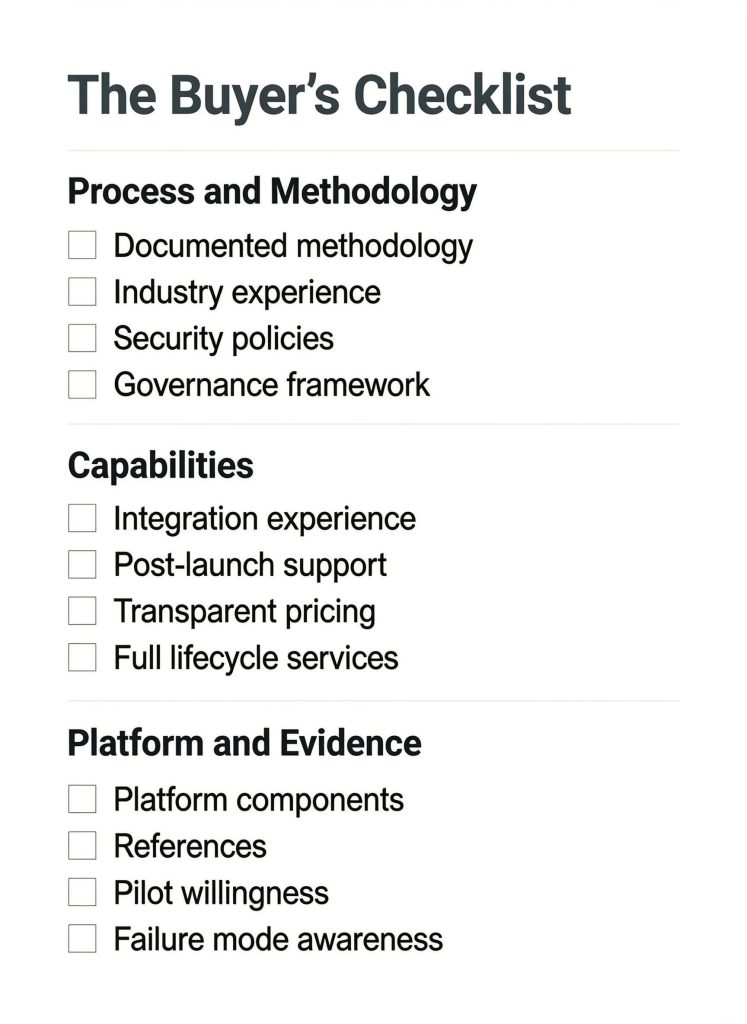
Use this checklist when evaluating vendors:
- Vendor has a documented implementation methodology
- Multiple production AI agents deployed in your industry
- Clear data handling and security policies
- Formal AI Agent Governance framework
- Demonstrated integration experience with your tech stack
- Structured post-launch support model
- Transparent pricing with clear scope boundaries
- AI Agent Development Services covering the full lifecycle
- Platform components (AI Agent Platform, builder, management tools)
- References from similar use cases
- Willingness to run a small pilot before large commitment
- Ability to explain failure modes, not just success stories
Using This Framework to Evaluate Vendors
By now, you’ve probably noticed a pattern. The strongest AI implementation partners don’t win because they have access to a better language model. They win because they combine the right technology with a structured implementation process, strong governance, reliable integrations, and long-term support.
That’s exactly the standard you should apply when evaluating any vendor, whether it’s a global consulting firm, a specialist AI agency, or a platform provider.
At Botsify, we’ve built our White Label AI Agent Platform around the same principles discussed throughout this guide. Instead of treating AI agent development as a one-time project, we combine an AI Agent Platform, an AI Agent Builder, AI Agent Governance, and end-to-end AI Agent Development Services to help businesses move from planning and deployment to long-term optimization.
Whether an organization needs Custom AI Agents for customer support, internal operations, sales, or industry-specific workflows, the objective remains the same: build AI agents that solve real business problems, integrate with existing systems, and continue improving after launch.
More importantly, these evaluation criteria shouldn’t change based on the vendor you choose. Ask every provider how they approach implementation, governance, integrations, security, monitoring, and post-launch support. The right partner will welcome those questions because experienced teams know successful AI adoption depends on far more than writing prompts or connecting an API.
Conclusion
Choosing the right AI agent development company is one of the most important decisions you’ll make in your AI strategy this year. The wrong choice wastes budget and momentum. The right choice creates a foundation you can build on for years.
The companies that succeed with AI agents aren’t the ones with the most advanced models. They’re the ones that found the right partner, asked the right questions, and invested in the right process.
Start with your requirements. Evaluate against the criteria in this guide. Run a pilot. And pay attention to how the vendor shows up in every interaction, because how they sell is how they’ll deliver.
AI Agentic Platform For Building Portable AI Agents
Say Hello To Agentic AI That Connects With Your CRM And Even Other Agents
Frequently Asked Questions
What should I look for in an AI agent development company?
Look for proven domain expertise, a structured implementation methodology, clear security and governance frameworks, deep integration capabilities, transparent pricing, and a robust post-launch support model. The best AI agent development companies combine a platform, builder, and governance capabilities with the ability to deliver custom solutions for your specific use case.
How much does it cost to develop a custom AI agent?
Costs vary widely based on complexity, from $20,000-$50,000 for a well-scoped single-use agent to $150,000-$500,000+ for enterprise implementations with multiple integrations, custom workflows, and ongoing optimization. The most important factor is not the upfront cost but the total cost of ownership, including monitoring, prompt tuning, model updates, and incident response over the agent’s lifecycle.
How long does it take to develop and deploy an AI agent?
A focused pilot can take 2-4 weeks. A full production implementation typically takes 8-16 weeks depending on scope, complexity, and integration requirements. Staged rollouts add another 2-4 weeks. The timeline depends heavily on data readiness, integration complexity, and how well-defined your requirements are before development begins.
What’s the difference between an AI agency and an AI agent development company?
An AI agency typically offers broad AI consulting and experimentation services. An AI agent development company specializes in building production-ready AI agents that integrate with your existing systems, follow governance frameworks, and deliver measurable business outcomes. The key difference is the focus on deployment, reliability, and ongoing optimization rather than just prototyping.
Should I build AI agents in-house or hire a development partner?
Build in-house if AI is core to your product and you have existing AI talent. Hire a partner if you need to move faster than hiring allows, lack internal expertise, or want to learn from proven patterns. Many successful organizations use a hybrid approach: partner for the first implementation while building internal capability through the engagement.
How do I evaluate an AI agent development company’s security practices?
Ask about their data handling policies, role-based access controls, audit logging, model governance framework, and compliance certifications. A mature vendor will have a documented AI Agent Governance framework and be transparent about how data flows through their system. If they can’t articulate these in your first meeting, they’re not ready for enterprise work.