


Businesses have experimented with chatbots, automation tools, and AI assistants for years. Some worked well for simple tasks. Many did not scale. As workflows became more complex and customer expectations increased, it became clear that isolated AI tools were not enough. What organizations need today is infrastructure, not just a bot, but a system that can create, manage, deploy, and improve intelligent agents across the business.
That system is an AI agent platform.
In this guide, we’ll break down what an AI agent platform actually is, how it works behind the scenes, how it differs from builders and frameworks, and how companies use it to deploy scalable AI solutions. We’ll also look at how platforms like Botsify help businesses move from experimental AI projects to production-ready deployments.
What Is an AI Agent Platform?
An AI agent platform is a centralized environment that allows organizations to design, deploy, manage, monitor, and scale intelligent AI agents across different channels and workflows.
Unlike a standalone AI assistant or chatbot, a platform provides the infrastructure layer. It handles orchestration, integrations, memory management, user permissions, analytics, and multi-agent coordination.
To understand this clearly, it helps to separate three concepts:
- AI agents: Individual intelligent systems that perceive inputs, make decisions, and take actions.
- Agentic AI systems: Broader ecosystems where agents operate autonomously and coordinate with tools and other agents.
- AI agent platforms: The environment where those agents are built, deployed, and maintained.
If you’re new to the concept of intelligent agents themselves, it’s useful to first understand how modern AI agents operate, they are not scripted bots but dynamic systems capable of reasoning and action. An AI agent platform provides the operational backbone that allows those agents to function reliably at scale.
Portable AI Agents In Seconds, Use Everywhere
Prompt, Test, and Deploy AI Agents Across Social Platforms and LLMs. Automate Everything.
How AI Agent Platforms Work Behind the Scenes
An AI agent platform is made up of several interconnected layers. Each plays a specific role in transforming an idea into a working AI system.
1. Agent Creation Layer
This is where businesses design and configure their agents.
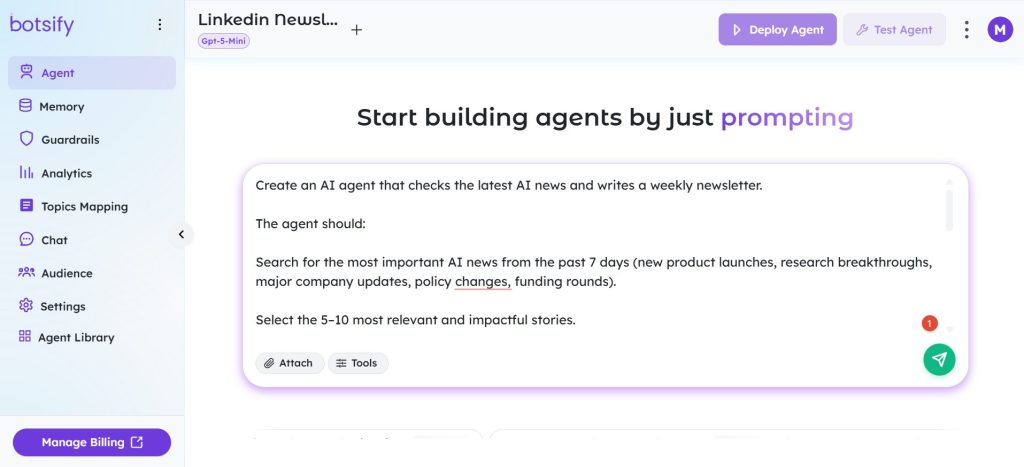

In practical terms, this includes:
- Defining the agent’s role and objectives
- Setting instructions and behavioral boundaries
- Connecting tools (CRM, APIs, databases)
- Designing workflows and triggers
- Testing conversational logic
Before configuring these elements, teams should document their AI Agent Requirements, including business goals, functional capabilities, data access, integrations, permissions, performance expectations, and operational boundaries.
Modern platforms typically provide a visual or structured interface for building agents. This is often referred to as an AI agent builder, but the builder is only one component of the larger platform.
On Botsify, for example, businesses can create structured agents without writing code. The interface allows teams to define agent goals with AI prompts, integrate external tools, and deploy across multiple channels from one dashboard.
This layer turns strategy into executable logic.
2. Memory and Context Management
True AI agents require context to operate effectively.
A robust AI agent platform manages:
- Session-based short-term memory
- Persistent user history
- Context retrieval from knowledge bases
- Structured data storage
For example, if a customer interacts with an agent on Monday and returns on Thursday, the platform should allow the agent to reference prior interactions. Without centralized memory management, agents become repetitive and ineffective.
Memory architecture is a defining factor between simple bots and modern agentic AI systems. Platforms that support deeper contextual handling enable more personalized and intelligent experiences.
3. Tool and Integration Layer
AI agents are most powerful when connected to tools.
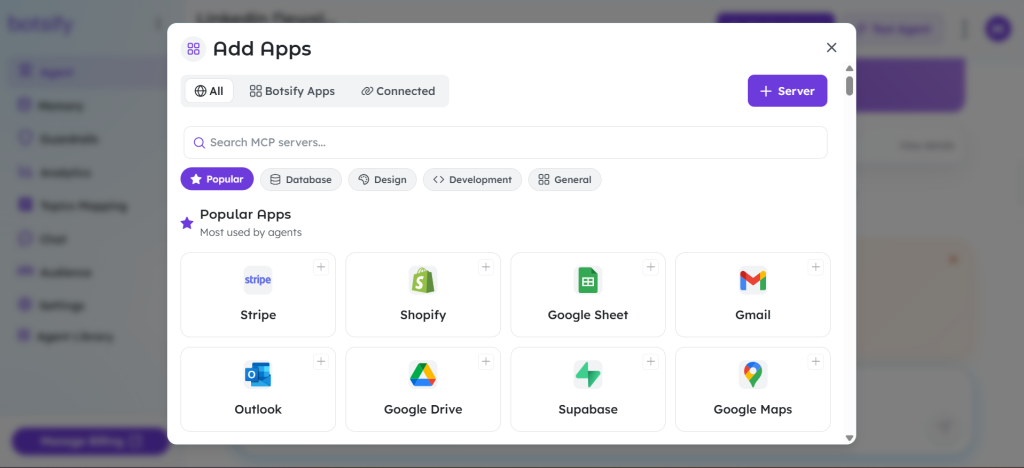

An agent may need to:
- Pull customer records from a CRM
- Update tickets in a helpdesk system
- Send emails
- Retrieve documents
- Trigger workflows
- Access internal dashboards
AI Agent Integration is the layer that connects agents to CRMs, APIs, databases, help desks, and other business systems so they can retrieve data, update records, and trigger real actions.
In technical environments, developers might build integrations manually using AI agent frameworks, but platforms abstract this complexity. Instead of managing infrastructure, API authentication, and error handling from scratch, businesses configure integrations through managed connectors.
For example, a Slack AI agent deployed through a platform can respond to team queries, pull information from internal databases, and trigger actions, all without custom backend engineering.
This integration layer transforms an agent from a conversational interface into an operational assistant.
4. Deployment Across Channels
An AI agent platform is multi-channel by design.
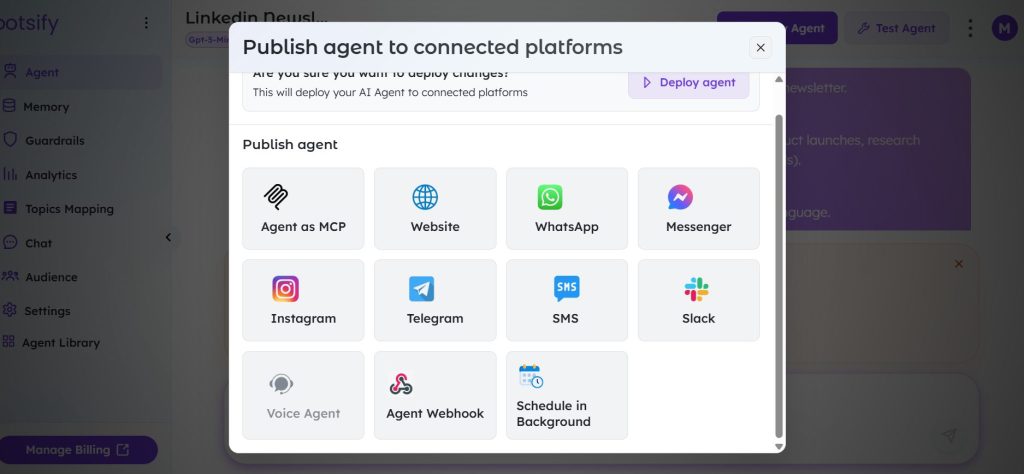

Agents can be deployed to:
- Websites
- Customer support portals
- Slack
- WhatsApp
- Internal dashboards
- Mobile applications
The ability to deploy across multiple environments from a single system is what separates a platform from a standalone bot solution.
For businesses, this means consistency. One agent logic can operate across multiple touchpoints without duplicating configuration.
Botsify, for instance, supports multi-channel deployment, allowing companies to manage customer-facing and internal agents from a unified dashboard.
5. Monitoring, Optimization, and Governance
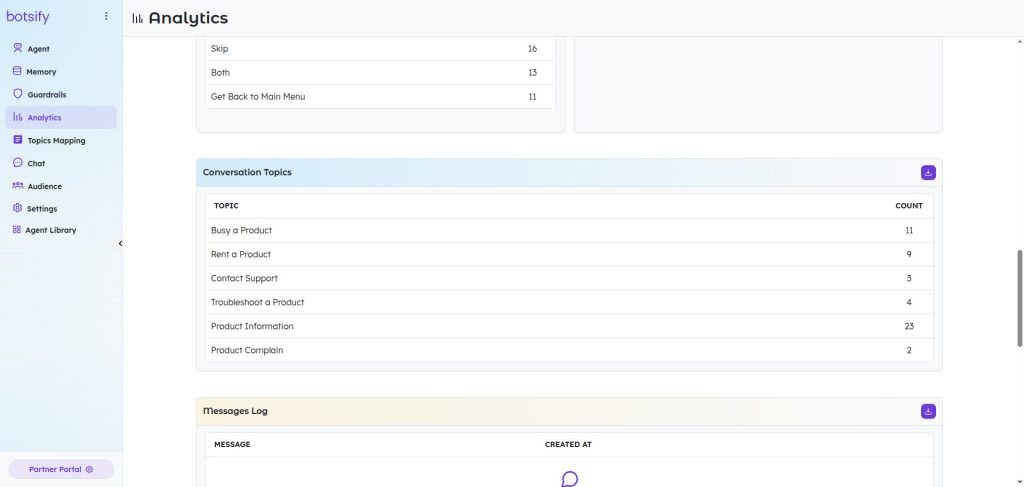

Deployment is only the beginning.
A mature AI agent platform includes:
- Performance analytics
- Conversation logs
- Escalation controls
- Human handoff workflows
- Usage monitoring
- Access controls
This governance layer ensures compliance, quality control, and continuous improvement.
Without centralized monitoring, AI deployments become fragmented and difficult to manage. Platforms provide accountability and visibility, which is especially important for enterprises and agencies managing multiple clients.
Many AI agent deployment mistakes happen when teams move to production without clear monitoring, escalation paths, integration testing, or ownership after launch.
Once requirements are defined, an AI Agent Implementation Roadmap gives teams a structured path from business case and discovery through development, testing, pilot deployment, and production.
AI Agent Platform vs AI Agent Builder
These terms are often used interchangeably, but they are not the same.
An AI agent builder is the creation interface, the tool that allows users to design and configure agents.
An AI agent platform includes:
- The builder
- Deployment tools
- Integration systems
- Analytics
- Multi-user management
- Infrastructure hosting
- Security and compliance layers
In other words, the builder is a component. The platform is the ecosystem.
If your goal is simply to experiment with building an agent, a builder might suffice. But if your goal is to operate AI agents across departments, serve customers, and manage workflows, a platform is required.
Botsify provides both creation tools and full lifecycle management, which is why it functions as a comprehensive platform rather than just a builder interface.
AI Agent Platform vs AI Agent Frameworks
For technical teams, another important distinction is between platforms and frameworks.
AI agent frameworks such as LangChain or AutoGen provide libraries for building agents programmatically. They are powerful, flexible, and suitable for developers building highly customized solutions.
However, frameworks require:
- Backend engineering
- Infrastructure setup
- Hosting management
- Security implementation
- Ongoing maintenance
An AI agent platform abstracts those complexities. It provides:
- Managed hosting
- Pre-built integrations
- User management
- Visual configuration
- Operational dashboards
For organizations without dedicated AI engineering teams, platforms can reduce the infrastructure and engineering work required to deploy and manage AI agents.
Botsify’s approach focuses on lowering the technical barrier while maintaining enterprise-level capabilities. This allows both technical and non-technical teams to launch and manage agents without building infrastructure from scratch.
Organizations with more complex requirements may instead work with an AI Agent Development Company to design custom agents, integrations, and deployment architecture around their existing systems.
Types of Businesses That Need an AI Agent Platform
Small and Growing Businesses
Smaller companies often operate with limited teams and tight budgets. Automation can create leverage, but managing custom-built systems is unrealistic.
An AI agent platform allows small businesses to:
- Automate support queries
- Qualify leads
- Schedule appointments
- Provide 24/7 responses
Many organizations exploring AI agents for small businesses find that platforms offer predictable costs and manageable complexity compared to hiring engineering teams.
Botsify enables smaller teams to deploy scalable AI without increasing headcount.
Agencies and Consultants
Agencies represent one of the fastest-growing segments for AI deployment.
An AI agent agency may build automation systems for multiple clients across industries. For these firms, scalability and branding matter.
A white label AI agent platform allows agencies to:
- Rebrand the software
- Manage multiple client accounts
- Set custom pricing
- Maintain centralized control
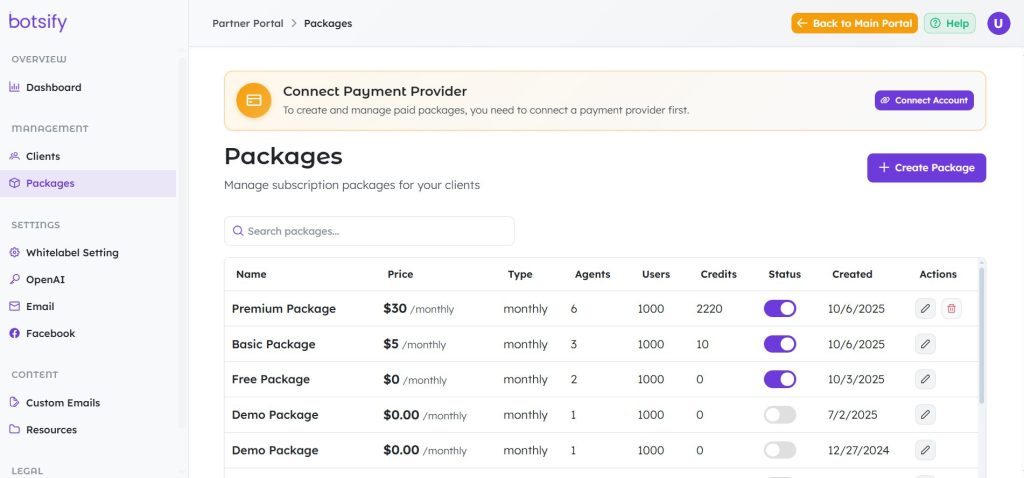

Botsify supports this model by enabling fully branded AI agent platforms under an agency’s identity. Agencies can operate as AI solution providers without building proprietary infrastructure.
Enterprises with Complex Workflows
Larger organizations often require:
- Multi-agent coordination
- Department-specific permissions
- Integration with internal systems
- Compliance and security controls
In these environments, custom AI agents may operate across customer support, operations, HR, and internal knowledge management.
Platforms enable enterprises to orchestrate agents across departments while maintaining oversight and governance.
What Makes a Good AI Agent Platform?
Choosing the right platform requires evaluating more than surface features.
Multi-Agent Support
Modern businesses rarely need just one agent. They need specialized agents that collaborate.
A good platform supports multiple agents operating under structured workflows, rather than isolated assistants.
Deep Integration Capabilities
The platform should connect seamlessly to CRM systems, databases, communication tools, and third-party APIs.
Without integration, agents remain conversational shells.
Scalability and Infrastructure Stability
Look for:
- Cloud-based hosting
- Role-based access controls
- Usage tracking
- High uptime reliability
A scalable system ensures that agents remain responsive even as usage increases.
White-Label and Branding Options
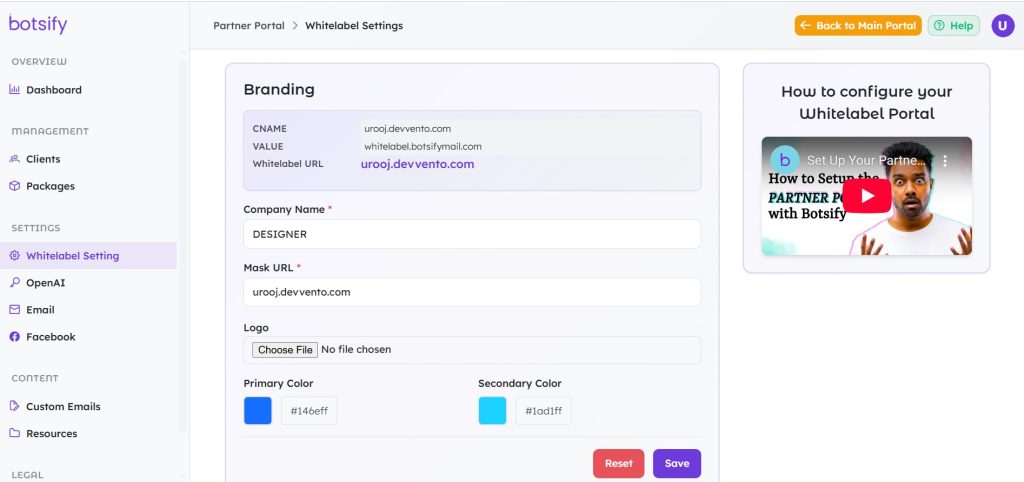

For agencies and SaaS entrepreneurs, branding control is critical.
Platforms offering white label AI capabilities allow users to operate under their own domain, logo, and pricing structure.
This enables businesses to build revenue streams using branded AI agent platforms without revealing the underlying provider.
Botsify’s white-label functionality is one of its strongest differentiators, enabling agencies to deploy AI solutions as proprietary offerings.
Customization and Flexibility
No two businesses are identical.
The ability to create custom AI agents tailored to industry-specific workflows, internal processes, and customer journeys is essential.
Businesses with requirements that go beyond platform configuration can also use AI Agent Development Services for custom workflows, integrations, and implementation support.
Rigid, template-only systems limit long-term value. Flexible platforms allow structured customization without sacrificing usability.
Choosing the platform is only part of the process. Before deployment, an AI Agent Implementation Checklist can help teams verify that data, integrations, permissions, testing, ownership, and governance are ready for production.
Real-World Applications of AI Agent Platforms
Understanding how an AI agent platform works conceptually is important. But its real value becomes clear when you see how businesses apply it in daily operations. Across industries, AI agents are no longer experimental tools, they are becoming operational layers that support customer interactions, internal workflows, and revenue generation.
Customer Support Automation
One of the most common use cases is customer support.
AI agents can answer frequently asked questions, check order statuses, process return requests, update customer records, and escalate complex issues to human representatives when needed. Because the agents operate within a centralized AI agent platform, support teams maintain visibility into performance, conversation logs, and resolution rates.
For ecommerce businesses, this becomes even more powerful when deploying a Shopify AI agent that integrates directly with store inventory, order data, and shipping systems. Instead of sending customers to static help pages, the agent can retrieve live order details and provide contextual assistance in real time.
This reduces ticket volume while improving response speed and customer satisfaction.
Internal Knowledge Assistants
AI agent platforms are equally valuable inside organizations.
Companies deploy intelligent assistants within communication tools to help employees retrieve documentation, check internal policies, and automate repetitive queries. A properly configured Slack AI agent integrated with knowledge bases and shared drives eliminates the need for manual document searches.
Beyond Slack, teams often deploy agents inside messaging environments such as a Telegram AI agent to support distributed teams or remote operations. These agents can provide structured information, notify departments of updates, and even trigger backend workflows, all managed centrally through the platform.
This internal layer improves operational efficiency without adding headcount.
Lead Qualification and Sales Routing
AI agent platforms are increasingly used to transform website traffic into structured sales pipelines.
Agents engage visitors, ask qualification questions, gather relevant details, and route leads to appropriate sales representatives automatically. Instead of static contact forms, businesses deploy conversational flows that adapt based on user responses.
Because the logic runs through a centralized system, marketing and sales teams can monitor performance metrics, optimize scripts, and refine routing rules without rebuilding infrastructure.
For companies operating in ecommerce or brick-and-mortar sectors, deploying an AI agent for retail can further enhance sales operations by recommending products, checking availability, and scheduling in-store visits, all while capturing actionable customer insights.
Marketing and Customer Engagement
Marketing teams use AI agents to personalize outreach, manage follow-ups, and guide customers through decision-making journeys.
Some organizations begin by evaluating the best AI agents available in the market. However, many eventually realize that pre-built solutions often lack the flexibility required for custom workflows. An AI agent platform allows marketing teams to design agents aligned with their own funnel structure, campaign objectives, and brand voice.
For example, ecommerce businesses can deploy agents that recommend products based on browsing behavior, notify customers of restocked inventory, or handle promotional campaigns across channels. Because everything operates within the same platform, data remains centralized and measurable.
This approach turns conversational AI into a structured revenue tool rather than a novelty feature.
Is an AI Agent Platform Right for Your Business?
An AI agent platform makes sense if:
- You need multi-step automation rather than static chat responses.
- You operate across multiple channels.
- You want visibility and analytics across deployments.
- You plan to scale usage over time.
- You want branding control or resale capability.
Before committing to a platform or custom implementation, an AI Readiness Assessment can help determine whether your processes, data, integrations, governance, and internal teams are prepared for AI agent adoption.
If you’re experimenting with one isolated use case, a standalone tool may be enough. For broader deployments, the decision often becomes whether to build internally, use a platform, work with a development partner, or combine approaches. Our Build vs. Buy AI Agents framework compares these models across expertise, customization, ownership, integrations, and maintenance.
Botsify is designed specifically for organizations that want both flexibility and scalability, whether they are small businesses, agencies, or enterprises.
Final Thoughts
An AI agent platform is not simply a chatbot system or a developer library. It is infrastructure.
It enables organizations to create intelligent agents, integrate them into workflows, deploy them across channels, and manage them responsibly.
As businesses increasingly adopt agent-driven automation, the difference between fragmented tools and centralized platforms becomes significant. Platforms provide structure, governance, scalability, and operational clarity.
Botsify’s approach reflects this shift. By combining agent creation tools, multi-channel deployment, white-label capabilities, and lifecycle management, it allows organizations to transition from experimental AI use to structured, production-ready deployments.
For businesses serious about automation, the question is no longer whether to use AI agents. It is how to deploy them sustainably.
An AI agent platform provides that foundation.
AI Agentic Platform For Building Portable AI Agents
Say Hello To Agentic AI That Connects With Your CRM And Even Other Agents