


You know you need AI agents. Your team is drowning in repetitive tasks, your competitors are automating, and your customers expect faster responses. But the moment you start planning, one question stops you cold:
Should we build this ourselves, buy a platform, or hire someone to do it for us?
It’s a high-stakes decision. Get it right and you create a clearer path to faster implementation, stronger adoption, and sustainable AI operations. Get it wrong and you’re stuck with a half-built prototype, a budget blowout, or a tool your team won’t use.
This build vs buy AI agent guide compares four delivery models, in-house development, AI agent platforms, development partners, and hybrid approaches, so you can choose the model that fits your business.
Key Takeaways
- There is no single right answer. The best delivery model depends on your team’s AI expertise, timeline, budget, and how much control you need over the final product.
- Building in-house gives you greater control but requires substantial internal capability. Depending on the project, that may include AI engineering, backend development, infrastructure, security, and ongoing operational expertise.
- AI agent platforms remove infrastructure headaches but can limit deep customization. They’re ideal when speed and reliability matter more than unique features.
- Development partners fill the expertise gap without requiring you to build a permanent AI team, but they introduce vendor dependency and higher upfront costs.
- Development partners fill the expertise gap without requiring you to build a permanent AI team, but they introduce external dependency, coordination requirements, and project-specific commercial terms.
- Time to production depends heavily on the delivery model and project complexity. Platforms can reduce infrastructure work, while fully custom development usually requires more architecture, engineering, testing, and maintenance effort.
- Your decision should be driven by your core competency. If AI infrastructure is not a strategic capability your business needs to own, building every layer from scratch may create unnecessary engineering and maintenance overhead.

Build vs Buy AI Agent: Understanding Your Four Options
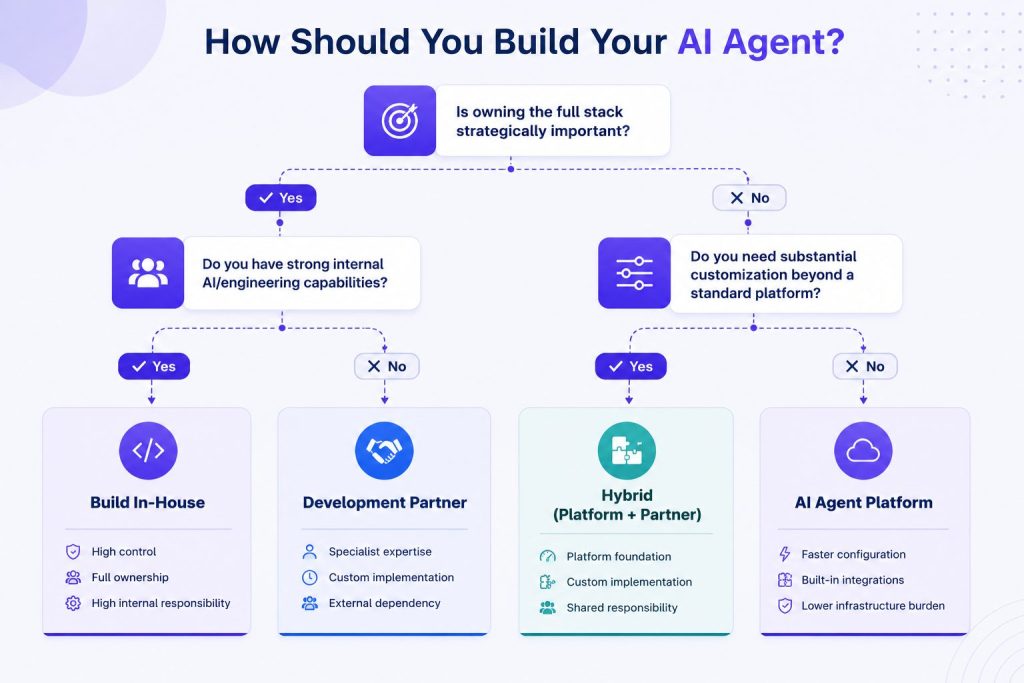
Every business building an AI agent eventually chooses one of four paths. Let’s look at each one honestly, what it costs, what it demands, and what you get back.
1. Build In-House
You assemble a team, architect the system, write the code, manage the infrastructure, and maintain everything yourself.
When it makes sense: Your AI agent is core to your product. You have existing ML/AI talent. You need extreme customization that no platform can deliver. You’re building a defensible IP asset.
When it doesn’t: Speed to deployment is a priority and your organization does not already have the technical capability required to build and maintain the stack internally. Before committing to this model, an AI Readiness Assessment can help determine whether your organization actually has the people, processes, data, and technical capability to support long-term ownership.
What you’ll need:
- Machine learning engineers (or at least strong backend engineers who can learn fast)
- Prompt engineering and LLM optimization skills
- DevOps for model hosting, scaling, monitoring
- Security and compliance expertise
- Ongoing maintenance budget
Example scenario : A fintech company building a compliance-checking AI agent might build in-house because they need to run on proprietary data, meet strict regulatory requirements, and integrate deeply with their existing stack. Their requirements may exceed what a standard platform configuration can support.
2. Use an AI Agent Platform
You subscribe to a platform like Botsify that handles the infrastructure, LLM orchestration, channel integrations, and deployment, you configure the agent’s behavior and connect it to your systems.
When it makes sense: You need to move fast. Your AI agent is a tool for your business, not your product. You want predictable pricing. You don’t want to manage infrastructure.
When it doesn’t: You need deep customization that the platform doesn’t support. You have very specific compliance or data residency requirements. You want to own every layer of the stack.
What you’ll get:
- Pre-built integrations (WhatsApp, Slack, web, CRMs)
- Managed LLM orchestration and prompt infrastructure
- Built-in monitoring, analytics, and logging
- Managed platform updates and infrastructure maintenance
- Reduced engineering effort compared with building the entire stack internally
Example scenario : A marketing agency wants to deploy AI agents for client lead qualification across multiple channels. They use an AI Agent Platform to build and white-label agents without hiring engineers. The platform lets the agency focus on configuring agent behavior and client workflows instead of building and maintaining the underlying AI infrastructure itself.
3. Work with a Development Partner
You hire an AI development partner to build your custom AI agent. They handle the technical work while you define requirements and own the outcome.
When it makes sense: You have a clear vision but no internal AI team. Your requirements are complex enough that a platform can’t handle them alone. You want a custom solution without building a permanent AI department.
When it doesn’t: You need ongoing rapid iteration, frequent changes may require additional coordination when development is handled outside your internal team. Your budget is tight. You want to build internal AI capability long-term.
What to expect:
- Discovery and requirements definition
- Architecture, development, and iteration
- Testing, deployment, and documentation
- Handover and knowledge transfer
- Optional ongoing support and maintenance
A clear AI Agent Requirements document gives both internal teams and external partners the same definition of scope, permissions, integrations, and success criteria before development begins.
Example scenario: A logistics company needs an AI agent that integrates with their legacy ERP system, handles multi-step workflows across warehouses, and respects role-based access controls. Their internal team is fully allocated on core product work. They partner with an AI development company to build the custom agent while their team focuses on the product roadmap.
4. Hybrid: Platform + Implementation Expertise
You use an AI agent platform as the foundation, then work with implementation experts to customize, integrate, and optimize it for your specific needs.
When it makes sense: You want the speed of a platform but need more customization than a self-serve setup provides. You have complex integrations. You want to avoid infrastructure management while still getting a tailored solution. This model becomes particularly useful when AI Agent Integration requires custom connections to CRMs, ERPs, legacy systems, or other business software.
When it doesn’t: Your requirements are truly unique and can’t be built on a platform’s architecture. You have the internal team to build and maintain a full custom solution.
What this looks like:
- Platform can provide: core infrastructure, supported channels, orchestration, scaling, monitoring, and platform-level security controls
- Implementation expertise can cover: custom workflows, advanced integrations, prompt optimization, training
Example scenario: A healthcare organization needs AI agents for patient intake, appointment scheduling, and follow-up care. They use an AI Agent Builder platform for the agent infrastructure, then work with implementation experts to customize the agents for HIPAA compliance, integrate with their EHR system, and train the models on their medical terminology. The hybrid approach allows them to use existing platform infrastructure while concentrating custom development effort on the workflows, integrations, and compliance requirements unique to their organization.
For businesses with specialized processes, Custom AI Agents can provide that tailored application layer without requiring the organization to rebuild the entire underlying platform.
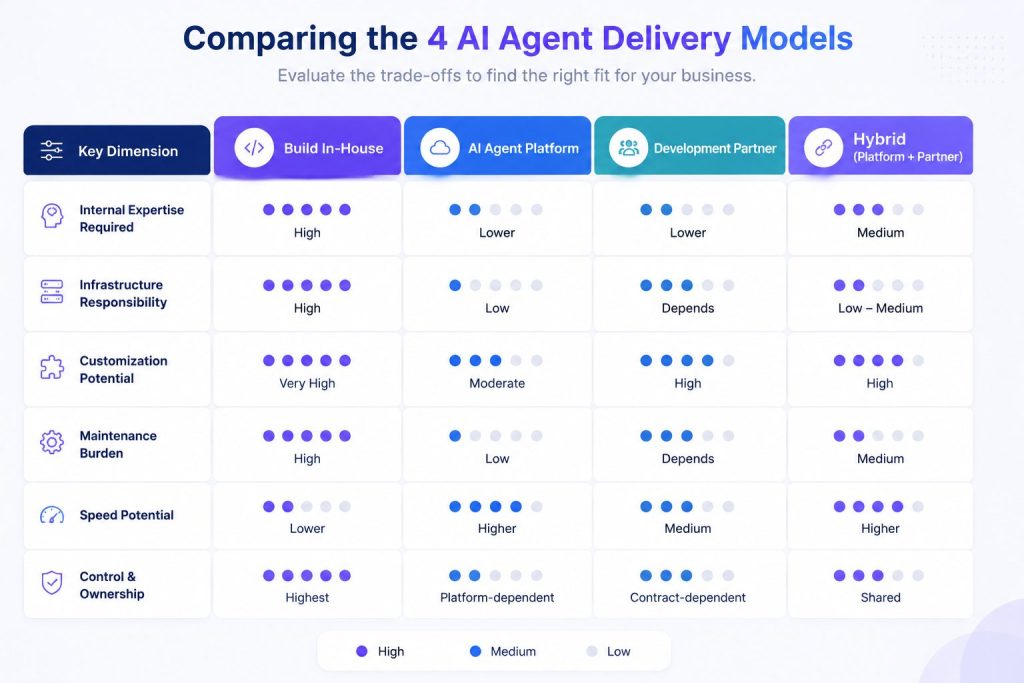
Comparison Table
| Factor | Build In-House | AI Agent Platform | Development Partner | Hybrid |
| Time to production | Usually longest setup | Typically faster for supported use cases | Depends heavily on scope | Can accelerate custom implementations |
| Upfront investment | High | Lower | Medium to high | Medium |
| Ongoing cost model | Internal team + infrastructure | Subscription/platform costs | Support/maintenance depends on agreement | Platform + implementation/support |
| Internal AI expertise required | High | Lower | Lower | Low to medium |
| Customization | Very high | Depends on platform capabilities | High | High within platform boundaries |
| Control | Highest | Platform-dependent | Defined by architecture and agreement | Shared across platform and custom layers |
| Integrations | Built and maintained internally | Native + supported custom integrations | Can be highly customized | Native + custom integrations |
| Security/compliance responsibility | Primarily internal | Shared with platform provider | Defined by engagement | Shared across platform, partner, and customer |
| Maintenance | Internal team | Platform handles platform layer | Defined by support agreement | Shared |
| Scalability | Internal responsibility | Platform-dependent | Designed during implementation | Platform + custom optimization |
| IP / asset ownership | Highest ownership potential | Governed by platform terms | Defined by contract | Platform terms + implementation agreement |
Whichever model you choose, AI Agent Governance should define who can change the agent, approve high-risk actions, access logs, and take responsibility for production behavior.
Pros and Cons at a Glance
Build In-House
Pros: Highest potential for technical control and ownership, deep customization, and stronger internal capability.
Cons: Higher internal resource requirements, longer setup for teams without existing capability, and full responsibility for maintenance.
AI Agent Platform
Pros: Lower infrastructure burden, easier iteration for supported use cases, managed platform layer, and built-in capabilities.
Cons: Limited deep customization, vendor lock-in risk, less control over underlying model behavior
Development Partner
Pros: Custom implementation without building a permanent internal AI team, access to specialist expertise, and support across complex technical work.
Cons: Greater external dependency, coordination requirements, and commercial terms that vary by project.
Portable AI Agents In Seconds, Use Everywhere
Prompt, Test, and Deploy AI Agents Across Social Platforms and LLMs. Automate Everything.
Hybrid (Platform + Partner)
Pros: Balances existing platform infrastructure with targeted custom implementation.
Cons: Two vendors to manage, platform limitations still apply, coordination overhead.
Choosing a delivery model that doesn’t match your team’s capabilities can also create the same AI Agent Deployment Mistakes that appear later during testing, ownership, and rollout.
Decision Matrix: Which Model Fits Your Situation?
A build vs buy AI agent decision should come down to your internal capabilities, customization needs, integration complexity, ownership requirements, and appetite for ongoing maintenance.
| Question | Yes → Lean Toward | No → Lean Toward |
| Is AI core to your product or competitive advantage? | Build In-House | Platform or Hybrid |
| Is rapid deployment a major priority? | Platform or Hybrid | Build |
| Do you have AI/ML engineers on staff? | Build or Hybrid | Partner or Platform |
| Are your requirements highly unique? | Build or Partner | Platform or Hybrid |
| Is minimizing upfront engineering investment a priority? | Platform or Hybrid | Build |
| Do you have strict compliance requirements? | Hybrid or Build | Platform |
| Can you manage ongoing maintenance? | Build or Platform | Partner or Hybrid |
| Do you need deep legacy system integrations? | Partner or Hybrid | Platform or Build |
Once you’ve chosen a delivery model, an AI Agent Implementation Checklist can help confirm that the people, systems, governance, testing, and deployment responsibilities are covered before launch.
Decision Scorecard: Compare the Four Models
Use this scorecard as a discussion tool rather than a mathematical formula. Identify the factors that matter most to your organization, then compare which model aligns most consistently with those priorities.
| Business condition | In-House | Platform | Partner | Hybrid |
| Strong internal AI/engineering team | Strong fit | Possible | Possible | Strong fit |
| Rapid deployment is important | Lower fit | Strong fit | Moderate fit | Strong fit |
| Requirements are highly customized | Strong fit | Depends | Strong fit | Strong fit |
| Complex legacy integrations | Strong fit | Depends | Strong fit | Strong fit |
| Limited technical resources | Low fit | Strong fit | Strong fit | Strong fit |
| Full stack ownership is strategically important | Strong fit | Low fit | Depends on contract | Moderate fit |
| Minimize infrastructure management | Low fit | Strong fit | Strong fit | Strong fit |
| Internal maintenance capacity is limited | Low fit | Strong fit | Strong fit | Strong fit |
| Business team needs ongoing control | Moderate fit | Strong fit | Depends on handover | Strong fit |
No scorecard can make the decision for you. Use it to identify where your priorities point consistently toward one model, then validate that choice against your requirements, security constraints, integration complexity, and long-term ownership strategy.
The chosen model should then be translated into an AI Agent Implementation Roadmap that assigns ownership, milestones, dependencies, testing, and production handover.
Conclusion
The build vs. buy decision for AI agents isn’t about which model is better in theory. It’s about which model fits your specific situation, your team, your timeline, your budget, and your goals.
If AI capabilities are strategically important intellectual property and you have the expertise to own the stack, in-house development may make sense. If reducing infrastructure work and accelerating implementation matter more, a platform may be the better fit. Complex requirements without sufficient internal capability can point toward a development partner, while organizations needing both platform speed and targeted customization may prefer a hybrid approach.
Many organizations do not need to own every layer of the AI stack. The more useful question is which capabilities create strategic value internally and which can be handled more efficiently by a platform or external implementation team. This becomes even more important as organizations move beyond one agent toward an AI Workforce, where multiple agents need shared infrastructure, governance, integration standards, and long-term ownership.
The right decision aligns implementation effort, ownership, technical complexity, and long-term maintenance with what your organization can realistically support.
Choose based on your situation, not on what sounds most impressive.
AI Agentic Platform For Building Portable AI Agents
Say Hello To Agentic AI That Connects With Your CRM And Even Other Agents
Frequently Asked Questions
What is the fastest way to deploy an AI agent?
An AI Agent Platform can often reduce implementation effort because infrastructure, deployment tooling, and supported integrations are already available. However, actual time to production depends on your requirements, integrations, testing, governance, and organizational readiness. Complex custom implementations will naturally require more work than standard use cases.
How much does it cost to build a custom AI agent?
The cost of a custom AI agent depends on its complexity, required integrations, security and compliance needs, development model, and ongoing maintenance. In-house development concentrates cost in internal talent and infrastructure, platforms usually use subscription pricing, and development partners price according to project scope and support requirements. Compare total ownership cost rather than development cost alone.
Should I build AI agents in-house or buy a platform?
Build in-house if AI is core to your product and you have the talent. Buy a platform if you need results fast, AI is a tool for your business rather than your product, and you want predictable costs. The decision should reflect how strategically important stack ownership is to your business and whether your team has the capability to maintain the system over time.
What is a hybrid approach to AI agent development?
A hybrid approach combines an AI agent platform with implementation expertise. The platform handles infrastructure, LLM orchestration, uptime, and built-in integrations. An AI implementation partner handles custom workflows, advanced integrations, prompt optimization, and compliance hardening. This model combines existing platform infrastructure with targeted custom implementation, reducing the amount of technology that must be built and maintained from scratch.
How do I choose between an AI development partner and building in-house?
Choose a development partner when you have a clear vision but no internal AI team, and you don’t want to build a permanent AI department. Choose in-house when AI is central to your product, you can hire and retain AI talent, and you need full control over every layer. Use our AI Readiness Assessment to evaluate your team’s capacity before deciding.
What are the biggest risks of outsourcing AI agent development?
The main risks include vendor dependency, unclear IP ownership, communication overhead, and insufficient documentation or knowledge transfer. Reduce these risks through clear contracts, defined ownership, transparent architecture, documentation standards, and a structured handover process.