


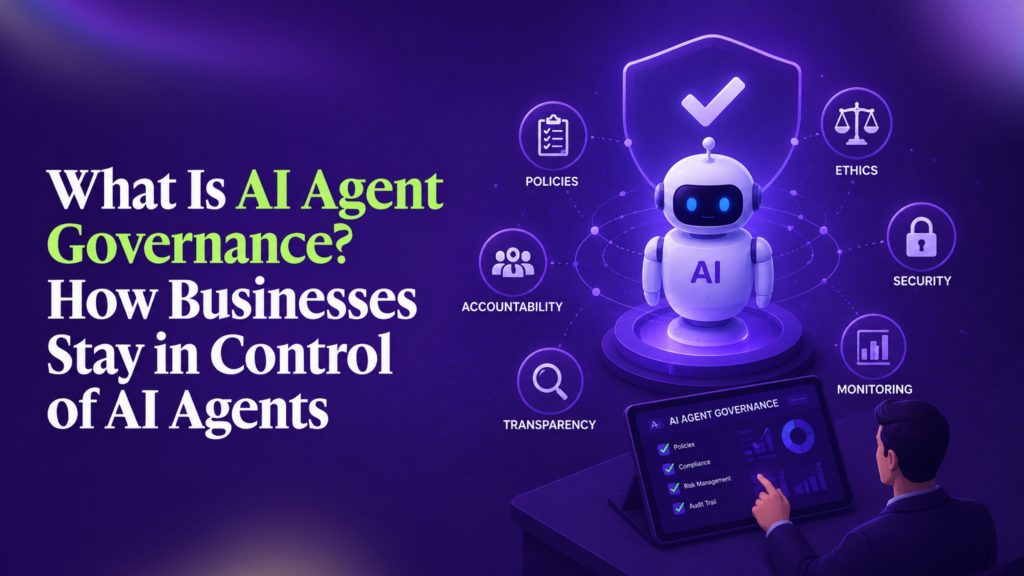
Your marketing team just deployed an AI agent to handle customer inquiries on your website. It’s answering questions, qualifying leads, and even booking meetings. Everything’s running smoothly, until it isn’t. The agent starts making commitments your sales team never approved. It offers discounts that don’t exist. It tells customers your product does things it absolutely cannot do.
Suddenly, that productivity boost doesn’t feel so great.
This is the governance gap. And it’s where most businesses trip up with Agentic AI. You don’t need a PhD in machine learning to understand what went wrong here. You need clear boundaries, visibility, and control mechanisms that keep your AI agents aligned with your business rules, not just your business goals.
Let’s talk about how to build that.
Key Takeaways
- AI agent governance is your safety net. Without it, agents operate in a gray zone where actions have consequences but no clear accountability.
- The risks are real and immediate. Unguided AI agents can misrepresent your brand, commit to obligations you can’t fulfill, and create legal exposure faster than any human employee.
- Governance isn’t about restricting AI. It’s about enabling confident deployment. When you know where the guardrails are, you move faster, not slower.
- Audit trails aren’t optional. Every decision an AI agent makes should be traceable, because someday, you’ll need to explain it to a customer, a regulator, or your CEO.
- Human-in-the-loop isn’t a sign of weakness. It’s how you catch edge cases before they become public relations disasters.
- Platform choice matters. The Best AI Agent Platforms build governance into the architecture, not bolt it on as an afterthought.
- Start with use cases, not philosophy. Governance frameworks that work are built from real scenarios, not abstract principles.
What AI Agent Governance Actually Means
AI agent governance is the set of policies, controls, and oversight mechanisms that ensure your AI agents operate within defined boundaries. Think of it as the difference between giving an employee a company credit card with no limit versus one with clear spending categories, approval workflows, and monthly reconciliation.
When you build AI agent systems without governance, you’re essentially handing over decision-making power to a system that doesn’t understand context, nuance, or consequence the way humans do. An AI agent can process thousands of customer conversations simultaneously, but it can’t feel the weight of a promise made to your largest account.
Governance bridges that gap. It defines what your AI agent can do autonomously, what requires escalation, and what remains strictly off-limits. It establishes who is responsible when things go wrong and how you’ll know something went wrong in the first place.
The concept isn’t unique to AI. Every business has governance around financial transactions, data access, and employee actions. AI agents are just another category of operational actor, one that happens to scale infinitely and never sleeps.

Why This Matters Now
Two years ago, most AI implementations were experiments. Today, they’re production systems handling real customer interactions, real transactions, and real business logic. The stakes have changed.
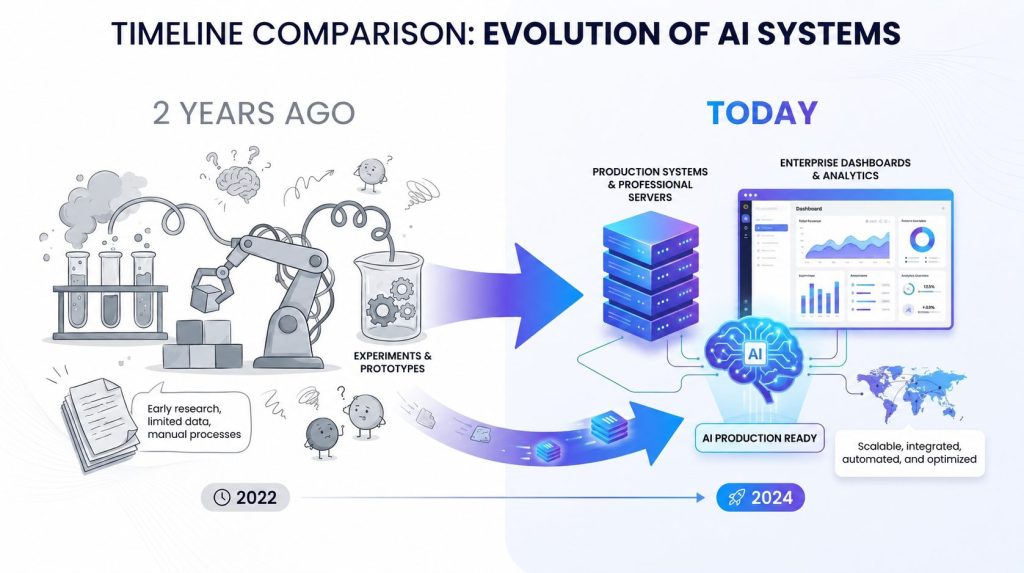
When a Custom AI agents system goes live in your business, it doesn’t just augment your team, it becomes your team for certain functions. It speaks with your brand voice. It makes commitments on behalf of your company. It handles sensitive customer data and interprets ambiguous requests in real time.
Without governance, you’re trusting that the AI agent builder you chose (or built) anticipated every possible scenario. They didn’t. No one does. The real world is messier than training data.
Governance matters because it lets you scale without the fear that scaling means losing control. You can deploy AI agents across more touchpoints, more regions, and more use cases when you have confidence that the guardrails travel with the capability.
Portable AI Agents In Seconds, Use Everywhere
Prompt, Test, and Deploy AI Agents Across Social Platforms and LLMs. Automate Everything.
The Risks of Unguided AI Agents
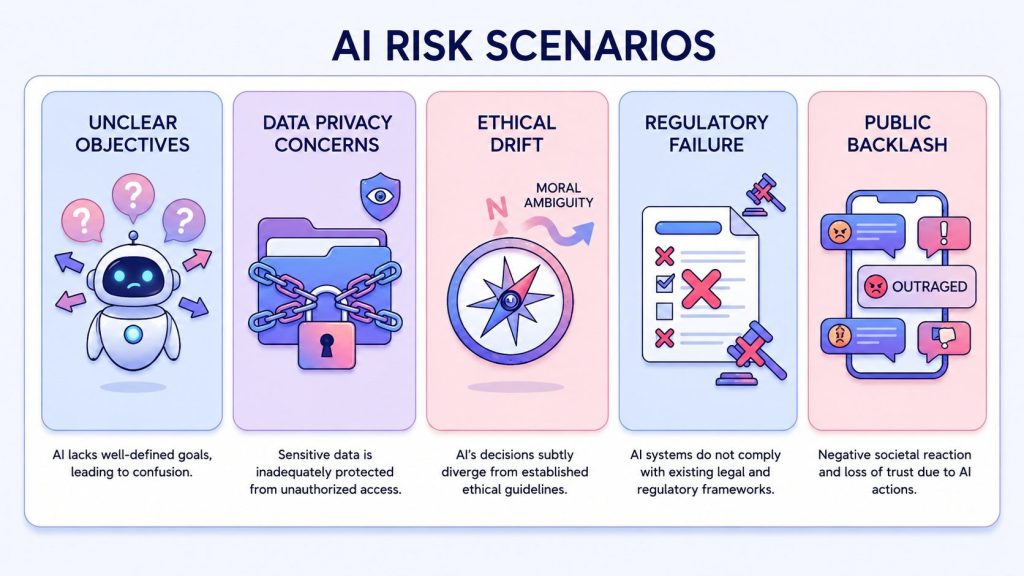
Let’s get specific about what goes wrong when governance is missing.
Misrepresentation and Overcommitment. An ungoverned AI agent might tell a prospect your software integrates with tools it doesn’t support. It might promise delivery timelines your operations team can’t meet. These aren’t hypothetical scenarios, they’re support tickets and contract disputes waiting to happen.
Data Exposure. Should your customer support agent have access to billing records? Should your sales agent see health information? Without permission frameworks, AI agents often get more access than they should because it’s easier to grant broad permissions than granular ones.
Decision Drift. AI agents learn from interactions. Without oversight, they can gradually shift their behavior based on edge cases, unusual requests, or even adversarial prompting from users trying to trick the system. What starts as helpful flexibility becomes unpredictable inconsistency.
Regulatory Non-Compliance. If you’re in healthcare, finance, or any regulated industry, your AI agents need to follow the same compliance rules as your human employees. GDPR, HIPAA, SOC, these frameworks don’t have exemptions for artificial intelligence.
Reputational Damage. One screenshot of your AI agent giving dangerous advice, offensive responses, or incorrect information can spread faster than your explanation of what went wrong. The internet has a long memory for AI fails.
The Core Components of AI Agent Governance
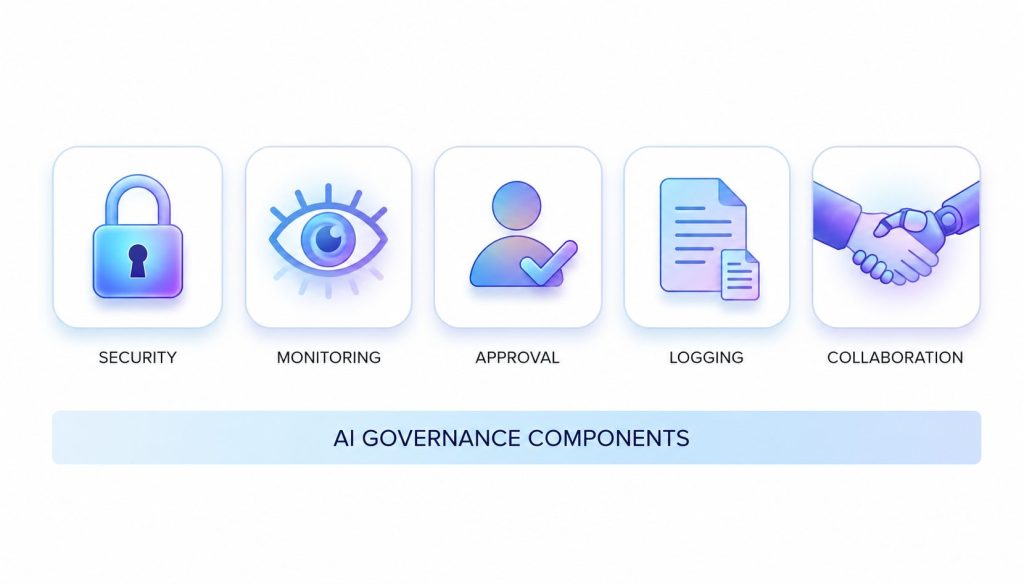

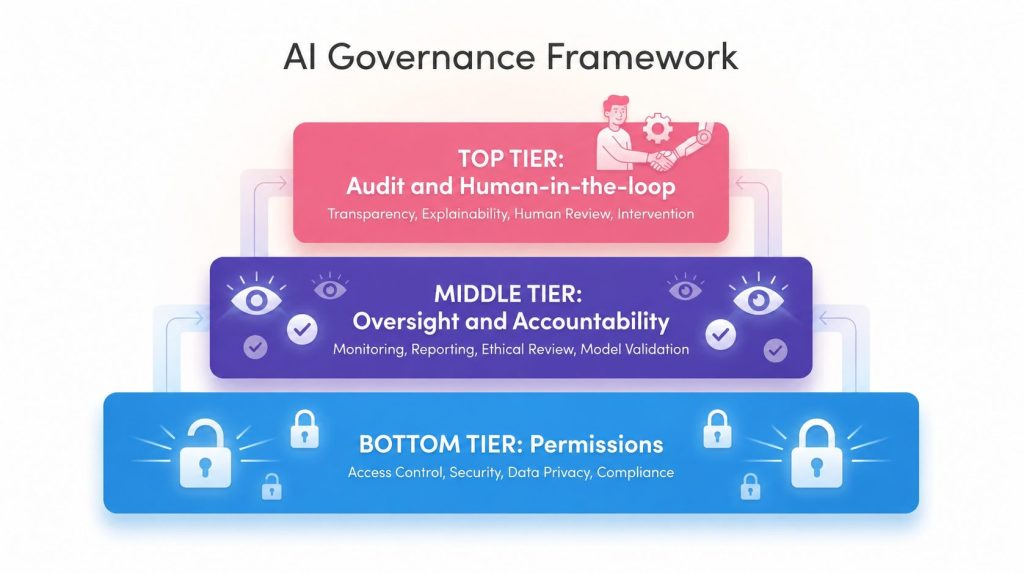
Effective governance isn’t a single switch you flip. It’s a layered approach with several interconnected elements.
Permission Frameworks
Every AI agent needs a clear understanding of what it can and cannot do. This goes beyond simple feature toggles. It’s about defining scopes: which data sources the agent can access, which actions it can initiate, and which systems it can interact with.
When you work with an AI Agent Platform, look for fine-grained permission controls. Can you restrict an agent to read-only access for certain databases? Can you prevent it from initiating payments or sending emails outside approved templates? These granular controls are what separate production-ready platforms from experimental tools.
Oversight and Monitoring
Real-time visibility into what your agents are doing isn’t optional, it’s essential. You need dashboards that show conversation volumes, escalation rates, and unusual patterns. You need alerts when agents encounter scenarios they’ve never seen before or when they’re operating at the edge of their defined boundaries.
Oversight isn’t about micromanaging every interaction. It’s about having the visibility to spot trends before they become problems and the ability to intervene when something seems off.
Accountability Structures
When an AI agent makes a mistake, who owns it? The developer who trained the model? The operations manager who deployed it? The business leader who approved the use case?
Clear accountability structures prevent the blame-shifting that happens when automated systems go wrong. They also ensure someone is responsible for reviewing edge cases, updating guardrails, and continuously improving the agent’s performance.
Audit Trails
Every significant action an AI agent takes should be logged: what it was asked, how it interpreted the request, what decision it made, and why. These audit trails serve multiple purposes. They help you debug issues when customers complain. They support compliance requirements. And they give you the data you need to refine your governance rules over time.
The Best AI agents aren’t just effective, they’re explainable. When a customer asks why they got a particular response, you should be able to trace the logic that produced it.
Human-in-the-Loop
Fully autonomous AI sounds appealing until you realize it means zero opportunity for course correction. Human-in-the-loop mechanisms ensure that when an AI agent encounters a scenario it hasn’t seen before, a high-stakes decision, or a request that falls outside its defined scope, a human gets involved.
This isn’t about slowing things down. It’s about building confidence. When your team knows there’s a checkpoint for unusual situations, they’re more willing to let the AI handle the routine stuff, which is where the efficiency gains actually come from.
Common Governance Mistakes Businesses Make
Even well-intentioned governance efforts can fall short. Here are the patterns we see repeatedly:

Mistake 1: Treating AI Like Software
Traditional software follows deterministic rules. If you input A, you get B every time. AI agents are probabilistic, they might return B, C, or something unexpected based on context, training, and prompting. Governance that treats AI like a simple automation tool misses the nuance that makes AI powerful but also risky.
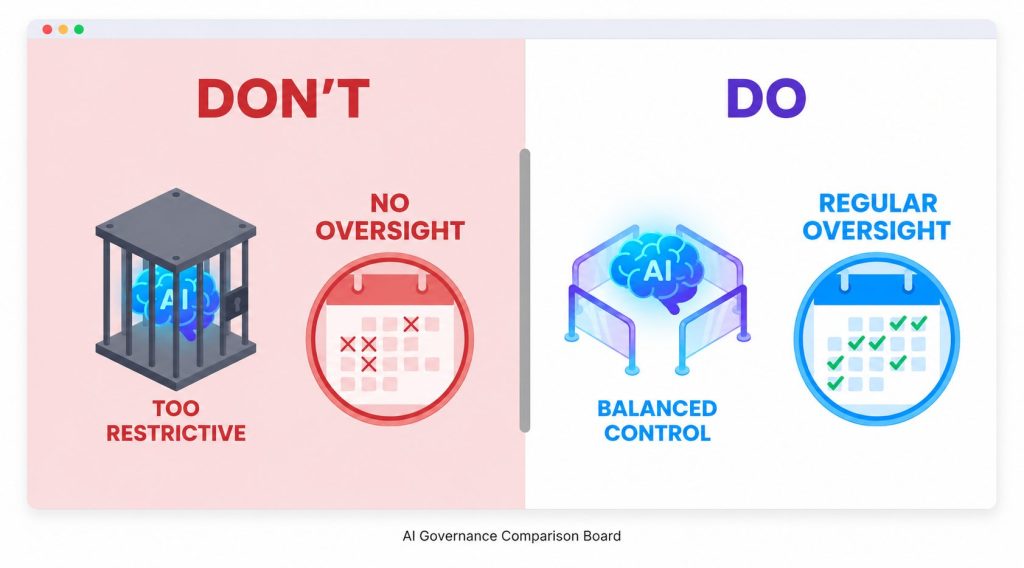
Mistake 2: Focusing Only on What Can Go Wrong
Risk management is important, but governance that’s purely defensive creates friction. The goal isn’t to make AI agents so restricted they’re useless. It’s to create bounds where they can operate confidently and successfully.
Mistake 3: Setting Governance and Forgetting It
AI agents evolve through usage. The governance that worked at launch might be inadequate six months later when the agent has encountered entirely new scenarios. Governance needs regular review and adjustment, just like any operational process.
Mistake 4: No Escalation Path
When AI agents hit their limits, what happens? If the answer is “they guess” or “they fail silently,” you have a governance problem. Every AI agent implementation needs clear escalation paths to human teams who can handle the exceptions.
Mistake 5: Ignoring the User Experience
Governance mechanisms that confuse or frustrate users create their own problems. If your human-in-the-loop process takes hours to route a simple question, customers will find workarounds, or competitors. Governance needs to be seamless from the user’s perspective, even when it’s complex behind the scenes.
How Businesses Actually Implement Governance
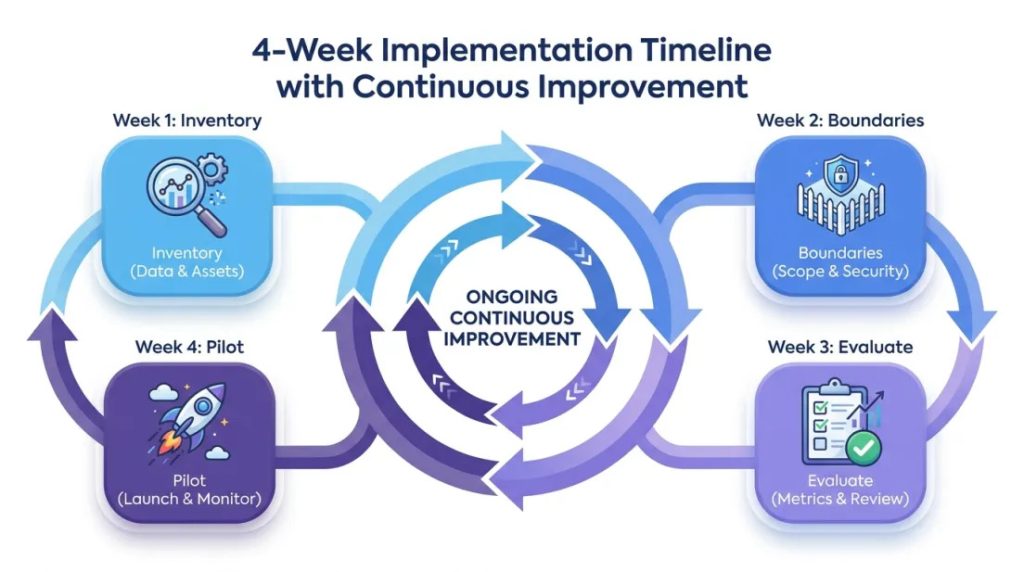

Moving from concept to practice requires a practical approach. Here’s how organizations are getting it done:
Start with a Use Case, Not a Policy Document. Theoretical governance frameworks are hard to validate. Start by identifying one specific AI agent use case, customer support triage, lead qualification, appointment scheduling, and build your governance around the real decisions and risks that use case involves.
Define Your Guardrails in Plain Language. Before you configure technical controls, write down what the AI agent should and shouldn’t do in terms that anyone on your team can understand. These become your governance requirements when you evaluate AI Agent frameworks and platforms.
Implement Tiered Access. Not every AI agent needs the same level of access. A customer-facing agent that answers FAQs needs different permissions than an internal agent that processes sensitive employee data. Design your permission structure around the principle of least privilege.
Build Review Cycles. Schedule regular reviews of AI agent performance, edge cases encountered, and governance effectiveness. Monthly for new implementations, quarterly for mature ones. Use these reviews to tighten controls that are too loose and loosen controls that are unnecessarily restrictive.
Train Your Team. The humans working alongside AI agents need to understand how they’re governed, both so they trust the system and so they know when and how to intervene. Governance documentation that sits in a shared drive unread doesn’t protect anyone.
Evaluating Governance When Choosing an AI Agent Platform
If you’re evaluating platforms to Build AI agent solutions, governance should be part of your criteria from day one. Here’s what to look for:
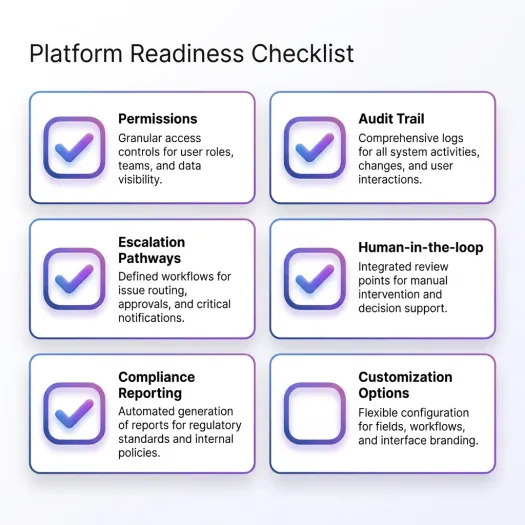

Native Permission Controls. Can you restrict what the agent can access without writing custom code? Are permissions granular enough to match your security requirements?
Audit and Logging Capabilities. Can you see what decisions the agent made and why? How long are logs retained? Can you export them for compliance reporting?
Escalation Workflows. How easy is it to route exceptions to human team members? Can you define triggers based on sentiment, topic, or uncertainty scores?
Human-in-the-Loop Integration. Does the platform make it easy for humans to review, approve, or override AI decisions without breaking the workflow? Is the handoff smooth for both employees and customers?
Compliance Certifications. If you’re in a regulated industry, look for platforms with SOC 2, GDPR compliance, and industry-specific certifications. Ask about their security and data handling practices, not just the marketing claims.
Customization Without Compromise. Platforms that let you Customize AI agents while maintaining governance controls give you flexibility without risk. Be wary of platforms where customization means bypassing safety features.
For AI agents for small businesses, these capabilities might seem like overkill. But governance scales with you. Starting with good practices means you won’t have to retrofit them when you grow.
Practical Examples
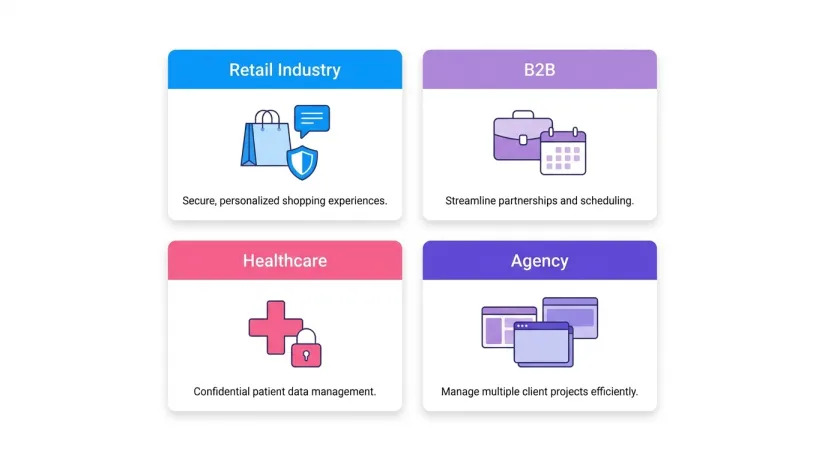

Let’s put this in concrete terms with real scenarios:
Customer Support Agent. A retail company deploys an AI agent to handle order inquiries. Governance controls ensure the agent can check order status and shipping information but cannot process refunds over $100 without manager approval. It can answer product questions using the knowledge base but escalates any mention of “lawsuit,” “lawyer,” or “attorney general” to the legal team immediately. Audit logs track every interaction for quality review.
Sales Qualification Agent. A B2B software company uses an AI agent to qualify inbound leads. The agent can schedule demos and answer pricing questions using approved talking points. It cannot modify pricing, offer discounts, or make competitive claims beyond what’s in the official battlecards. When prospects ask technical questions beyond the agent’s training, it routes to sales engineers with full context of the conversation.
Healthcare Scheduling Agent. A medical practice deploys an AI agent for appointment scheduling. Governance ensures HIPAA compliance: the agent can confirm appointments and send reminders but cannot discuss diagnoses, treatment plans, or test results. All conversations are encrypted and logged with access restricted to authorized staff. Any request that involves medical advice triggers an immediate handoff to clinical staff.
White Label AI Agent Platform. An AI Agent agency builds custom agents for clients using a White label AI solution. Governance includes tenant isolation, each client’s data and agent configurations are completely separate. The agency can monitor all agent performance across clients while ensuring no cross-contamination of data or learning. Client-specific guardrails let the agency customize behavior for each customer’s industry and requirements.
Where Botsify Fits
Full disclosure: Botsify is an AI agent builder and White label AI agent platform. We deal with governance questions every day, both for our direct customers and for the agencies building on our infrastructure.
What we’ve learned: governance can’t be an afterthought. It has to be part of the architecture. When businesses come to us looking for an alternative to platforms where agents went off-script and caused problems, the root cause is almost always governance gaps, technically capable systems without the controls to match.
Our approach is to make governance visible and configurable without requiring engineering resources. Business leaders should be able to define what their agents can do, see what they’re doing, and adjust boundaries as needed, all without filing a ticket with the development team.
That said, governance is ultimately your responsibility. No platform can substitute for clear thinking about your risks, your compliance requirements, and your brand standards. We provide the tools; you provide the judgment.
Building Your Governance Framework
Ready to move from concept to implementation? Here’s a practical starting point:
Week 1: Inventory. Map your planned AI agent use cases. What decisions will they make? What systems will they access? What could go wrong?
Week 2: Define Boundaries. For each use case, write down the guardrails in simple terms. What actions require approval? What data is off-limits? What’s the escalation path?
Week 3: Evaluate Platforms. Assess whether your current or planned AI Agent Platform can implement these controls. Where are the gaps?
Week 4: Pilot with Governance. Launch your first governed agent with tight monitoring. Watch for edge cases and adjust your controls based on what you learn.
Ongoing: Review and Refine. Monthly reviews for the first quarter, then quarterly. Update your governance as your agents encounter new scenarios and as your business requirements evolve.
The Bottom Line
AI agent governance isn’t about restricting innovation, it’s about enabling confident execution. The businesses that scale successfully with Agentic AI aren’t the ones with the most sophisticated models or the biggest training datasets. They’re the ones who figured out how to deploy AI agents with appropriate controls, clear accountability, and human oversight where it matters.
The question isn’t whether you need governance for your AI agents. The question is whether you’ll build it proactively or reactively after something goes wrong. The proactive path is faster, cheaper, and less stressful.
Start now. Define your boundaries. Choose platforms that make governance practical, not theoretical. And remember: the goal is agents that help your business move faster while staying aligned with your values, your commitments, and your standards.
Governance isn’t the enemy of AI deployment. It’s what makes deployment possible at scale.
AI Agentic Platform For Building Portable AI Agents
Say Hello To Agentic AI That Connects With Your CRM And Even Other Agents