


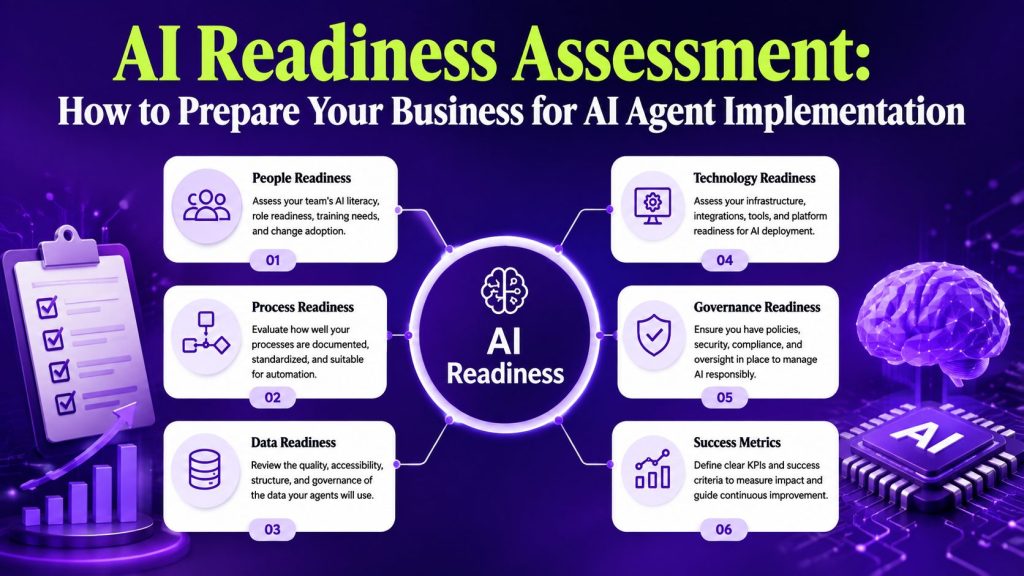
Six months ago, the CEO of a mid-market logistics company did what every ambitious leader does: she bought an AI agent platform, hired a team of developers, and told them to “make it work.” Three months later, the platform was collecting dust. The agents hallucinated customer data. The team couldn’t explain why. Morale dropped. The CFO called it a six-figure experiment.
Here’s what nobody tells you about AI agent implementation: the technology is rarely the problem. The real issue is AI readiness, including the quality of your data, the clarity of your processes, your team’s ability to adopt new ways of working, and the governance model surrounding the technology. As businesses continue moving toward Agentic AI, organizational readiness has become a bigger success factor than model selection itself.
This guide is built for founders, CTOs, operations leaders, and IT managers who’ve decided to adopt AI agents and want to do it right. We’ll skip the hype and focus on the practical, organizational preparation that separates successful deployments from expensive failures. By the end, you’ll have an AI readiness assessment framework, a scorecard for measuring your current position, and a clear path forward, whether you build in-house or partner with an experienced AI Agent Development Company.
Key Takeaways
- AI readiness extends beyond technology. Successful adoption depends on prepared teams, reliable data, documented processes, clear ownership, and effective governance.
- Data readiness is one of the most important parts of AI readiness. Your AI agents are only as smart as the data they access. If your data is siloed, inconsistent, or poorly documented, no platform will fix it.
- Governance isn’t optional, it’s the difference between a pilot and a production system. AI Agent Governance frameworks must be established before deployment, not after an incident forces your hand.
- Start with a narrow, high-value use case. The companies that succeed deploy one agent, prove the value, learn the lessons, then scale. The ones that fail try to automate everything at once.
- Your people need to be part of the plan, not an afterthought. Change management, training, and role redesign are not soft skills, they’re critical success factors for enterprise AI adoption.
- You need clear success metrics before you start. “Improve efficiency” is not a metric. Define what good looks like in measurable terms before you write a single line of configuration.
- The right implementation partner accelerates your timeline by months. An experienced AI Agent Development Company brings battle-tested patterns, governance frameworks, and deployment playbooks that would take your team years to figure out on their own.
Section 1: Why AI Readiness Determines Whether AI Adoption Succeeds
Most organizations discuss AI transformation as a technology project, but AI readiness is primarily an organizational issue.
When you look at the data on enterprise AI adoption, a clear pattern emerges. McKinsey and BCG have both published studies showing that 70% of AI initiatives fail to deliver meaningful business value. But here’s the interesting part: the failure rate drops dramatically, to under 20%, when organizations invest in readiness activities before deployment.
The organizations that fail share a common profile. They rush to buy an AI Agent Platform without understanding their data landscape. They skip the governance conversation because it feels premature. They assign the work to a junior team without executive sponsorship. They treat AI agent implementation as a technical implementation rather than a business transformation.
The ones that succeed do the opposite. They spend weeks, sometimes months, on preparation. They map their processes. They clean their data. They define their governance. They train their people and prepare them to work alongside an AI Workforce, where AI agents handle repetitive execution while employees focus on judgment, collaboration, and customer relationships.
Section 2: AI Readiness Assessment Framework: Six Areas to Evaluate
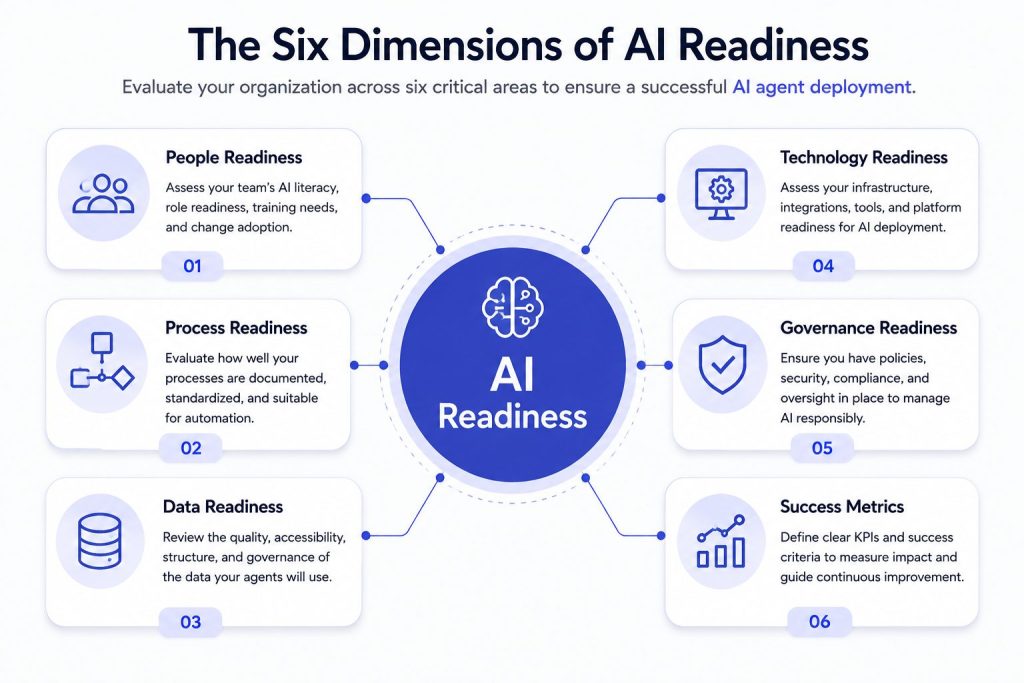
Before starting implementation, conduct an AI readiness assessment to understand where your organization is prepared and where important gaps remain. The following framework covers six dimensions of readiness. Rate yourself on a scale of 1-5 for each, and you’ll have a clear picture of what needs work before you move forward.

2.1 People Readiness
Why it matters: Your AI agents will work alongside your team, not replace them, at least initially. If your team is anxious, resistant, or unclear about how their roles will change, your implementation will stall before it starts.
Assessment questions:
- Do your leaders understand what AI agents can and cannot do?
- Has your team received basic AI literacy training?
- Have you mapped how roles will change post-deployment?
- Do you have executive sponsorship for this initiative?
- Is there a dedicated owner for the AI implementation?
Score 1: No awareness, no sponsorship, no training planned.
Score 5: Executive sponsors identified, team trained, role changes mapped, dedicated owner assigned.
2.2 Process Readiness
Why it matters: AI agents automate processes. If your processes are undocumented, inconsistent, or broken, the AI will automate the chaos, faster and at scale.
Assessment questions:
- Are your core business processes and AI Agent Workflows documented well enough for an agent to execute them consistently?
- Have you identified which processes are candidates for business process automation?
- Do you know which steps in each process are rule-based vs. judgment-based?
- Have you measured baseline process performance (time, cost, error rate)?
- Are there processes that are too unstable or variable to automate?
Score 1: No documentation, no baseline metrics, unclear candidates.
Score 5: Full process documentation, baseline metrics for all candidates, clear automation suitability analysis.
Portable AI Agents In Seconds, Use Everywhere
Prompt, Test, and Deploy AI Agents Across Social Platforms and LLMs. Automate Everything.
2.3 Data Readiness
Why it matters: This is the single most common failure point. AI agents need clean, structured, accessible data. Strong AI Agent Memory depends on reliable information, because agents can only retain and retrieve context that’s accurate in the first place. If your data is messy, you’ll burn your budget on data engineering before you ever see an agent work.
Assessment questions:
- Where does your data live? (CRM, ERP, data warehouse, spreadsheets, emails?)
- Is your data structured and consistent?
- Do you have data quality issues (duplicates, missing values, outdated records)?
- Can your AI agents access data in real time, or are there access barriers?
- Do you have data privacy and security policies that apply to AI?
Score 1: Data scattered across silos, inconsistent formats, no quality controls.
Score 5: Centralized, clean, real-time accessible data with clear privacy policies and security controls.
2.4 Technology Readiness
Why it matters: Your AI Agent Builder should integrate with your existing tech stack so business teams can configure, test, and improve agents without unnecessary development bottlenecks. If your systems are legacy, outdated, or poorly documented, integration will be expensive and slow.
Assessment questions:
- Do you have APIs for your core systems?
- Is your IT infrastructure modern enough to support AI agent deployment?
- Do you have the right security and compliance controls in place?
- Can your platform handle the compute and latency requirements?
- Do you have the internal technical skills to support the platform?
Score 1: Legacy systems, no APIs, limited IT bandwidth.
Score 5: Modern API-first architecture, strong security posture, adequate technical resources.
2.5 Governance Readiness
Why it matters: Without governance, you’re flying blind. Who decides what an AI agent can do? Who’s responsible when it makes a mistake? How do you ensure compliance with regulations? AI Agent Governance answers these questions, or someone else will answer them for you, in court.
Assessment questions:
- Do you have a responsible AI policy?
- Have you defined human-in-the-loop requirements?
- Do you have escalation paths for AI failures?
- Have you considered regulatory requirements (GDPR, CCPA, industry-specific)?
- Is there a governance board or committee overseeing AI use?
Score 1: No governance policies, no responsible AI framework, no escalation paths.
Score 5: Comprehensive AI governance framework, clear accountability, regulatory compliance mapped, active governance board.
2.6 Success Metrics Readiness
Why it matters: If you can’t define what success looks like, you can’t prove value. And if you can’t prove value, your initiative will be the first thing cut when budgets tighten.
Assessment questions:
- Have you defined specific, measurable success criteria?
- Do you have baseline data to measure improvement against?
- Are you tracking both efficiency gains and quality metrics?
- Have you defined the time horizon for expected ROI?
- Is there a process for iterating based on metrics?
Score 1: “We’ll know it when we see it”, no defined metrics, no baseline.
Score 5: Clear KPIs with targets, baseline data collected, regular review cadence, defined iteration process.
Section 3: AI Readiness Scorecard for Business Teams
Use this AI readiness scorecard to combine your results across all six dimensions and identify the areas that need attention before implementation. This gives you a visual snapshot of where you’re ready and where you need work.
| Dimension | Score (1-5) | Status | Priority Action |
| People Readiness | Red Red / Yellow Yellow / Green Green | ||
| Process Readiness | Red Red / Yellow Yellow / Green Green | ||
| Data Readiness | Red Red / Yellow Yellow / Green Green | ||
| Technology Readiness | Red Red / Yellow Yellow / Green Green | ||
| Governance Readiness | Red Red / Yellow Yellow / Green Green | ||
| Success Metrics Readiness | Red Red / Yellow Yellow / Green Green |
Scoring guide:
1-2 (Red): Do not proceed with deployment. Invest in readiness activities first.
3 (Yellow): Proceed with caution. Address gaps before scaling beyond a pilot.
4-5 (Green): Ready to move forward. Your foundation is solid.
Section 4: Common AI Readiness Mistakes and How to Avoid Them
Mistake 1: Starting with Technology Instead of People
What happens: An organization buys an AI Agent Platform, builds agents, and then tries to push them onto teams that never asked for them. The result? Low adoption, passive resistance, and a graveyard of unused agents.
How to avoid it: Start with an AI readiness discovery phase that involves the teams who will work with the agents. Talk to the teams who would use the agents. Understand their pain points. Show them what’s possible. Get their input on the AI Agent Requirements. When people feel ownership, they adopt. When they feel imposed upon, they resist.
Mistake 2: Trying to Automate Everything at Once
What happens: The team identifies 20 processes they want to automate. They build agents for all of them simultaneously. Nothing works well. Everything is delayed. The initiative collapses under its own weight.
How to avoid it: Pick one narrow, high-value use case. This is where an AI Agent Implementation Checklist becomes invaluable, it forces you to define scope, success criteria, and rollout steps for a single agent before you expand. Prove the value. Learn the lessons. Then scale.
Mistake 3: Ignoring Data Quality
What happens: The AI agent is configured perfectly. The prompts are polished. The model is state-of-the-art. But the agent keeps making mistakes because the underlying data is wrong. Duplicate customer records. Outdated inventory numbers. Inconsistent naming conventions.
How to avoid it: Audit your data before you deploy. Deduplicate. Standardize. Document. This is boring work, but it’s the most important work. No amount of prompt engineering can fix bad data.
Mistake 4: Skipping Governance
What happens: An agent makes a mistake that costs a customer $10,000. No one knows who’s responsible. The legal team gets involved. The agent gets shut down. The entire initiative is put on hold indefinitely.
How to avoid it: Establish AI Agent Governance before deployment. Define who’s accountable for agent behavior. Set up human-in-the-loop checks for high-stakes decisions. Create escalation paths. Document everything. This is not bureaucracy, it’s insurance.
Mistake 5: No Clear Definition of Success
What happens: The team deploys an agent. It works. But when asked to prove its value, they point to vague metrics like “increased efficiency” or “improved response times.” The CFO is unimpressed. Budget for the next phase gets cut.
How to avoid it: Define success metrics before you deploy. “Reduce average response time for customer inquiries from 4 hours to 15 minutes.” “Increase lead qualification accuracy by 25%.” “Handle 40% of Tier 1 support tickets without human intervention.” Specific, measurable, and tied to business outcomes.
Section 5: From AI Readiness to Deployment: A Four-Phase Roadmap
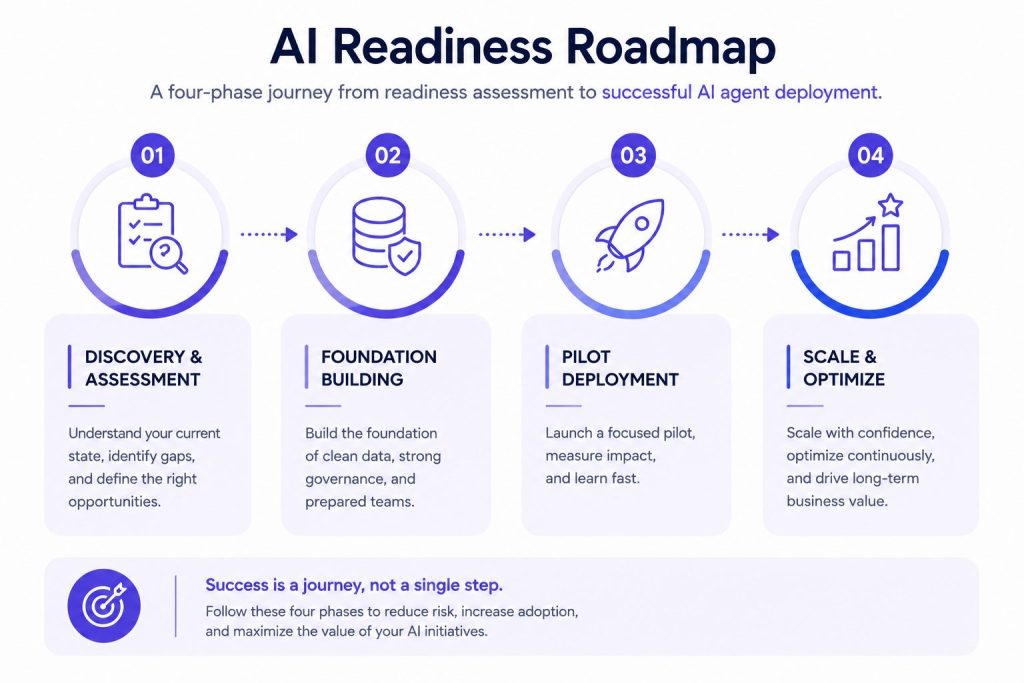
Phase 1: Discovery and Assessment (Weeks 1-3)
This is where you do the boring work that pays off later. Use the AI readiness framework from Section 2 to assess your current state across all six dimensions. Document your findings. Identify the gaps. Prioritize what needs to happen first.
Key activities:
- Run the readiness assessment with key stakeholders
- Document your top 3-5 candidate processes for automation
- Map your data landscape: sources, quality, access, and privacy
- Identify governance and compliance requirements
- Define preliminary success metrics
Output: A readiness assessment report with a prioritized gap-closure plan.
Phase 2: Foundation Building (Weeks 4-6)
Now you close the gaps. Address data quality issues. Document processes. Train your team. Establish governance frameworks. Set up your technology stack.
Key activities:
- Clean and structure your data for AI agent access
- Document and standardize candidate processes
- Deliver AI literacy training to affected teams
- Establish AI Agent Governance policies and escalation paths
- Select and configure your AI Agent Builder platform
- Map the AI Agent Lifecycle for your organization: build, test, deploy, monitor, iterate
Output: An organization with stronger AI readiness, supported by cleaner data, documented processes, trained teams, and clear governance.
Phase 3: Pilot Deployment (Weeks 7-10)
Deploy one agent for one specific use case. This is not about proving the technology, it’s about proving the process. Can your team work with the agent? Is the data feeding it correctly? Are the governance controls working?
Key activities:
- Build and test the pilot agent using your AI Agent Platform
- Run a controlled rollout with a limited user group
- Monitor performance against your defined success metrics
- Collect feedback from users and stakeholders
- Document lessons learned
Output: A proven deployment model with validated metrics, user feedback, and documented learnings.
Phase 4: Scale and Optimize (Weeks 11+)
With a proven model, you can expand.Deploy additional agents, introduce AI Agent Orchestration where specialized agents need to collaborate, and expand automation into additional business functions.. Automate more processes. Integrate with more systems. This is where the real ROI starts to compound.
Key activities:
- Expand to additional use cases based on priority
- Build AI agent integration patterns for your core systems
- Automate monitoring and alerting for agent performance
- Establish a continuous improvement cycle
- Begin planning your AI Agent Implementation Roadmap for the next 6-12 months
Output: A scaled deployment with multiple agents, automated operations, and a clear roadmap for the future.
Section 6: Build In-House vs. Partner with an AI Agent Development Company
Once your AI readiness assessment is complete, one of the biggest decisions is whether to build implementation capabilities internally or work with an experienced partner.
| Factor | Build In-House | Partner with a Development Company |
| Timeline | 6-12 months to build capabilities | 4-8 weeks to first deployment |
| Cost | Higher upfront (hiring, training, infrastructure) | Lower upfront, predictable pricing |
| Control | Full control over everything | Shared control, but faster execution |
| Knowledge | Deep internal knowledge built over time | Knowledge stays with the partner |
| Risk | Higher — you’re learning as you go | Lower — battle-tested patterns and playbooks |
| Scalability | Limited by your hiring capacity | Scales with the partner’s resources |
| Long-term | You own the capability | You may need to transition later |
When to build in-house:
- You have a strong existing engineering team
- AI agents are core to your business model
- You have a 12+ month horizon and can absorb learning costs
- You want to build proprietary IP around your AI implementation
When to partner:
- You need to move fast (3-6 months to production)
- You don’t have AI/ML expertise in-house
- You want to de-risk the first deployment
- You need help with the full AI Agent Lifecycle, from requirements to production to iteration
- You’re exploring Custom AI Agents for complex workflows and need specialized expertise
- You want access to comprehensive AI Agent Development Services that cover strategy, architecture, implementation, and ongoing optimization
The hybrid approach: Many successful organizations do both. They partner with an AI Agent Development Company for the first deployment (learning the patterns and playbooks), then build internal capability for subsequent deployments. This combines speed with long-term ownership.
Section 7: Final AI Readiness Self-Assessment Before Deployment
Before deploying your first agent, use this final AI readiness checklist to confirm that the organization, data, systems, governance, and success metrics are prepared. Completing these checks significantly reduces the risk of the most common AI Agent Deployment Mistakes discussed earlier.
People & Organization
☐ We have executive sponsorship for this initiative
☐ We’ve identified a dedicated owner for the AI agent implementation
☐ We’ve delivered AI literacy training to affected teams
☐ We’ve mapped how roles will change post-deployment
☐ We have a change management plan in place
Process & Use Case
☐ We’ve selected one specific, high-value use case for our pilot
☐ The selected process is documented and stable
☐ We have baseline metrics for the current process
☐ We know which steps are rule-based vs. judgment-based
☐ We’ve defined success criteria for the pilot
Data
☐ We’ve audited the data sources our agent will access
☐ Data quality issues have been identified and addressed
☐ Data access and permissions are configured
☐ Privacy and security requirements are documented
☐ We have a plan for ongoing data maintenance
Technology
☐ Our AI Agent Platform is selected and configured
☐ Core systems have accessible APIs for AI Agent Integration
☐ Security and compliance controls are in place
☐ We have monitoring and logging infrastructure
☐ We’ve tested the platform with a sandbox environment
Governance
☐ We have AI Agent Governance policies documented
☐ Human-in-the-loop requirements are defined for each use case
☐ Escalation paths for failures are established
☐ Regulatory compliance requirements are mapped
☐ A governance board or owner is assigned
Success Metrics
☐ Success criteria are specific and measurable
☐ Baseline data has been collected for comparison
☐ We’re tracking both efficiency and quality metrics
☐ We’ve defined the time horizon for expected ROI
☐ There’s a process for reviewing and iterating on metrics
Conclusion
AI readiness isn’t about checking a few technical boxes before deployment. It’s about preparing your business to adopt AI in a way that’s sustainable, measurable, and aligned with how your teams actually work.
Organizations that succeed don’t rush into implementation. They invest time in understanding their processes, improving data quality, establishing governance, and preparing employees for change. Those early investments reduce risk, speed up adoption, and create a stronger foundation for long-term success.
Whether you decide to build internally or work with an experienced implementation partner, use the readiness framework and scorecard in this guide to identify gaps before your first deployment. The more prepared your organization is today, the easier it becomes to scale AI initiatives tomorrow.
If you’re looking for a faster path from planning to production, Botsify combines a White Label AI Agent Platform, implementation expertise, and Custom AI Agents to help businesses deploy AI with confidence. More importantly, the principles in this guide apply regardless of the platform you choose. Strong AI readiness is what ultimately determines whether an implementation becomes a lasting business capability or another abandoned pilot project.
AI Agentic Platform For Building Portable AI Agents
Say Hello To Agentic AI That Connects With Your CRM And Even Other Agents
Frequently Asked Questions
- How long does an AI readiness assessment take?
A focused AI readiness assessment typically takes two to four weeks, while closing identified gaps may require another two to six weeks. This covers the readiness assessment, data cleanup, process documentation, team training, and governance setup. The pilot deployment adds another 3-4 weeks. Most organizations can go from decision to first deployed agent in 8-10 weeks if they follow a structured preparation process.
- What is the biggest AI readiness mistake businesses make?
The most common mistake is skipping the readiness assessment and jumping straight into technology selection and deployment. Over 70% of AI initiatives fail, and the primary cause is not technology, it’s inadequate preparation in people readiness, data quality, and governance. Companies that invest in preparation before deployment see dramatically higher success rates.
- Do I need to clean all my data before implementing AI agents?
Organizations working with experienced AI Agent Development Services often prioritize data for the first production use case instead of attempting an enterprise-wide cleanup before deployment. The key is to identify the specific data sources your agents will access and focus your cleanup efforts there. Trying to clean your entire enterprise data landscape before deploying is a common cause of analysis paralysis. Start with the data for your pilot use case, validate your approach, then expand.
- What’s the difference between AI readiness and AI implementation planning?
AI readiness focuses on your organization’s ability to successfully adopt and use AI agents, covering people, processes, data, governance, and metrics. AI implementation planning is the tactical step-by-step plan for deploying the technology. Readiness comes first; you assess readiness to inform your implementation plan. Without readiness assessment, your implementation plan is built on assumptions rather than reality.
- How do I measure if my organization is ready for AI agents?
Use the six-dimension readiness framework in this article: people readiness, process readiness, data readiness, technology readiness, governance readiness, and success metrics readiness. Rate each dimension on a 1-5 scale. Any dimension scoring below 3 needs work before you proceed to deployment. The pre-deployment checklist in Section 7 provides a more detailed readiness check.
- Should I hire an AI Agent Development Company or build my own implementation capability?
It depends on your timeline, budget, and long-term AI strategy. If you need to move fast (3-6 months to production), want to de-risk your first deployment, or lack in-house AI expertise, partnering with an experienced development company is usually the better choice. If AI agents are core to your business model and you have a 12+ month horizon, building in-house gives you more control and long-term ownership. Many successful organizations use a hybrid approach: partner for the first deployment, then build internal capability for subsequent ones.