


Choosing an AI agent platform is less about finding the longest feature list and more about matching a tool to one real workflow your team can support. A platform may look capable in a demo yet still be a poor fit if it does not connect to the systems you use, make testing practical, or give someone clear responsibility after launch.
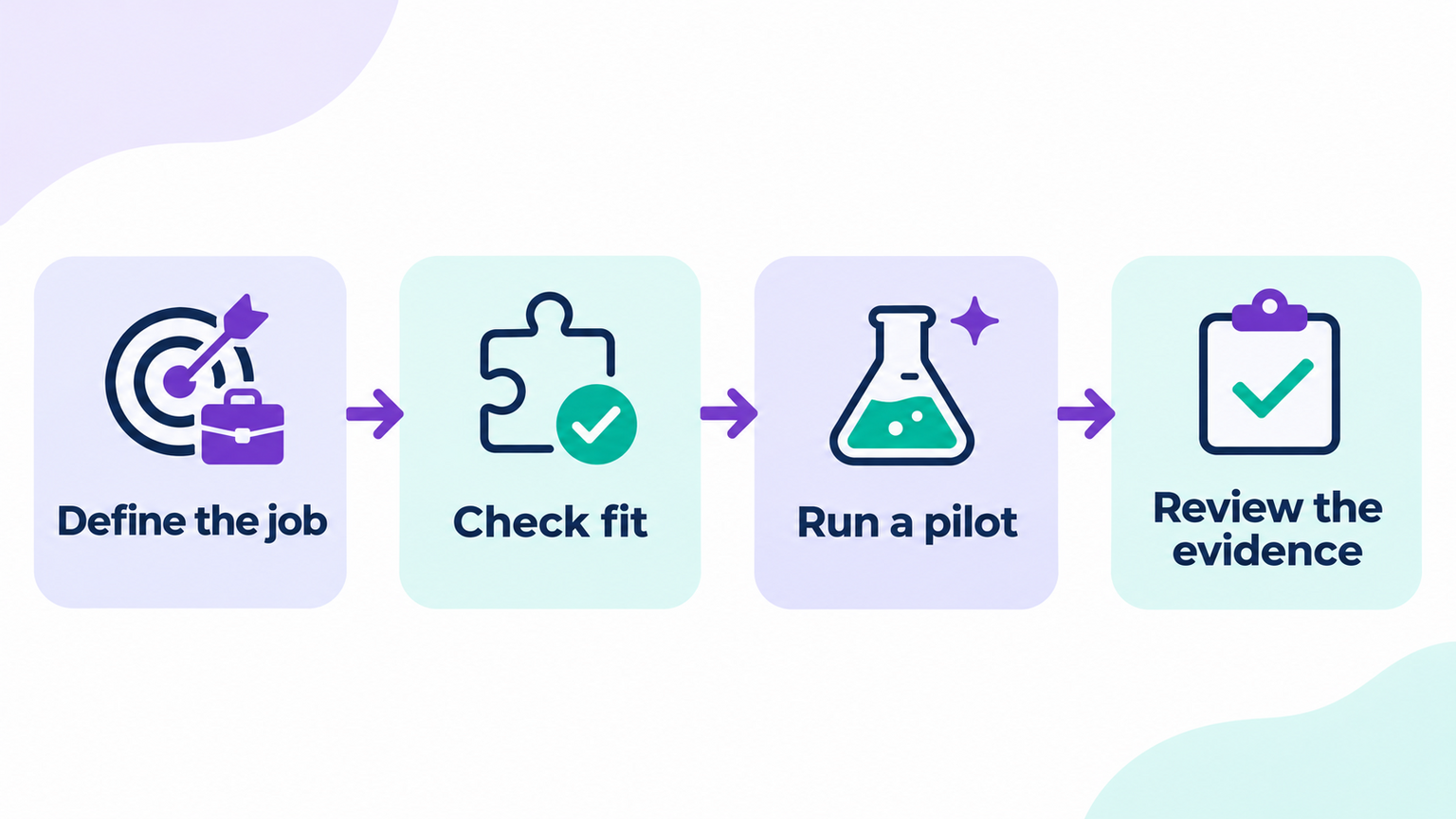
This guide provides a vendor-neutral evaluation process for small businesses and operations teams. Define the job first, shortlist the right type of platform, test it with realistic cases, model the full cost, and decide what evidence you need before expanding. If a simpler chatbot or ordinary automation can solve the problem, you may not need an agent at all. Start by understanding what an AI agent platform does and the scope of work you want it to handle.
1. Define the business job before shopping
Write a short job statement before opening vendor comparison pages:
When [trigger] happens, the agent should [specific task] using [approved information or systems], then [desired outcome]. It must hand off when [conditions].
For example: “When a website visitor asks about a service, the agent should answer from our current service pages, collect contact details when the visitor is interested, and route pricing exceptions to sales.” This is easier to evaluate than “we need an AI agent for sales.”
Then document the current process. Who does the task today? Which tools do they use? How often does it happen? What exceptions require judgment? What does a successful result look like? These answers keep the evaluation focused on a business need instead of a technology trend.
Also check whether an agent is necessary. A fixed FAQ, form, rules-based workflow, or existing feature may be cheaper and easier to control. An agent is more relevant when a task requires interpreting varied language or selecting among steps based on context. Avoid handing a system broad authority when a narrow workflow would do.
2. Set your non-negotiable requirements
Separate requirements into three groups: essential, useful, and optional. If a platform misses an essential requirement, remove it from the shortlist rather than letting a polished demo compensate.
| Area | Questions for your team |
|---|---|
| Users and channels | Where do customers or staff need to interact with the agent? |
| Knowledge | Which approved sources can it use, and who updates them? |
| Actions | Must it only answer, or also create or update records? |
| Handoff | Which cases need a person, and what context should transfer? |
| Integrations | Which CRM, calendar, help desk, or other systems are required? |
| Ownership | Who configures, tests, reviews, and maintains the agent? |
| Data and access | What information can it see, and what controls does your organization require? |
| Cost | Which subscription, usage, integration, and support charges apply? |
| Exit | What can you export or retain if you change platforms? |
Be specific about what “supports WhatsApp” or “integrates with our CRM” means. Does the connection support the actual messages and actions you need? Is it included in the plan? Does it depend on a third-party connector? Who troubleshoots it? A bot platform selection checklist can prompt questions about features, integration, and scale. If your team is still assessing its processes and content, an AI readiness assessment can help surface gaps before you evaluate vendors.
3. Identify the platform type that fits your team
“AI agent platform” can describe quite different products. A no-code builder may prioritize business users and deployment across communication channels. An automation platform may connect existing apps and let a team design workflows. A developer framework offers more control, but typically asks for engineering capacity to build and operate the surrounding system. Some products combine elements of these approaches.
| Platform type | May fit when | Validate carefully |
|---|---|---|
| No-code or low-code agent builder | Business teams need to configure and manage agents through a visual interface | Whether your use case fits the builder’s limits, integrations, and plan |
| Workflow automation with AI steps | Your process already depends on connected business apps and defined automations | How model behavior, errors, retries, and human review are handled |
| Developer framework or custom stack | Engineers need control over architecture, code, deployment, or specialized integrations | Total engineering ownership, monitoring, maintenance, and support |
| Managed or done-for-you service | Your team needs outside help with scoping, configuration, or implementation | Exact deliverables, ongoing responsibilities, access, and handover |
These types are not a quality ranking. A technically flexible framework can be a poor choice for a team without developers, while a no-code platform may not suit a workflow with specialized requirements. Use a current AI agent platform comparison to research candidates, or compare no-code AI agent builders if a visual builder is among your requirements. Verify each product’s present capabilities and plan details directly before deciding.

4. Score platforms against your actual workflow
Create a shortlist of three to five candidates, then score each against the same criteria. Agree on weights before demos so the team does not change the rules to favor a preferred vendor.
Use a simple scale such as 0 for does not meet, 1 for partly meets, and 2 for meets with evidence. “Evidence” should mean you saw the capability working in the product, received plan details in writing, or tested it with your own scenario. A slide or verbal promise should not receive the same score as a working demonstration.
| Criterion | Evidence to request | Suggested weight |
|---|---|---|
| Workflow fit | Can it complete the job using the steps and exceptions you documented? | Essential |
| Knowledge grounding | Can you add approved sources and test what happens when an answer is missing? | High |
| Integrations | Can it perform the required operation with your actual systems and permissions? | Essential if required |
| Human handoff | Can you route uncertain or sensitive cases with useful context? | High |
| Testing and review | Can your team exercise normal, edge, and failure cases before rollout? | High |
| Administration | Can the intended owner update content, settings, and routing without unnecessary friction? | Medium to high |
| Visibility | Can you review conversations, outcomes, errors, usage, and costs at the level your team needs? | High |
| Security and data terms | Do the product documentation and contract meet your organization’s requirements? | Essential if required |
| Support and portability | Are response expectations, export options, and exit terms acceptable? | Medium to high |
Do not let a total score conceal a critical failure. A platform that scores well overall but cannot meet a required channel, data constraint, or handoff requirement should not advance. Compare the evidence behind the score, not just the number.
Use a decision worksheet, not a feature-count contest
A compact worksheet makes the discussion easier to repeat. Start with the non-negotiable gates, then score the remaining requirements. One workable approach is to label criteria as essential, important, or optional, and assign a weight before any vendor meeting. Give each candidate a score only when you can point to evidence from documentation, a plan comparison, or your own test.
Keep the raw evidence alongside the score. For example, record the integration name, the action demonstrated, which plan included it, and any limitation the vendor disclosed. A score of “meets” without those notes is hard to audit later and easy to reinterpret after a persuasive demo.
Do not average away a blocker. If a candidate cannot meet a required data condition or lacks a necessary channel, mark it as not qualified even if it scores well on lower-priority preferences. If two candidates pass the gates, compare the remaining evidence and identify which trade-off matters more to your team. The outcome may be a platform, a managed service, an existing software feature, or a decision to wait until the workflow is better defined.
Assign one person to maintain the worksheet and capture open questions. Invite the people who own the process, technical connections, customer handoff, and purchasing decision. You do not need a large committee, but you do need input from the people who will live with the result.
5. Test the product with real scenarios
Ask each shortlisted vendor to demonstrate the same representative workflow. Use sanitized examples from your business, not customer data unless the vendor’s data terms and your policies permit it. Include common requests, unclear phrasing, outdated information, unsupported questions, and cases that should go to a person.
A useful evaluation set includes:
- Typical request: Can the agent complete the normal task using the information you expect?
- Missing information: Does it acknowledge uncertainty and ask a useful follow-up rather than inventing an answer?
- Conflicting or stale source: Can your team see the issue and correct the source or behavior?
- Integration failure: What does the user experience if a connected system is unavailable or rejects an action?
- Boundary case: Does the agent route sensitive, unusual, or out-of-scope requests appropriately?
- Handoff: Does the receiving person get enough context to continue without making the user repeat everything?
- Change test: Can an authorized owner update a rule or source and retest the affected scenarios?
Record the expected behavior before running the test. Review outputs with a subject matter expert and note whether each result passed, failed, or needs a human decision. A practical AI agent testing guide can help your team build repeatable cases. Test the platform’s actual product and plan, not only a sales demo environment.
Turn test results into acceptance criteria
For each scenario, write down the expected behavior before the demo. Then classify the result as pass, fail, or needs review. “Mostly worked” is difficult to compare across vendors, so describe the observed result: the agent answered from the approved source, asked a follow-up when information was missing, or escalated without losing conversation context.
Separate a product limitation from a configuration issue. If the agent fails, ask whether a setting, a better source document, or a different integration would address it. Then ask the vendor to show the change and repeat the same test. Keep the original result as well as the retest so that the evaluation reflects the product you actually tried, not a promise about a future setup.
Avoid optimizing only for answer accuracy. A strong-looking answer can still be wrong for the workflow if the agent takes the wrong action, fails to disclose uncertainty, or sends the user to an unavailable team. Review the whole interaction from trigger through completion or handoff.
Test your AI agent workflow with a practical implementation plan
Discuss your use case, scope, and team responsibilities with Botsify.
6. Evaluate control, access, and handoff
Before connecting business systems, list what the agent can read, what it can change, and which actions should require a person. Use the smallest access needed for the pilot. Ask how administrators can disable an integration or pause the workflow if behavior is unexpected.
Clarify the human role. Some workflows need a person to approve an action; others need escalation only for uncertainty or complaints. Decide who receives a handoff, what information is passed, and how quickly the case should be handled. Bots can lose customer trust when an escalation strands the conversation or makes someone repeat context. Document human handoff rules before deployment.
Ask vendors how they support role permissions, configuration changes, conversation review, and issue investigation. Verify these details against current documentation, contracts, and the exact plan you would buy. Do not infer security, compliance, audit, or data-retention features from a general statement that a product is “enterprise ready.” Your organization should assess its own legal and security requirements. A practical AI agent governance guide can help your team articulate oversight and control questions without assuming every product offers the same safeguards.
7. Calculate total cost at your expected usage
A subscription price is only one part of the cost. Ask vendors to model your expected monthly use and identify what their meter counts. Depending on the product, charges can relate to seats, messages, model usage, credits, integrations, voice minutes, storage, setup, or support. Confirm which costs are included and what happens when you exceed a limit.
Build a comparison using the same workflow and volume assumptions:
| Cost item | Questions to answer |
|---|---|
| Platform plan | Which features, users, environments, and support are included? |
| Usage | What is counted, what is the allowance, and what are overage rules? |
| Setup | Is configuration or onboarding a separate charge? |
| Integrations | Are connectors included, usage-based, or maintained by another provider? |
| Internal labor | How much time will setup, review, content maintenance, and troubleshooting take? |
| Support | What assistance is included, and what requires a higher plan or paid service? |
| Exit | Are there fees or effort to export configurations, content, or records? |
Ask for a written estimate based on your scenario, then test the assumptions during the pilot. If pricing is credit-based, understand which actions consume credits and how to estimate your volume. The vendor’s current pricing terms remain authoritative, so retain the written estimate and the assumptions used to calculate it.
8. Check the operating work after launch
An agent is not a one-time configuration. Someone needs to own source updates, test changes, review exceptions, respond to user feedback, and track whether the workflow remains useful. Ask vendors what the customer team must do each week or month, and what work the provider handles.
Name an internal owner before the pilot. Give that person enough authority and time to coordinate content, operations, and technical support. Define a simple review rhythm: what will be checked, who will decide whether a problem is acceptable, and how a change gets retested. Track a small number of measures tied to the original job, such as completion rate, handoff frequency, correction rate, response time, or cost per completed workflow. Choose measures your team can collect consistently.
A structured AI agent implementation checklist can help the team prepare content, responsibilities, and rollout steps. Review common AI agent deployment mistakes before expanding beyond the first workflow.
9. Check the contract and the exit path
The product interface is only one part of the decision. Read the order form, terms, data-processing documents, and support policy that apply to your account. Confirm that the written terms match what the sales team demonstrated. Pay attention to renewal dates, usage limits, plan changes, notice periods, price adjustments, third-party services, and what happens when an account is suspended or closed.
Decide what your business needs to retrieve if it leaves. This may include source documents, agent instructions, configuration, conversation records, integration mappings, or reports, depending on your policies and the platform. Ask what export format is available, whether the export is self-service, and whether fees or vendor assistance are required. Also determine whether any workflow depends on proprietary connectors or settings that cannot be moved directly.
Record unresolved questions as risks rather than treating them as minor procurement details. If your company has a security, privacy, or legal review process, include it before uploading sensitive information or connecting production systems. Do not assume a platform’s default contract or settings satisfy your organization’s requirements.
10. Run a bounded pilot before committing to scale
Agree on a pilot scope in writing. State the workflow, users or channels, information sources, test cases, success measures, escalation owner, and end date for the evaluation. Establish how you will pause the pilot if the product behaves unexpectedly.
Keep the pilot narrow enough that the team can review results. Do not connect every channel or grant broad permissions simply because they are available. Start with a controlled workflow, collect examples of failures as well as successes, and ask the people handling handoffs whether the process is workable.
At the end, make one of three decisions: expand because the evidence supports it; revise the workflow and run another test; or stop because a simpler option or different platform fits better. This makes the evaluation a learning process rather than a commitment made during a demo. The AI agent lifecycle is useful context for planning what happens after the first deployment.
11. Ask vendors these questions
Use the same questions with each vendor and save the answers:
- Can you demonstrate our workflow with our test cases?
- Which channels and integrations are included in the plan we would purchase?
- What happens when information is missing, a tool fails, or the agent is uncertain?
- How do we configure human review and escalation?
- What can our team change without vendor assistance?
- Which usage limits and additional charges should we model?
- What logs or reports can our administrators review?
- How are data access, retention, export, and deletion described in the contract?
- What onboarding and ongoing support are included?
- What would migration away from the platform involve?
For each answer, distinguish what is available now from what is on a roadmap. Record the plan name, date, and source of the answer. If a capability is essential, ask for product documentation or contractual language instead of relying on a verbal assurance.
When Botsify may fit
Botsify’s current site presents a no-code AI agent builder for businesses and a separate white-label offering for agencies that want to brand and resell agents. Those are different buying situations. A business should evaluate whether the business-facing product, available channels, knowledge sources, integrations, support, and plan terms match its workflow. An agency should also examine the white-label controls, client setup, billing model, and partner support that apply to its needs. Verify current features and terms directly with Botsify before purchasing.
Frequently asked questions
What is the most important feature in an AI agent platform?
Start with whether the platform can support your specific workflow safely and reliably. The required channels, knowledge, integrations, controls, and reporting depend on the job you defined, so there is no single feature that matters most for every buyer.
Should a small business choose a no-code platform?
A no-code or low-code interface may suit a team that wants to configure an agent without building a full custom application. Still, verify that your required workflow, integrations, access controls, and support are available in the product and plan you would use.
How many platforms should we compare?
A short list of three to five candidates is usually manageable when you filter it using non-negotiable requirements first. If no candidates pass, reconsider the scope or requirements before widening the list.
Do we need a pilot?
A pilot is useful when it tests a real workflow and informs a clear decision. Keep the scope bounded, prepare representative cases, assign an owner, and decide in advance what evidence will justify expansion.
How do we avoid vendor lock-in?
Ask what can be exported, who owns custom configuration and content, what integrations depend on vendor-specific services, and what an exit would require. Include these terms in the evaluation before relying on the platform for an important process.
Choose for the work your team can operate
The right AI agent platform is the one that fits a defined business job, meets your essential requirements, and gives your team a workable way to test, monitor, and maintain the result. Compare the evidence, full cost, and ongoing responsibilities, then expand only when the pilot supports it.
Find the right AI agent setup for your business workflow
Discuss your use case, scope, and team responsibilities with Botsify.