


As AI agents take over tasks like test execution, debugging, data analysis, and tool coordination, the need to understand how to test AI agents properly has become critical. These systems make autonomous decisions. When they fail, whether through hallucinations, wrong tool calls, or inconsistent reasoning, they can disrupt entire workflows.
That’s why learning how to test AI agents has become essential for every team adopting AI in their testing environments. Effective testing ensures that AI agents behave consistently, reason accurately, follow instructions reliably, and remain stable even in complex or unexpected scenarios.
What Is AI Agent Testing
AI agent testing is the process of evaluating how autonomous, AI-driven systems behave when they’re responsible for making decisions on their own. Rather than checking fixed code paths, the focus is on how an agent interprets inputs, selects actions, and adapts to situations that don’t follow a predictable script.
These agents represent the core of present-day AI automation in most cases, coordinating tools, analyzing data, and handling tasks with very little human intervention. Because they operate independently, testing becomes less about verifying a single output and more about understanding the patterns behind their behavior, how they reason, how consistently they perform, and how safely they respond to unexpected conditions. These systems are often developed using modern AI agent frameworks, which define how agents reason, act, and interact within complex environments.
Many agents can even generate or refine their own test cases, which means evaluation must extend beyond correctness to include reliability, stability across runs, and resilience to edge cases. Effective AI agent testing ensures that autonomy works in your favor, supporting workflows, improving accuracy, and strengthening the systems the agent interacts with.
Portable AI Agents In Seconds, Use Everywhere
Prompt, Test, and Deploy AI Agents Across Social Platforms and LLMs. Automate Everything.
What Makes AI Agents Hard to Test
Testing AI agents is complex because they learn, adapt, and operate in unpredictable environments. Their behavior changes with context, making it difficult to ensure consistent and transparent results.
Non-Determinism Complicates Testing
AI behavior can change based on factors like wording, past context, or recent interactions. Small adjustments, like rephrasing a prompt, can lead to very different results. This unpredictability is especially noticeable in open-ended tasks, where there isn’t one correct answer to compare.
Emergent Behavior
As models mature, AI agents can display unexpected behaviors even when the underlying code has not changed. Updates to model weights, system optimizations, or prompt modifications can trigger new patterns that are hard to predict. Unlike conventional software, these emergent patterns cannot always be predicted through static test cases.
Dependencies on Tools, APIs, and Memory
AI agents rarely operate alone. They sometimes rely on external APIs, databases, and search tools, any of which can add variability. Responses that are slow or inconsistent can create problems for the agent’s workflow. Agents often employ memory to manage previous interactions, but it’s difficult to know how that memory impacts decisions or to identify when it leads to errors.
Complex Multi-Step Reasoning
Most AI agents carry out multi-step reasoning processes. Testing them means looking at not only the result but also the entire reasoning chain. This makes testing AI agents more of a whole-system exercise, focused on assessing reasoning paths rather than isolated functions.
Multi-Agent Coordination
More complex AI systems typically include multiple agents working together or delegating tasks. This adds asynchronous workflows and interdependencies. One misinterpretation, hallucination, or tool misuse by one agent can propagate across the system, complicating the identification of the source of errors.
Hallucinations and Model Instability
Large language models (LLMs) hallucinate, meaning they provide confident outputs that are factually incorrect. These can range from small errors to serious mistakes, especially in sensitive domains like healthcare or customer service. Hallucinations are unreliable, so an output that passes today could fail tomorrow in the same setting.
Methods for Testing AI Agents
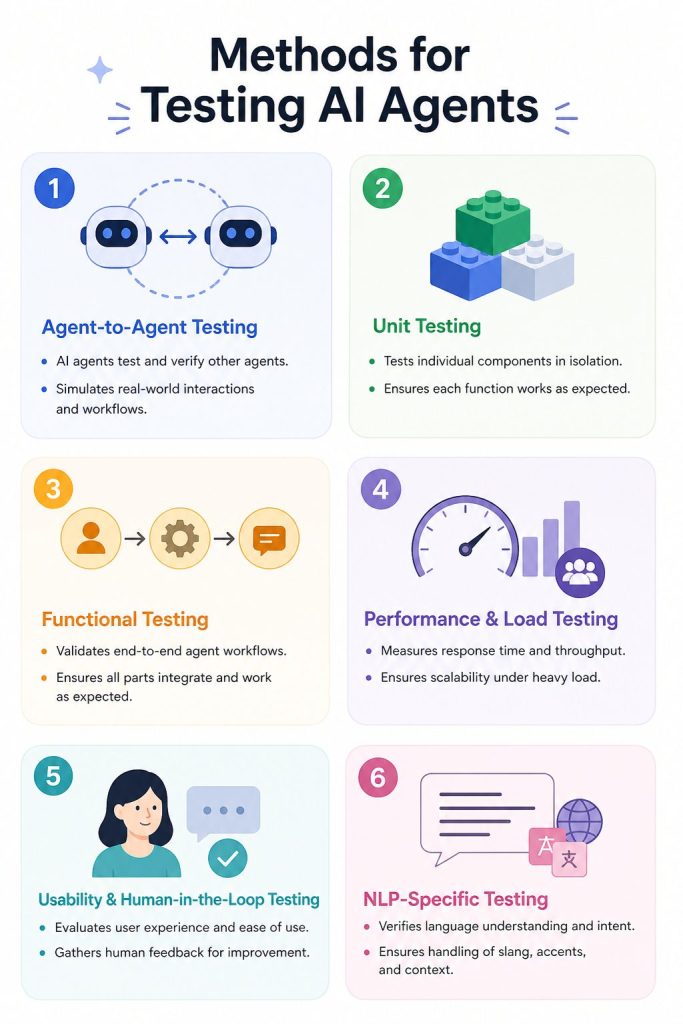
Testing AI agents can be done in many ways, depending on what you want to measure. Here are some of the most important methods used to evaluate AI agents effectively.

Agent-to-Agent Testing
Agent-to-Agent testing is an advanced, AI-based method in which intelligent agents are tested and verified by other AI agents using realistic, automated interactions. Unlike traditional testing, which can overlook flaws in multi-agent workflows, A2A testing simulates real-world, dynamic scenarios to build more resilient and trustworthy AI systems.
With the increasing sophistication of AI ecosystems, testing effectively requires environments that enable large-scale simulation and continuous verification. TestMu AI is one of the first platforms to introduce agent-to-agent testing, allowing teams to test how smart agents engage, collaborate, and act in real-world situations. Its integration of cloud scale and intelligent automation makes multi-agent testing more accessible, dependable, and future-ready.
Unit Testing
Unit testing is the cornerstone of AI agent testing.It involves testing the building blocks of your agent in isolation to ensure every part works as it should, especially when you build AI agents with multiple interconnected components. This may include intent recognition models, entity extraction, and backend API calls. Automated unit tests enable repeated checks of these components so each function consistently produces the expected outcome as the AI system grows.
Functional Testing
Functional testing focuses on end-to-end validation of AI agent workflows. It checks that all parts of the system integrate properly and function smoothly. For a customer care chatbot, functional testing ensures the agent correctly understands user needs, retrieves necessary details like order numbers, and provides the right answer or action.
Performance and Load Testing
AI agents must withstand real-world situations, such as multiple simultaneous users or high-demand environments. High-traffic AI applications, such as an AI Avatar generator, particularly depend on stable response times and scalable infrastructure to maintain a smooth user experience during peak demand. Performance and load testing measure response times, system throughput, and scalability. By simulating large numbers of concurrent interactions, you ensure the AI agent remains responsive, reliable, and scalable without bottlenecks or crashes.
Usability & Human-in-the-Loop Testing
Even the smartest AI agent can fall short if people can’t use it easily. Usability testing examines how smoothly users interact with the agent, whether its responses make sense, and if tasks can be completed without frustration. Observing users and gathering feedback highlights breakdowns and areas for improvement in design.
NLP-Specific Testing
For language-processing AI agents, testing goes beyond normal functional checks. NLP-specific testing verifies whether the agent interprets intentions correctly, handles grammar, slang, or accent differences, and demonstrates contextual awareness. This ensures the agent understands meaning, not just literal text, for precise and reliable interactions.
How to Test AI Agents
Testing an AI agent becomes much easier when you follow a clear, step-by-step process. This helps you see how well it performs for real users.
- Define Objectives and Process Structure
Clearly outline what you expect your AI agent to do and how it should behave. Set targets for task accuracy, response speed, tool usage, and error handling. Breaking the agent into smaller components, such as input understanding, multi-step action planning, context memory, and error recovery, helps build a focused testing plan. - Use Benchmark and Custom Datasets
Benchmark datasets provide uniform metrics to evaluate the AI agent against established models. Custom datasets allow testing domain-specific or specialized scenarios. Combining both ensures comprehensive evaluation, highlights weaknesses, measures progress, and ensures readiness for diverse real-world conditions. - Simulation and Controlled Testing
Controlled simulations let you evaluate decisions, actions, and results in a safe environment, without affecting real users. Multi-agent simulations reveal emergent behaviors, coordination issues, or integration challenges. Maintaining versioned datasets, environment parity with production, and reproducible test runs ensures simulations accurately reflect real-world scenarios. - Select the Right Testing Framework
A structured testing framework ensures consistency and efficiency, particularly when working with an AI agent builder that simplifies development and testing workflows. It should support automated and human-in-the-loop testing, track conversation flows, verify tool usage, and handle end-to-end scenario validation. A phased approach, starting with functional testing, adding reasoning evaluation, and concluding with full workflow tests, ensures thorough coverage. - Human and Automated Evaluation
Human judgment enriches the understanding of the AI agent’s capabilities, while automated evaluation provides scalability. Experts assess outputs for accuracy, ethical alignment, and context relevance. Automated evaluators enable large-scale checks for consistency, logic, and task completion. Hybrid evaluation ensures AI agents are effective and user-friendly. - Performance Metrics Evaluation
Evaluate AI agents using metrics that capture behavior, reliability, and reasoning, not just prediction accuracy. Key measures include task completion rate, response consistency, multi-step reasoning quality, tool selection correctness, and latency. These metrics demonstrate how robustly and efficiently the agent performs under real conditions. - Safety and Security Evaluation
Safety and security testing prevent harmful outputs and vulnerabilities. Red-teaming, stress tests, and adversarial scenarios identify risks. Continuous monitoring ensures sensitive data is handled carefully and that agents behave ethically. Lessons from these checks improve reliability and resilience over time. - Real-World Testing and Iteration
Finally, test AI agents with real users in controlled settings. Observing engagement, task completion, and interaction quality provides insights that simulations cannot capture. Iteration based on these observations refines the AI agent for practical, everyday use.
Conclusion
Testing AI agents is no longer just about checking whether they produce the right output.It’s about understanding how they think, adapt, and behave in unpredictable real-world environments, especially as AI agents for small businesses and enterprises become more widely adopted.
Structured testing, multi-agent simulations, benchmark and custom datasets, performance metrics, and continuous real-world validation help ensure AI agents remain stable, accurate, and dependable over time.
AI Agentic Platform For Building Portable AI Agents
Say Hello To Agentic AI That Connects With Your CRM And Even Other Agents