
A polished demo can make an AI agent look ready for every customer, every edge case, and every business system. A buyer may hear “it can handle support” as “it will resolve almost every support request without supervision.” If you mean something narrower, the difference needs to be clear before the proposal is signed.
To sell AI agents without overpromising, make every claim specific enough to test. State the task, conditions, evidence, exclusions, and human responsibilities. If you have not tested a result in the buyer’s environment, describe it as a hypothesis or pilot goal, not a proven outcome. Objective advertising claims should have an adequate basis before they are made; the FTC’s advertising substantiation guidance explains this principle for U.S. advertising, though a specific campaign may need legal review.
This guide focuses on the trust and evidence layer of an AI agent sale. Botsify’s broader guide to selling AI agents to businesses covers offer design, positioning, pricing, and retention. Here, the practical question is narrower: how can you explain what the agent is likely to do, what it has actually done, and where the buyer should still expect uncertainty?
A simple rule: match the claim to the evidence
An AI agent sales claim usually combines three things: a business result, a system behavior, and conditions under which that behavior should occur. The more specific and consequential the promise, the stronger the evidence should be.
| Claim type | Example | Evidence to gather before making it |
|---|---|---|
| Capability | “The agent can answer questions from approved product documentation.” | Test cases showing it retrieves relevant source material and handles missing information appropriately. |
| Workflow | “The agent can qualify an inbound lead and route it to the right team.” | Tests of required fields, routing rules, exception cases, and the destination system. |
| Performance | “The agent resolved 62 of 100 eligible questions in our pilot.” | A defined sample, denominator, time window, success definition, and review method. |
| Business impact | “This may reduce time spent on routine inquiries.” | A baseline, measured change, costs, human review time, and a clear statement of what is estimated. |
| Guarantee | “The agent will reduce support costs by 30%.” | Robust evidence for the exact result under conditions comparable to the customer’s use case, plus legal review. |
Do not slide from one row to another without proof. A successful test of one task demonstrates that the task worked in those test conditions. It does not, by itself, establish a company-wide savings figure or a guarantee for every future conversation.
The FTC distinguishes express claims from implied ones. A sentence can imply a measurable result even when it avoids a percentage. For example, “replace your night shift” may communicate a staffing outcome. “Never miss another lead” can imply that every lead will be captured and handled. Review the impression a reasonable buyer could take from the full pitch, including screenshots, demo narration, and case studies, rather than checking only the literal words.
Define the job before describing the agent
“An AI agent that automates sales” is not a useful scope. It bundles research, outreach, qualification, pricing, negotiation, CRM updates, and follow-up into one vague promise. A buyer cannot tell what is included, and a delivery team cannot test it.
Write the job as a bounded sentence:
The agent handles [specific task] for [defined inputs] through [approved systems], then [completion or escalation behavior], subject to [known conditions].
For example:
The agent answers inbound questions about published service hours and location, asks for missing booking details, and offers the approved scheduling link. It escalates requests about refunds, exceptions, or unclear policy to the team.
This statement can be converted into a test plan. It also shows the buyer that “answers questions” does not mean “makes every business decision.” For lead handling, a specific AI lead qualification workflow can define which fields are collected and when a sales representative should take over.
Clarify four boundaries during discovery:
- Input boundary: Which channels, file types, languages, and data sources are in scope?
- Action boundary: Can the agent answer, draft, recommend, update a record, or commit the business to an action?
- Decision boundary: Which choices require a person’s approval?
- Exception boundary: What happens when information is missing, conflicting, outdated, or outside the agreed use case?
A capability may exist technically while still being excluded from a safe initial deployment. For example, an integration may be available, but the buyer may not yet have approved the permissions, data access, or operating process needed to use it. Keep “possible in principle” separate from “configured, tested, and included in this scope.”
Use an evidence ladder for every claim
A practical way to avoid accidental overstatement is to label the evidence behind each statement. Use the strongest category that is actually true, and keep the label visible in proposals and internal sales notes.
- Product description: The platform documentation or current product page states that a feature is available. This supports a feature statement, not a customer result.
- Demonstration: A controlled demo shows a defined task working with example data. This supports “we demonstrated,” not “it will perform the same way on your live data.”
- Test set: A documented set of representative and edge-case inputs was run under stated conditions. This supports a measured result for that set, subject to its limits.
- Customer pilot: A real workflow was measured over an agreed period with a baseline and success definition. This supports a result for that customer and scope, not a universal benchmark.
- Replicated evidence: Similar tests across multiple relevant deployments produce a consistent result. This may support a broader, carefully qualified claim if the sample, conditions, and exclusions are disclosed.
When you only have a demo, say so. A credible line might be: “We have demonstrated the workflow using sample inquiries. We have not tested it against your knowledge base or measured its resolution rate yet. The pilot will establish those results.” That sentence makes the next step clear without pretending the unknown is already known.
Maintain a simple claims register
Keep a shared record for each measurable or material statement used in sales materials. Update it when the product, model, prompt, integration, or customer workflow changes.
| Field | What to record |
|---|---|
| Claim | Exact wording used in the deck, proposal, or demo. |
| Claim type | Feature, workflow, measured performance, business impact, or guarantee. |
| Evidence | Test report, approved product page, pilot data, or customer-approved case study. |
| Conditions | Dataset, channels, system permissions, dates, volume, and human support involved. |
| Exclusions | Requests, populations, languages, or actions not included in the evidence. |
| Owner and review date | Who can approve the claim and when it should be checked again. |
A claim register is especially useful when multiple people sell the same service. It prevents an accurate, qualified pilot result from turning into an unqualified headline after it is copied into a new deck.
Build a sales pitch grounded in evidence and clear scope
Discuss scope and evidence before making a client promise.
Build the demo to reveal limits
A demo should help the buyer decide whether the workflow is suitable. A perfect scripted conversation has low decision value because it hides how the agent behaves when context is incomplete or the request falls outside scope.
Use a small sequence that shows both the intended task and the boundary:
- A normal in-scope request: Show the agent using current, approved information.
- A request with missing details: Show the clarifying question, not a confident guess.
- An unsupported or conflicting question: Show the fallback language and route to a person.
- A decision with business impact: Show the approval step or explain that the agent cannot commit on the business’s behalf.
- A tool or integration failure: Explain what the user sees and how work is recovered.
Use synthetic or approved sample data unless the prospect has explicitly authorized real data for the demonstration. If a demo uses preselected questions, disclose that they are examples. Avoid presenting a carefully prepared path as representative of all possible customer conversations.
When the agent must hand work to a person, describe the handoff as part of the product experience. State what context transfers, who receives it, what response time is realistic, and what the customer sees while waiting. Good AI human handoff rules help define escalation triggers, preserve context, and prevent a promise of “instant help” when a human queue may take longer.
Make the pilot a fair test, not an open-ended promise
A pilot is useful when both sides know what question it is supposed to answer. It should not be described as proof that the entire workflow is ready for full automation. Before starting, agree on a contained use case, representative inputs, a baseline, human responsibilities, and a decision date.
Structure the sales conversation
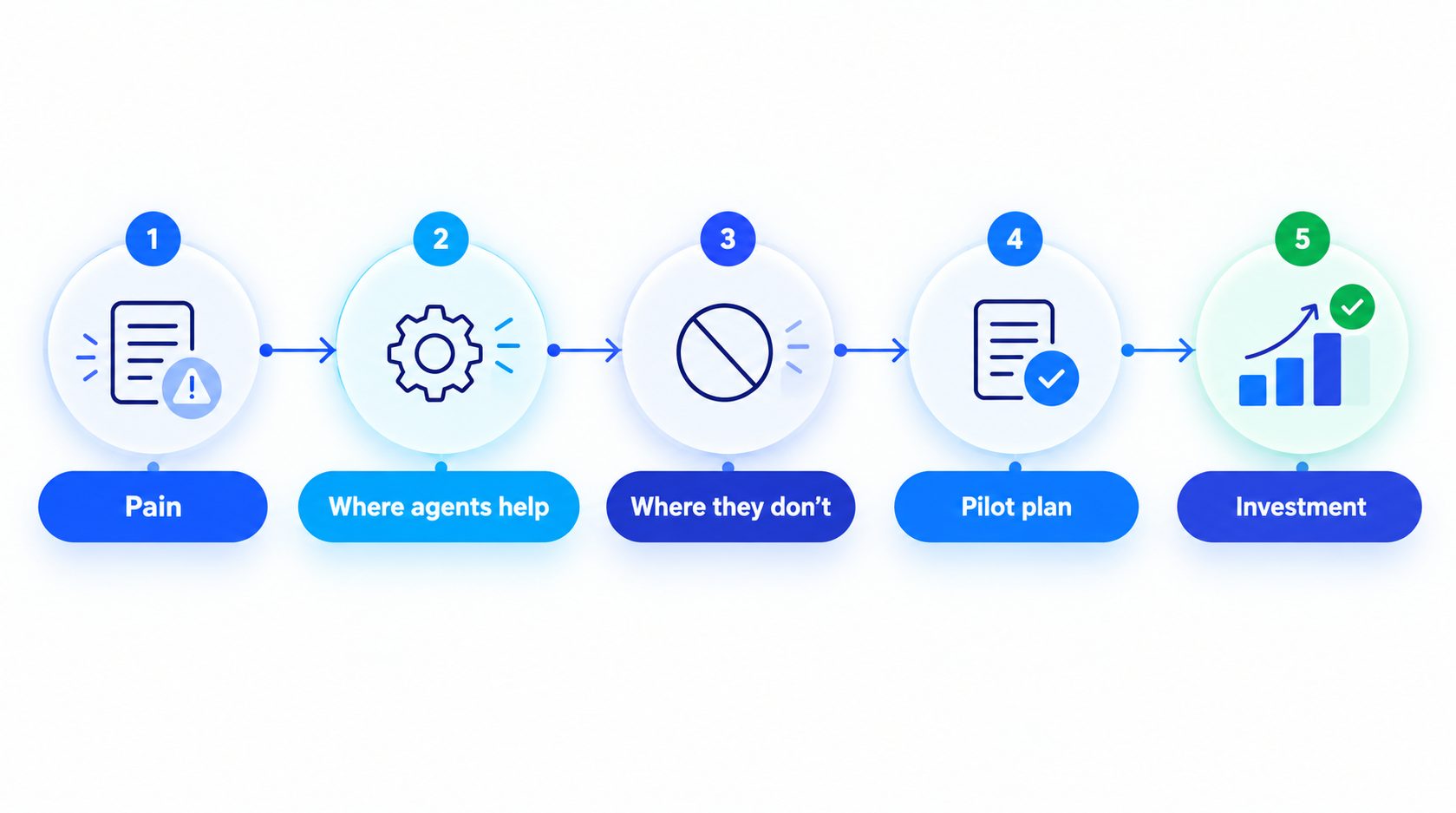
A clear agenda helps you understand the buyer’s context before showing the solution. Cover the current pain, where an agent may help, where it should not act, the pilot plan, and the investment. The existing diagram below gives a simple five-step sequence for that conversation.
Write a one-page pilot brief
Include these items in plain language:
- Use case: The single workflow or task being evaluated.
- Eligible volume: Which conversations or records count as in scope.
- Baseline: How the work is handled now, including time, volume, cost, quality, or service level where available.
- Test period: Dates and hours during which the evaluation runs.
- Sample: What inputs will be tested and how edge cases will be included.
- Success measures: Two or three metrics that describe quality and effort, not just volume handled.
- Human role: Who reviews exceptions, handles escalations, and checks samples.
- Stop conditions: Errors or service conditions that pause the workflow.
- Decision: What the parties will do if the pilot meets, partly meets, or misses its criteria.
Use pilot goals as goals, not forecasts. “We will test whether the agent can answer routine opening-hours questions with approved information” is honest. “It will answer 90% of customer questions” is a result claim and needs evidence relevant to the customer’s volume, content, and criteria.
Choose a narrow first use case
A suitable first workflow is repetitive, bounded, and easy to verify. Examples may include answering approved FAQs, collecting required information before a person reviews a request, classifying an inbound inquiry, or preparing a draft response for approval. Which task is appropriate depends on the buyer’s risk, data, system access, and ability to supervise it.
Start with tasks where the cost of a wrong answer is limited and recovery is straightforward. If an error could affect a person’s health, finances, legal position, access to essential services, or another high-impact outcome, do not treat a generic pilot checklist as sufficient. The buyer may need specialist risk, privacy, security, or legal review before testing or deployment.
A usable test set should include ordinary cases and the uncomfortable ones: incomplete requests, contradictory sources, stale policy, unusual wording, unsupported languages, a user asking for a person, and a tool being unavailable. Write down expected behavior before running the test so the team does not redefine success after seeing the result. For a repeatable approach, use a structured AI agent testing guide.
Plan a contained AI agent pilot with your team
Set success measures and decision points before launch.
Measure performance without hiding the workload
Choose measures that answer the buyer’s real question. If the value is support capacity, count cases that were correctly resolved, not just conversations the agent touched. If the value is lead handling, measure qualified leads that reach the right person, not just messages sent.
Good pilot measures may include:
- Eligible coverage: Number of in-scope cases exposed to the agent divided by the total in-scope cases.
- Verified task success: Cases that met a pre-agreed correctness checklist divided by cases evaluated.
- Escalation quality: Whether cases that needed a person were routed correctly, with usable context.
- Repeat contact or rework: How often a person had to correct, redo, or revisit an agent-handled task.
- Human time: Review, exception handling, correction, and maintenance time added or avoided.
- Customer or employee experience: A small, consistently collected feedback measure when appropriate.
- Total operating cost: Usage, platform, integration, monitoring, review, and support costs relevant to the comparison.
Report the denominator and the time period. “The agent handled 40%” is not enough. Does that mean 40% of every conversation, only eligible requests, or cases that ended without a human? Were the answers correct? Did people contact the company again? Did the team spend time reviewing each conversation?
For customer support, deflection alone can create a flattering but incomplete story. Pair it with accuracy, repeat contacts, satisfaction, escalation, and cost per verified resolution. The AI customer support metrics guide explains why a lower escalation rate is not automatically better if customers are being kept from needed help.
If you calculate return on investment, separate observed savings from estimated value. A pilot may show time released from a task; it does not necessarily show that payroll or cash costs went down. The team might use the time for other work instead. State the calculation, assumptions, and costs, and call the result a scenario when it depends on future staffing or volume decisions.
Answer tough buyer questions with precision
“Can it do everything our team does?”
Avoid: “Yes, it can handle the whole process.”
Try: “It can support the parts we define and test. Let’s map the workflow together, mark which steps are routine, and identify approvals or exceptions that stay with your team. We’ll include the agreed boundary in the pilot.”
This avoids confusing a broad model capability with the full responsibility of a business role.
“What percentage of our work will it automate?”
Avoid: Quoting a benchmark from a different customer or workflow as if it predicts this buyer’s outcome.
Try: “We do not have a measured percentage for your workflow yet. We can estimate the eligible task volume from your baseline, then measure correct completion and human effort in a contained pilot.”
If you have relevant pilot data, state the sample, scope, dates, and what counted as successful. Explain differences between that deployment and the buyer’s.
“Will it make mistakes?”
Avoid: “Hallucinations are solved” or “it never makes mistakes.”
Try: “It can produce an incorrect or incomplete answer. We can reduce risk by limiting the scope, using approved sources, testing difficult cases, and defining when it should stop or hand off. The pilot will help us measure the remaining failure modes.”
Risk controls reduce exposure; they do not prove that all errors have been eliminated. A human-in-the-loop review approach can help determine which outputs need review before they are sent or acted on.
“Can it take actions in our systems?”
Avoid: “It connects to everything and runs the workflow automatically.”
Try: “We should confirm the specific system, permissions, actions, and recovery path. We can begin with read-only or draft actions where practical, then expand only after the tests and your approvals support that change.”
Confirm whether an integration is available, included, configured, and tested. Those are separate questions. Do not imply that a platform’s catalog of integrations means every buyer’s system is already connected or ready for the required workflow.
“Can you guarantee a return?”
Avoid: Guaranteeing a savings or revenue percentage without contractually defined conditions and substantiation.
Try: “We can agree on a measurable pilot and show the result against your baseline. We cannot responsibly guarantee an outcome that depends on adoption, input quality, volumes, policy decisions, and other factors outside the agent.”
If the buyer needs a formal performance commitment, define the metric, data source, measurement period, exclusions, dependencies, and remedy with appropriate commercial and legal review. A vague guarantee creates more disagreement than confidence.
Put the boundary in the proposal and operating plan
The sales conversation, proposal, implementation plan, and handoff to the service team should describe the same scope. Record what the agent will do, what it will not do, what the customer must provide, and what happens when assumptions change.
Include:
- Included workflows and channels: Name each task and place of use.
- Knowledge and data inputs: Identify the source material, content owner, and refresh responsibility.
- Actions and permissions: List system access and each action allowed.
- Human decisions: Name approvals, exceptions, and escalation owners.
- Service expectations: State hours, expected response process, and what “available” means.
- Dependencies: Note customer systems, integrations, policies, and staff availability.
- Change control: Explain how new use cases, content, channels, or material workflow changes are estimated and approved.
- Measurement: Define metrics and who supplies or validates the data.
- Known exclusions: Record unsupported tasks, data, languages, or conditions.
Do not promise security, retention, audit, or compliance controls based only on a general platform description. Confirm the exact requirement and the actual product configuration with the responsible technical or legal owner. An AI agent governance plan can help teams assign oversight and control responsibilities, while an AI agent audit trail for leadership may inform which operational events a buyer wants to record. Verify that any specific logging or retention capability exists in the product and contract before promising it.
When deploying for an agency’s clients, be equally precise about who owns the relationship and what is included in the service. A white-label AI agent platform may support the agency’s branded delivery model, but platform availability does not itself establish how quickly an agency can implement a particular client workflow or what business result that workflow will produce.
Package the commercial offer around work you can control
The scope should explain what the buyer pays for and what ongoing responsibilities remain. Separate setup and implementation from recurring work such as monitoring, updates, support, reporting, or knowledge maintenance. If the offer is Done-For-You, distinguish the work Botsify or your agency performs from the business decisions and source content the customer must provide. If it is white-label, distinguish platform access and reseller rights from custom implementation or guaranteed client outcomes.
Botsify’s Done-For-You AI agent service describes its own service scope, while its white-label AI agent page lists current platform features. Check live terms before using product details in a proposal because features and commercial terms can change. Do not silently carry one client’s price, timeline, or pilot result into another engagement.
If you sell leads or sales workflow automation, make the unit of value explicit. A qualified lead might require a set of agreed fields, a valid contact method, and a defined fit rule. A booked meeting may still be canceled or unqualified. The AI sales assistant workflow and its follow-up cadence can help define the operational steps, but any claimed lift should come from your own relevant measurement.
FAQs about selling AI agents honestly
How do I sell AI agents without overpromising if I have no case studies?
Sell a contained evaluation, not an outcome you cannot demonstrate yet. Show a working example with sample data, name what has not been tested, and propose how the customer’s own workflow will be measured. You can build credibility through a clear test plan and candid limitations before you have a customer case study.
Should I mention limitations during the first sales call?
Yes, when the limitation affects fit, risk, cost, or expected results. Explain it in the same context as the capability. For example, if an agent can collect information but not approve a refund, say both together and explain the handoff.
Is a pilot result proof that the agent will work everywhere?
No. A pilot is evidence for the tested scope and conditions. Differences in customer behavior, source content, channel, language, integrations, and operating process can change performance. State what was tested and retest material changes.
What if a competitor makes bigger claims?
Keep your claim tied to your evidence. Ask the buyer which outcome, conditions, and support they need, then explain what you can verify. A stronger claim is not stronger evidence, and a precise scope can help a buyer compare offers fairly.
Final checklist before you send the proposal
- Can every measurable claim be tied to evidence that existed before the claim was made?
- Does the wording match what the evidence actually tested?
- Are sample size, denominator, time period, and relevant conditions clear?
- Have you shown an unsupported request, a failure case, and a human handoff?
- Are automation, review, correction, and operating costs represented honestly?
- Do the proposal, pilot brief, and demo describe the same boundaries?
- Have you verified every product, integration, price, and service claim against current documentation?
To sell AI agents without overpromising, make uncertainty part of the method: name it, test it, and report what you learn. If you are evaluating an agency or Done-For-You offer, a strategy conversation can help turn the workflow into a scoped pilot with clear measures and responsibilities.
Scope an AI agent pilot with clear measures and limits
Discuss a scoped agent workflow and the evidence needed to evaluate it.
