
Sales teams receive inquiries from people at very different stages of the buying process. Some prospects are ready to discuss a solution, while others are comparing options, looking for general information, or contacting the wrong department. When every inquiry enters the same queue, identifying the leads that deserve immediate attention becomes difficult.
An AI sales assistant can help businesses manage this process by asking relevant qualification questions, evaluating prospects against predefined criteria, and routing them to the appropriate sales representative or workflow. Instead of manually reviewing every conversation, sales teams receive structured information about what each prospect needs and whether they’re ready for a sales discussion.
However, building an effective assistant requires more than connecting a chatbot to a website. You need a clear qualification rubric, consistent lead scoring, reliable routing rules, and a way to transfer customer context into your CRM.
In this guide, you’ll learn how to build an AI sales assistant that qualifies and routes leads, with practical examples for HubSpot and Salesforce, a customizable qualification prompt, testing scenarios, and performance metrics you can use to improve the process.
Why Lead Qualification Matters for Sales Teams
Sales teams often receive inquiries from people with very different needs and levels of buying intent. Some prospects are actively looking for a solution, while others are researching options, comparing products, or contacting the wrong department.
When every inquiry receives the same attention, representatives can spend valuable time reviewing leads that aren’t ready for a sales conversation.
An AI sales assistant helps organize this process by collecting relevant information, identifying potential customer fit, and directing inquiries toward the appropriate next step.
For example, a prospect requesting a product demonstration may be ready to speak with sales, while someone exploring general features might benefit from additional information first.
The objective isn’t to reject as many leads as possible. It’s to understand what each prospect needs and make sure the right conversations reach the right people.
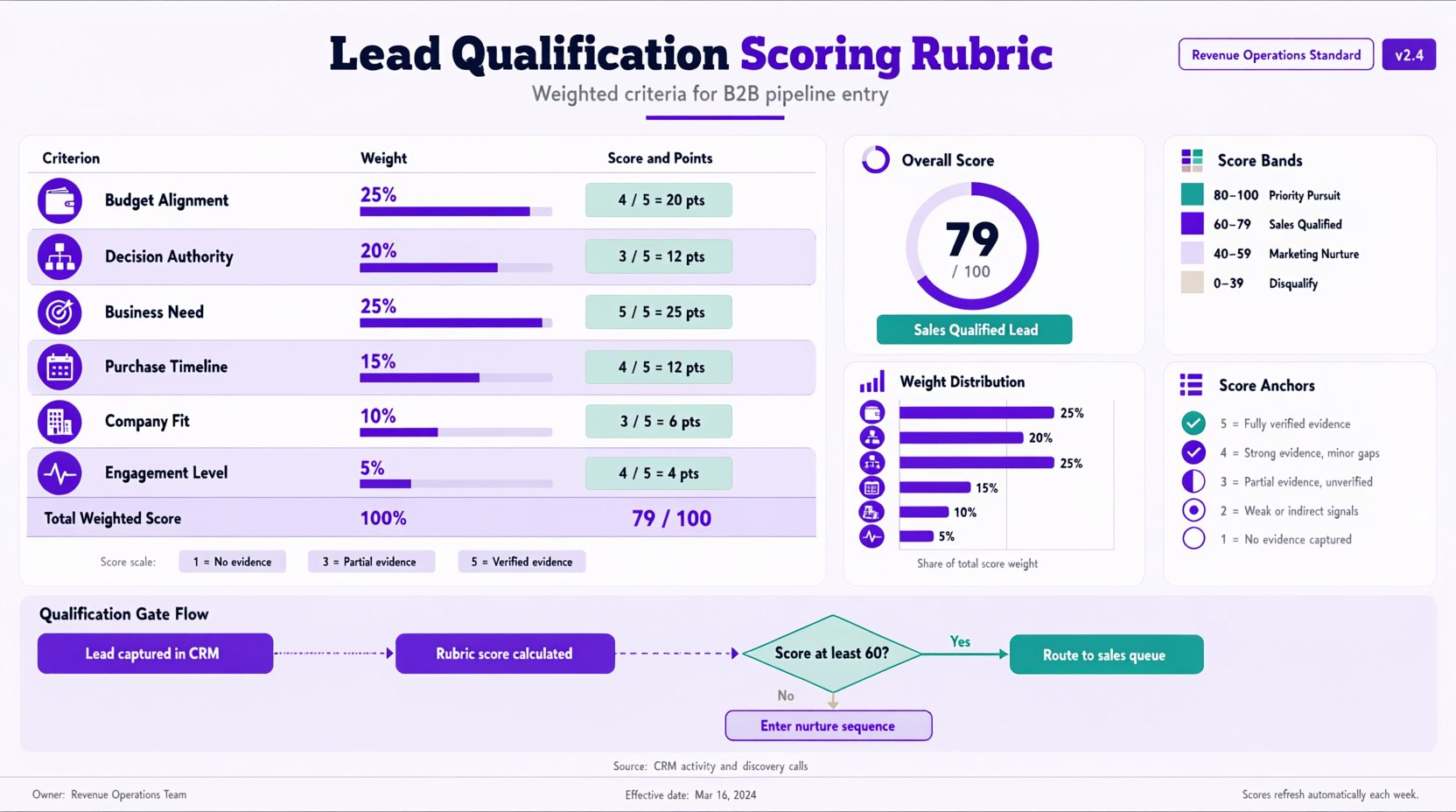
How to Build a Lead Qualification Rubric for Your AI Sales Assistant
Before an AI sales assistant can qualify leads accurately, it needs clear criteria for identifying which prospects are worth pursuing.
Many sales teams have an informal understanding of their ideal customers, but those assumptions aren’t always documented. One representative might prioritize company size, while another focuses on budget or urgency.
A qualification rubric turns those judgments into consistent rules that the assistant can apply during conversations. For B2B teams, AI lead scoring provides a way to evaluate customer fit, buying intent, and urgency before deciding which prospects need immediate attention.
Choose your qualification criteria
Start by defining your ideal customer profile (ICP) and identifying the information that matters most to your sales process.
| Criterion | What the assistant should learn | Example score |
|---|---|---|
| Customer fit | Industry, company size, role, and relevant needs | 0–3 |
| Purchase intent | Whether the prospect has a problem your solution can address | 0–3 |
| Timeline | When the prospect expects to make a decision or implement a solution | 0–3 |
| Buying involvement | Whether the prospect makes or influences purchasing decisions | 0–3 |
| Engagement | Whether the prospect is actively participating in the conversation | 0–3 |
With five criteria scored from 0 to 3, the maximum score is 15 points.
You can then create initial routing categories:
| Score | Category | Recommended action |
|---|---|---|
| 12–15 | High priority | Notify an appropriate sales representative |
| 8–11 | Needs qualification | Ask relevant follow-up questions or request human review |
| 4–7 | Nurture | Offer useful information and continue only through permitted follow-up workflows |
| 0–3 | Low priority | Provide appropriate resources or close the conversation when there is no relevant opportunity |
These thresholds are examples, not industry benchmarks. Your team should adjust them based on actual lead quality and sales outcomes.
Important: Keep disqualifying conditions separate from the numerical score. For example, an unsupported use case or a region your business cannot serve may require a different route regardless of the lead’s total score.
Build the rubric with your sales team
The people receiving qualified leads should help define what a good lead looks like.
A practical workshop can follow five steps:
- Review successful deals. Examine recently closed opportunities and identify common characteristics such as company size, industry, buying needs, and urgency.
- Review unsuccessful opportunities. Look for recurring reasons leads didn’t progress, including poor product fit or unsupported requirements.
- Agree on scoring criteria. Decide which information the assistant needs and how each response should affect the score.
- Document disqualifiers. Identify situations that should trigger an alternative route or end the qualification process.
- Test historical leads. Have sales representatives score the same sample of leads and discuss disagreements until the rules become clear.
Validate the rubric before automating it
Run several historical or simulated leads through the proposed scoring model.
If representatives consistently disagree with the assistant’s decisions, review the criteria before launch.
A qualification rubric should also evolve as your business learns which types of leads actually progress to meetings and customers.
The goal isn’t to create a perfect scoring system immediately. It’s to establish a consistent starting point that can be measured and improved.
How an AI Sales Assistant Qualifies, Routes, and Hands Off Leads
An AI sales assistant should do more than greet website visitors and collect contact information. An AI lead qualification agent can collect relevant answers, assess customer fit, and identify when a prospect should move to a human sales representative or another workflow.
The workflow begins when someone submits a form, starts a website conversation, or contacts the business through another supported channel.
The lead qualification workflow
| Stage | What the AI assistant does | What the sales team does |
|---|---|---|
| New inquiry | Responds and identifies the reason for contacting the business | Reviews incoming activity when needed |
| Qualification | Asks relevant questions and records the answers | Defines and maintains qualification rules |
| Scoring | Applies the agreed qualification rubric | Reviews scoring quality and exceptions |
| High-priority lead | Creates a summary and triggers the appropriate handoff | Takes over the sales conversation |
| Needs more information | Asks a relevant follow-up question or offers human assistance | Reviews leads that require judgment |
| Nurture opportunity | Provides useful information or enters a permitted follow-up workflow | Reviews prospects when they become sales-ready |
| Poor-fit inquiry | Explains limitations or directs the person toward appropriate resources | Handles exceptions when necessary |
Make qualification feel like a conversation
The assistant shouldn’t present every prospect with a long list of screening questions.
Instead of asking:
“What is your company size?”
It could ask:
“To help me point you toward the right solution, roughly how many people are on your team?”
Both questions collect similar information, but the second explains why the answer matters.
Ask only the questions needed to determine the next step. If a prospect clearly wants to speak with a representative, the assistant should offer that option rather than forcing them through the entire rubric.
When to use multiple AI agents
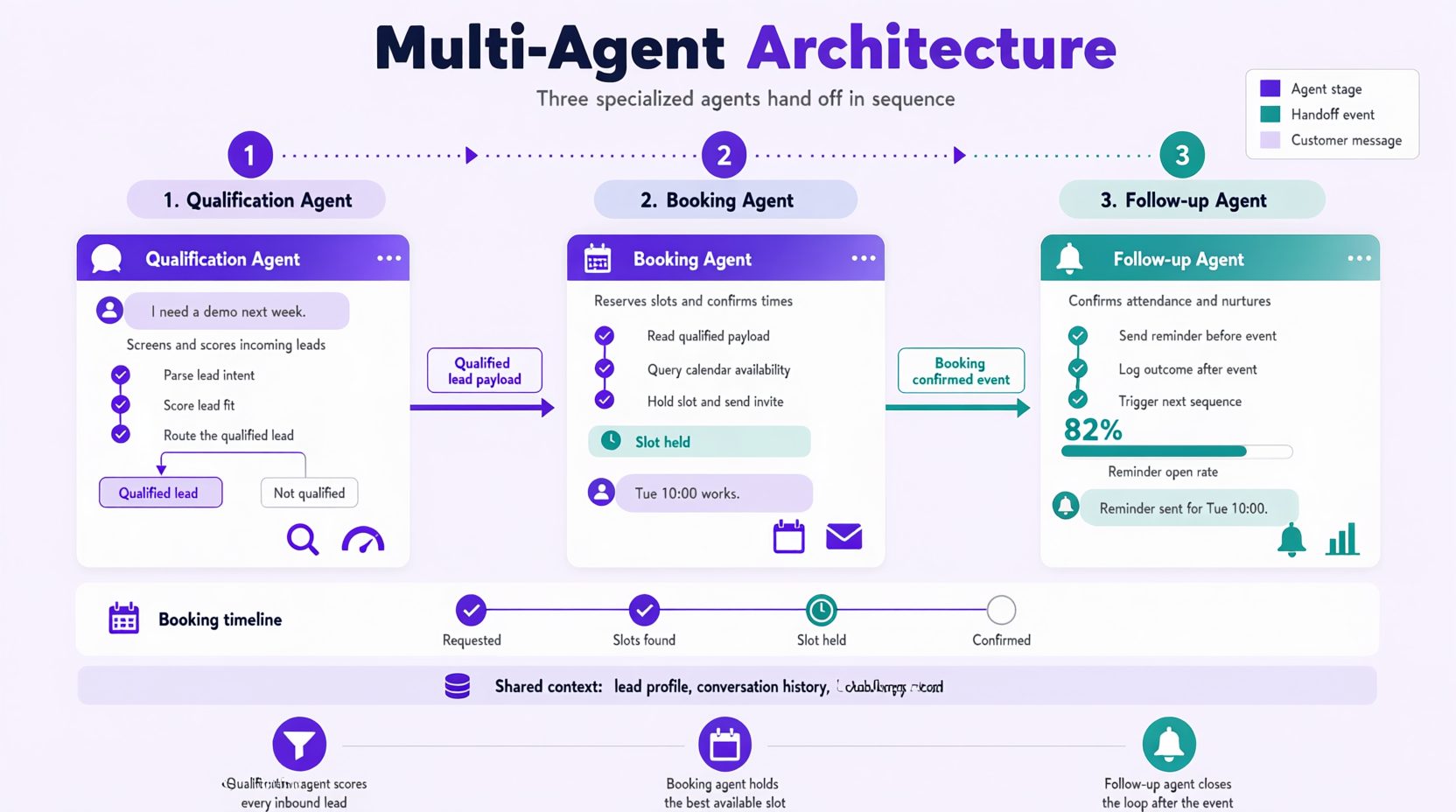
A single AI sales assistant can manage qualification, basic routing, and straightforward next steps. As explained in Botsify’s guide to AI sales agents, connected sales workflows can also support CRM updates, meeting scheduling, follow-ups, and human handoffs when the necessary integrations are configured.
As the workflow becomes more complex, businesses may separate responsibilities across specialized agents or connected automation workflows.
For example:
- Qualification agent: Collects information, evaluates customer fit, and identifies the next step.
- Booking agent: An AI booking agent helps qualified prospects move into an appointment scheduling workflow, using relevant availability and booking information when connected to the appropriate systems.
- Follow-up agent: Manages permitted reminders and relevant follow-up conversations.
- Nurture workflow: Shares appropriate educational information with prospects who aren’t ready to speak with sales.
A multi-agent setup isn’t necessary for every business. It becomes useful when different tasks require distinct integrations, instructions, or operational controls.
Preserve context during handoffs
Whether the next step is handled by another AI agent or a human representative, the receiving system should have access to the information already collected.
A useful handoff summary includes the prospect’s original request, relevant qualification answers, lead score, important concerns, and recommended next action.
This allows the next conversation to continue without asking the prospect to repeat everything.
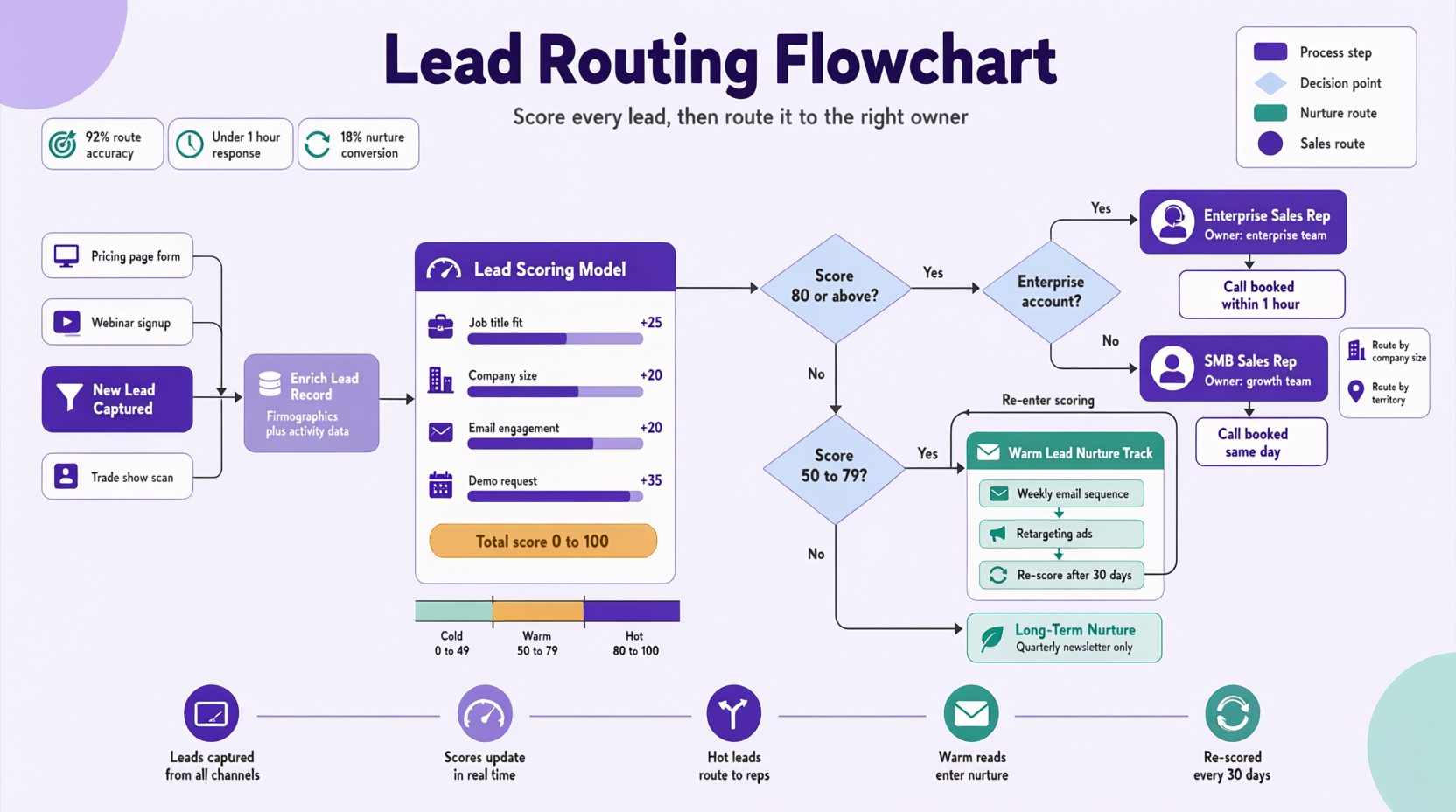
AI Sales Assistant Lead Routing Rules and Exceptions
Qualifying a lead is only useful when the result leads to an appropriate next action.
An AI sales assistant should know whether to assign the prospect to a sales representative, request more information, send the inquiry to a specialist, or direct the person toward another resource.
These decisions should follow documented routing rules rather than relying on the assistant to make unrestricted judgments.
Common lead routing methods
| Routing method | How it works | When to use it |
|---|---|---|
| Round-robin assignment | Distributes eligible leads among available representatives | When representatives handle similar opportunities |
| Territory-based routing | Assigns leads according to location or market | When teams manage specific regions |
| Industry-based routing | Sends prospects to representatives with relevant industry expertise | When products or sales approaches differ by industry |
| Product-based routing | Assigns leads according to the solution they need | When different teams manage different offerings |
| Account ownership | Routes existing customers or returning prospects to the responsible representative | When preserving relationship history matters |
| Shared queue | Holds leads for a monitored team when direct assignment isn’t possible | During unavailable hours or staffing gaps |
A business may combine several methods. For example, a lead might first be routed by industry and then assigned round-robin among representatives serving that industry. When inquiries arrive through website chat, WhatsApp, and social messaging, multi-channel lead qualification can help teams apply consistent criteria while adapting conversations to each channel.
Set clear ownership and escalation rules
Every high-priority lead should have an assigned owner or a monitored queue.
If a representative is unavailable, the workflow should identify an alternative route rather than leaving the lead unassigned.
Teams can also establish response-time expectations and escalation rules based on staffing capacity and customer needs.
Handle unusual lead situations
Not every prospect fits neatly into a scoring category.
| Situation | Recommended action |
|---|---|
| Student or researcher with no buying intent | Offer relevant public information without forcing a sales conversation |
| Agency interested in reselling | Route to partnerships or channel sales when applicable |
| Former customer returning | Check CRM history and consider routing to the previous account owner |
| Existing customer requesting support | Route to the appropriate customer service or account team |
| Duplicate lead submission | Check existing records and avoid creating conflicting assignments |
| Conflicting qualification answers | Flag the discrepancy and request clarification when necessary |
| Question outside the assistant’s knowledge | Offer human assistance instead of guessing |
| Frustrated or angry prospect | Acknowledge the concern and prioritize appropriate human assistance |
| Prospect requests a representative | Provide a handoff option regardless of the numerical score |
Keep routing decisions explainable
The assistant should record why a lead was assigned to a particular category or team.
A representative reviewing the record should be able to understand which qualification answers influenced the score and which routing rule was applied.
This makes it easier to investigate mistakes and improve the workflow over time.
Test exceptions before launch
Create simulated conversations for unusual cases, including duplicate submissions, missing information, returning customers, and after-hours requests.
Confirm that the assistant selects the correct route and transfers relevant context.
As new situations appear in real conversations, document them and update the routing rules when necessary.
Stop Letting Qualified Leads Get Lost in Your Pipeline
See how Botsify can help you qualify incoming leads, capture relevant information, and connect prospects with the right next step.
How to Connect an AI Sales Assistant to HubSpot or Salesforce
An AI sales assistant becomes more useful when its qualification decisions are available in the CRM your sales team already uses.
Without that connection, representatives may need to copy information manually, review entire chat transcripts, or ask prospects questions they’ve already answered.
The goal is to transfer relevant lead information into the CRM and trigger the appropriate next action.
What information should the AI assistant send to the CRM?
| CRM field | Information to store | Purpose |
|---|---|---|
| Lead score | Qualification score from 0–15 | Helps prioritize opportunities |
| Qualification status | High priority, needs qualification, nurture, or low priority | Determines the next workflow |
| Customer needs | The problem or use case described by the prospect | Helps the representative prepare |
| Company details | Relevant company size, industry, and role information | Supports fit assessment |
| Conversation summary | Main questions, answers, and concerns | Prevents repetitive conversations |
| Lead source | Website, form, WhatsApp, or another channel | Supports reporting and attribution |
| Assigned owner | Representative or team responsible for the lead | Establishes ownership |
| Next action | Book meeting, ask another question, nurture, or close | Keeps the process moving |
Example: Configuring the workflow in HubSpot
In HubSpot, teams can create custom properties to store information such as the AI qualification score, lead status, and conversation summary.
For example:
| Qualification result | Example CRM action |
|---|---|
| Score 12–15 | Assign to an appropriate representative and create a priority follow-up task |
| Score 8–11 | Flag for further qualification or human review |
| Score 4–7 | Add to an appropriate nurture workflow when permitted |
| Score 0–3 | Record the outcome and determine whether any further action is appropriate |
| Prospect requests a human | Create an immediate handoff regardless of score |
The exact implementation depends on the integrations, workflow features, and permissions available in your HubSpot setup.
Example: Configuring the workflow in Salesforce
Salesforce can use a similar approach with custom fields and lead assignment processes.
Example custom fields include:
AI_Lead_Score__c: Stores the qualification score.AI_Qualification_Summary__c: Stores a structured conversation summary.AI_Qualification_Status__c: Records the lead’s current category.AI_Conversation_ID__c: References the related conversation.AI_Disqualify_Reason__c: Records an applicable disqualification reason.
Salesforce assignment rules, flows, and notifications can then be configured around the qualification result.
For example, a high-priority lead might be assigned according to territory or product specialization, while an ambiguous lead could be placed in a review queue.
These are illustrative configurations, not automatic capabilities of every AI platform or CRM connection. The relevant fields, workflows, and API actions must be configured and tested.
Make the handoff useful for sales representatives
A lead score alone doesn’t explain why someone is worth contacting.
The representative should also receive a short summary of what the prospect wants, what information they provided, and which questions remain unanswered.
For example:
Lead score: 13/15
Qualification status: High priority
Customer need: Wants to automate inbound lead qualification from a website
Timeline: Planning implementation this quarter
Main concern: Needs integration with an existing CRM
Recommended next step: Arrange a technical discovery call
This gives the representative enough context to continue the discussion without starting from the beginning.
Review routing outcomes regularly
Compare AI qualification decisions with what happens after the handoff.
If representatives frequently reject high-priority leads, investigate whether the rubric is too permissive or important information is missing.
If low-priority leads repeatedly become customers after manual review, examine whether the scoring criteria are excluding valuable opportunities.
The CRM should help teams improve the qualification process, not simply store the AI’s decisions.
Writing the qualification prompt
The qualification prompt defines how the assistant should ask questions, evaluate responses, and recommend next steps. You can adapt the template below when configuring an agent with Botsify’s AI Agent Builder, provided the required scoring, routing, and CRM actions are also configured in the workflow.
You are an AI sales qualification assistant for [company].
Your role is to understand incoming leads, evaluate customer fit, and recommend the appropriate next step.
Ideal Customer Profile:
[Describe industries, company sizes, relevant roles, customer needs, and supported use cases.]Qualification criteria:
Score each criterion from 0 to 3.1. Customer fit
2. Purchase intent
3. Timeline
4. Buying involvement
5. EngagementMaximum score: 15
Routing categories:
12-15: High priority
8-11: Needs qualification
4-7: Nurture
0-3: Low priorityThese thresholds are configurable examples.
Disqualifying conditions:
[List approved disqualifiers separately.]Conversation rules:
– Ask one relevant question at a time.
– Avoid repeating questions already answered.
– Use a natural, professional tone.
– Do not invent information about the lead.
– Do not assume missing information is confirmed.
– Offer human assistance when requested.
– Do not provide unapproved pricing or product claims.
– Stop unnecessary qualification when the lead is ready for a human conversation.Routing rules:
– Apply the approved qualification criteria.
– Check for disqualifying conditions.
– Follow the configured CRM assignment rules.
– Escalate complex or sensitive requests.
– Preserve conversation context during handoffs.Handoff summary:
Lead name:
Company:
Original inquiry:
Qualification score: [X]/15
Qualification category:
Relevant answers:
Outstanding questions:
Concerns:
Recommended next action:
This prompt does three things that separate it from generic sales chatbot prompts: it defines the ICP explicitly, it forces a structured handoff summary, and it tells the AI what not to do (quote pricing, over-qualify, interrogate).
Ready to Build Your Own AI Sales Assistant?
Turn your qualification criteria into a practical AI workflow. Explore how Botsify can support lead conversations, qualification, and sales handoffs.
How to Test an AI Sales Assistant Before Launch
Before allowing an AI sales assistant to interact with real prospects, test how it handles qualification questions, scoring decisions, CRM updates, and human handoffs.
A successful test should verify more than whether the assistant can answer questions. It should confirm that the assistant makes appropriate decisions when information is missing, a prospect changes their mind, or a conversation requires human attention.
Essential AI sales assistant test scenarios
| Test scenario | What to verify |
|---|---|
| Ideal customer inquiry | The assistant identifies relevant needs and assigns a score consistent with the rubric |
| Poor-fit prospect | The assistant recognizes applicable disqualifiers and responds politely |
| Ambiguous inquiry | The assistant asks relevant clarification questions instead of guessing |
| Prospect requests a human | The assistant offers a handoff without requiring unnecessary qualification |
| Multi-turn conversation | The assistant remembers previous answers and avoids repeating questions |
| Pricing question | The assistant uses approved pricing information or refers the question to a representative |
| After-hours inquiry | The lead is recorded and routed to an appropriate queue |
| CRM synchronization | Qualification answers, scores, and summaries are transferred correctly |
| Lead assignment | Routing rules select the correct representative or team |
| Incomplete information | The assistant avoids treating missing answers as verified facts |
| Frustrated prospect | The assistant acknowledges the concern and offers appropriate human assistance |
Check for common qualification mistakes
Asking too many questions
A long qualification conversation can discourage prospects who only want a quick answer or a meeting.
Start with a small number of relevant questions and test whether each additional question provides information needed for routing.
Treating qualification like a form
An assistant that asks rigid questions without responding to the prospect’s answers may feel frustrating.
Test whether the conversation flows naturally and whether the assistant explains why it needs particular information.
Using inconsistent scoring
The same prospect should receive a comparable score when their answers are equivalent.
Run repeated test conversations and investigate scoring differences.
Sending incomplete handoff summaries
A representative shouldn’t have to read a long transcript to understand why a lead was assigned.
Check whether the summary includes the prospect’s needs, relevant answers, score, concerns, and recommended next action.
Failing to provide human assistance
If the assistant cannot answer a question or encounters a sensitive situation, it should have a clear way to involve a person.
Test that the handoff actually reaches the intended team.
Review results with sales representatives
Ask representatives to evaluate a sample of simulated conversations.
Have them compare the assistant’s qualification scores with their own assessments and identify information they would need before contacting the lead.
Document disagreements and adjust the rubric, prompts, or routing rules before launch.
Continue testing after deployment
Testing shouldn’t end when the assistant goes live.
Review conversation samples, failed handoffs, CRM errors, and incorrect qualification decisions regularly.
Re-test the workflow whenever you change scoring criteria, integrations, routing rules, or the assistant’s instructions.
How to Measure AI Sales Assistant Performance
Once the assistant is live, measure whether it improves the qualification process and helps sales representatives spend more time on relevant opportunities.
| Metric | What it measures |
|---|---|
| Time to first response | How quickly the assistant responds to incoming inquiries |
| Qualification completion rate | Percentage of leads who complete the required qualification steps |
| Lead-to-rep handoff rate | Percentage of leads transferred to sales representatives |
| Meeting booking rate | Percentage of qualified leads who book a meeting |
| Qualified lead conversion rate | Percentage of qualified leads who eventually become customers |
| Routing accuracy | Whether leads reach the correct representative or team |
| Qualification drop-off rate | Percentage of prospects who leave before completing qualification |
| Human override rate | How often representatives change the assistant’s qualification or routing decision |
Compare these metrics against your previous sales process rather than relying on a universal benchmark.
For example, if qualification drop-off increases after adding new questions, review whether those questions are necessary. If representatives frequently reject high-priority leads, investigate the scoring criteria.
The most useful measure of success is whether the assistant helps the sales team identify relevant opportunities and move them toward meaningful conversations.
Real conversation examples: what good looks like
Abstract prompts are hard to evaluate. Here are two illustrative conversations showing how an AI sales assistant can qualify prospects, collect relevant information, and determine the appropriate next step.
These examples focus on qualification and handoff, but the same approach can support meeting conversion. For businesses that receive most inquiries through their websites, a website AI agent can help answer initial questions and guide suitable prospects toward booked sales calls.
Example 1 — Good qualification (software company, 50-person team):
Lead: Hi, do you integrate with Pipedrive?
AI: I can help you find out whether our available integrations support your Pipedrive workflow. What would you mainly want the integration to handle?
Lead: Qualifying inbound leads mostly, from our website and WhatsApp.
AI: Got it — and roughly how many leads come through per week?
Lead: Maybe 80 to 100.
AI: That’s solid volume. And who on your team handles the qualified ones — is that you, or a dedicated sales team? Lead: Two reps, me included.
AI: Thanks, that gives me a better understanding of your setup. I’ll pass your requirements to our sales team, including your interest in Pipedrive and the number of leads you receive each week. Someone can then review the integration options with you. Would you like me to arrange that?
Lead: Yes, perfect.
Notice what happened: the AI asked three questions, each one natural, each one mapped to a rubric criterion. The lead never felt interrogated. The handoff summary gave the rep everything they need to open the call with context rather than re-asking. What makes this good: – One question at a time, naturally framed, Each answer updates the score in real time,The AI knew when to stop asking and hand off — it didn’t over-qualify – The rep gets a summary, not a raw transcript.
Example 2 — Handling a lead who isn’t ready to buy
Lead: Hi, I’m researching AI chatbots for a university project. Can you tell me how they qualify customers?
AI: Of course. AI chatbots can ask questions about a customer’s needs, collect relevant details, and help determine whether someone should speak with a sales representative. Are you researching how the technology works, or are you also looking to implement a chatbot?
Lead: Just researching for an assignment. I’m not planning to buy anything.
AI: Understood. In that case, I can point you toward some educational resources about AI chatbots and lead qualification. Would that be helpful?
Lead: Yes, that would be great.
AI: Happy to help. Here are some resources you can start with: [approved resource links].
Why it works: The assistant identifies that the visitor is researching rather than evaluating a purchase. Instead of forcing the person through additional qualification questions, it offers information relevant to their needs and avoids an unnecessary sales handoff.
FAQ
Will leads get annoyed by qualification questions?
They can, especially when the assistant asks too many questions or requests information that doesn’t seem relevant. Keep qualification conversations focused, explain why information is needed, and offer a human handoff when requested.
How does this work with an existing SDR team?
An AI sales assistant can handle routine qualification tasks and organize incoming inquiries before passing relevant opportunities to sales development representatives. SDRs can then focus on understanding customer needs, answering detailed questions, and moving qualified prospects toward meetings.
What about leads that provide inaccurate information?
The assistant should record what prospects share without assuming every answer is verified. Where possible, businesses can compare relevant details with approved CRM records or other reliable information. Uncertain or conflicting details should be flagged for review rather than treated as confirmed facts.
Can this replace lead scoring tools like MadKudu or Clearbit?
An AI sales assistant can complement existing lead scoring and enrichment tools by collecting conversational information about customer needs, buying intent, and timelines. Whether it replaces any part of an existing tool depends on the capabilities, integrations, and requirements of your sales process.
Final thought
Building an AI sales assistant is ultimately about helping sales teams spend more time on meaningful conversations and less time sorting through incoming inquiries. When qualification criteria, lead scoring, and routing rules work together, prospects can receive more relevant responses while representatives get the context they need to continue the discussion.
A successful AI sales assistant should recognize when to ask another question, when to involve a human representative, and when a prospect would benefit more from helpful information than another sales pitch. That judgment depends on the quality of your qualification rubric, CRM data, and workflow configuration.
Start with a small group of leads, test the assistant against real sales scenarios, and compare its decisions with your team’s assessments. As you refine the process, focus on improving qualification accuracy, handoff quality, and the number of relevant conversations that turn into booked meetings.
Turn More Inquiries Into Qualified Sales Conversations
Discover how Botsify can help your team engage incoming leads, collect qualification details, and move promising opportunities toward a sales conversation.
