
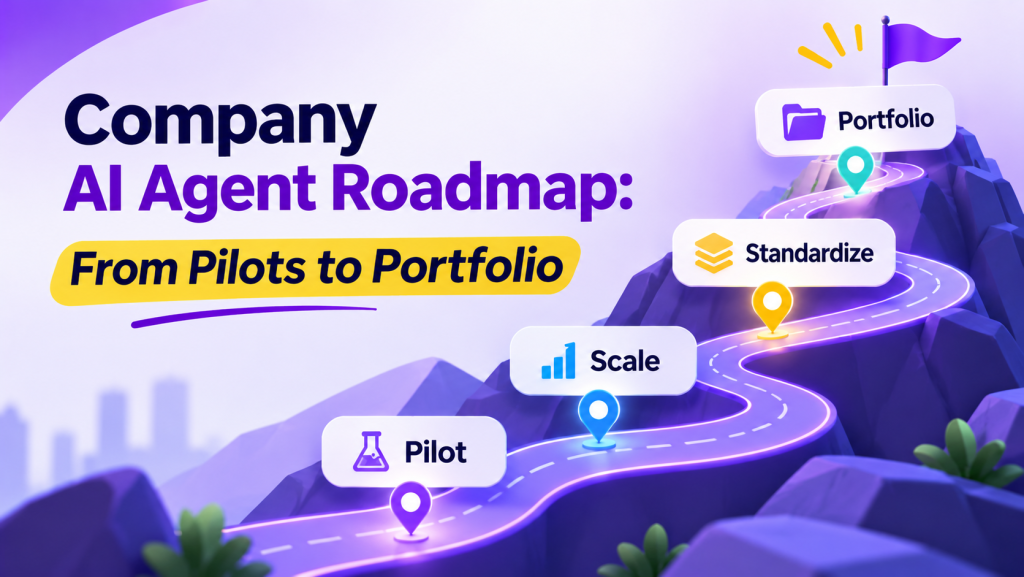
A company roadmap manages a portfolio, not just a launch
A business can have a useful agent pilot and still lack a plan for what comes next. Another team may be building a similar assistant, important data work may have no owner, and no one may know which workflow should receive the next dollar of investment. A company AI agent roadmap helps leaders manage those choices as one portfolio.
This is different from a project schedule. Botsify’s 90-day AI agent implementation roadmap follows one use case from business case through pilot and production handover. A company roadmap sits above that level. It shows which workflows the organization may pursue, what must be in place first, who is accountable, and what evidence will justify expanding, pausing, or ending each effort.
The roadmap should not promise that every department will get an agent by a certain quarter. It should make the next decisions clear, expose dependencies, and give teams a shared way to compare opportunities. The useful output is a living portfolio of choices, owners, evidence, and unresolved constraints.
Start with outcomes and boundaries
Begin with the company’s existing priorities. If leaders want to shorten time to resolution, improve lead follow-up, reduce rework, or help employees find approved information, write that outcome down before proposing an agent. The roadmap should explain how each initiative supports an operational goal and how the team will observe progress.
Then describe the process that produces the outcome. Name the people involved, the request or event that starts the work, the decisions made, the systems used, and the exceptions that need judgment. A clear process map often reveals that a fixed rule, a search tool, or a small workflow change would solve the problem more simply than an AI agent.
A rule-based process with predictable inputs and outputs may be better handled by conventional automation. A knowledge question over a stable set of documents may need retrieval and a good search experience. An agent becomes more relevant when the workflow requires interpreting variable context, choosing between permitted steps, or coordinating tools within defined boundaries. Microsoft makes a similar distinction in its guidance on when to use AI agents. Botsify’s explanation of AI automation and business processes and practical AI agent workflows can help teams describe those options in everyday language.
For each company priority, write a short outcome statement:
For [team or user], improve [business process or experience] by changing [measurable part of the workflow], while protecting [important boundary].
For example: “For the support team, reduce the time spent routing common account questions while keeping account changes behind the existing human approval step.” This statement describes a result, a process, and a boundary. It does not assume an agent is automatically the right solution.
Set exclusions as well. Some decisions may be out of scope because a mistake could be hard to reverse, the information is not available to the system, or no qualified person can review an exception. An explicit “not now” is a useful roadmap decision. It keeps a promising idea from being mistaken for an approved project.
Build an opportunity portfolio before choosing tools
Collect workflow ideas from teams that own the work, not only from an executive brainstorm or vendor demonstration. Ask people to describe a recent example, how often the task occurs, where time or quality is lost, what information is needed, and what happens when the process fails. Those details make proposals comparable.
Use one common intake record for every candidate. Keep the fields short enough that teams can complete them, but specific enough to make the idea reviewable:
- Business outcome: What should improve, and for whom?
- Current process: What happens today, including handoffs and exceptions?
- Evidence of the problem: A baseline, recent examples, or a clearly labeled estimate.
- Potential agent role: What could the agent interpret, recommend, or do?
- Human role: Which decisions remain with a person, and who handles escalations?
- Information and systems: What sources and tools would be required?
- Risks and reversibility: What could go wrong, and can the action be corrected?
- Owner and contributors: Who is accountable for the outcome and who must help?
- Open questions: What must be learned before the organization commits?
The intake is a starting hypothesis, not a purchase request. A team should be able to bring forward an idea without pretending that the benefit, data quality, or technical effort is already known. Record confidence and unknowns beside estimates instead of making them look precise.
Compare candidates with a consistent rubric
A roadmap review needs a shared comparison, not a magic score. Rate each dimension with plain-language descriptions such as low, medium, or high, then add one sentence of evidence. The labels help identify trade-offs; they do not create a universal threshold for investment.
| Dimension | Questions for the review | Evidence to request |
|---|---|---|
| Strategic fit | Does the workflow support an agreed business priority? | Named goal, process owner, affected users |
| Value potential | What might improve: time, quality, service, capacity, or revenue? | Current baseline, observed friction, or labeled estimate |
| Frequency and reach | How often does the work happen, and who experiences it? | Volume range, seasonality, affected teams |
| Process fit | Does the task require flexible interpretation or tool coordination? | Process map, decision points, exception patterns |
| Information readiness | Are the necessary sources available, current, and permitted? | Source owners, known gaps, update process |
| Feasibility | Can the team connect the required systems and support the workflow? | Integration review, platform fit, skills and capacity |
| Risk and reversibility | What is the consequence of a wrong answer or action? | Impact assessment, approval needs, rollback path |
| Measurement | Can the team compare results with the current process? | Metric definitions, data access, reviewer capacity |
Do not add the row labels into a single total and select the top score automatically. A strong business opportunity with inaccessible data may need a data-readiness initiative first. A low-risk internal assistant may be a reasonable early experiment even if its direct financial value is modest. A high-value workflow with irreversible actions may need stronger controls or a narrower scope before a pilot is considered.
The purpose is to reveal why one candidate is ready to explore and another is not. A business AI readiness assessment can surface broader gaps in people, information, process, and infrastructure; the roadmap should translate those gaps into owned work rather than treating readiness as a one-time pass/fail label.
Keep different types of value visible
Teams often focus only on labor savings because they are easy to describe. A portfolio can include other outcomes: fewer errors, faster service, more consistent policy answers, better access to information, improved lead response, or new capacity for work that is currently neglected. These benefits should be measured honestly and not converted into financial returns without a defensible method.
For each proposal, choose one or two primary signals and define how they will be observed. For lead qualification, for example, a team might measure completeness of required information and the time from inquiry to a human sales follow-up. The specific measures depend on the process. A real AI lead qualification workflow makes clear that capturing information, routing it, and enabling follow-up are connected parts of the outcome.
Microsoft’s business strategy guidance recommends mapping a process, identifying agent decision points, defining value dimensions, and establishing a baseline before comparing results. Treat that as a useful reference, not a universal sequence every company must copy. The roadmap should fit the organization’s risk, size, and planning cadence.
Turn your AI agent ideas into a practical company roadmap
Bring your workflows and identify the next credible step.
Organize work into decisions, not promises
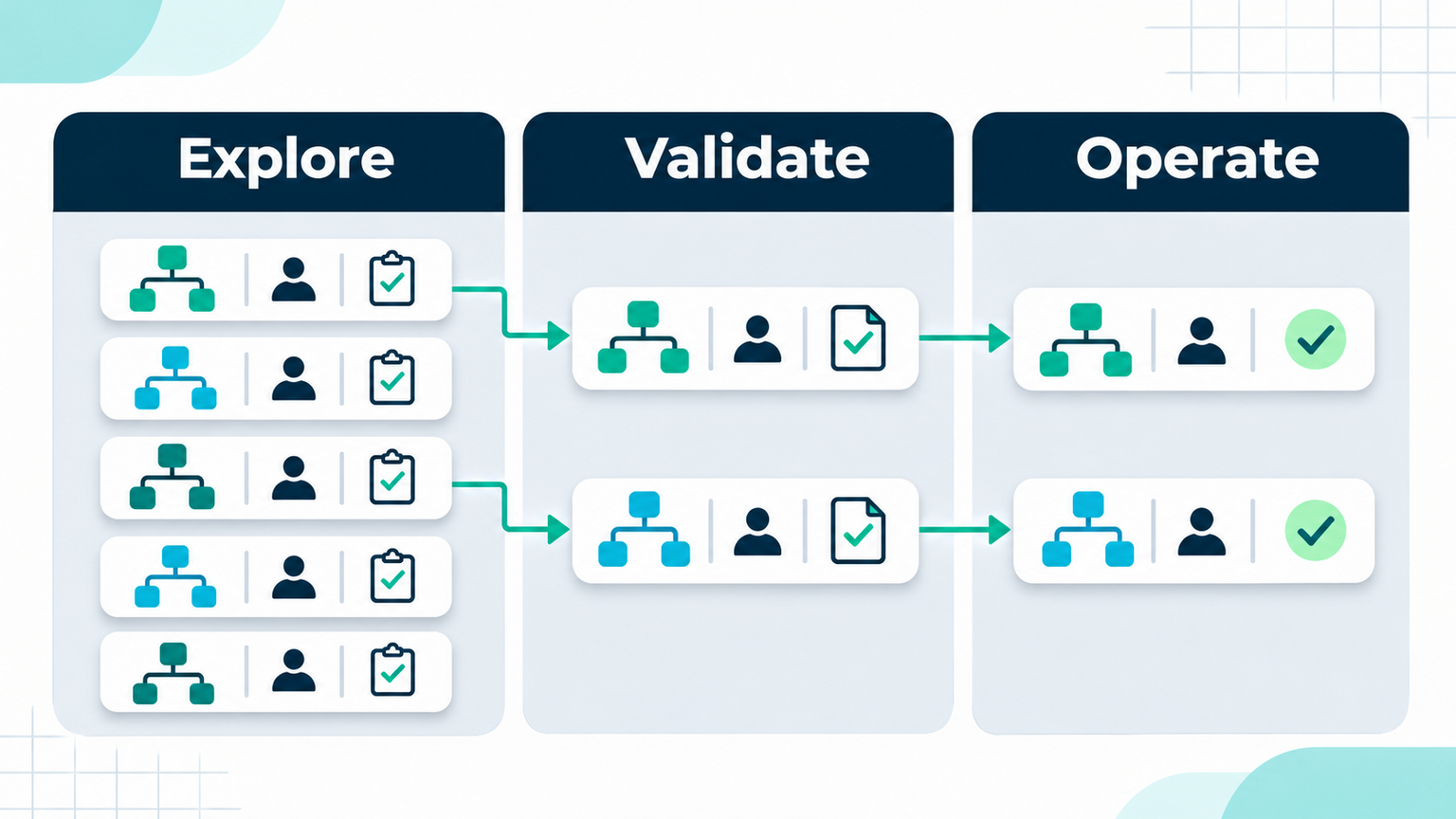
Once ideas are visible, place them into decision lanes. A lane describes the next question the company needs to answer. It should not imply that an initiative will automatically progress or that a calendar date guarantees success.
Explore: Is this a valuable and suitable problem?
An exploration item has a business owner and a credible problem statement, but important questions remain. The next work may be interviewing users, mapping the process, measuring a baseline, checking source ownership, or comparing an agent with a simpler option.
An exploration should end with a decision record: proceed to validation, gather a specific missing fact, redesign the idea, or close it. Without an owner and a decision date, “research” can become a permanent waiting room.
Validate: Can this use case work safely in context?
A validation item has a bounded workflow and an evaluation plan. The team tests representative cases, checks that information and integrations behave as expected, and defines when a human must review or take over. Validation may be a prototype, a shadow test, or a supervised pilot; the form depends on consequence and reversibility.
Record the system version, assumptions, sample, and review criteria. The team should know what evidence would support continuing and what event would stop the work. A practical AI agent testing guide can help structure the test set and evaluation questions. The published project roadmap has the more detailed single-use-case milestone sequence for teams moving into implementation.
Operate: Who owns the result after launch?
A live agent is a business service with a named owner, support path, current information, and maintenance responsibility. Before moving into operation, identify how changes are approved, who reviews incidents, how source or connector failures are handled, and what evidence is reviewed over time.
When value or conditions change, the decision may be to improve the workflow, reduce its scope, pause it, or retire it. A roadmap should include those outcomes. Keeping every launched agent indefinitely is not the same as managing a portfolio.
Show dependencies between initiatives
Some roadmap work supports several agent ideas. A shared knowledge source, identity approach, integration pattern, evaluation rubric, or staff training effort may be more valuable than building several isolated agents in parallel. Represent these as dependencies with owners and expected consumers.
Distinguish a genuine shared foundation from an oversized platform project. Start with the smallest reusable capability that solves a real constraint. If the first workflow needs current support policies, for example, establish source ownership and a process for updates. A grounded AI knowledge base for customer support is relevant when support answers depend on maintained organizational information. Do not build a company-wide knowledge platform before the use cases establish the need.
The portfolio graphic below illustrates the three decision lanes. An idea can remain in exploration, return for more evidence, move into operation, or close; it does not need to travel in a straight line.
Put shared foundations on the roadmap
A company roadmap should show the work that makes several deployments easier to govern and support. These foundations are often less visible than a new agent, but they can determine whether teams can safely operate more than one workflow.
Information and data ownership
For each information source, name the owner, intended use, update process, access limits, and known quality problems. Decide what the agent can retrieve and whether any content needs to be excluded or summarized. A team should know who corrects a source when policies or product details change.
Do not use “we have data” as a proxy for readiness. Useful data must be accessible for the intended task, current enough for the decision, and approved for the way it will be processed. Put remediation on the roadmap when it blocks several candidate workflows.
Access, approvals, and human handoffs
Set a company policy for how teams request access to systems and who approves sensitive actions. An agent that drafts a recommendation has a different consequence from one that changes customer records, issues credits, or sends an external commitment. Make the allowed actions visible in the workflow and grant only what the use case requires.
For decisions that require human judgment, define the trigger, destination, context passed along, and responsible responder. Clear human handoff rules for AI agents help operators understand when the agent must stop and who takes responsibility next. These practices belong in the shared operating foundation, but they do not replace an organization’s own security, legal, or privacy review.
Evaluation, change, and incident review
Agree on a minimum evaluation record that each initiative keeps: task scope, test cases, evaluation criteria, configuration or version, known limitations, and the owner who accepted the result. A common format helps teams compare evidence without pretending every workflow uses the same success metric.
A change to a model, prompt, knowledge source, tool permission, or business process can affect behavior. Decide which changes require retesting and who signs off. Maintain a route for staff to report a problem, contain the agent, correct affected work, and update the test set. Company-level AI agent governance can clarify accountability and oversight as the portfolio grows.
Make these controls usable. If every low-risk edit requires a lengthy committee review, teams may work around the policy. If consequential actions have no review path, the governance model is too weak. Tailor checks to impact and keep decision rights explicit.
Assign owners and decide how funding works
An agent initiative needs a business owner for its result. The person or team that knows the process and accepts its operational impact should not be replaced by a platform administrator who only manages configuration. Technical and governance partners have important roles, but someone must own the service outcome.
A practical responsibility map can name:
| Role | Accountable for | Typical partners |
|---|---|---|
| Executive sponsor | Strategic priority, cross-team decisions, investment boundary | Finance, business leaders |
| Business process owner | Workflow outcome, users, exceptions, operating procedures | Frontline staff, agent owner |
| Agent or service owner | Day-to-day quality, change requests, incident follow-up | Platform team, support team |
| Data or knowledge owner | Accuracy, access, updates, and source lifecycle | Subject matter experts, security |
| Platform and security partners | Approved environments, identity, integrations, policy controls | IT, privacy, risk, procurement |
| Reviewers and users | Practical feedback, edge cases, acceptance in the workflow | Process owner, service owner |
One person may hold several roles in a small company. Record the responsibilities separately so combining roles does not make an obligation disappear. The AI agent implementation checklist is useful for project-level readiness; a portfolio roadmap should also name who maintains shared practices and who funds the ongoing service.
Funding can be centralized, owned by departments, or shared. Central investment can support common capabilities such as approved infrastructure or organization-wide guidance. A business unit may fund a workflow when it receives the main benefit. A blended approach is another option. Choose a method that makes both the cost and the expected outcome visible to the people making continuation decisions.
Show the full effort, not only software fees. Include discovery, integration, review, training, incident response, maintenance, and any work displaced by the change. Where benefits are uncertain, label estimates and revisit them as evidence improves. Do not promise a specific return before a team has defined the baseline and measurement method.
Review the roadmap as evidence changes
A roadmap is a management tool, not a poster that freezes decisions for a year. Set a review cadence that matches the organization’s planning cycle and the speed of change in the workflows. The review should be short enough to use and detailed enough to expose blocked or unsupported initiatives.
For each item, ask:
- Is the business outcome still important?
- Has the process, data, or policy changed?
- Is the named owner still able to support the work?
- What new evidence has arrived since the last review?
- Is the next decision clear, and who will make it?
- Should this remain active, move forward, return for more work, pause, or close?
Track portfolio health with measures that support decisions. Examples include the share of active initiatives with a named process owner, the number with a baseline and written success criteria, unresolved high-impact dependencies, incidents awaiting a response, and the operating cost of live services. These are examples, not universal targets. A count is useful only when it prompts a specific action.
For value, compare the same process measure before and after the change where possible. Include reviewer effort and rework. If cases differ or the sample is small, state the limitation instead of presenting a precise-looking percentage as proof. Combine quantitative results with user and operator feedback, particularly where service quality or trust is part of the intended outcome.
A formal AI agent test plan and evidence-based agentic AI implementation can support project-level evaluation; portfolio review asks what the results mean for future investment across the company. Microsoft’s business strategy maturity model likewise treats process mapping and value measurement as capabilities that mature over time, rather than a one-time launch checklist.
Common roadmap mistakes
Turning a list of requests into a roadmap. A backlog without outcomes, owners, dependencies, and decision gates does not help leaders choose. Give every item a next decision and a reason it belongs in the portfolio.
Promising one agent for every department. Teams differ in process maturity, data access, risk, and operational capacity. Sequence work according to evidence and readiness, not organizational symmetry.
Confusing a platform rollout with business value. A connected agent or an active user count may show activity, but neither alone proves the workflow improved. Tie measures to the process and baseline.
Treating governance as a final approval gate. Access boundaries, source ownership, review duties, and incident response shape what should be explored from the start. Make them part of portfolio design.
Keeping pilots alive without a decision. A pilot with no owner, review date, or stop condition can absorb effort indefinitely. Define what would justify another round and what would close the work.
Making the roadmap too detailed too early. The farther away an initiative is, the more assumptions it contains. Keep near-term work specific; describe later opportunities as hypotheses with dependencies and revisit them when evidence changes.
Frequently asked questions
How long should a company AI agent roadmap cover?
Use the planning horizon that matches the organization’s budgeting and strategy cycle. Keep near-term work concrete and later items conditional on evidence, capacity, and dependencies. A roadmap can be reviewed quarterly or when important conditions change; it does not need to lock every team into a fixed launch date.
How many AI agents should a company plan to build?
There is no useful universal count. Start with workflows that solve real problems and have owners, information access, feasible controls, and a way to evaluate results. Several candidate ideas may lead to one agent, a simpler automation, or no deployment.
Should every team use the same AI platform?
Not necessarily. A common platform may simplify support, security, and training, but one tool may not meet every workflow’s requirements. Define the capabilities and operating constraints first, then compare platforms against the same needs. Limit the number of platforms when additional choices create unnecessary support and governance work.
What if the company has no AI team?
Begin with a process owner, an executive sponsor, and a technical or platform partner who can assess integrations and access. Keep the first exploration narrow, use approved tools, and bring in specialist support if internal skills or capacity are insufficient. Keep business accountability inside the organization even when a partner helps build or configure an agent.
How is a roadmap different from an AI implementation checklist?
A checklist helps a team prepare and execute one project. A roadmap helps leaders decide which projects deserve attention, how they depend on shared foundations, who owns them, and what evidence will change the investment decision. The two documents support different levels of planning.
A useful roadmap makes the next decision easier
A company AI agent roadmap is valuable when it connects business outcomes to a manageable portfolio of workflows. Make the assumptions visible, assign owners, surface shared dependencies, and set evidence-based decisions for work to continue, expand, pause, or retire. Keep the roadmap open to revision as teams learn what fits their processes and constraints.
Botsify’s agent builder lets teams connect apps, add a knowledge base, and choose deployment channels. Those capabilities can support individual initiatives within a broader company plan, while each organization defines its own owners, boundaries, and measures.
Build a company AI agent roadmap around real workflows
Review portfolio priorities and outline a credible next step.
