
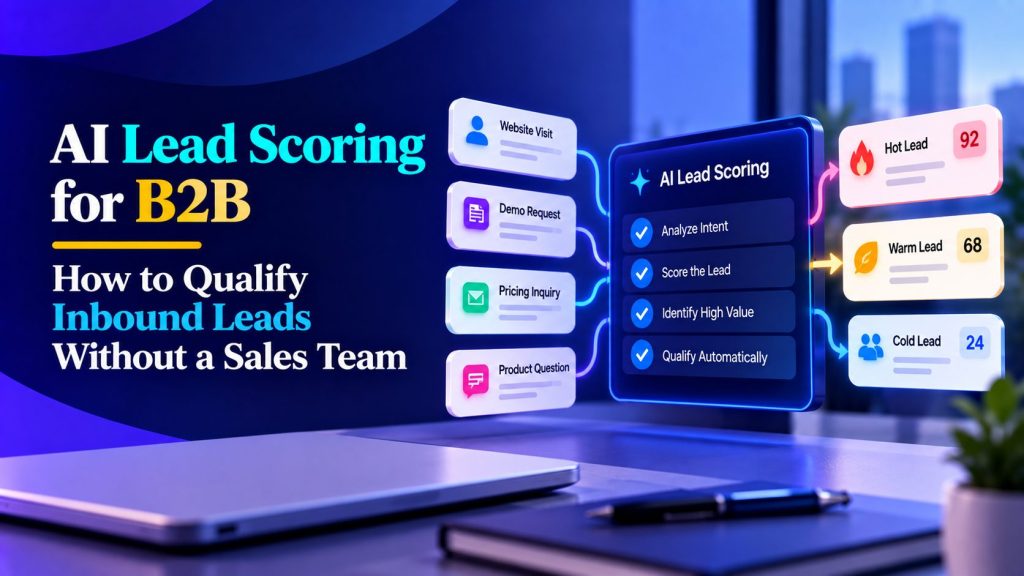
Most B2B teams do not need more leads. They need better context on the leads they already have.
A new form submission arrives. Someone asks a salesperson to review it. The salesperson checks the CRM, sends a reply, waits, and repeats.
That loop is slow, inconsistent, and expensive.
AI lead scoring fixes the first few minutes, not the entire sales process. It turns messy inbound conversations into a structured score, a
recommended owner, and a next action.
This is not “replace your sales team with AI.” This is “stop wasting your best salespeople on the wrong leads.”
Start with the scoring decision, not the prompt
Most teams build the prompt first and the workflow later. That is backwards.
A good lead-scoring agent should always know:
- Who the lead is
- What they want
- Whether they are qualified now
- Who should handle them
- When a human should take over
- What the next action is
That means the prompt is only one part of the system, and it should be built after you define your AI agent requirements. The more important parts are:
- The qualification questions
- The scoring rules
- The routing rules
- The CRM fields
- The human handoff trigger
- The follow-up path
This is the same logic behind AI workflow automation and AI chatbots for lead qualification: the conversation is only one part of the system.
Define your ICP before assigning points
An AI lead scoring model is only useful if the business has already decided what a good customer looks like.
Before assigning weights, define the characteristics that usually make an account worth pursuing. For a B2B company, that may include:
- Industry
- Company size
- Geography
- Team size
- Existing tools or technology
- Use case
- Budget range
- Buying authority
- Implementation complexity
- Expected contract value
These are not all buying signals. They describe fit.
For example, a 500-person healthcare company may match your ideal customer profile perfectly but have no active project. A 10-person company may request a demo tomorrow but still fall outside the market you serve.
That is why the scoring model should not begin with “How many points should a demo request receive?” It should begin with:
What characteristics consistently appear in customers we actually want?
Look at your strongest existing customers, lost opportunities, poor-fit leads, and deals that consumed a lot of sales time without converting. Those patterns give you a much better starting point than assigning weights based on instinct.
Your ICP does not need to be perfect before launch, but it should be specific enough that the scoring model knows the difference between a lead showing interest and a lead that genuinely fits the business.
Use intent signals, not just keywords
Many teams qualify leads based on surface-level words like “price,” “demo,” or “buy.” That is too shallow.
Use a combination of:
- Explicit intent
- Behavioral intent
- Contextual intent
- Fit signals
- Urgency signals
| Signal type | Examples |
|---|---|
| Explicit intent | “Can you send pricing?” “Can we book a call?” “I’m ready to start.” |
| Behavioral intent | Repeated questions, follow-up messages, clicking pricing page, asking for demo |
| Contextual intent | Mentions specific team size, timeline, or workflow |
| Fit signals | Company size, industry, use case, decision-maker role |
| Urgency signals | “Next week,” “we’re launching,” “this is blocking us” |
For example:
- “What is pricing?” is useful but not always hot.
- “We need to automate WhatsApp bookings before our launch next week” is much hotter.
- “Can this integrate with HubSpot?” is strong because it implies deployment planning.
Your agent should score the combination, not one keyword.
Separate fit from buying intent
One of the easiest ways to break a B2B scoring model is to treat fit and intent as the same thing.
They answer different questions.
Fit asks: Is this the type of company we want as a customer?
Intent asks: Is this company showing signs that it may buy now?
A useful model considers both.
| Lead | Fit | Intent | What it means |
|---|---|---|---|
| Company A | High | High | Prioritize immediately |
| Company B | High | Low | Nurture and monitor |
| Company C | Low | High | Review before using sales time |
| Company D | Low | Low | Low priority |
This prevents a common problem where any person asking for pricing automatically becomes a hot lead.
A student researching software may ask detailed pricing questions. An ideal enterprise account may quietly read implementation content, ask about a CRM integration, and mention an upcoming migration without ever saying “I want to buy.”
An AI lead qualification agent can collect missing context through conversation, while the scoring model converts that context into a consistent priority.
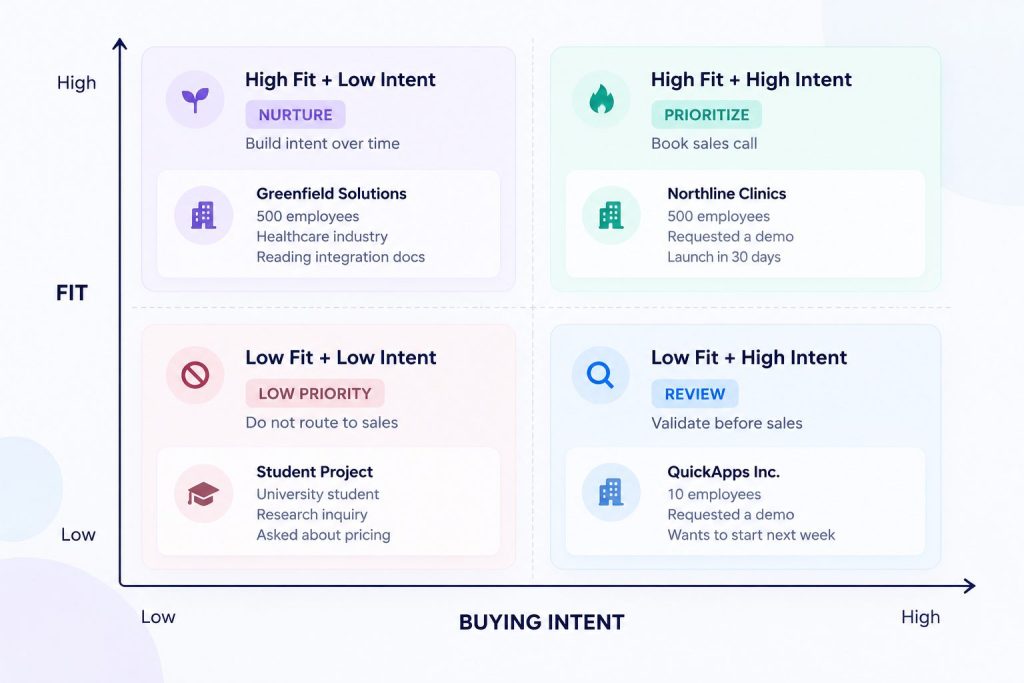
The strongest leads usually combine meaningful intent with strong business fit. Your weights should reflect that rather than rewarding activity alone.
Build an AI Lead Scoring Model Your Team Understands
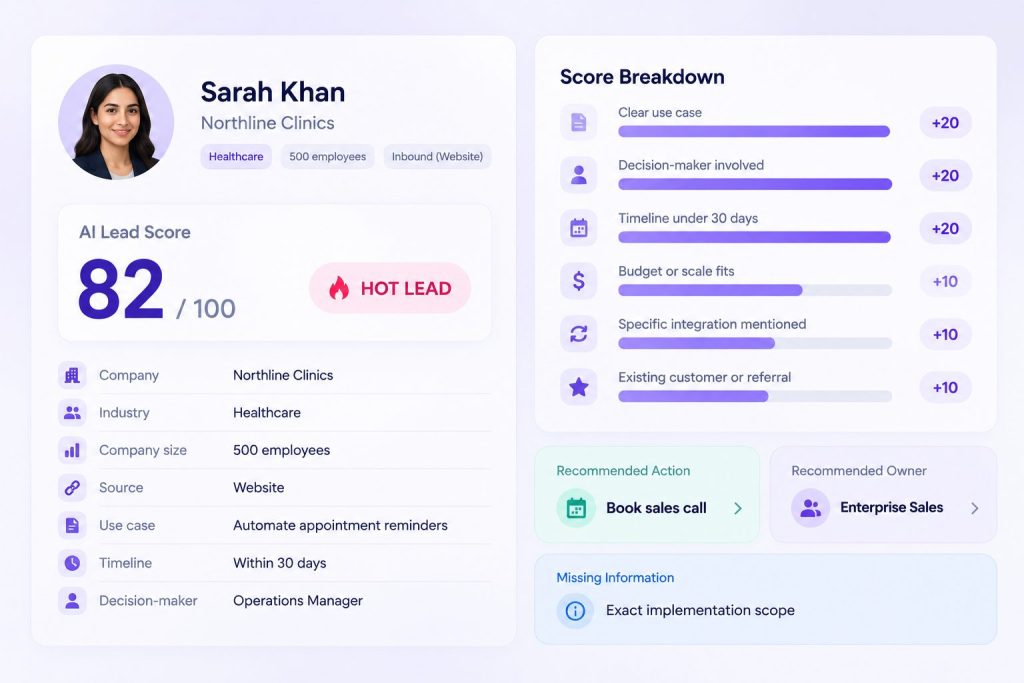
Avoid black-box scoring. Your sales team should know why a lead is hot, and the output should connect to the chatbot KPIs your team already tracks.
A simple scoring model works well:
| Signal | Weight |
|---|---|
| Clear use case | 20 |
| Decision-maker involved | 20 |
| Timeline under 30 days | 20 |
| Budget or scale fits | 10 |
| Repeated follow-up | 10 |
| Specific integration mentioned | 10 |
| Existing customer or referral | 10 |
Then set thresholds:
| Score | State | Next action |
|---|---|---|
| 75–100 | Hot | Notify sales and book call |
| 50–74 | Warm | Nurture and clarify |
| 25–49 | Not qualified | Send helpful resources |
| 0–24 | Unclear | Ask follow-up |
You can adjust the weights by business model. The important thing is that the agent’s output is explainable.
Add negative scores and disqualifying signals
Lead scoring should not only add points. Some information should lower the score or stop the lead from reaching sales altogether.
Examples might include:
- Outside your supported geography
- Company below your minimum size
- Student or research inquiry
- Job applicant
- Vendor outreach
- Unsupported use case
- No project planned
- No budget and no defined timeline
- Existing customer asking for support
- Competitor research
You can handle these in two ways.
Negative scoring works when a signal makes the opportunity weaker but does not eliminate it.
For example:
No implementation timeline: −10
Company below preferred size: −15
Disqualification rules work when there is no reason to send the lead into the sales queue.
For example:
Job applicant → route to careers
Existing customer support request → route to support
Unsupported country → provide appropriate information without routing to sales
This is especially important for teams with limited sales capacity. A scoring system that only adds points eventually turns almost every active person into a “qualified” lead.
Good scoring should help the business say no just as consistently as it says yes.
Handle missing data without guessing
Inbound leads rarely arrive with every field your scoring model wants.
A form might contain a name, company email, and one sentence about the problem. A website chat may reveal the use case but not the company size. A social conversation may show urgency but say nothing about budget.
The AI should not fill those gaps with assumptions.
Instead, separate:
Known signal
The lead explicitly said it.
Enriched signal
The information came from a trusted CRM, company record, or connected source.
Unknown signal
The information is still missing.
Unknown should not automatically mean negative.
For example, if decision-making authority is unknown, the agent can ask:
Who else will be involved in evaluating this?
If company size is missing, the workflow may retrieve it from an approved business-data source rather than asking another question.
The score should also be able to show confidence alongside the number.
A lead scored 72 with complete fit, budget, authority, and timing data is different from a lead scored 72 using only three known signals.
A useful output can therefore include:
Score: 72
Confidence: Medium
Missing: Budget, decision-maker role
Next action: Ask two questions before routing
That makes the score useful without pretending the system knows more than it actually does.
Turn Inbound Leads Into Clear Priorities
See how Botsify can qualify, score, and route leads automatically.
What if you do not have a dedicated sales team?
For a small B2B company, the purpose of lead scoring may not be to choose between ten sales reps. There may be no dedicated sales team at all.
The score still matters because it decides what should happen next.
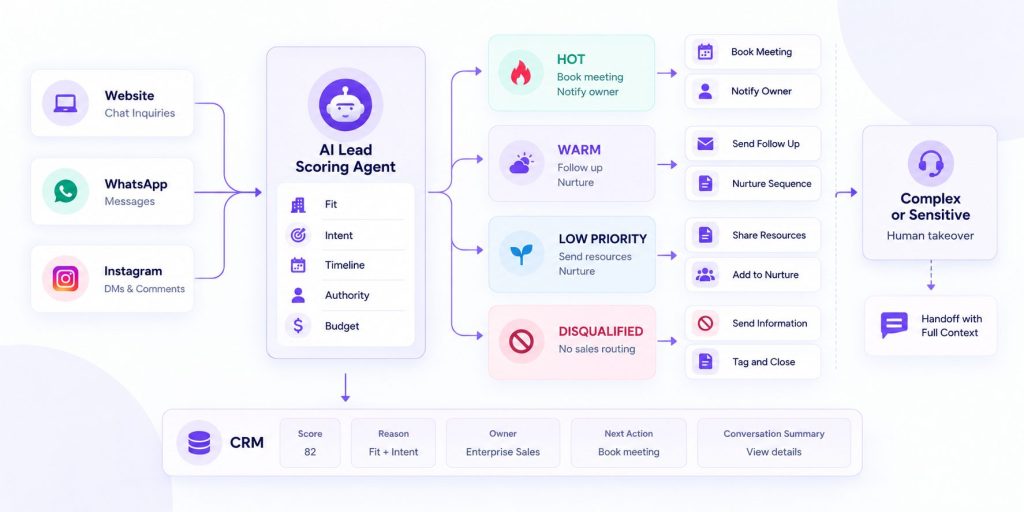
A simple routing model might be:
Hot lead
Notify the founder, account owner, or business development person and offer a meeting immediately.
Warm lead
Continue automated qualification or send relevant content before asking for a call.
Nurture lead
Keep the contact in an appropriate follow-up sequence until stronger intent appears.
Poor-fit lead
Give them the appropriate resource or destination without consuming manual time.
Appointment-driven businesses can take this one step further. Once a lead reaches the required qualification threshold, an AI booking agent can move directly from qualification into scheduling without waiting for someone to manually coordinate the meeting.
The point is not to eliminate humans from important conversations. It is to make sure human attention is reserved for the opportunities that actually need it.
For very small teams, that can mean the founder only sees leads that meet the agreed threshold rather than manually reviewing every form submission, DM, or chat conversation.
Connect the agent to your CRM
The agent should not just collect answers in chat.
It should update the CRM with:
- Lead source
- Use case
- Qualification score
- Timeline
- Decision-maker status
- Recommended route
- Conversation summary
- Next action
A useful CRM field structure:
| Field | Purpose |
|---|---|
| Lead source | Attribution |
| Use case | Routing |
| Qualification score | Prioritization |
| Timeline | Urgency |
| Decision-maker | Fit check |
| Recommended owner | Automation logic |
| Next action | Follow-up clarity |
| Summary | Sales context |
Without CRM integration, the agent becomes another inbox. With it, the agent becomes a workflow layer. This is the same principle behind broader AI agent integration.
Keep scoring consistent across inbound channels
B2B leads do not always arrive through one form.
A prospect may start with a website chatbot, ask a question through WhatsApp, comment on Instagram, reply to an email, or return later through another channel.
The scoring model should evaluate the same core signals regardless of where the conversation begins.
For example, a lead coming through a WhatsApp lead generation workflow may reveal urgency and use case through a messaging conversation, while Instagram DM automation may begin with a comment and collect qualification context privately afterward.
The channel is useful context, but it should not automatically determine quality.
A WhatsApp lead is not inherently better than a form submission. An Instagram lead is not automatically lower intent. What matters is what you learn about:
- Fit
- Need
- Timing
- Authority
- Scale
- Buying behavior
When the lead later appears in another channel, the system should continue from the existing context rather than starting the score from zero.
That is another reason CRM integration matters: the score should belong to the lead or account, not to an isolated conversation.
Calibrate AI Lead Scoring Against Real Sales Outcomes
A scoring model is not finished when the weights add up to 100.
The real test is whether high-scoring leads consistently turn into better opportunities.
Compare the score with outcomes such as:
- Sales-accepted leads
- Meetings booked
- Meetings actually held
- Opportunities created
- Deals won
- Deal size
- Time to conversion
- Leads rejected by humans after handoff
Look for patterns.
If leads scoring 80–100 regularly get rejected by the person reviewing them, the model is rewarding the wrong signals.
If leads scoring 40–60 repeatedly become strong opportunities, an important buying signal may be underweighted.
You should also look at the leads at both extremes.
Top-scoring leads: Why did they score highly, and did they actually convert?
Low-scoring leads: Did any unexpectedly become valuable customers?
This is how a scoring system improves over time.
The weights you launch with are hypotheses. Real pipeline outcomes tell you whether those hypotheses are correct.
Review the model regularly, especially after changes to your pricing, ICP, product positioning, sales motion, or target market.
Build a Smarter Lead Scoring Workflow
Use Botsify to score inbound leads and send the right opportunities to your team.
Track the right metrics
Do not measure the agent by how clever it sounds. Measure by outcomes.
| Metric | Why it matters |
|---|---|
| Qualified leads | The main output |
| Hot leads routed | Sales efficiency |
| Time to first human response | Speed |
| Booked calls | Downstream conversion |
| Meetings held | Sales quality |
| Escalation rate | Human handoff quality |
| Wrong routing rate | Workflow quality |
| Lead drop-off point | Conversation friction |
A simple weekly review:
- How many leads arrived?
- How many became hot?
- How many were routed correctly?
- How many booked calls?
- Where did the agent lose people?
- Which questions caused confusion?
- Which handoffs needed human correction?
This turns the agent into an improving system, not a static bot.
What AI Lead Scoring Looks Like With Botsify
Botsify supports the pieces you need for this workflow across its core AI agent features:
- Website, WhatsApp, Messenger, Instagram, Telegram, SMS, and other channel deployment
- Conversation-based lead capture
- Document and website knowledge sources
- Skill chaining
- CRM and app integrations
- Human escalation and guardrails
- Scheduling and time-based triggers
- Voice agents for calls
- Optional BYOK for model control
A practical Botsify setup might look like this:
- Lead messages on WhatsApp or website.
- Agent asks what they want to automate.
- Agent asks timeline and use case.
- Agent scores the lead.
- Agent routes hot leads to the right owner.
- Agent books a call or notifies sales.
- CRM is updated with summary and next action.
- Agent follows up if no response.
- Human reviews the handoff summary, not the whole transcript.
With Botsify’s AI Agent Builder, the qualification instructions, scoring rules, knowledge sources, connected tools, and routing actions can be configured as part of the same agent workflow.
Prompt templates you can copy
Do not start from a blank prompt. Copy these three prompts, replace the bracketed fields, and test them against ten real conversations before you touch anything else.
Qualification prompt
You are a B2B lead qualification assistant for [COMPANY].

Goal: learn only what the sales team needs to decide whether this lead
deserves a call this week.

Ask these questions in a natural order, one or two at a time:
1. What are you trying to solve?
2. What tools or process are you using today?
3. How many people or accounts would this affect?
4. When do you want this live?
5. Who else is involved in the decision?

Rules:
- Never promise pricing, discounts, delivery dates, or outcomes.
- If the lead asks to talk to a human, stop qualifying and hand off.
- After five answered questions, output:
  score, tier (hot / warm / nurture / reject), missing data, and
  a two-line summary for the sales rep.
- Score hot only when budget, timing, and authority are all present.
Scoring prompt
Score this lead from 0 to 100 for [COMPANY].

Signals and weights:
- Explicit budget mentioned: +20
- Buying timeline under 30 days: +20
- Role is decision maker: +15
- Team size or account volume above threshold: +15
- Matched ICP industry: +15
- Active evaluation of alternatives: +10
- Asked about implementation or migration: +5

Rules:
- 70 or above = hot
- 40 to 69 = warm
- 20 to 39 = nurture
- Below 20 = reject
- Never invent signals that are not in the conversation.
- If a critical signal is missing, lower the confidence and say what to ask next.
Follow-up prompt
Write a follow-up message for a [TIER] lead.

Context: [CONVERSATION SUMMARY]
Next step: [BOOKING LINK / CONTENT LINK / HUMAN HANDOFF]

Rules:
- Under 80 words.
- Reference what the lead actually said.
- One clear next action.
- No buzzwords, no “I hope this email finds you well”.
- End with a question only if the next action requires a reply.
A scoring prompt is a policy, not a piece of poetry. If you cannot explain why a lead gets 70 points instead of 65, the prompt is not ready.
Failure modes that quietly ruin lead scoring
Every production scoring system eventually hits the same problems. Catching them early is cheaper than discovering them from lost pipeline.
| Failure mode | What it looks like | Fix |
|---|---|---|
| Keyword worship | Agent scores “enterprise” mentions as hot even from students or vendors |
Ask behavioral questions, not only labels |
| Optimistic inference | “We might do something next year” becomes “budget confirmed” | Score only stated facts |
| Question fatigue | Prospects abandon after the sixth question | Cap live questions at five, enrich the rest from CRM |
| Hardcoded routing | Every hot lead goes to one person, who becomes the bottleneck | Rotate hot leads and set a response SLA |
| Score drift | Scores look right but conversion falls after a market shift | Review top and bottom decile monthly |
| Silent failures | Agent times out and the lead never reaches the CRM | Log errors, alert on missing records |
FAQ
Can AI lead scoring work for small B2B teams?
Yes, and small teams often benefit most, because they cannot afford a dedicated SDR. Start with five questions, one channel, and manual routing before adding integrations.
How accurate should the model be before launch?
Accuracy matters, but consistency and speed matter too. Evaluate the scoring model against leads your team later confirms as qualified, and improve the rules when the scores stop matching real sales outcomes.
Should the agent reveal the score to the prospect?
No. The score is an internal routing signal. The prospect should only see a natural conversation and a clear next step.
Does lead scoring work for enterprise deals? Yes,
but the signal changes. For enterprise, use account-based fields, employee range, security review, procurement cycle, and let the agent collect missing context before routing to an account owner.
Final thought
An AI lead scoring agent is not a magic revenue machine. It is a routing and context system.
When built well, it does three things:
- Removes delay.
- Reduces wasted sales time.
- Gives humans better context.
That is enough to change the economics of your sales process.
Automate Your B2B Lead Scoring
Let Botsify qualify, score, route, and follow up with inbound leads.
