
Every sales team knows the pattern. A lead comes in, someone qualifies it, someone researches the company, someone sends a follow-up, someone updates the CRM, someone books a meeting. Then the cycle repeats for the next lead. And the next one. And the one after that.
The repetitive work around lead research, qualification, follow-up, CRM updates, scheduling, routing, and answering the same prospect questions over and over takes up a significant portion of a sales team’s time. It is necessary work, but it is also work that keeps salespeople away from the conversations, relationships, and negotiations where they actually create value.
AI sales agents have emerged as a practical answer to this problem. These systems can handle structured, repeatable parts of the sales process while leaving the judgment calls, relationship building, negotiation, and complex conversations to human sellers. They are not replacements for salespeople. They are systems that handle what should have been automated years ago, so sales teams can focus on what only humans can do.
Key Takeaways
- AI sales agents handle the structured parts of sales: lead research, qualification, follow-up, CRM updates, and scheduling. They are not general AI assistants but systems designed specifically for sales workflows.
- Unlike chatbots or fixed automation sequences, AI sales agents combine conversation, context, knowledge, and actions to adapt to each prospect’s situation and decide what to do next.
- AI sales agents can reduce repetitive sales work such as lead enrichment, qualification questions, CRM logging, follow-up, and meeting booking, giving reps more time for conversations that require human judgment.
- AI sales agents are most useful when they handle repetitive, structured work while human reps remain involved in discovery, negotiation, relationship building, and closing.
- AI sales agents work for both inbound and outbound sales, though the tasks differ. Inbound agents handle website conversations and qualification. Outbound agents focus on research and personalized outreach.
- An AI sales agent is only as effective as the sales process, knowledge sources, and escalation rules behind it. Clean data and clear criteria matter more than the technology itself.
Portable AI Agents In Seconds, Use Everywhere
Prompt, Test, and Deploy AI Agents Across Social Platforms and LLMs. Automate Everything.
What Is an AI Sales Agent?
An AI sales agent is a system that can carry out parts of a sales process by combining conversation, context, knowledge, tools, and actions. It is different from a traditional chatbot, which follows a scripted tree of responses. It is also different from basic sales automation, which sends predefined emails on fixed triggers without adapting to what a prospect actually says.
An AI sales agent can interpret what a prospect is asking, look up relevant information from a knowledge base or CRM, take actions like updating records or scheduling meetings, and decide whether a conversation can continue autonomously or needs to go to a human. It adapts within defined boundaries rather than following one rigid path.
The key distinction is not that the agent is smarter. It is that the agent has enough context and capability to handle real sales interactions, not just scripted flows. It knows what product a prospect asked about. It remembers what was discussed earlier. It can look up account history before responding. It can decide to escalate when a prospect asks something outside its scope.
This makes AI sales agents useful for the parts of sales that follow patterns but still require some judgment and adaptation. They bridge the gap between rigid automation and full human involvement.
Not every AI sales agent operates with the same level of autonomy. Some assist sales reps with research, summaries, or recommended next steps, while others can engage prospects and take approved actions with limited human involvement. The right level depends on the task, risk, and amount of human oversight required. This broader ability to reason, use tools, and take actions is what distinguishes an AI agent from simpler rule-based automation.
How AI Sales Agents Work
The operating model of an AI sales agent is straightforward at a conceptual level. A lead or trigger starts a conversation. The agent gathers context about who the prospect is, where they came from, and what they are looking for. It retrieves relevant information from connected knowledge sources and CRM data. It assesses the prospect’s intent and responds appropriately.
From there, the agent can take actions based on what it understands. It can answer a question using approved product or pricing knowledge. It can update a CRM record with qualification details. It can route a prospect to the right team. It can schedule a meeting. It can send a follow-up. It can decide that the conversation has gone beyond what it should handle and hand it to a human.
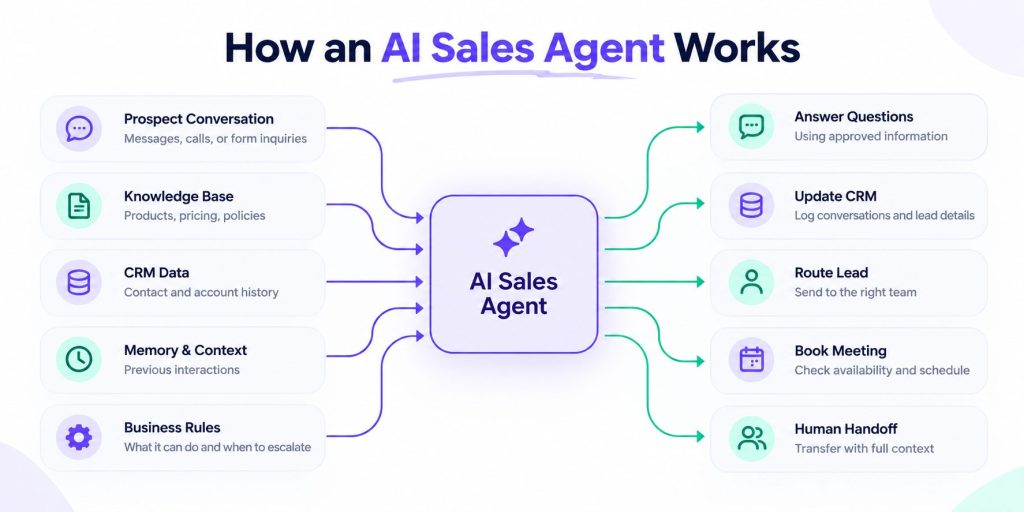
Several components make this possible:
Knowledge bases give the agent accurate, approved information about products, pricing, policies, and common questions. A well-maintained AI knowledge base helps the agent retrieve the right information instead of relying only on the model’s general knowledge.
CRM data gives the agent context about who the prospect is, what stage they are in, and what has happened before.
Integrations and APIs connect the agent with CRMs, calendars, messaging platforms, and other business systems so it can take actions instead of just responding. This is where AI agent integration becomes essential for moving from conversation to execution.
Business rules define what the agent can and cannot do, which actions require approval, which questions it can handle, and when it must escalate.
Memory and context allow the agent to remember what was discussed in previous interactions and carry that forward.
Human handoff is the mechanism that transfers the conversation, along with all accumulated context, to a real salesperson when the agent reaches its limits.
None of this requires the agent to make strategic sales decisions. It requires the agent to follow rules, retrieve information, take permitted actions, and recognize when it should pass control to a human.
Where AI Sales Agents Fit in the Sales Process
AI sales agents can operate across multiple stages of a typical sales journey. Some stages are more natural fits than others, but the pattern is that agents handle structured, repeatable tasks while humans handle interactions that require judgment or persuasion.
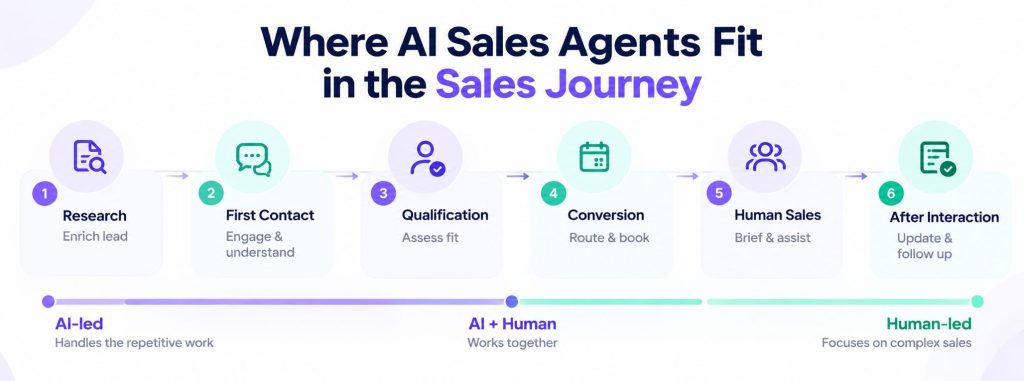
Before engagement. AI sales agents can research and enrich leads, gather company context, and prepare information before a conversation begins.
At first contact. When a prospect arrives through a website, messaging channel, email, or phone call, the agent can respond immediately and understand what the person needs.
During qualification. The agent can collect the information needed to determine basic fit and decide whether the prospect should continue with automation, enter a nurture path, or move to a salesperson.
At conversion points. When a prospect is ready for the next step, the agent can route the lead, schedule a meeting, or transfer the conversation to the appropriate person.
During human-led sales. Agents can support reps by retrieving account context, preparing prospect summaries, and keeping CRM information available and current.
After an interaction. Agents can update records, send approved follow-ups, record outcomes, and prepare the next action.
What Can AI Sales Agents Actually Do?
Lead Research and Enrichment
Before a salesperson ever speaks to a prospect, useful context can make the difference between a generic pitch and a relevant conversation. An AI sales agent can gather information about a prospect’s company, industry, role, recent activities, and potential pain points from connected data sources. This preparation means that when a human salesperson takes over, they already understand who they are talking to and what might matter to them.
Lead Qualification
Qualification is one of the most natural applications for AI sales agents. The agent asks a series of structured questions, captures the responses, and evaluates the lead against defined fit criteria. Does this prospect match the ideal customer profile? Do they have budget? Are they the right decision-maker? Do they have a timeline?
Based on the answers, the agent can decide whether the lead should move forward, needs more nurturing, or does not fit. The evaluation is consistent across every lead, and the criteria can be refined over time based on what actually converts.
Answering Prospect Questions
Prospects ask the same kinds of questions repeatedly. What does your product do? How much does it cost? Do you integrate with this tool? How long does implementation take? AI sales agents can answer these questions using approved knowledge sources, ensuring that every prospect gets accurate, consistent information regardless of when they ask or which channel they use.
CRM Actions
Manual CRM updates are one of the most common frustrations for sales teams. AI sales agents can look up customer records, create new contacts, log conversations, update lead statuses, and prepare account summaries. With the right AI agent integrations, these actions can happen across connected sales systems without requiring reps to manually update every interaction.
Routing and Booking
When a qualified prospect needs to speak with a human, the agent handles the logistics. It routes the lead to the right person or team based on territory, product interest, or deal size. It checks calendar availability, proposes times that work for both parties, sends invitations, and handles rescheduling if needed. These routing and scheduling actions can become part of broader AI workflow automation, where qualification, assignment, booking, and CRM updates happen as one connected process.
Follow-Up
After a conversation or a meeting, the agent can continue the dialogue. It sends relevant follow-up information, responds to prospect replies, checks in after a set period, and re-engages prospects who have gone quiet. The follow-up is contextual because the agent remembers what was discussed.
Sales Rep Handoff
When a prospect is ready for a human conversation, the agent does not just pass along a contact. It transfers the full conversation history, qualification data, questions the prospect asked, answers that were provided, and any relevant context the salesperson needs. The human rep picks up where the agent left off, not from zero.
AI Sales Agents for Inbound vs Outbound Sales
AI sales agents serve different purposes depending on whether they are handling inbound interest or outbound outreach.
Inbound AI sales agents typically operate through a website chatbot, WhatsApp, messaging platforms, or voice conversations. A prospect arrives with some level of interest, and the agent engages immediately. The agent answers product questions, qualifies the lead, routes them to the right person, books a meeting, or follows up if the prospect leaves. Speed matters here because inbound leads expect immediate responses.
Outbound AI sales agents focus on the front of the outbound process. They research prospects, help create personalized messaging, re-engage cold leads, and can use channels such as email, messaging, or Voice AI for initial outreach. The goal is to create qualified conversations that human sellers can take forward.
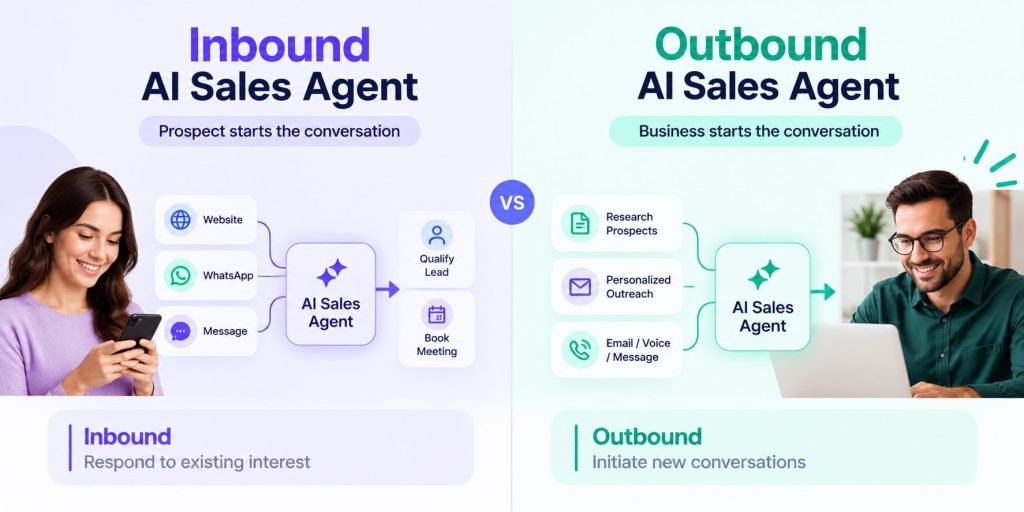
In practice, the term AI SDR often refers specifically to outbound sales agent roles, while AI sales agent is the broader category. The distinction matters mainly for understanding what a particular solution is designed to do. Inbound and outbound agents share the same underlying capabilities but apply them to different points in the sales process.
AI Sales Agent vs Sales Automation
Traditional sales automation has been around for years. It works on predefined triggers and fixed sequences. If a lead fills out a form, send an email. If they open the email, send another one after three days. If they do not respond, send a sequence of follow-ups. This works for predictable patterns, but it cannot adapt when a prospect responds with an unexpected question or takes an unexpected action.
An AI sales agent operates differently. It interprets what a prospect actually says rather than following a fixed path. It retrieves information dynamically based on what is needed in the moment. It chooses from permitted actions rather than executing a predetermined sequence. It adapts within defined boundaries.
This does not mean AI agents replace AI sales automation. The best setups often combine both. Automation handles predictable, event-driven steps, while agents handle conversational and context-driven work where flexibility matters. Together, they can form broader AI agent workflows that move information and actions across the sales process.
Where Humans Still Matter
AI sales agents can handle a lot, but there are clear boundaries on where they should operate independently. These boundaries are not technical limitations alone. They are practical distinctions between work that follows patterns and work that requires human judgment.
Complex discovery. Understanding a prospect’s unique business challenges, mapping solutions to their specific situation, and uncovering needs the prospect has not articulated often benefits from the contextual understanding and judgment of an experienced salesperson.
Strategic conversations. When a deal involves multiple stakeholders, competitive positioning, or long sales cycles, the conversation shifts from answering questions to guiding a buying process. That guidance requires judgment, timing, and relationship awareness that agents do not have.
Relationship building. In complex or high-value sales, human interaction can play an important role in building trust and understanding buyer concerns. Prospects who feel understood, listened to, and valued are more likely to buy. AI agents can be helpful and efficient, but they cannot replace the human connection that drives major purchasing decisions.
Custom pricing or exceptions. When a deal falls outside standard pricing or requires approval, a human needs to evaluate the situation, understand the business impact, and make a judgment call.
Sensitive accounts. Enterprise prospects, existing customer expansions, and high-value opportunities often require the kind of attention and care that only a human salesperson can provide.
Unclear intent. When a prospect’s question or request does not clearly match any defined scenario, an AI agent should escalate rather than guess.
The strongest model is straightforward. AI agents handle the repeatable, structured work. Humans handle the judgment, persuasion, relationships, and exceptions. Each focuses on what they do best.
Portable AI Agents In Seconds, Use Everywhere
Prompt, Test, and Deploy AI Agents Across Social Platforms and LLMs. Automate Everything.
Benefits of Using AI Sales Agents
Sales teams that use AI agents effectively see practical improvements in how they operate.
Faster lead response. Agents respond immediately to inbound leads, which matters because prospects expect quick answers and may lose interest if they wait.
More consistent qualification. Every lead goes through the same process with the same criteria. This reduces the risk of leads being missed because a rep was busy or a qualification step was skipped.
Less manual CRM work. Agents handle data entry, record updates, and logging, which removes one of the most common drains on sales productivity.
Broader coverage outside sales hours. AI sales agents can respond outside normal business hours when the required channels and systems are available, reducing the time prospects have to wait for an initial response.
Better handoff context. When a prospect moves from agent to human, the salesperson has full context about what was discussed, what was asked, and what was answered. No lost information and no repeating questions.
Reduced repetitive work for reps. Salespeople spend less time on tasks that do not require their specific skills and more time on conversations that actually move deals forward.
More scalable lead handling. This can be particularly useful for AI agents for small businesses, where growing lead volume does not always justify expanding the sales team at the same rate.
Risks and Limitations
AI sales agents are useful tools, but they come with real limitations that need to be managed.
Incorrect or outdated information. If product details, pricing, policies, or other knowledge sources are incomplete or outdated, the agent can give prospects incorrect answers. Maintaining reliable sources is an important part of the AI agent lifecycle, not a one-time setup task.
Poor qualification rules. If qualification criteria are too broad or too narrow, the agent will pass unqualified leads to sales or disqualify good ones. The rules need to reflect actual sales outcomes.
Bad CRM data. An agent is only as good as the data it works with. If CRM records are incomplete or inaccurate, the agent will make decisions based on bad information.
Over-automation. Pushing too many interactions through an agent without proper escalation paths can frustrate prospects who need human help.
Spammy follow-up. Agents that follow up too aggressively or without good context can damage relationships rather than build them.
Weak escalation. If the agent does not recognize when a conversation exceeds its capabilities, prospects can get stuck in an unhelpful loop.
Permission and security issues. Agents need access to CRM data and other systems. Getting the permissions right is critical for data security and compliance.
Inability to handle nuanced negotiations. Agents cannot read a room, sense hesitation, or adjust persuasion tactics. Complex negotiations need humans.
Customer frustration. Some prospects simply prefer talking to a human. Forcing them through an agent can create a negative experience.
AI agent governance helps reduce these risks by defining guardrails, escalation rules, permission controls, monitoring requirements, and human handoff paths.
What Businesses Need Before Using an AI Sales Agent
An AI sales agent will not fix a broken sales process. Before bringing one in, businesses need several foundational elements in place.
A clear sales process. The agent needs to know what happens at each stage, what qualifies a lead, and what actions to take. If the process is unclear to the humans, it will be unclear to the agent.
Clean knowledge sources. Product information, pricing, policies, and common answers need to be documented, accurate, and accessible to the agent.
Defined actions. What is the agent allowed to do? Update records, schedule meetings, answer questions, send follow-ups? Each action needs clear permission and scope.
Escalation rules. When should the agent hand off to a human? After qualification? When a prospect asks for pricing? When they ask to speak to someone? Clear triggers prevent prospects from getting stuck.
Ownership and monitoring. Someone needs to review agent conversations, update knowledge sources, refine criteria, and handle escalations. An agent without oversight will drift over time.
These foundations are part of a broader AI agent implementation process. Defining them before deployment is easier than trying to correct unclear rules after the agent is already interacting with prospects.
How to Choose an AI Sales Agent Approach
The right approach depends on what a business actually needs from an AI sales agent.
Inbound versus outbound. Does the business need to handle incoming leads more effectively, or does it need to generate meetings through outreach? The answer determines what capabilities matter most.
Channels. Where do prospects interact? Website, WhatsApp, email, phone, social media? The agent needs to work across the channels where conversations happen.
CRM and tech stack. The agent needs to integrate with the systems the business already uses. Integration depth matters more than the number of integrations.
Required actions. Does the agent need to update records, book meetings, answer questions, send follow-ups, or all of the above? The scope of actions determines what platform or approach fits.
Human handoff. How seamless does the transfer need to be? Some solutions offer better context passing than others.
Governance and control. Some businesses need fine-grained control over what the agent can say and do. Others are comfortable with more autonomy.
The decision usually comes down to whether a business needs a specialized sales solution, a custom-built system, or an AI agent builder that can connect knowledge, tools, channels, and business actions. The right choice depends on the complexity of the sales process, lead volume, required integrations, and level of control.
AI Sales Agent Examples by Use Case
SaaS inbound qualification. A SaaS company sets up an AI sales agent on its website. When a visitor arrives, the agent engages, asks about company size and use case, checks fit against the ideal customer profile, and books a demo for qualified prospects with the appropriate sales rep.
Real estate lead booking. A real estate agency uses an AI agent to handle incoming inquiries from property listings. The agent answers questions about property details, schedules viewings based on agent availability, and sends follow-up information after the visit.
Service business appointment scheduling. A home services company deploys an AI agent on its website and WhatsApp. Customers describe their issue, the agent determines the right service type, checks technician availability in their area, and schedules the appointment.
Ecommerce product assistance. An online retailer uses an AI sales agent to understand what a shopper needs, recommend suitable products, answer pre-purchase questions about specifications or availability, and guide high-intent shoppers toward the appropriate product or next step.
B2B lead research. A B2B company uses an AI agent to research inbound leads before sales calls. The agent gathers company information, recent news, relevant contacts, and potential pain points, then presents a brief to the sales rep before the meeting.
Voice-based inbound or outbound sales. A business deploys a voice AI agent to handle initial outbound calls or answer inbound phone inquiries. The agent qualifies leads, answers common questions, and transfers interested prospects to human salespeople.
Final Thoughts
AI sales agents are most useful when their role is clearly defined. They can handle repetitive work such as research, qualification, CRM updates, scheduling, follow-up, and common prospect questions, while humans remain responsible for complex discovery, negotiation, relationships, and important commercial decisions.
The goal is not to automate the entire sales process. It is to decide which parts benefit from speed and consistency, which require human judgment, and design the handoff between the two.
That is where AI sales agents become useful: not by replacing salespeople, but by giving them more time for the work that actually requires them.
FAQs
What is an AI sales agent?
An AI sales agent is a system that carries out parts of the sales process by combining conversation, context, knowledge, and actions. It can research leads, qualify prospects, answer questions, update CRM records, schedule meetings, and hand off conversations to human salespeople when needed.
How do AI sales agents work?
An AI sales agent responds to a lead or trigger, gathers context about the prospect, retrieves relevant information from knowledge bases and CRM data, takes permitted actions like updating records or booking meetings, and escalates to a human when the conversation exceeds its capabilities.
What can an AI sales agent do?
AI sales agents handle lead research, qualification, answering common prospect questions, CRM updates, lead routing, meeting scheduling, follow-up, sales rep briefing, and post-conversation record keeping. They handle structured, repeatable sales tasks.
Can AI sales agents qualify leads?
Yes. AI sales agents can ask structured qualification questions, capture responses, and evaluate fit against defined criteria. They can decide whether a lead should progress, needs nurturing, or does not fit, based on rules that reflect actual sales outcomes.
Can AI sales agents update a CRM?
Yes. AI sales agents can look up customer records, create contacts, log conversations, update lead statuses, and prepare account summaries. This keeps the CRM current without requiring manual data entry.
Can AI sales agents book meetings?
Yes. AI sales agents can check calendar availability, propose meeting times, send invitations, and handle rescheduling based on defined rules and availability windows.
Will AI sales agents replace salespeople?
No. AI sales agents handle repetitive and structured tasks. Complex discovery, strategic conversations, negotiation, relationship building, and closing still require human judgment and skills. The most effective approach uses agents and humans together.
What is the difference between an AI sales agent and an AI SDR?
AI sales agent is the broader category, covering systems that handle inbound, outbound, or both types of sales tasks. AI SDR typically refers specifically to outbound-focused agents that research prospects and generate meetings through outreach. Many systems overlap both definitions.
AI Agentic Platform For Building Portable AI Agents
Say Hello To Agentic AI That Connects With Your CRM And Even Other Agents
