
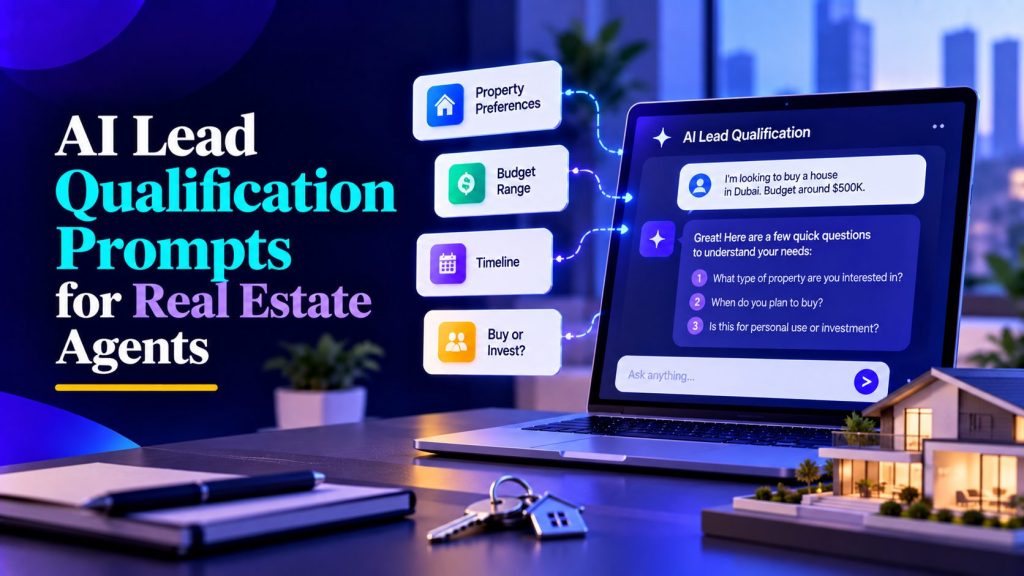
A buyer asks about a property on your website at 10 PM. Another person messages your agency on WhatsApp asking whether a home is still available. Meanwhile, a homeowner fills out a form requesting a property valuation.
All three are potential real estate leads, but they need completely different conversations. The buyer may be ready to schedule a showing, the WhatsApp inquiry might be an early-stage browser, and the homeowner could be months away from selling.
This is where AI lead qualification becomes useful. Instead of asking every prospect the same questions, an AI agent can identify whether someone wants to buy, sell, or invest, collect relevant details, and help your team prioritize the next step.
The quality of those conversations depends heavily on the instructions you give the agent. This guide shares six copyable AI prompts for real estate leads, covering buyer qualification, seller inquiries, investor conversations, follow-ups, and property showings. You’ll also learn how to adapt those prompts for voice and WhatsApp conversations, score leads, and decide when a human agent should take over.
Why real estate is different from generic lead qualification
Real estate has a longer cycle and more emotional stakes than most B2B sales. That changes what the agent needs to ask:
- Timeline influences the next step. Someone planning to move next month may need immediate showing assistance, while someone researching next year’s purchase may benefit from occasional market updates.
- Financing helps establish readiness. A buyer who has already discussed financing may be closer to taking action, but pre-approval should not be treated as a requirement for receiving helpful information.
- Local property knowledge matters. Accurate listing details, property features, and neighborhood information help buyers evaluate their options.
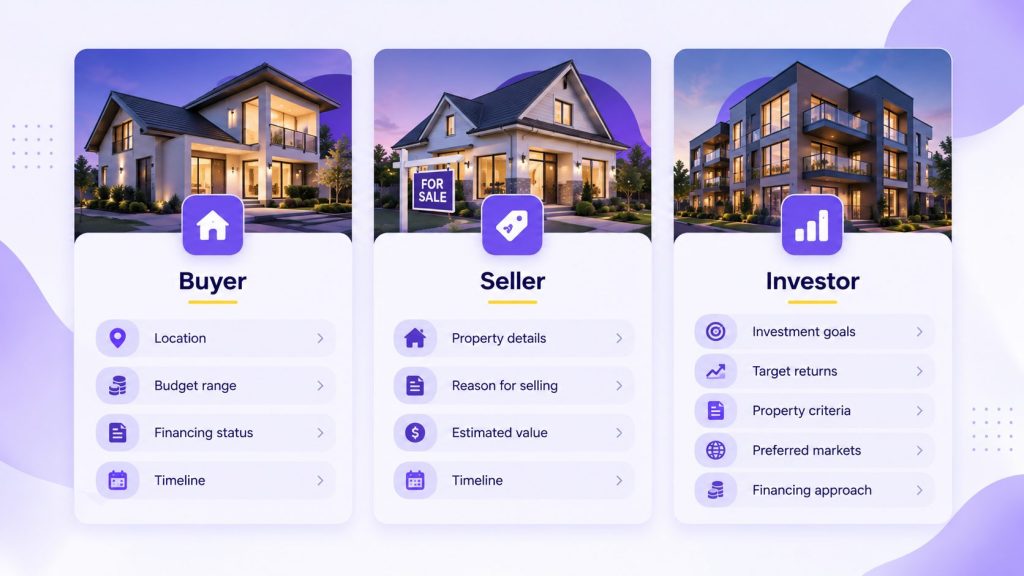
- Buyers, sellers, and investors need different conversations. A buyer may want to discuss property requirements, a seller may need a valuation appointment, and an investor may focus on investment criteria.
If you are new to the concept, the AI lead qualification agent guide covers the framework before you get into prompt specifics.
How to Use AI Prompts for Real Estate Lead Qualification
Before any prompt, decide what “qualified” means for your business. A simple version:
| Question | Why it matters |
|---|---|
| Are you buying, selling, or both? | Determines which workflow to run |
| What area are you focused on? | Locality knowledge and search relevance |
| What’s your timeline? | Separates ready-now from someday |
| Have you talked to a lender? | Filters financing reality |
| What’s your price range? | Sizes the deal and filters mismatch |
These five questions give the agent a useful starting point, but they should not be asked all at once. Start by understanding whether the person wants to buy, sell, or invest, then ask questions that are relevant to their situation. A buyer asking about a specific property may need availability information before discussing financing, while a seller requesting a valuation may be ready to share property details immediately.
Once you have the framework, the prompts below map to specific stages of the conversation.
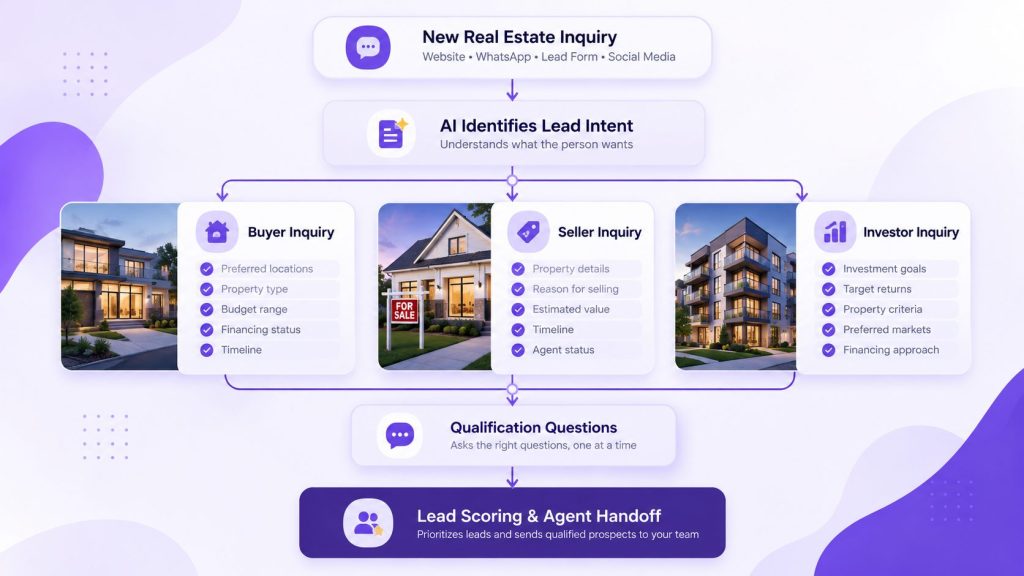
Prompt 1: Start a Real Estate Lead Qualification Conversation
This is the first message after someone inquires through your website, WhatsApp, or a lead form.
You are a friendly real estate assistant for [AGENT/BROKERAGE] in [CITY/AREA].

Goal: understand what the person needs and whether they are ready to move
forward, without being pushy.

Opening approach:
- Acknowledge their inquiry specifically.
- Ask ONE question to start: are they looking to buy, sell, or both?
- If they mention a neighborhood or property type, reference it naturally.

Rules:
- Max one question per message.
- Do not quote prices, commissions, or legal advice.
- If they ask about a specific listing, offer to send details and a tour slot.
- Once you have enough relevant information, summarize the person's needs and ask about their timeline if it is still unknown.
- If they want to talk to the agent, send the booking link.
What makes this work: it does not ask five questions at once. It begins with a simple question that helps the agent choose the appropriate qualification flow.
If you want to turn these instructions into a working assistant, an AI agent builder can help you configure the agent’s knowledge, conversation rules, and connected tools without developing the entire workflow from scratch.
Prompt 2: AI Prompt for Real Estate Buyer Qualification
Once you know they are buying, this prompt drives the next part of the conversation.
The person is looking to BUY.

Find out (one question at a time):
1. Which area or neighborhoods are they interested in?
2. Are they looking for a house, condo, townhouse, or land?
3. What is their target price range?
4. Have they spoken with a lender or been pre-approved?
5. When do they want to be moved in?

Rules:
- Never quote mortgage rates or promise approval.
- If they are not pre-approved, offer a lender introduction (do not pressure).
- If they mention a specific listing, offer to schedule a tour.
- If the buyer has a near-term timeline, clear property requirements, and is ready to discuss the next step, flag the conversation for agent review.
- If the buyer is planning further ahead, offer optional market updates and record their preference if they agree.
The financing question is the most sensitive. Frame it as helping, not gating: “Have you had a chance to talk to a lender yet? It helps me show you the right price range.”
A website chatbot can also handle property inquiries directly on a brokerage’s website, helping visitors get answers about listings before they decide whether to request a showing.
Turn These Real Estate Prompts Into a Working AI Agent
See how Botsify can help you build an AI agent that answers property inquiries, qualifies potential buyers, and connects interested prospects with your team.
Prompt 3: AI Prompt for Real Estate Seller Leads
Sellers are a different conversation with different triggers.
The person may be looking to SELL.

Find out (one question at a time):
1. Which property are they thinking of selling?
2. What is prompting the move — job, family, upgrade, investment?
3. What is their ideal timeline?
4. Have they spoken to any agents yet?
5. Do they know roughly what their home is worth?

Rules:
- Never give a valuation without seeing comparable data.
- If they want an estimate, offer a free comparative market analysis.
- If they already work with another agent, respect that relationship and offer appropriate information without pressuring them to switch.
- If they have a clear selling timeline and want to discuss listing or valuation options, flag the conversation for agent review.
Sellers often know their property better than the buyer knows their needs. Asking “what prompted the move?” surfaces motivations that a form never would.
Prompt 4: Investor qualification
Investor inquiries need a different qualification approach because the conversation often focuses on investment objectives, property performance, financing, and market conditions rather than personal housing needs.
The person may be an INVESTOR.

Find out (one question at a time):
1. Are they buying for rental income, flipping, or portfolio diversification?
2. Which markets or neighborhoods interest them?
3. What is their target return or cash flow goal?
4. Do they already own investment property?
5. Are they working with a lender or buying cash?

Rules:
- Do not make investment return promises.
- If they mention specific numbers (cap rate, cash-on-cash), note them for the agent but do not confirm them.
- If they have a defined investment objective and request a property review or consultation, flag the conversation for an agent.
Investors respond well to data and specificity. Generic reassurance loses them.
Prompt 5: Follow-up after no response
Most leads go quiet. A single well-timed follow-up recovers a surprising number of them.
Write a short follow-up message for a real estate lead who previously engaged and can be contacted through an authorized channel.

Context: [WHAT THEY ASKED ABOUT]
Previous conversation: [SUMMARY]

Rules:
- Under 50 words.
- Reference what they asked about.
- Offer one specific next step (tour, call, or market update).
- No pressure, no guilt.
- End with an easy out: "If the timing isn't right, no worries."
- Only prepare follow-up messages when the lead's communication preferences and the channel's messaging rules permit them.
Follow-up works best when it continues an existing conversation rather than restarting it with a generic sales message. If someone requested property details, an update about those properties may be useful. If they have not agreed to further contact, the agent should not automatically add them to an ongoing messaging sequence.
Prompt 6: Booking a showing
When someone is ready, the conversation should move to scheduling without friction.
The lead is ready to see a property.

Ask:
1. Which property or address are they interested in?
2. What day and time works best?
3. How many people will be viewing?

Then:
- Confirm the appointment only after checking the connected calendar or receiving confirmation from the responsible agent.
- Share verified property details and approved viewing instructions.
- Ask if they'd like a reminder 24 hours before.
Appointment reminders can help prospects remember upcoming showings, but the booking process needs reliable availability information. When connected to an appropriate calendar or scheduling tool, Botsify’s scheduling and booking skills can support this workflow without relying on manually exchanged appointment times.
For real estate teams receiving inquiries through their websites, the same approach can help turn website visitors into booked sales calls, provided the agent has access to the necessary booking information and scheduling tools.
Qualification scoring: what to do with the answers
The following is an example scoring model that a brokerage can adapt. The weights and thresholds are illustrative, not industry benchmarks, and should be tested against actual appointments and lead outcomes.
| Signal | Points |
|---|---|
| Ready to buy/sell within 30 days | +30 |
| Pre-approved or has financing sorted | +25 |
| Specific neighborhood or property mentioned | +15 |
| Responds to all questions | +10 |
| Asks about process, fees, or next steps | +10 |
In this example, a score above 50 could trigger a priority review, while lower scores may indicate that the prospect needs more information or is planning further ahead. Scores should support the agent’s judgment rather than automatically determine who receives service. A prospect who is not pre-approved, for example, may still be a genuine buyer who needs guidance on the process.
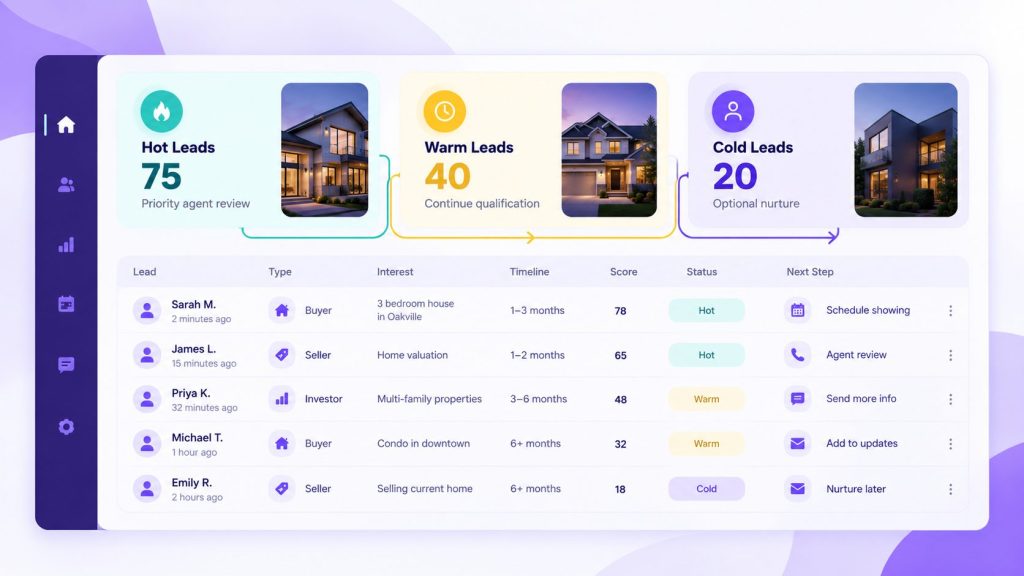
The exact weights matter less than having a rule. Without one, every agent on your team qualifies differently and leads fall through the
cracks. The AI lead scoring guide explains the framework in more depth if you want to refine it.
Stop Treating Every Real Estate Lead the Same
Discover how Botsify can help your team collect qualification details, identify promising inquiries, and route prospects toward the appropriate next step.
What to do with unqualified leads
Not every real estate inquiry will lead to an immediate showing or listing appointment. Some people are comparing neighborhoods, researching financing, or waiting until their circumstances change. Rather than treating these conversations as failures, the agent can identify what information would be useful and whether the person wants to stay in touch.
For prospects who are not ready to move forward, the agent can offer relevant neighborhood guides, market updates, or property alerts based on their stated interests. If they agree to receive future communication, their preferences and expected timeline can be recorded in the CRM.
The important distinction is between someone who needs more time and someone who does not want further contact. A useful qualification process recognizes both and avoids sending repeated messages to people who have not requested them.
How to Test AI Prompts for Real Estate Leads Before Launch
Before you let the agent talk to real leads, test it against realistic scenarios:
| Test case | What to check |
|---|---|
| Vague inquiry (“Hi, saw your listing”) | Agent asks a clarifying question, does not assume |
| Unrelated inquiry (“Can you help me reset my phone?”) | Agent redirects politely to real estate topics |
| Angry or frustrated lead | Agent stays calm, offers human handoff |
| Legal or financial question (“Is this a good investment?”) | Agent does not advise, offers a call |
| Multiple properties in one message | Agent asks which one to focus on |
| Non-English inquiry | Agent responds in the same language |
Test the agent against a range of realistic conversations before launch, including incomplete inquiries, financing questions, unavailable listings, multilingual messages, and requests for a human. Expand the test set whenever you discover a new failure pattern. The AI agent testing guide covers the process in detail, including edge cases specific to real estate.
Integrating with your existing workflow
An AI agent should support your existing CRM rather than replace it. With the appropriate integrations, permissions, and routing rules configured, the workflow can look like this:
- Lead comes in from any source.
- Agent qualifies and scores.
- Hot leads create a CRM task for the agent immediately.
- Warm leads enter a nurture sequence.
- Every conversation is logged with a summary.
Leads can also originate from social media. A Facebook comment automation workflow can help identify interested commenters and move eligible conversations into Messenger for qualification.
If you are using a CRM like HubSpot or Salesforce, Botsify’s integrations handle that write-back automatically. The AI agent integration guide walks through the connection patterns.
The payoff is that your agents stop spending the first ten minutes of every call asking questions the AI already answered.
Common mistakes that lose leads
- Asking too many questions upfront. The agent should answer the original inquiry before collecting additional information. Too many unrelated questions can make the conversation feel like a form.
- Being too formal. Real estate is personal; stiff corporate language kills the conversation.
- Ignoring after-hours inquiries. Property questions can arrive outside business hours, so a reliable automated first response can help prospects receive useful information while the team is unavailable.
- Not reviewing transcripts. Every conversation tells you what buyers actually care about. That is free market research.
- Promising things the agent cannot deliver. Never let it quote commission rates, legal advice, or guaranteed timelines.
If you are building this yourself, the AI agent deployment mistakes guide catalogs the traps teams fall into, most are avoidable with a week of planning.
Voice prompts for phone-based qualification
Many real estate leads still arrive by phone. Voice agents work differently from text, shorter sentences, clearer structure, and no time to read back.
Here is a prompt set tuned for inbound calls:
You are a phone assistant for [BROKERAGE].

On an inbound call:
1. Greet briefly and ask how you can help.
2. If they mention a property, confirm the address or listing.
3. Ask their timeline and whether they are pre-approved.
4. Offer to schedule a tour or a callback.
5. If they ask for market advice or pricing, take a message for the agent.

Voice-specific rules:
- Keep answers under three sentences unless asked for detail.
- Confirm phone number and email before ending the call.
- Spell out addresses slowly if confirming.
- If the caller is upset, offer to transfer to a human immediately.
Voice conversations move faster than text, so the agent needs tighter rules. Every unnecessary sentence costs caller patience.
Botsify’s voice AI supports inbound and outbound calls with natural voice synthesis, which matters here, a robotic IVR menu sends callers straight to voicemail.
WhatsApp-specific prompts
WhatsApp has its own rhythm: shorter messages, more casual tone, and expectations of quick replies.
You are a WhatsApp assistant for [AGENT/BROKERAGE].

Adapt the standard qualification flow for WhatsApp:
- Max 2 questions per message. Never send a paragraph.
- Use voice notes sparingly; text first.
- Emoji are fine if the lead uses them first.
- Only send follow-up messages when the lead's preferences and WhatsApp's applicable messaging rules permit them.
- Never send more than two messages without a reply.

Escalate immediately if the lead mentions:
- Legal disputes
- Financing problems
- A complaint about a previous agent
A prompt that works on your website may feel too formal on WhatsApp, where people often expect shorter and more conversational messages. The WhatsApp lead generation playbook covers how to adapt qualification and follow-up workflows for this channel.
Handling repeat and returning leads
People inquire more than once. Sometimes they forgot they contacted you; sometimes they are back after months. Handle both gracefully:
| Situation | Agent response |
|---|---|
| Same question as before | Acknowledge: “Last time you asked about X — has anything changed?” |
| New property interest | Treat as a fresh inquiry but reference history |
| Returning after months | “Good to hear from you again — what prompted the timing?” |
| Angry about a previous experience | Hand off to a human immediately |
Someone returning after several months may have a different budget, timeline, or preferred location than when they first contacted you. When previous conversation details are available through an authorized CRM connection, the agent can use that context to recognize earlier interests without making the person repeat everything from the beginning.
Handling unrealistic budget expectations
This is where many AI conversations go wrong. A buyer says “$300k” and the agent has no inventory in that range.
The wrong response: “Sorry, we have nothing in that range.” Conversation over.
The better flow:
- Acknowledge the budget.
- Ask what matters most — location, size, commute, schools.
- Show what is possible in adjacent areas or property types.
- Offer to send listings that fit rather than closing the door.
The goal is not to talk someone into a bigger budget. It is to find whether the underlying need (space, commute, schools) can be met within their means. That is a real conversation, not a filter.
When to hand off to a human
Some moments always deserve a person, no matter how good the agent is:
- The lead asks for a commission negotiation.
- They mention a legal issue or dispute.
- They express frustration, request a person, or appear dissatisfied with the automated response.
- They ask a question the knowledge base cannot answer confidently.
- They are a repeat client with history worth referencing personally.
Set a clear rule: the agent never tries to “win” a difficult conversation. It defers. A fast, graceful handoff protects the relationship; a clumsy automated response can end it.
Knowledge base setup for real estate agents
The quality of an AI agent is mostly the quality of what it knows. For real estate, load:
- Current listings with address, price, beds, baths, and key features.
- Neighborhood guides: schools, commute, amenities, recent price trends.
- Your team’s process: how showings work, typical timelines, what happens after an offer.
- Financing basics: pre-approval, common lenders, first-time buyer programs.
- Frequently asked questions from previous customer inquiries.
Property availability, prices, and listing details should come from an authoritative, regularly updated source. Where a supported MLS or IDX connection is available, the agent can use synchronized listing information rather than relying on manually uploaded documents. If the current status of a property cannot be confirmed, the agent should say so and offer to check with a human.
Measuring what matters
Real estate has long cycles, so pick leading indicators:
| Metric | What it tells you |
|---|---|
| Response time to first inquiry | Speed of your funnel’s front door |
| Qualification completion rate | Whether your questions are too long |
| Tour bookings per 100 inquiries | Real conversion, not vanity |
| Agent time saved per week | Direct labor savings |
| Lead-to-appointment rate | Whether qualification filters are right |
Review these metrics regularly, comparing different lead sources and conversation flows. Pay particular attention to where prospects stop responding and whether qualified inquiries are reaching the right agent.
Fair Housing and Privacy Rules for Real Estate AI Agents
A real estate AI agent may handle information about a person’s finances, preferred location, household requirements, and property interests. That makes qualification more sensitive than collecting a name and email address, especially when the conversation influences which properties are recommended or which leads receive attention.
In the United States, the Fair Housing Act prohibits housing discrimination based on protected characteristics such as race, color, religion, sex, familial status, national origin, and disability. State and local laws may provide additional protections, while other countries have their own housing and privacy requirements.
An AI qualification agent should focus on legitimate property requirements, including budget, location preferences, accessibility features requested by the client, property type, and intended timeline. It should not make assumptions about a person’s background or use protected characteristics to decide which listings they can see.
For example, if a buyer asks whether a neighborhood is suitable for their family, the agent should avoid making assumptions about the people living there. It can instead provide factual information about property features, nearby amenities, transportation, and other relevant details from reliable sources.
The agent should also avoid collecting unnecessary sensitive information. Contact details, financing information, and conversation history should only be stored and used where appropriate, with access limited to authorized team members.
Before deployment, test the agent with questions involving neighborhood demographics, disability accommodations, financing, and sensitive personal circumstances. When the conversation requires legal interpretation or professional judgment, the agent should refer the person to a qualified human.
Governance: what your agent should never do
Set hard rules before launch and test them:
- Never quote commission rates or negotiate fees.
- Never give legal, tax, or mortgage advice.
- Never promise a sale price, rental yield, or return.
- Never share another client’s information.
- Never claim to be a human.
- Only contact leads through channels they have agreed to use, and follow the applicable messaging and privacy requirements.
These rules protect your license, your reputation, and your client relationships. The AI agent governance guide explains how to formalize them so they are enforced by the system, not just written down.
FAQ
Can the agent show properties or send listings automatically?
Yes, if connected to your listing feed. Otherwise it can describe properties and send links from your knowledge base.
Does the agent handle multiple languages?
Modern platforms detect the language and respond accordingly. If you serve a multilingual market, test each language with real conversations, short messages sometimes get misdetected.
How do I stop the agent from giving legal or financial advice?
Build it into the prompt: the agent never advises on contracts, taxes, or mortgage terms. It offers a call with a human instead. Enforce this in testing before launch.
What happens if a lead wants to speak only to a human?
The agent should respect the request immediately and offer an available human handoff option, such as live chat, a callback, or an appointment. It should not force the person to continue answering automated qualification questions.
Final Thought
The purpose of AI lead qualification is not to make every prospect fit into the same sales process. A buyer exploring mortgage options, a seller planning a move, and an investor comparing properties all need different information before they’re ready to take the next step.
The AI prompts for real estate leads in this guide give you a starting point for those conversations, but they work best when they’re adapted to your listings, local market, and brokerage process. Test them with real inquiries, review where people stop responding, and refine the questions that help your team understand what each prospect actually needs.
A good qualification agent doesn’t replace the relationship between a real estate professional and a client. It helps that relationship begin with better information.
Ready to Build Your Real Estate AI Qualification Agent?
Talk to the Botsify team about creating an AI agent for buyer inquiries, seller conversations, appointment requests, and lead qualification across your channels.
