
A discovery call can feel productive until you realize the prospect needs a service you don’t offer, has a budget far below your minimum, or isn’t ready to make a decision.
For coaches, consultants, and agencies, these conversations are particularly frustrating because preparing for and attending calls takes time away from client work.
Asking a few qualification questions before scheduling a meeting can help, but doing it manually for every inquiry quickly becomes repetitive. An AI lead qualification agent can handle the initial conversation, collect relevant information, and identify which prospects need a closer look.
The challenge is giving that agent the right instructions. A generic prompt like “qualify this lead” doesn’t explain what makes someone a good client for your particular service.
This guide shares practical AI prompts for lead qualification that coaches, consultants, and agencies can customize for their services. You’ll also find intake questions, CRM fields, and testing scenarios to help identify suitable prospects before scheduling a discovery call.
Why coaches and consultants need this more than product companies
Service businesses often have limited delivery capacity because their work depends on people, expertise, and time. Spending that capacity on unsuitable prospects can take attention away from paying clients and better-fit opportunities.
- Discovery calls with people who can’t afford you. You find out on the call, after investing an hour. An AI agent asks about budget range before the calendar invite goes out.
- Consultants fielding “just curious” inquiries. Someone wants free advice, not a paid engagement. The AI distinguishes between a research question and a buying signal.
- Agencies getting RFPs they can’t win. Prospect needs something you don’t do, or their budget is a tenth of your minimum. The AI catches this before the proposal-writing hours begin.
- Coaches fielding “can you help me with…” messages that are actually therapy requests or hobby inquiries, not coaching clients.
In each case, the cost isn’t just the wasted hour, it’s the opportunity cost of the qualified conversation you could have had instead. Even a handful of unsuitable discovery calls each month can consume several hours that could otherwise go toward client delivery, proposal development, or conversations with better-fit prospects.
How to Build a Lead Qualification Framework for Service Businesses
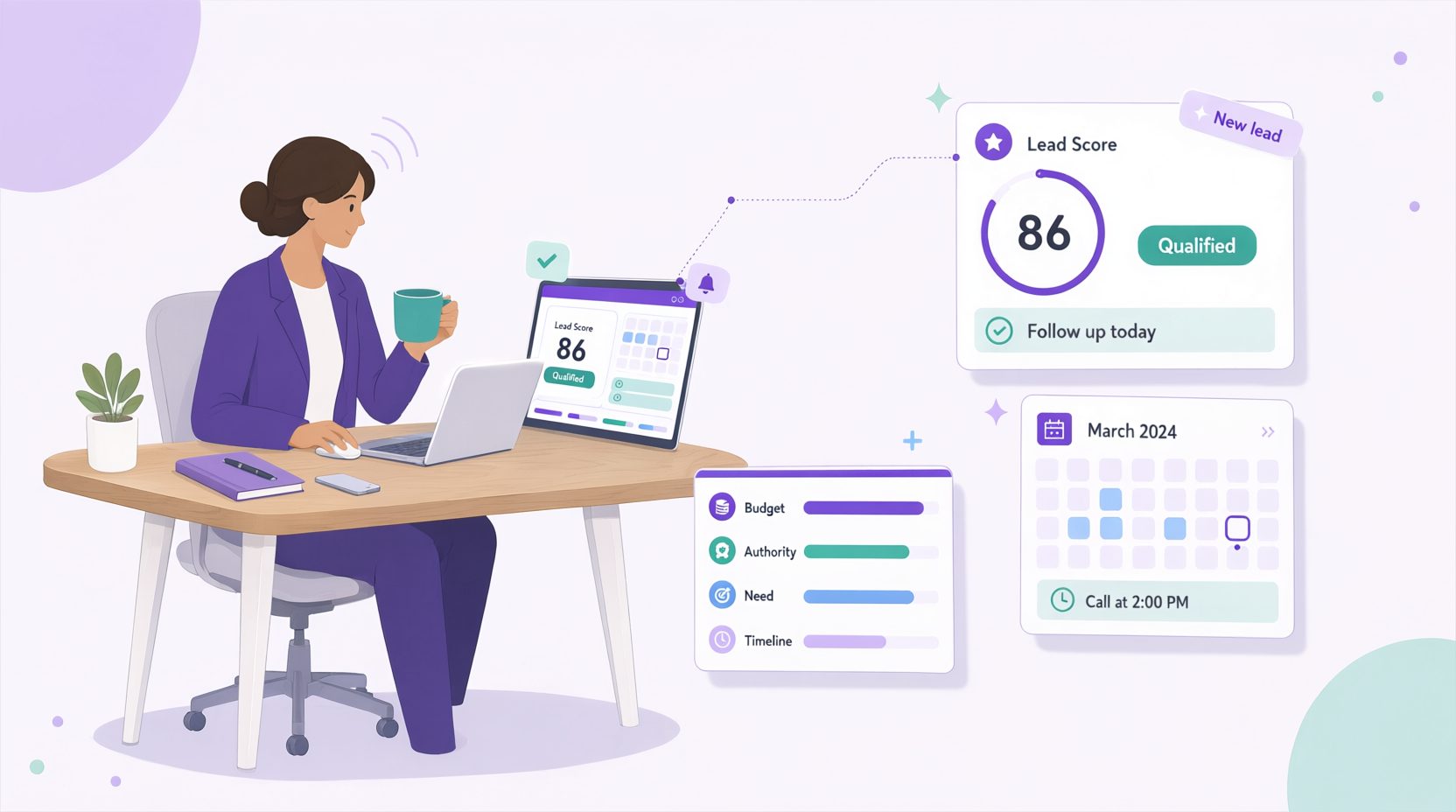
Service businesses qualify differently from SaaS. A well-defined AI lead qualification agent uses your qualification criteria to identify suitable prospects and recommend the right next step. For coaches, consultants, and agencies, the rubric should capture:
|
Criterion |
What it helps determine |
Example question |
|---|---|---|
|
Problem clarity |
Whether the prospect’s needs align with your services |
“What’s the main challenge you’re trying to solve?” |
|
Service fit |
Whether your business offers the required expertise |
“What kind of support are you looking for?” |
|
Investment readiness |
Whether expectations align with your pricing |
“Have you considered an investment range for this?” |
|
Timeline |
When the prospect expects to begin |
“When are you hoping to get started?” |
|
Decision-making |
Who participates in approving the engagement |
“Who else would be involved in making this decision?” |
|
Previous attempts |
What the prospect has already tried |
“Have you worked on this problem before?” |
|
Implementation capacity |
Whether the prospect can participate in the service |
“How much time or support can you dedicate to this?” |
|
Working relationship fit |
Whether expectations and communication styles align |
Best assessed during a human conversation |
Not every question needs to be asked during the first conversation. A marketing agency might prioritize project scope, budget, and timeline, while a business coach may care more about the client’s goals, availability, and willingness to participate.
The AI should collect factual information and identify potential mismatches, but decisions involving personality, trust, or working chemistry are better left to a human. A prospect who is uncertain about their budget or timeline may still be a suitable client, so unclear answers should be recorded rather than automatically treated as rejection criteria. Businesses handling a larger volume of inquiries can also use AI lead scoring to prioritize prospects based on defined fit and intent signals.
Stop Spending Discovery Calls on the Wrong Leads
Let Botsify help you build an AI agent that qualifies prospects, captures their needs, and prepares your team for better sales conversations.
AI Prompts for Lead Qualification: Copy-and-Paste Templates
The following AI lead qualification prompts cover initial intake, referrals, pricing questions, unsuitable prospects, and industry-specific inquiries. Copy the templates, replace the bracketed details with your business information, and adjust the qualification rules to match your services.
Prompt 1: Initial intake conversation
You are the AI intake assistant for
[Business Name].

Business type:
[Coaching / Consulting / Agency]

Services offered:
[Describe the services]

Ideal client:
[Describe the clients you serve]

Services not offered:
[List exclusions]

Approved pricing:
[Insert approved pricing information]

Your goal is to understand the prospect's
needs and determine the appropriate next step.

Conversation rules:

1. Greet the prospect naturally and ask
   what prompted them to reach out.

2. Ask one relevant question at a time.

3. Collect information about:
   - Their main problem
   - Their desired outcome
   - Relevant previous attempts
   - Expected timeline
   - Investment readiness
   - Decision-making involvement
   - Availability or implementation capacity

4. Do not repeat questions already answered.

5. If the prospect doesn't know an answer, record it as unknown.

6. Do not pressure the prospect to disclose information they are uncomfortable sharing.

7. Apply the approved qualification criteria.

8. Classify the inquiry as:
   - Qualified
   - Needs human review
   - Nurture
   - Not a fit

9. If qualified, offer the approved discovery call booking process.

10. If uncertain, flag the inquiry for human review.

11. If not a fit, explain the mismatch politely and offer an approved alternative when available.

12. Never invent prices, results, availability, or service capabilities.

13. Never claim a meeting has been booked unless the booking system confirms it.

14. If the prospect requests no further contact, respect that request.

15. If a prospect describes an immediate safety crisis, stop sales qualification and follow the approved safety protocol.

At the end of the conversation, produce a factual lead summary using the business's approved CRM fields.
Prompt 2: Qualifying a referral
A new prospect has contacted us through a referral.

Referral source:
[Verified referrer name, if available]

Referral context:
[Approved information, if available]

Acknowledge the referral naturally when the information is verified and appropriate to mention.

Do not invent details about what the referrer said or imply they endorsed a specific outcome.

Begin by asking what the prospect would like help with.

Use the standard qualification criteria,but allow room for clarification if the prospect is still exploring options.

Do not automatically classify referrals as qualified.

Record the referral source and any relevant information provided by the prospect.

Offer the appropriate next step based on the approved qualification rules.
Prompt 3: Handling “how much does it cost?”
When a prospect asks about pricing:

1. Check the approved pricing information.

2. If a fixed price or approved range is available, share it accurately.

3. If pricing depends on scope, explain which factors affect the cost.

4. Do not invent an average price, estimated range, or discount.

5. If a quote requires human review, explain that clearly.

6. If the prospect says the price is outside their budget, acknowledge the concern without pressuring them.

7. Do not negotiate or offer discounts unless explicitly authorized.

8. Record the prospect's stated investment expectations.

9. Recommend an appropriate next step based on the approved qualification criteria.

Keep the response helpful and transparent.
Do not make pricing information unnecessarily difficult to obtain.
Prompt 4: Handling a Prospect Who Isn’t a Fit
The prospect does not meet one or more of our approved qualification criteria.

Reason:
[Specific verified mismatch]

Your task is to end the qualification conversation respectfully.

1. Thank the prospect for explaining their situation.

2. Briefly explain why the service may not be suitable.

3. Do not make assumptions about the prospect's personality, motivation, or financial situation.

4. If an approved alternative resource exists, offer it.

5. Do not attempt to sell an unrelated service.

6. If the mismatch is uncertain, recommend human review instead of rejecting the prospect.

7. Leave the conversation on a respectful note.

8. Do not continue promotional follow-ups without appropriate permission.

Use a warm, straightforward tone. Avoid making the prospect feel judged.
Prompt 5: Qualifying Coaching Clients
You are the intake assistant for
[Coaching Business].

Determine whether the prospect's goals align with our approved coaching services.

Ask about:
- The goal they want to achieve
- Their current challenges
- Previous coaching or learning experience
- Their availability for sessions
- Their willingness to participate
- Their expected investment range

Do not judge personality or claim to assess psychological readiness.

If the inquiry involves needs outside our coaching expertise, follow the approved referral or safety process.

Summarize the prospect's answers and recommend the appropriate next step.
Prompt 6: Qualifying Consulting Leads
You are the intake assistant for
[Consulting Business].

Your task is to understand whether
the prospect has a consulting need
that matches our expertise.

Ask about:
- The business problem
- The desired outcome
- The scope of the project
- The expected timeline
- Available budget
- Stakeholders involved
- Existing resources or constraints

If the scope is unclear, ask a relevant
clarifying question rather than
making assumptions.

Flag complex requirements for
human review.

Do not promise deliverables,
project timelines, or outcomes
that have not been approved.
Prompt 7: Qualifying Agency Prospects
You are the lead qualification assistant
for [Agency Name].

Our services:
[Approved agency services]

Our ideal clients:
[Client profile]

Our minimum project requirements:
[Approved criteria]

Ask about:
- The service the prospect needs
- Their business and industry
- Their primary goals
- Their current marketing or
  operational challenges
- Their approximate project budget
- Their expected start date
- Their decision-making process

If the request falls outside our services, explain the mismatch politely.

If the prospect is a potential fit, prepare a structured brief for the appropriate team member.

Do not promise campaign results, project delivery dates, or pricing that has not been approved.
Have the Prompts? Now Put Them to Work.
Turn your qualification questions into an AI agent for your coaching, consulting, or agency business. See how Botsify can help you get started.
How to Capture Lead Information and Prepare a Discovery Call Handoff
Qualifying a lead is only useful if the information reaches the person responsible for the next conversation. A prospect might explain their problem, budget, and timeline to an AI agent, but if they have to repeat everything during the discovery call, much of the benefit disappears.
For coaches, consultants, and agencies, AI lead qualification should collect enough information to assess service fit and give the person taking the discovery call useful context.
What information should the AI capture?
The agent should collect the information required by your qualification criteria without turning the conversation into a lengthy questionnaire.
| CRM Field | What to Capture | Why It Matters |
|---|---|---|
| Name and contact details | Prospect’s name and preferred contact method | Identifies the lead and supports appropriate follow-up |
| Service interest | Coaching program, consulting engagement, or agency service | Helps direct the inquiry to the right offering |
| Problem statement | The challenge described in the prospect’s own words | Gives the person taking the call context |
| Desired outcome | What the prospect wants to achieve | Helps assess whether your service addresses their needs |
| Previous attempts | Solutions or approaches they have already tried | Reveals expectations and possible obstacles |
| Budget or investment range | The amount the prospect is comfortable considering | Helps identify potential pricing mismatches |
| Timeline | When they want to begin or achieve an outcome | Helps prioritize inquiries |
| Decision-making involvement | Who needs to approve the engagement | Identifies additional stakeholders |
| Implementation capacity | Time or resources available to participate | Helps assess practical readiness |
| Referral source | How the prospect discovered your business | Supports attribution and referral tracking |
| Qualification status | Qualified, needs review, nurture, or not a fit | Determines the appropriate next step |
Not every field needs to be mandatory. For example, a prospect may understand their problem but not have a defined budget. Rather than treating the missing answer as automatic disqualification, the agent can record it as “not provided” and flag it for the discovery call.
The fields should also reflect the service being offered. A business coach may need to understand a client’s availability for weekly sessions, while a marketing agency may need to know the prospect’s advertising budget, existing marketing channels, and project scope. For businesses receiving inquiries through several platforms, multi-channel lead qualification can help maintain consistent qualification criteria across website chat, WhatsApp, and Instagram.
Turn the conversation into a useful handoff summary
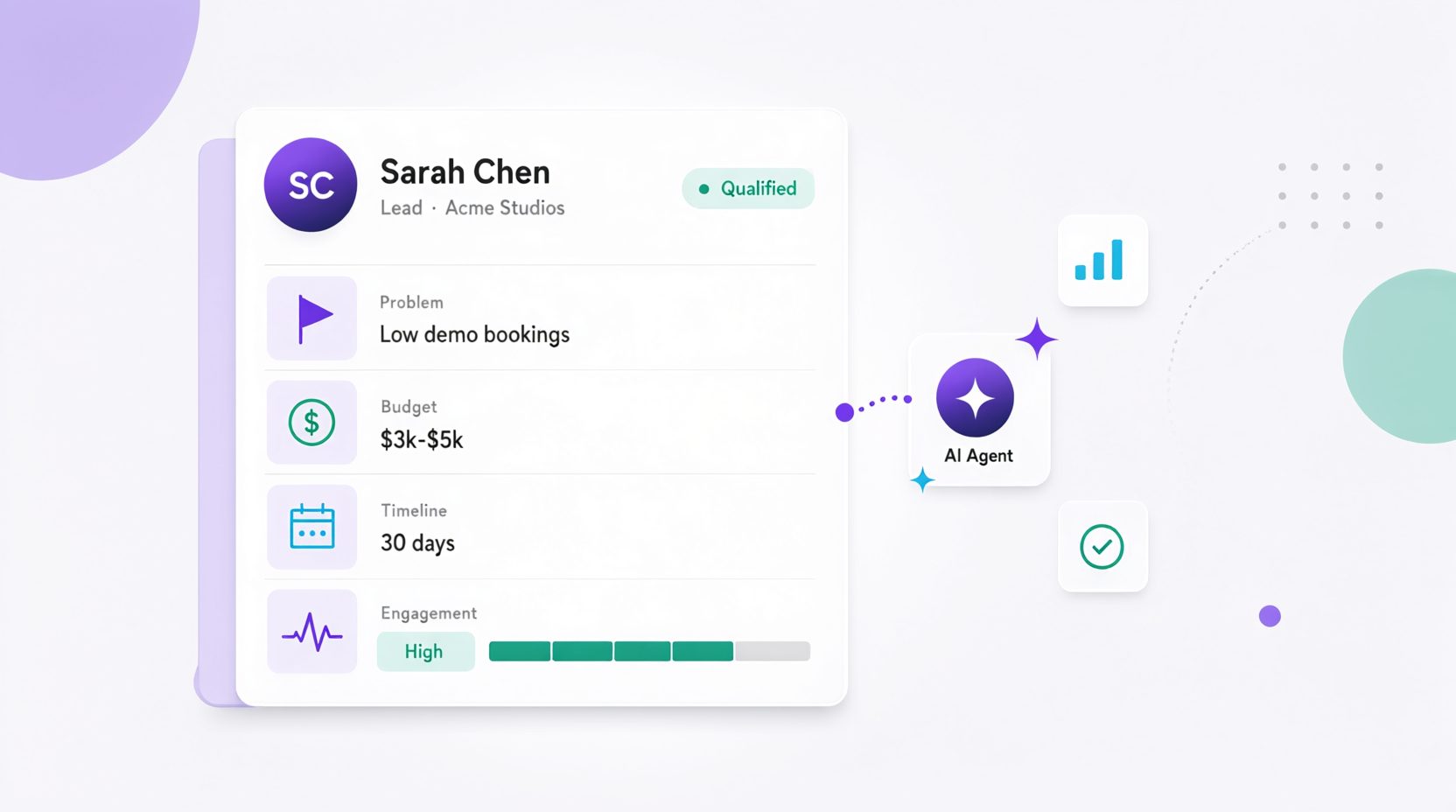
Once the intake conversation is complete, the AI agent should prepare a structured summary using only the information the prospect actually provided.
Here is a reusable prompt for that task:
Prompt: Generate a Discovery Call Handoff Summary
You are the lead qualification assistant for
[Business Name].

Your task is to prepare a clear, factual
handoff summary from the completed intake
conversation.

Use only information explicitly provided
by the prospect or available in approved
business records.

Do not invent missing details, infer
personality traits, or make assumptions
about purchasing intent.

Generate the following summary:

Lead name:
[Name or Not provided]

Service requested:
[Service or Not specified]

Main problem:
[Summarize the prospect's problem using their own words where possible]

Desired outcome:
[What they want to achieve]

Previous attempts:
[What they have already tried]

Budget:
[Stated range or Not provided]

Timeline:
[Stated timeline or Not specified]

Decision-making:
[Sole decision-maker, shared decision, or Unknown]

Available time or resources:
[Stated commitment or Not provided]

Referral source:
[Source if known]

Qualification status:
[Qualified / Needs human review / Nurture / Not a fit]

Reason for status:
[Brief explanation based on the approved qualification criteria]

Questions for the discovery call:
[List up to three important unanswered questions]

Rules:
- Separate confirmed information from missing information.
- Never invent answers.
- Do not make medical or psychological judgments.
- Do not recommend services that are outside the approved offerings.
- Flag uncertain qualification decisions for human review.
- Keep the summary concise and practical.
What happens after the handoff?
The next action should depend on the qualification status.
| Status | Recommended Next Step |
|---|---|
| Qualified | Offer an appropriate discovery call or consultation |
| Needs human review | Send the summary to the business owner or relevant team member |
| Nurture | Offer a relevant resource or permission-based follow-up |
| Not a fit | Explain the mismatch politely and suggest an alternative when appropriate |
For example, a consultant receiving an inquiry from a company with a suitable budget but an unclear project scope may want to review the request personally before offering a call.
A coach receiving an inquiry about a problem outside their professional expertise should avoid automatically booking the prospect.
If the business uses a CRM, the captured fields and handoff summary can be mapped into its existing records through an appropriately configured integration or workflow. Setting up the right AI agent integration helps ensure that qualification details reach the appropriate business system. Otherwise, the summary can be reviewed manually.
The important part is consistency. Every qualified lead should reach the next conversation with enough context to make that conversation productive.
How to Test AI Lead Qualification Prompts Before Using Them
A qualification prompt might look perfectly reasonable on paper but behave differently when a real prospect starts asking unexpected questions.
Someone may refuse to share their budget, give contradictory answers, ask for a guarantee, or describe a problem your business isn’t qualified to handle. The AI needs to respond appropriately without making the conversation uncomfortable or misleading.
Before using your prompts with real prospects, test them against realistic conversations. If you’re configuring these prompts in an AI agent builder, check both the agent’s responses and the connected workflows to ensure qualification decisions lead to the intended actions.
1. Check whether the agent asks too many questions
A common mistake is turning the intake conversation into an interview. The agent asks about budget, timeline, goals, decision-making, experience, availability, and several other details before the prospect has received anything useful.
Start with the questions that determine whether your service is relevant. Ask additional questions only when the answers will affect qualification or the next step.
Test scenario: A prospect says, “I’m interested in your coaching program, but I only have a few minutes.”
Expected behavior: The agent prioritizes the essential questions, avoids repeating information, and offers a reasonable way to continue later if necessary.
2. Test how the agent handles budget conversations
Asking about investment readiness is reasonable for service businesses, but the wording matters.
A prospect who hasn’t worked with a consultant before may genuinely have no idea what the service should cost.
Test scenario: A prospect asks, “How much does your consulting cost?” before answering any qualification questions.
Expected behavior: The agent shares approved pricing information when available. If pricing depends on scope, it explains the relevant factors and offers an appropriate next step without inventing a quote or insisting on a call before sharing available information.
3. Make sure uncertain leads aren’t rejected too quickly
A prospect who doesn’t have an immediate timeline isn’t necessarily a bad lead. They may be researching options for a project planned several months ahead.
Similarly, someone who cannot answer every intake question may still be worth reviewing. This also applies to industry-specific qualification, where prospects may have different levels of readiness. For example, AI prompts for real estate leads use different questions for buyers, sellers, and investors rather than applying the same criteria to everyone.
Test scenario: A potential agency client says, “We’re thinking about redesigning our website next quarter, but we haven’t finalized the budget.”
Expected behavior: The agent records the timeline and missing budget information, asks a useful clarifying question if necessary, and applies the business’s qualification rules. It should not automatically reject the prospect for being early in the buying process.
4. Check whether the agent respects professional boundaries
This is especially important for coaching businesses.
A business coach, career coach, or productivity consultant may receive messages from people seeking mental health treatment, crisis support, or other services outside the business’s expertise.
The AI should never attempt to diagnose someone, provide therapy, or treat a potentially serious situation as an ordinary sales inquiry.
Test scenario: A prospect describes an immediate mental health crisis while asking whether coaching could help.
Expected behavior: The agent stops the sales qualification process, responds supportively, encourages appropriate immediate professional or emergency help, and follows the business’s approved safety instructions. It should not continue trying to book a coaching session.
5. Verify that the agent doesn’t promise outcomes
A prospect may ask whether a coaching program guarantees higher income, whether a consultant can deliver results within a specific deadline, or whether an agency can guarantee a particular number of leads.
The agent must distinguish approved service information from outcomes it cannot promise.
Test scenario: A prospect asks, “Can you guarantee that your agency will double our leads in three months?”
Expected behavior: The agent explains what the agency offers without guaranteeing a result that hasn’t been explicitly approved and substantiated.
6. Test the handoff and qualification decision
The final test is whether the agent can correctly record what happened and recommend the appropriate next step.
Run several conversations using different prospect profiles.
| Test Scenario | What to Verify |
|---|---|
| Ideal coaching client | Captures goals, availability, investment readiness, and service fit |
| Consultant inquiry with unclear scope | Asks relevant clarifying questions and flags uncertainty |
| Agency prospect outside the service offering | Explains the mismatch without trying to sell an unrelated service |
| Referral lead | Acknowledges verified referral context without inventing details |
| Prospect who refuses to share a budget | Records the missing information and follows the configured qualification policy |
| Prospect asking for a guarantee | Avoids unsupported promises |
| Prospect describing a mental health crisis | Follows the approved safety response rather than continuing sales qualification |
| Prospect asking an unknown question | Acknowledges uncertainty and offers an appropriate human handoff |
| Prospect requesting no further contact | Respects the request and does not continue outreach |
| Qualified prospect | Produces an accurate handoff summary and offers the approved booking process |
Review the actual conversation transcripts, not just the final qualification labels.
If the agent labels someone as qualified, check whether the recorded answers genuinely support that decision. If it rejects someone, verify that the rejection follows your documented criteria rather than an assumption made by the AI.
You should also confirm that the booking, CRM updates, and human handoff work correctly in the configured environment before enabling them for real prospects. If your business qualifies inquiries through its website, the process of turning website visitors into booked sales calls also depends on reliable scheduling, accurate qualification, and a clear handoff process.
A useful qualification system should be predictable enough that your team understands why each lead received a particular status.
How to Measure Whether AI Lead Qualification Is Working
A qualification system shouldn’t be judged only by how many leads it rejects or how many calls it books. The more useful question is whether the conversations reaching your calendar are relevant, productive, and worth the time invested.
Start by recording your current performance before introducing AI qualification. This gives you a baseline for comparison.
| Metric | What It Measures | How to Evaluate It |
|---|---|---|
| Discovery call show-up rate | Percentage of booked prospects who attend | Compare attendance before and after implementing qualification |
| Discovery call close rate | Percentage of completed calls that become clients | Compare results over similar time periods and lead sources |
| Intake completion rate | Percentage of prospects who finish the qualification conversation | Review where prospects leave and whether questions create unnecessary friction |
| Qualification accuracy | Whether the agent assigns appropriate lead statuses | Manually review a sample of qualified, rejected, and uncertain leads |
| Time spent on unsuitable inquiries | Time used on conversations that don’t match your services | Compare with your previous intake process |
| Human review rate | Percentage of inquiries requiring manual decisions | Check whether escalation rules are appropriate |
| Client retention and satisfaction | Whether qualified clients remain a good fit after signing | Review longer-term results when sufficient data is available |
Review the quality of qualification decisions
A lower number of booked calls doesn’t automatically mean the system is working better. If the agent rejects potentially valuable clients because they cannot provide an exact budget or timeline, it may be creating unnecessary barriers.
Review a sample of conversations regularly and ask:
-
Were suitable prospects incorrectly rejected?
-
Did unsuitable prospects reach the booking stage?
-
Were important details missing from the handoff summaries?
-
Did prospects abandon the conversation at a particular question?
-
Did the agent follow the approved qualification criteria?
For coaches, consultants, and agencies, client suitability often becomes clearer after the first real conversation. Use feedback from those calls to refine the prompts rather than treating the AI’s initial assessment as a final decision.
The aim is to improve the quality of discovery conversations while keeping the intake experience straightforward for prospective clients.
Frequently Asked Questions
Can AI lead qualification feel personal to prospective clients?
Yes, when the conversation responds to the prospect’s actual answers rather than following a rigid script. The agent should ask relevant questions, avoid unnecessary repetition, and explain its purpose clearly. Businesses should also be transparent that prospects are interacting with an AI assistant.
Can an AI agent determine whether someone is coachable?
Not reliably. An AI agent can record what a prospect says about their goals, availability, and willingness to participate, but it cannot accurately determine someone’s personality, motivation, or long-term commitment from a short intake conversation. Those judgments are better handled during a human discussion.
Should group coaching programs and one-to-one coaching use different qualification prompts?
Usually, yes. Group programs may have standardized eligibility requirements, pricing, and schedules, making some intake decisions easier to automate. Individual coaching engagements may require more detailed discussions about goals, expectations, and working relationships.
The underlying framework can remain similar, but the questions and qualification criteria should reflect the service.
What if a prospect refuses to share their budget?
The agent should respect that decision and record the budget as unknown. Depending on the service and qualification rules, it can share approved pricing information, ask whether the prospect is comfortable with a published range, or recommend a human conversation.
Missing budget information should not automatically be treated as dishonesty or disqualification.
Can AI qualification prompts work with an existing CRM?
Yes, when the AI system and CRM have the necessary integration or workflow configured. The agent can collect structured information such as service interest, timeline, budget range, and qualification status. The business should test the field mapping and confirm that information is recorded correctly before relying on the workflow.
Final Thoughts
For coaches, consultants, and agencies, a good qualification process should make it easier to identify suitable clients without making every new inquiry feel like an application form.
These AI prompts for lead qualification provide a starting point, but they work best when adapted to your services, pricing, capacity, and client requirements. A coaching business may prioritize goals and participation, while a consulting firm needs to understand project scope and decision-making. An agency may need to qualify budgets, timelines, and service requirements before preparing a proposal.
Start with a small set of essential questions, test the prompts against realistic scenarios, and review the qualification decisions before relying on them.
The most useful role for AI is to gather accurate information, identify clear mismatches, and prepare your team for better conversations. The final decision about whether a client is a good fit should still involve human judgment.
Make Every Discovery Call Count
Spend less time sorting through inquiries and more time talking to suitable prospects. Discover how Botsify can support your lead qualification process.
