

A company signs up for an AI service that appears under an agency’s name. The dashboard has the agency’s logo, the client gets an account, and the agency sends the invoice. Does that mean the agency owns the AI software, customer data, or every support obligation? Not necessarily.
White-label AI describes a business arrangement where one provider supplies AI technology that another business presents or sells under its own brand. The label usually refers to the client-facing identity and resale or service rights. The exact branding, access, billing, data, and operational rights depend on the product and agreement.
That distinction matters because “white-label” is often treated as if it answers every question about ownership. It does not. A branded dashboard does not automatically transfer source code, intellectual property, customer records, or responsibility for every technical issue. A business needs to understand what the provider supplies and what its own team promises to clients.
This guide explains the term, how the business model works, and what to clarify before offering a white-label AI service. It focuses on rights and responsibilities, rather than a step-by-step guide to launching an AI agency.
Plain definition: White-label AI is AI software or a service supplied by one company and offered to customers under another company’s brand, within the rights and limits set by their agreement.
What White-Label AI Does and Does Not Promise
The phrase describes a relationship between the provider, the business using the provider’s technology, and the end customer. The provider may host and maintain the platform. The business may choose the offer, brand the customer experience, set client pricing, configure agents, and deliver ongoing service. The client receives the branded product or service.
Those responsibilities are common possibilities, not automatic features of every arrangement. One vendor may let a partner replace the logo and domain but require the provider to handle billing. Another may allow the partner to create client workspaces and charge its own rates. A third may provide the technology while the reseller handles setup and customer support. The commercial agreement should state which model applies.
A white-label agreement might give a business the right to:
- Apply its business name, logo, colors, or domain to specified parts of the service.
- Create or manage client accounts under its organization.
- Package the underlying software as part of a broader service.
- Set client-facing prices or billing terms, where the provider allows it.
- Receive partner support or ask the provider to help with technical issues.
The agreement may also reserve important rights to the platform provider, including ownership of the software, infrastructure, platform updates, and technical service. The client or agency may retain other rights, such as ownership of its pre-existing materials or the customer relationship. The details vary by contract.
A useful way to evaluate whether white-label software is the right choice is to compare the rights you need with the rights the provider actually grants. Do not infer ownership from the presence of your logo.
White-Label AI, Reselling, Private Label, and Custom Software
These terms are sometimes used loosely, so it helps to compare what the customer sees and what the selling business controls.
| Model | Typical arrangement | What to verify |
|---|---|---|
| Referral or affiliate | You introduce a customer to a provider; the provider sells the product | Who owns the customer relationship, payment, and support |
| Software resale | You sell access to another company’s product, often with visible provider branding | Whether you can set pricing, package services, or manage accounts |
| White-label service | You present an underlying product or service under your brand | Branding scope, customer access, billing rights, support boundaries, and data terms |
| Private-label product | A provider makes a product that is branded and packaged for a buyer, often with narrower customization | Whether the buyer gets exclusivity, product changes, or only naming and packaging rights |
| Custom-built AI product | You own or commission a bespoke product or system | Code, model, infrastructure, maintenance, security, and development costs |
| Done-for-you AI service | A provider builds or manages the AI solution for the customer | Who operates it, what is included, and how it differs from a white-label resale right |
The borders between these models can blur. A white-label platform can include onboarding or managed services; a reseller can provide extensive consulting. The contract and the client experience matter more than the label on a sales page.
For agencies, white-label AI for agencies explains the broader service opportunity. This article focuses on a narrower question: what the word “white-label” establishes, and which commercial and operational terms still need to be made explicit.
Four Different Questions: Brand, Control, Ownership, and Responsibility
A common source of confusion is treating these four ideas as if they mean the same thing. They are separate questions.
Brand: what does the client see?
Branding covers the visible identity of the service. It may include a logo, colors, domain, login screen, email notifications, client portal, or product name. A provider may white-label some screens but leave other communications or third-party integrations branded. Ask for a complete walkthrough of the customer journey, not only a dashboard screenshot.
Control: what can your team configure?
Control describes the settings and decisions available to your business. You may be able to configure agents, manage client workspaces, choose channels, define permissions, or change billing. Some controls may remain with the platform provider. Confirm which settings your team can manage directly and which require a support request.
Ownership: what belongs to whom?
A branded interface does not by itself transfer ownership of software, customer data, uploaded content, agent configurations, prompts, or custom work. Agreements often treat these items differently. Clarify who owns each category, who can access it, and what happens to it when the relationship ends.
Data terms deserve particular attention. Ask where customer data is stored, who can view it, whether it is used to improve models, how long it is retained, and how export or deletion works. A practical AI agent data-retention policy can help frame these questions.
Responsibility: who delivers and supports the outcome?
Responsibility covers onboarding, configuration, testing, customer education, routine support, incident handling, and communication when something fails. The agency might handle the client relationship and workflow design while the platform provider handles infrastructure. But the actual division needs to be documented.
Good AI agent governance sets expectations for access, oversight, escalation, and accountability regardless of whose brand appears in the interface.
How the White-Label AI Business Model Works
White-label AI can create a new service line, but the underlying platform fee is only one part of the economics. The provider charges for some combination of subscriptions, usage, seats, workspaces, or add-ons. The business may charge clients for setup, access, usage, management, or a larger outcome-focused service.
Possible revenue components include:
- Setup and onboarding: configuring the service, connecting data, documenting workflows, and training client staff.
- Recurring service fee: ongoing access, management, monitoring, support, or optimization.
- Usage-based charges: client activity may drive model, message, voice, or connected-tool costs.
- Professional services: workflow design, integration, content preparation, reporting, or staff training.
The business model should also account for costs that can grow with each client: platform fees, usage, payment processing, support time, configuration, quality review, and incident response. A high headline markup can still produce weak contribution if servicing the client requires significant work.
A simple planning formula is:
Contribution per client = client revenue − direct platform and usage costs − delivery and support costs.
Break-even client count = fixed monthly business costs ÷ contribution per client.
These are planning tools, not a promise of revenue. Estimate delivery and support from a pilot or observed workload. Keep assumptions separate from measured costs, and model low, expected, and high usage. Do not set a price only by multiplying the platform fee; price according to the service scope and value while making the included support clear.
Businesses exploring how to sell AI agents to clients should connect their offer to a defined business problem and describe what they will manage after launch. For packaging examples, see how to launch a chatbot business with white-label AI agents.
Price the service scope, not just the software
A client proposal should separate the initial setup from the recurring service. Setup might cover discovery, configuration, connecting an approved channel, testing, and staff handover. The monthly service might include a defined amount of monitoring, content maintenance, and support. Extra channels, custom integrations, expanded usage, or major workflow changes may need separate terms.
For example, an agency might offer an appointment-intake agent. Its setup includes mapping the intake questions, configuring the agent, and testing routing with the client. The recurring service includes a scheduled review of failed handoffs and an agreed allowance for updating business information. The proposal should say whether the client or agency changes appointment availability, who responds to urgent requests, and what happens if a connected calendar is unavailable.
This example does not assume a particular price or result. It makes the delivery unit visible so the business can estimate staff time, platform use, and support effort before committing to a fee. The AI agent requirements for the service should match the scope in the client proposal.
Model the service before you set the price
Map platform fees, delivery time, support, and client value.
A Practical Responsibility Map
Before signing an agreement or selling the service, write down who handles each part. The table below is a starting point; the actual assignment depends on the contract and the offer.
| Work area | Platform provider may handle | Agency or service business may handle | Client may need to handle |
|---|---|---|---|
| Platform infrastructure | Hosting, platform updates, uptime communication | Explain service limits and route issues | Maintain user accounts and devices |
| Branding and accounts | Enable domain, logo, and workspace settings | Set up the client-facing experience | Approve brand use and user access |
| Agent setup | Provide builder, templates, and support | Define the workflow, configure, test, and document it | Supply accurate information and business rules |
| Integrations | Provide connectors and technical guidance | Map the business process and verify access | Approve credentials and system permissions |
| Ongoing quality | Monitor platform services and fix platform defects | Review the agent against agreed outcomes | Report changed policies, processes, or content |
| Customer support | Handle platform-level incidents as agreed | Handle the support included in the client contract | Identify an internal owner for business decisions |
| Data and security | Explain platform controls and contractual terms | Configure access and communicate data handling | Approve data use and meet internal requirements |
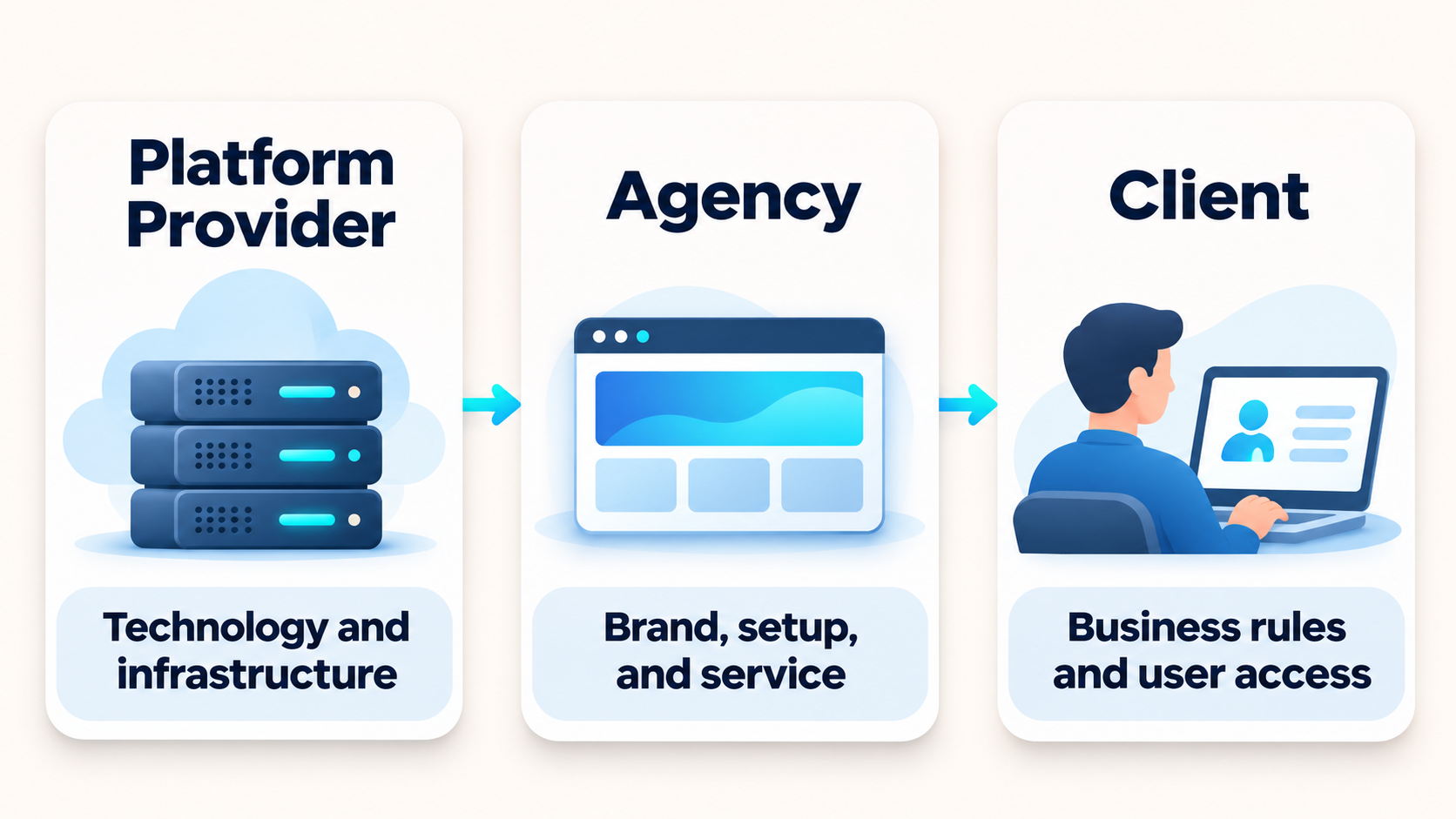
For example, a marketing agency might offer an AI lead-intake service to a local business. The provider supplies the platform. The agency maps the intake questions, configures the flow, and agrees how leads are routed. The client confirms what qualifies as a sales-ready lead and assigns someone to respond. If those roles are not written down, each party may assume another one is responsible when a lead is missed or an answer is wrong.
A clear AI agent requirements brief gives each party a shared reference for purpose, allowed actions, information sources, and escalation rules.
What to Check Before Choosing a White-Label AI Provider
A white-label offer should be evaluated as both a product and a business relationship. Ask for demonstrations, written terms, and examples that match the service you intend to sell.
Branding and client experience
- Which screens, emails, links, and notifications carry your brand?
- Can you use a custom domain, and who manages its setup and renewal?
- Are provider names or badges visible anywhere in the workflow?
- Can you create a client account and view the service as that client?
Billing and commercial rights
- Can you invoice clients directly, or must the platform provider bill them?
- Can you set your own prices, billing cycles, usage limits, and refund terms?
- How are usage charges calculated and passed through?
- What happens to prepaid balances or open invoices when a client leaves?
Data and exit
- Who owns each type of data and configuration?
- Can you export client records, conversations, files, prompts, and settings?
- What is deleted at termination, and when?
- Can the client continue with another provider or migrate its own materials?
Platform operation and support
- Which product issues are handled by the provider, and what response commitments apply?
- What support are you expected to provide to your own client?
- How are outages, security incidents, and product changes communicated?
- Can your team see usage and errors across separate client workspaces?
Capabilities and fit
- Which agents, channels, models, integrations, and usage limits are included?
- Can the platform connect to the client’s required systems? Review the specific AI agent integration requirements rather than relying on a general capability claim.
- Which functions can your team configure without provider assistance?
- What will change if the provider retires a feature or modifies its terms?
Compare providers against the work you plan to deliver, not the number of features on a page. A white-label AI platform comparison can help you build a shortlist, but verify current terms directly with each provider.
See what your brand controls in a white-label AI platform
Review branding, workspaces, billing, support, and client access together.
A Simple Decision Framework
White-label AI may fit when the business wants to own the customer-facing offer and service delivery but does not want to build and operate every part of the technology stack. It may be a poor fit when the business needs exclusive control over the underlying code, infrastructure, model behavior, or data architecture and the provider cannot meet those requirements.
Use these questions to decide what to investigate next:
- What is the client buying? A software login, a configured agent, or an ongoing managed service?
- What must carry your brand? Define the exact screens, domains, communications, and client touchpoints.
- Which rights do you need? Separate branding, resale, billing, data access, and configuration rights.
- Which work can your team reliably deliver? Include setup, quality checks, client training, and support.
- What costs change as usage grows? Model platform, usage, labor, and support rather than assuming a fixed margin.
- How can you leave the provider? Review data export, deletion, migration, notice periods, and client continuity.
A staged agentic AI implementation plan can help test the offer with limited scope before adding more clients, channels, or actions.
A One-Page Worksheet for Defining the Offer
Before you add a white-label service to a proposal, write down the customer experience and the operating boundaries in one place. This helps the provider, your team, and the client agree on what the brand promise includes.
- Client and problem: Which type of customer is the offer for, and what repeatable problem will the AI service help address?
- Service and channel: What should the agent do, where will the client use it, and which systems does it need?
- Information and permissions: Which approved sources can it use, which actions can it take, and which actions need human approval?
- Your brand: Which screens, URLs, emails, and support touchpoints will use your identity? Which will still identify the provider?
- Included work: What setup, training, routine review, and support are included in the fee? What counts as a change request or out-of-scope work?
- Provider dependency: Which platform capabilities, support commitments, and service conditions does your offer rely on?
- Client responsibilities: Who supplies current information, approves access, monitors business outcomes, and responds to escalations?
- Commercial boundaries: How are usage, platform fees, payment failures, refunds, and termination handled?
- Exit path: How can data and configurations be exported, transferred, or deleted if the arrangement ends?
A concise offer statement can make the boundaries visible: “Under [your brand], [client type] can use [agent task] through [channel], based on [approved sources]. We handle [included setup and support]. The client owns [business decisions and inputs]. The provider supplies [platform services]. [Sensitive actions] require [review or approval].” Replace each bracket with an agreed term before using it in a proposal.
This worksheet does not replace the provider agreement or the client contract. It makes the terms easier to compare and exposes unanswered questions before a client assumes the label means more than it does.
Common White-Label AI Misunderstandings
“If it has my logo, I own the product.”
Branding rights and product ownership are different. The provider may retain the software and infrastructure while granting the right to present the service under your brand. Read the license and data terms.
“The provider stays invisible in every situation.”
A white-label interface may remove provider branding from defined screens. The provider may still appear in payment receipts, support emails, service terms, connected applications, or technical notices. Inspect the full journey and confirm it in writing.
“My agency automatically owns the customer relationship.”
The business may manage sales and first-line support, but the contract can define who controls accounts, billing, renewals, and direct provider contact. Confirm how these responsibilities work before promising exclusivity.
“The platform fee determines my margin.”
Platform fees are only one cost. Setup, training, monitoring, usage, payment processing, and support all affect contribution. Model the work involved in the promised service.
“White-label means no technical responsibility.”
A provider may operate the infrastructure, but the business still needs to choose suitable workflows, configure access, validate results, and communicate limitations. Read white-label AI for agencies for the separate delivery and service-building discussion.
Frequently Asked Questions
What is white-label AI in simple terms?
It is AI software or a service supplied by one provider and presented to customers under another company’s brand, within the rights defined by their agreement.
Is white-label AI the same as reselling?
Not always. Reselling can mean selling access to a provider-branded product. White-label arrangements typically allow more control over the client-facing brand, but the exact rights, billing, and account controls vary.
Does white-label AI mean I own the software?
Usually, the term alone does not grant software ownership. A provider may license the platform while allowing another business to brand or resell it. Check the contract for software, configuration, content, and data rights.
Can I choose my own prices?
Some programs let partners set client prices; others impose billing rules or charge customers directly. Confirm the provider’s current commercial terms and calculate your service costs before setting rates.
Who supports the end customer?
It depends on the agreement and service package. The provider may handle platform defects while the agency answers workflow and configuration questions. Define first-line support, escalation, and incident communication in the client agreement.
Is white-label AI a good fit for a small agency?
It can be, if the agency has a clear customer problem to solve, understands the work it is taking on, and can support the promised service. Start with one focused offer and verify costs and responsibilities before expanding.
How is white-label AI different from a done-for-you AI service?
White-label usually describes branding and resale rights for technology or a service. Done-for-you describes who builds or manages the solution. A provider may offer both, but they are separate parts of the commercial arrangement.
Final Thought
White-label AI can let a business offer AI capabilities under its own brand while relying on a provider for some or all of the underlying platform. The value is not the label by itself. It comes from a client experience, service scope, and commercial model your team can explain and deliver.
Before committing, separate brand rights from ownership, billing, data access, and operating responsibilities. Then test the real client journey and calculate the work and cost behind the promise. A clear agreement makes the business model easier to price, support, and scale responsibly.
Build a white-label offer your team can deliver
Compare your service scope with the platform behind it.
