
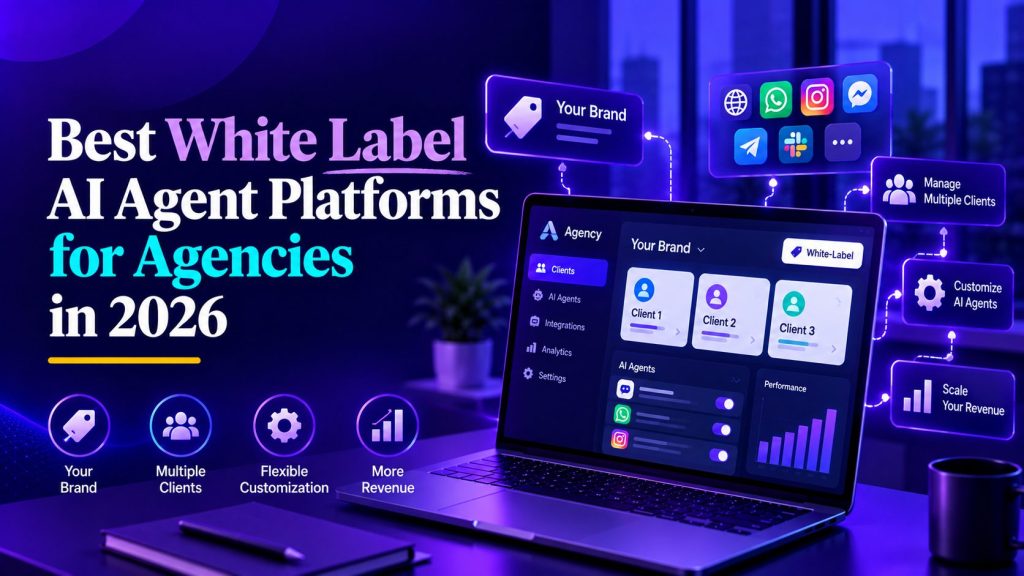
Agencies selling AI services face a different set of requirements than businesses building an AI agent for their own use. If you are running an agency that builds AI agents for clients, you need more than a tool that generates chatbot responses. You need a platform that lets you operate under your own brand, manage multiple client environments separately, control access and permissions, deploy agents across the channels your clients actually use, and set your own pricing without the underlying vendor inserting itself into the relationship.
This distinction matters because choosing a white-label platform is not the same as choosing an ordinary AI agent builder. A platform that works well for a single business automating its own support may be a poor fit for an agency that needs to spin up ten isolated client workspaces under its own domain. The platforms in this comparison are evaluated specifically for agency use cases: white-label depth, client management, reseller controls, and the agent capabilities that matter when you are delivering this as a service rather than using it internally.
Key Takeaways
- White-label depth varies considerably between platforms. Some provide a fully branded dashboard, custom domain, client workspaces, and billing controls, while others make white labeling available through a separate agency or partner program.
- Botsify and Lety.ai combine white-label infrastructure with multi-client management, omnichannel deployment, and agency billing or reseller controls.
- Stammer AI combines chat and voice agents with white-label branding, client sub-accounts, and flexible usage resale for agencies.
- Autocalls is primarily designed for agencies selling AI voice agents, with unlimited client sub-accounts, custom branding, and client billing through the agency’s own Stripe account.
- Evoriqa focuses on white-label AI customer support, using branded client workspaces, pooled credits, per-client spending limits, and agency-controlled billing.
- BotPenguin provides white-label AI agents through its partner program rather than its standard chatbot plans.
What Is a White Label AI Agent Platform?
A meaningful white label AI for agencies setup usually goes beyond removing a logo. Agencies may need their own domain and branding, separate client workspaces, control over client access, and the ability to package or bill the service themselves.
The exact level of white labeling varies by platform, so agencies should verify what clients actually see, how client accounts are managed, and whether the vendor remains visible anywhere in the customer experience.
Portable AI Agents In Seconds, Use Everywhere
Prompt, Test, and Deploy AI Agents Across Social Platforms and LLMs. Automate Everything.
Quick Comparison of the Best White Label AI Agent Platforms
| Platform | White-label depth | Custom domain | Client/sub-account management | Chat/voice capabilities | Reseller or billing controls | Best suited for |
| Botsify | Full white-label with zero vendor visibility | Yes | Client packages/workspaces with usage controls | Chat + Voice + SMS + social channels | Markup on LLM tokens, MCP calls, setup fees; 4 revenue streams | Agencies needing full omnichannel + billing infrastructure |
| Stammer AI | Full white-label on Pro plan ($99/mo) | Yes | Sub-accounts with separate wallets | Chat + Voice (chat agents + voice agents) | Agency Wallet; set your own prices for replies, minutes, agents | Agencies reselling both chat and voice AI agents |
| Lety.ai | Full white-label on all paid plans from $97/mo | Yes | Client sub-accounts (2 on Starter, 10 on Standard, unlimited on Unlimited) | Chat + Voice + multi-channel deployment | Flat platform fee + pass-through LLM/WhatsApp costs; you set client pricing | Agencies wanting flat-fee pricing and vertical-specific templates |
| BotPenguin | White-label through partner program | Not specified on standard plans | Via partner program | Chat + Voice + WhatsApp + Instagram + Facebook + Telegram + MS Teams + SMS | Partner program with referral/resell/white-label paths | Agencies that prioritize social messaging channels and WhatsApp |
| Autocalls | Full white-label on Agency White Label plan ($419/mo) | Yes | Client sub-accounts with your Stripe billing | Voice-first (AI phone calls + WhatsApp chatbot) | Your brand, your Stripe, your prices; 300+ integrations | Voice-focused agencies and call center automation |
| Evoriqa | Full white-label with branded workspaces | Supported custom domain | Client workspaces with pooled credits + per-client caps | Chat + Voice (phone on every plan) + WhatsApp + Instagram + SMS | Bill on your own Stripe; reseller plans from $79/mo (5 clients) | Agencies reselling AI customer support under their brand |
Best White Label AI Agent Platforms for Agencies
-
Botsify
Botsify’s white-label AI agent platform is designed as a broader infrastructure layer for AI agencies rather than just an agent builder. The platform focuses on four operational layers: building agents, branding the experience under the agency’s domain, billing clients through the agency’s own invoices, and scaling across multiple clients.
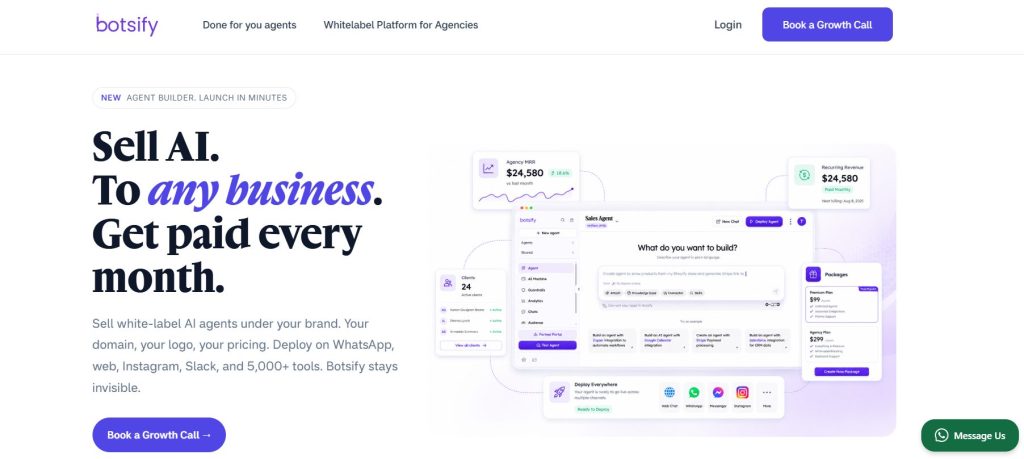
AI agent capabilities. Botsify’s agent builder lets you describe a client’s industry in one sentence and generates a system prompt automatically. It indexes files from PDFs, URLs, and Google Drive, supports 600+ MCP integrations for connecting external tools, and deploys agents across multiple channels simultaneously.
White-label functionality. Botsify offers custom domain support with included SSL so clients access their dashboard at app.youragency.com. Your logo appears on every screen including the login page, dashboard, and client portal. Botsify claims zero vendor visibility, meaning no “powered by” badge, no links back to Botsify, and no Botsify branding anywhere the client can see.
Client and sub-account management. The platform provides client packages that function as isolated environments with their own agents, usage tracking, and billing. Agencies manage multiple clients from a single dashboard.
Reseller and billing controls. Botsify structures its billing around four revenue streams: subscriptions, token markup, MCP call markup, and setup fees. Agencies can mark up LLM tokens and MCP calls by 3x, 5x, 10x or whatever multiple they choose. Clients receive a single invoice under the agency’s brand, and free trials can be configured on the agency’s own terms (7, 14, or 30 days).
Channels and integrations. Botsify supports website chat, WhatsApp, Instagram, Messenger, Telegram, Slack, SMS, and voice, alongside CRM and business-tool connections. The platform supports 600+ MCP integrations and 50+ channel and CRM connections.
Pricing. Botsify offers separate plans for businesses and agencies. Its Done-for-You Agent plan costs $149 per month or $1,490 per year and includes unlimited agents, 30,000 monthly credits, 60 voice minutes, and BYOK support. Agencies looking for the white-label platform use a separate agency plan with custom branding, unlimited client workspaces, reselling rights, pay-as-you-go client management, and dedicated partner support, with pricing based on the agency’s requirements.
Best for. Agencies that want deep white-label control across a wide range of channels with built-in billing infrastructure to manage multiple revenue streams per client.
-
Stammer AI
Stammer AI combines white-label chat and voice agents with a reseller system designed for agencies. Its Pro White Label plan includes branded client experiences, sub-accounts, chat and voice agents, and controls for reselling AI usage at agency-defined prices.
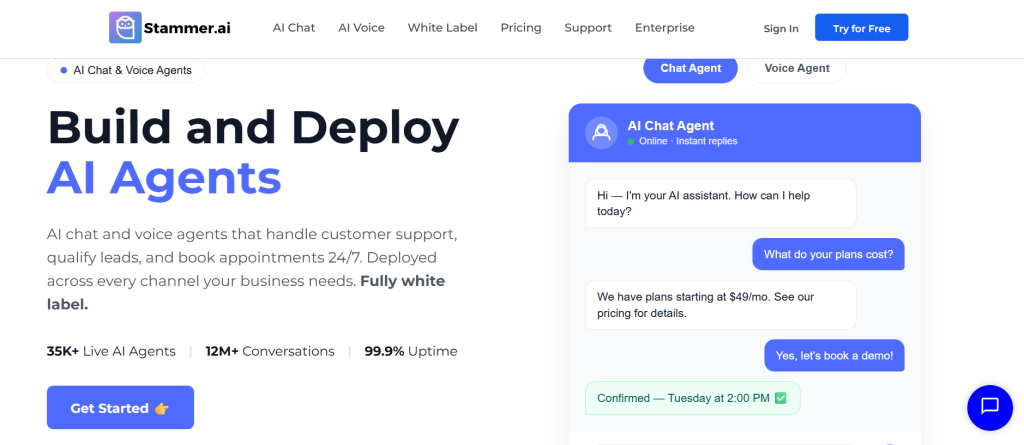
AI agent capabilities. Stammer provides both chat AI agents and voice AI agents. Chat agents handle website, SMS, and messaging channel conversations with knowledge retrieval, lead collection, and scheduling. Voice agents handle inbound and outbound phone calls with natural conversation flow. The platform supports MCP for connecting external data sources and tools.
White-label functionality. The Pro plan removes all Stammer branding and allows the agency to use its own domain, logo, and colors across the entire experience including the dashboard, login, and client-facing portal. Stammer also offers a White Label API that presents API endpoints under the agency’s own domain for client-facing integrations.
Client and sub-account management. Each client gets a sub-account with its own wallet. Clients preload funds into their sub-account wallet, and Stammer deducts usage at the price the agency sets. The agency manages all sub-accounts from a single dashboard.
Reseller and billing controls. Stammer’s Agency Wallet lets agencies set their own prices for chat replies, voice minutes, and agents. Agencies can also charge setup fees and recurring subscriptions. The Pro plan includes five chat agents and five voice agents, with additional agents available for $10 per month each.
Communication channels. Stammer supports web chat, Facebook, Instagram, WhatsApp, SMS, and phone calls. Voice agents include features like voice cloning and appointment booking.
Integrations. The platform offers basic integrations on the Standard plan and full access to every channel and connector on the Pro plan. MCP support is included on Pro, and agencies can bring their own LLM API keys (OpenAI, Anthropic, etc.) to control model costs directly.
Pricing. Pro White Label costs $99 per month and includes five chat agents, five voice agents, full white-label branding, reseller controls, advanced AI models, and access to all channels and connectors. Additional chat or voice agents cost $10 per month each.
Best for. Agencies that want to resell both chat and voice AI agents with branded client experiences and usage-based pricing controls.
-
Lety.ai
Lety.ai uses a flat monthly platform fee with LLM-token and WhatsApp-session costs passed through at vendor rates. Agencies set their own client pricing, while white-label branding and unlimited agents are included across its paid plans.
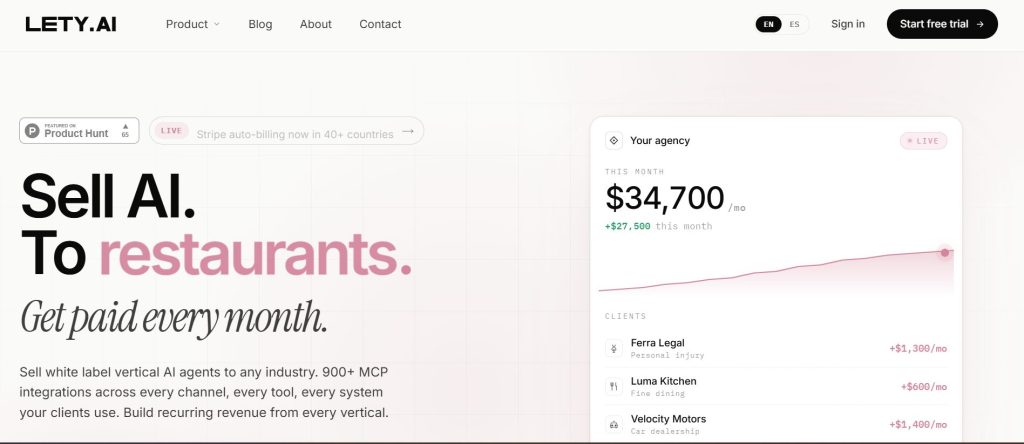
AI agent capabilities. Lety ships with pre-configured agents for 12 industry verticals and 46 specific niches. Each niche comes with prompts, playbooks, and integrations. The agent builder lets you pick an industry and niche, write a one-sentence brief, upload files, connect MCP tools, and deploy. Supported AI models include GPT-4o, Claude 3.5, Gemini Pro, and Llama 3. Agencies can bring their own API keys.
White-label functionality. Full white-label branding is included on every paid plan. The agency gets a custom domain (app.youragency.com), its own logo and colors on every screen, and Lety never appears to end clients. The platform emphasizes that clients see “zero Lety anywhere.”
Client and sub-account management. Client capacity varies by plan: Starter ($97/mo) includes 2 client sub-accounts, Standard ($297/mo) includes 10, and Unlimited ($497/mo) includes unlimited sub-accounts. Each client receives a branded workspace for managing their AI agents.
Reseller and billing controls. Agencies set their own client pricing while Lety charges a flat platform fee. LLM tokens and WhatsApp session fees are passed through at vendor cost without additional markup from Lety, allowing agencies to separate their service margin from underlying usage costs.
Communication channels. Lety supports multi-channel deployment across web, WhatsApp, Instagram, Facebook, SMS, email, and other connected channels, with broader business-tool connectivity through its MCP ecosystem.
Integrations. 900+ MCP integrations across LLMs, CRMs, payment processors, calendars, and automations. Native support for Stripe, Shopify, WooCommerce, PayPal, Square, Calendly, HubSpot, Gmail, and many others.
Pricing. Starter $97/mo (2 sub-accounts, 4.9% transaction fee). Standard $297/mo (10 sub-accounts, 2.9% transaction fee). Unlimited $497/mo (unlimited sub-accounts, 1.9% transaction fee, dedicated account manager). All plans include a 7-day trial. LLM tokens and WhatsApp session fees are pass-through at vendor cost.
Best for. Agencies that want predictable platform costs and pre-configured vertical agents, particularly those serving specific industries like healthcare, real estate, legal, hospitality, and e-commerce.
-
BotPenguin
BotPenguin combines AI chatbots, voice agents, and broad messaging-channel support with a dedicated partner program for agencies that want to white-label or resell the platform.
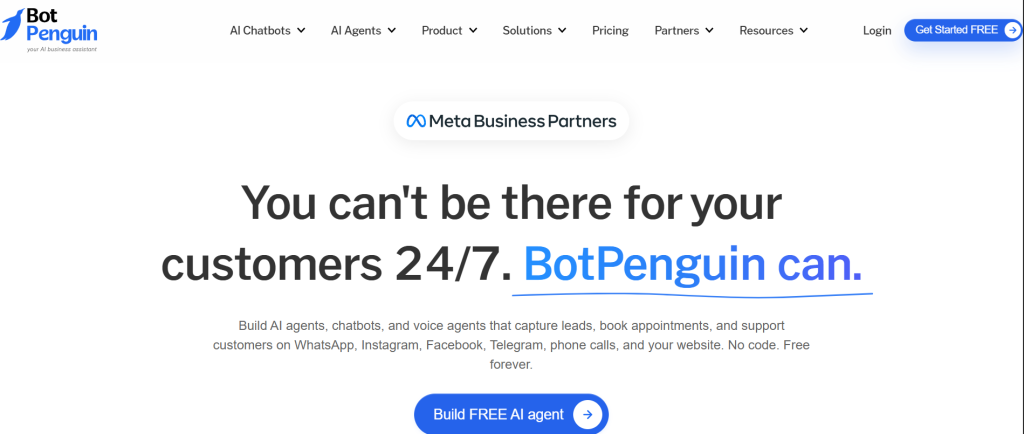
AI agent capabilities. BotPenguin provides a no-code builder for AI agents, chatbots, and voice agents. The platform supports LLM integration with OpenAI models, knowledge base training from website content, PDFs, and FAQs, and configurable AI bot personality. It includes intent-based chat routing, live chat with human handoff, and appointment booking.
White-label functionality. BotPenguin’s white-label capabilities are delivered through its partner program rather than being included in standard plans. The partner program offers three paths: white-label (own the platform under your brand), reseller (sell BotPenguin with commissions), and affiliate (promote for referral fees). White-label partners get their own branded platform with custom domain, logo, and colors. The standard plans (Free, Little at $29/mo) do not include white-label branding.
Client and sub-account management. Multi-client management and white-label client accounts are available through BotPenguin’s partner program, allowing agencies to manage client deployments separately under their own branding.
Reseller and billing controls. BotPenguin offers separate white-label and reseller partnership models. White-label partners can brand the platform, set their own client pricing, and retain the revenue they generate, while the reseller program uses a commission-based model.
Communication channels. BotPenguin has strong social messaging channel coverage including WhatsApp, Instagram, Facebook, Telegram, website chat, Microsoft Teams, and SMS. It is an official Meta Business Partner for WhatsApp and Facebook chatbot solutions.
Integrations. 80+ integrations available including Shopify, Google Calendar, Zendesk, and common business tools. The platform also supports mobile apps for iOS and Android.
Pricing. BotPenguin’s white-label partner program starts at $600 per year, while its separate reseller program starts at $500 per year. AI-agent functionality is available on higher white-label tiers, so agencies that specifically need AI agents rather than standard chatbot functionality will need an appropriate partner plan.
Compliance. BotPenguin lists ISO 27001, SOC 2, HIPAA, GDPR, and CCPA among its security and compliance credentials.
Best for. Agencies focused on WhatsApp, social messaging, and omnichannel customer engagement that want a dedicated white-label partner program.
-
Autocalls
Autocalls is a voice-first platform built around inbound and outbound AI calling, with white-label infrastructure for agencies that want to resell voice automation.
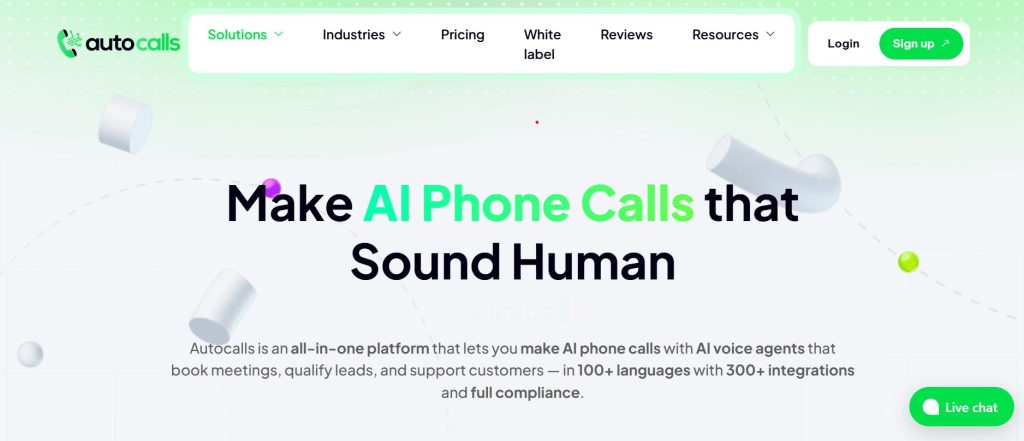
AI agent capabilities. Autocalls provides AI voice agents for inbound and outbound phone calls. Capabilities include AI receptionist services, cold calling, appointment booking, call center automation, and voice cloning. The platform supports 100+ languages with regional accents and offers phone numbers in 150+ countries. It also includes a WhatsApp AI chatbot, though its chat capabilities are secondary to its voice offering.
White-label functionality. The Agency White Label plan ($419/mo or $355/mo with yearly billing) provides full white-label branding with your own domain, logo, and colors. Autocalls branding is completely invisible to your clients. The white-label plan includes unlimited assistants, unlimited outbound campaigns, 1,000 parallel calls, unlimited cloned voices, and unlimited no-code automation runs.
Client and sub-account management. The Agency White Label plan includes unlimited client sub-accounts. Clients get their own login under the agency’s domain with their own plans and billing managed through the agency’s own Stripe account. Each client sub-account can have its own configuration, phone numbers, and voice agents.
Reseller and billing controls. Agencies set their own prices and bill clients through their own Stripe account. The white-label plan has no revenue share or per-client fee, allowing agencies to control both recurring plans and usage-based pricing.
Communication channels. Primarily voice calling (inbound and outbound) with WhatsApp AI chatbot support. The platform does not emphasize website chat, Instagram, Facebook Messenger, or other social messaging channels in the way that Botsify or BotPenguin do.
Integrations. 300+ integrations including HubSpot, Salesforce, GoHighLevel, Calendly, Google Calendar, and Apple Calendar. The platform also supports SIP integration for bringing your own phone numbers.
Pricing. Agency White Label costs $419 per month and includes 3,500 voice minutes, unlimited client sub-accounts, 1,000 parallel calls, custom branding and domain support, and client billing through the agency’s own Stripe account. Additional voice usage is charged at $0.09 per minute.
Security. Autocalls states that it is ISO 27001 certified and GDPR compliant, with HIPAA support available for relevant deployments and a 99.9% uptime SLA.
Best for. Agencies that specialize in AI voice calling solutions, call center automation, and phone-based client services such as real estate, healthcare, debt collection, and service businesses that rely heavily on telephone communication.
-
Evoriqa
Evoriqa is built specifically for agencies that want to resell AI agents for customer support under their own brand. It is notably transparent about its pricing and client economics.
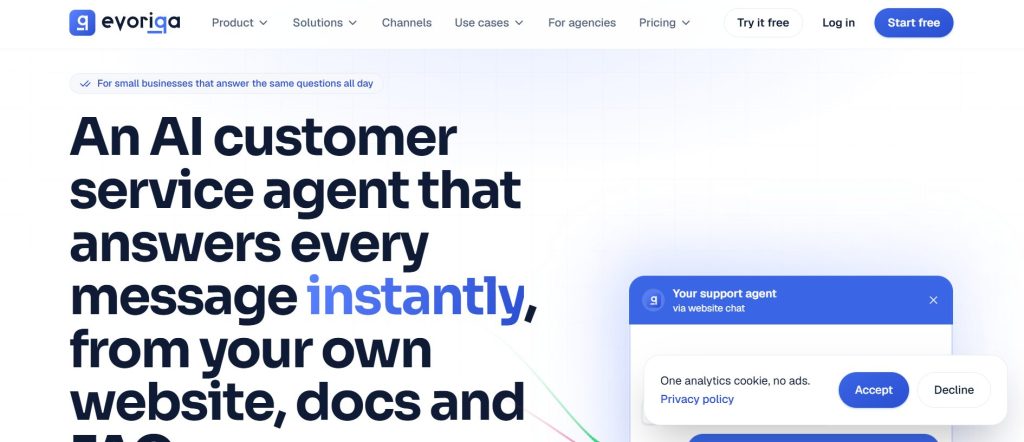
AI agent capabilities. Evoriqa’s agent is designed for customer support use cases. It learns from website content, documents, and FAQs, then answers questions across chat, WhatsApp, Instagram, SMS, and phone calls. The platform includes a playground to test answers before going live, source citations for every answer, confidence scoring (0-100), and a shadow mode where the AI drafts replies for a human team to approve before gaining autonomy.
White-label functionality. Evoriqa provides branded client workspaces with the agency’s logo and colors on the dashboard, chat widget, and supported email domains. The chat widget can drop its badge entirely on plans that include branding removal. Custom domain support is available. Evoriqa emphasizes that they contract with the agency, never with the agency’s clients, and that clients never see or contact Evoriqa.
Client and sub-account management. The agency manages all clients from a single reseller console. Each client gets its own branded workspace with its own knowledge base, channels, and settings. The agency can provision workspaces itself or enable self-serve signup on the agency’s domain. The agency retains read-only access to every client workspace without taking a seat on the client’s team.
Reseller and billing controls. Evoriqa uses a pooled credit model. The agency gets one monthly credit pool shared across clients, with per-client spend caps so a single client cannot drain the pool. Billing happens on the agency’s own Stripe account with the agency’s own plans, prices, and payouts. Evoriqa does not interact with the agency’s clients on billing.
Communication channels. Evoriqa supports website chat, WhatsApp, Instagram, SMS, email, and phone, with voice usage handled through the platform’s shared credit system.
Integrations. The platform includes REST API access with scoped keys, signed webhooks, and agentic actions for booking appointments and lead capture. Specific third-party CRM integrations are not detailed on the public pages.
Pricing. White-label reseller plans start at $79 per month for up to five client workspaces. Higher tiers increase client capacity, with Growth at $249 per month for 30 workspaces and Pro at $499 per month for 70. The reseller plans use pooled AI credits with per-client spending controls.
Best for. Agencies that want to resell AI-powered customer support with transparent per-client economics, particularly those serving clients who need a combined chat and phone answering solution.
AI Agentic Platform For Building Portable AI Agents
Say Hello To Agentic AI That Connects With Your CRM And Even Other Agents
How to Choose a White Label AI Agent Platform for Your Agency
A long feature list does not necessarily make a platform a good fit for an agency. The more important question is whether the platform supports the way you plan to deliver, manage, and charge for AI services across multiple clients.
1. White-Label Depth and Vendor Visibility
White labeling can mean anything from removing a small badge to replacing the entire client-facing experience with your own brand. Check what actually changes across the login page, dashboard, client portal, agent widgets, notifications, and other surfaces your clients will see.
Custom-domain support is especially important if clients will log into the platform themselves, and it should come with automated certificate management so SSL certificates on client-facing domains renew on time. Also consider whether the original vendor remains visible through documentation, support links, emails, invoices, or other parts of the client experience. The level of white labeling you need will depend on whether you simply deliver managed agents or want clients to feel that they are using your own software platform.
2. Client Workspaces and Access Controls
Managing one client is very different from managing twenty. Each client should have a clearly separated environment for its agents, knowledge sources, integrations, usage, and team access.
Look for native client workspaces or sub-accounts rather than relying on separate logins and manual tracking. Permission controls also become increasingly important as the agency grows. Clients may need access to reporting or agent settings without being able to see other customers, agency-level billing, or infrastructure they should not control.
3. Reseller Pricing and Billing
The platform’s billing model directly affects how you can package your service. Some platforms let agencies set subscriptions, mark up AI usage, add setup fees, or bill through their own Stripe account. Others charge a fixed platform fee and leave the agency to invoice clients separately.
Neither model is automatically better. What matters is whether it fits the business model of your AI automation agency. How you plan to sell AI agents also affects the billing controls you need. Agencies charging fixed retainers may value predictable platform costs, while usage-heavy services may benefit from stronger usage tracking and markup controls.
4. Agent Capabilities, Channels, and Integrations
A polished white-label dashboard has limited value if the underlying agents cannot handle the work your clients need. Evaluate whether agents can retrieve information from client knowledge, use external tools, perform actions, book appointments, update business systems, hand conversations to humans, and work with the AI models your projects require. For more complex client projects, well-designed AI agent workflows also determine how reliably agents can move between tools, actions, and human handoffs.
Channel coverage should reflect your target clients rather than the longest possible list. An agency selling voice automation has different requirements from one serving e-commerce brands through WhatsApp, Instagram, and website chat.
Integrations matter for the same reason. CRM systems, calendars, payment tools, ecommerce platforms, APIs, and MCP connections can determine how much additional development is required for each deployment. A broader integration ecosystem can reduce the custom connection work needed as your client base grows.
5. Deployment and Ongoing Management
Consider what happens after the first agent is built. Good AI agent implementation requires agencies to create new client environments efficiently, update knowledge, monitor usage, troubleshoot integrations, manage spending, and improve agents over time.
Templates and reusable configurations can make repeated deployments easier, especially if you serve similar businesses. Centralized monitoring is also useful as the number of client accounts grows, since problems that are easy to track across three clients become much harder across thirty.
6. Support and Scalability
The platform becomes part of the service you sell, so vendor support can affect your own client relationships. Look at onboarding assistance, agency support, account management, technical documentation, service reliability, and how the platform handles higher client volumes.
Also consider what changes as you scale. Pricing that works for five clients may look very different at fifty, while limits on workspaces, agents, channels, or usage can become more important over time. The right platform should fit not only the agency you have now but also the type of client operation you expect to manage later.
White Label AI Agent Platform vs Regular AI Agent Builder
A standard AI agent builder is typically designed for a business creating and managing agents for its own use. Agencies can still use these platforms for client projects, but they may need separate accounts, additional billing tools, or custom infrastructure to create a fully branded client experience.
White-label platforms add the business infrastructure agencies need around the agents themselves, such as branded client access, multi-client management, reseller pricing, billing controls, and clearer separation between client environments.
This distinction becomes more important when an agency wants to offer AI agents as an ongoing managed service rather than simply build an agent and hand it over.
Final Thoughts
There is no single white-label AI agent platform that fits every agency model. The right choice depends on the services you plan to sell, the channels your clients use, the level of branding and client control you need, and how you want to handle billing. Agencies that do not specifically need white-label infrastructure can also compare the broader market of AI agent platforms before deciding which type of platform fits their delivery model.
Botsify stands out for agencies that want a broader omnichannel offering with white-label client workspaces, reseller controls, and support for chat, messaging, voice, and external tools. Lety.ai is a strong fit for agencies that prefer flat platform pricing, vertical-specific agent templates, and extensive MCP connectivity. Stammer AI is particularly suited to agencies that want to package both chat and voice agents with usage-based resale controls.
Autocalls is much more specialized, making the most sense for agencies whose core offer revolves around AI phone calls and voice automation. Evoriqa is more focused on agencies reselling AI-powered customer support, while BotPenguin is worth considering when WhatsApp, social messaging, and omnichannel customer engagement are central to the service.
The important point is to compare the platforms against the business you actually want to build rather than choosing purely by feature count. A voice automation agency, a customer-support agency, and a full-service AI automation agency can reasonably end up choosing three different platforms.
FAQs About White Label AI Agent Platforms
What is a white label AI agent platform?
A white-label AI agent platform lets an agency build, deploy, and manage AI agents for clients under the agency’s own brand. The agency’s logo, domain, and branding appear on every client-facing surface, and the original platform vendor remains invisible to end clients.
Can agencies resell AI agents under their own brand?
Yes. Most platforms in this comparison are built specifically for this purpose. Agencies create agent workspaces for clients, brand them with their own logo and domain, set their own pricing, and manage everything from a single dashboard. Clients interact only with the agency’s brand.
What should agencies look for in a white label AI platform?
The most important criteria include white-label depth (how many surfaces get branded), custom domain support, client workspace isolation, reseller billing controls, the actual capabilities of the AI agents, supported communication channels, integrations with business tools, and the quality of agency support and onboarding.
What is the difference between white labeling and reselling AI software?
White labeling means the product is rebranded as your own. Clients see your name, your logo, and your domain, and they have no relationship with the original vendor. Reselling typically means selling someone else’s product as-is with a commission or discount structure, where the client may still interact with the original vendor.
Can white label AI agent platforms support multiple clients?
Yes. Agency-focused white label AI agent platforms typically support multiple clients through separate sub-accounts or workspaces. These environments can keep each client’s agents, knowledge, settings, usage, and access separate while allowing the agency to manage them from a central dashboard.
Can agencies set their own pricing for AI agents?
Platforms like Botsify, Lety.ai, Stammer AI, Autocalls, and Evoriqa all allow agencies to set their own client pricing. Some use a markup model where the agency pays wholesale rates and charges clients a premium. Others use a flat platform fee where the agency keeps everything it charges above that fee.
Are white label AI agents available for both chat and voice?
Several platforms offer both chat and voice capabilities under white-label branding. Botsify, Stammer AI, Lety.ai, and Evoriqa include both. Autocalls is primarily voice-focused but includes WhatsApp chatbot functionality. BotPenguin offers voice through its partner program alongside its chat and social messaging capabilities.
AI Agentic Platform For Building Portable AI Agents
Say Hello To Agentic AI That Connects With Your CRM And Even Other Agents
