
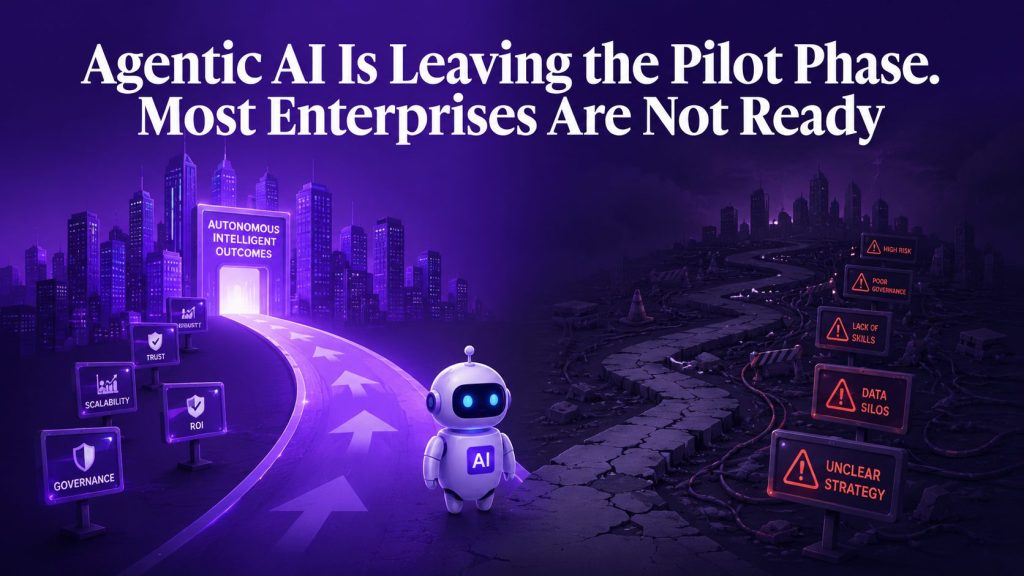
Artificial intelligence has moved beyond experimentation. Over the past two years, businesses have invested heavily in AI-powered tools, from coding assistants and customer support bots to workflow automation platforms. While these pilots have demonstrated the potential of AI, many organizations are discovering that running a successful proof of concept is very different from deploying AI across the enterprise.
This is where agentic AI implementation becomes the real challenge.
Many companies have already explored the capabilities of an AI agent, but only a small percentage have successfully integrated autonomous agents into their day-to-day operations. The organizations seeing measurable returns are not necessarily the ones experimenting with the latest models. Instead, they are the ones building the right processes, governance, and infrastructure to support AI at scale.
If the pilot phase proved that AI works, implementation determines whether it creates lasting business value.
What Is Agentic AI Implementation?
Agentic AI implementation refers to the process of integrating autonomous AI agents into real business workflows rather than using them as isolated productivity tools.
Unlike traditional automation, which follows predefined rules, agentic AI systems can make decisions, use multiple tools, retrieve information, and adapt their actions based on changing circumstances. This allows them to complete complex tasks while working alongside human teams.
If you’re new to the concept, learn more about agentic AI before planning an enterprise deployment.
Successful implementation goes beyond deploying software. It requires organizations to rethink how work is assigned, approved, monitored, and measured.
Why Most AI Pilots Never Reach Production
Many AI projects generate excitement during the testing phase but fail to become part of everyday business operations. This happens because organizations often focus on technology before addressing operational readiness.
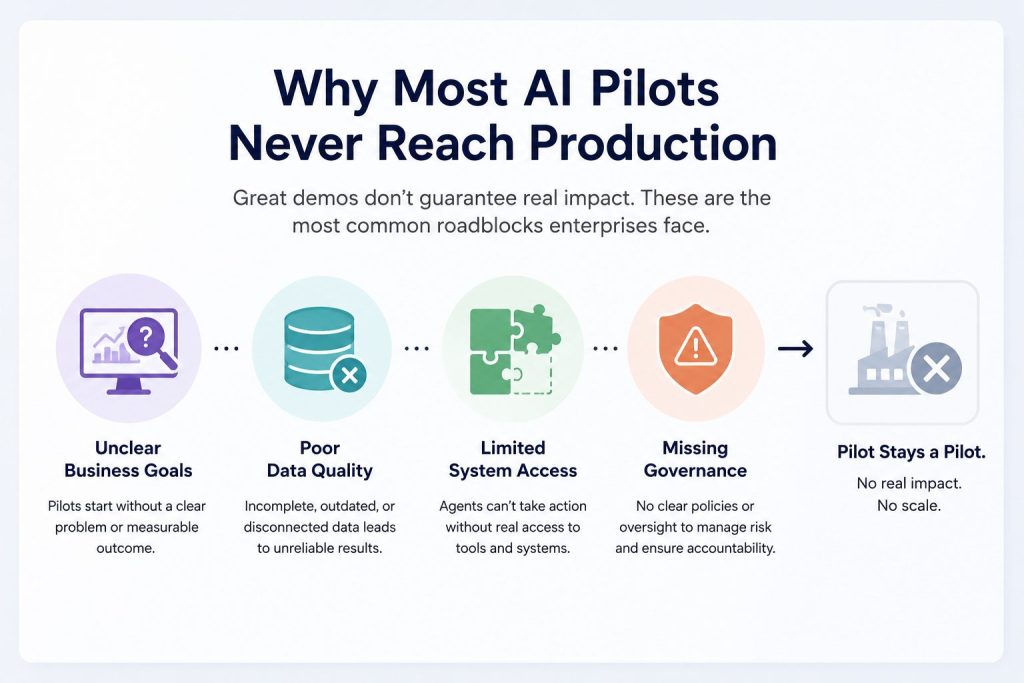
Some of the most common reasons include:
Lack of Clear Business Objectives
AI initiatives often begin because the technology is available rather than because a specific business problem needs solving.
For example, deploying an AI chatbot without defining success metrics such as reduced response times or increased customer satisfaction makes it difficult to evaluate its value.
Implementation should always begin with measurable business outcomes.
Poor Data Quality
Even the most advanced AI model depends on accurate and accessible information.
When company knowledge is spread across multiple systems, outdated documents, or disconnected databases, AI agents struggle to deliver reliable results.
Before expanding AI initiatives, organizations should ensure their knowledge base is current, structured, and easily accessible.
Limited System Access
Many AI demonstrations rely on mock environments that don’t reflect real business operations.
In production, an AI agent often needs permission to access CRM systems, help desks, ERP platforms, calendars, or internal documentation. Without secure integrations and proper access controls, the agent cannot complete meaningful tasks.
Missing Governance
As AI agents become more autonomous, organizations need clear policies defining what actions an agent can perform independently and when human approval is required.
Governance is no longer optional. It is a key part of successful agentic AI implementation.
Agentic AI Is an Operational Change, Not Just a Technology Upgrade
One of the biggest misconceptions surrounding enterprise AI is that deploying an AI platform automatically transforms business operations.
Technology alone rarely creates meaningful change.
Consider customer support as an example.
An AI agent capable of answering customer questions may significantly reduce response times. However, if every refund request still requires manual review from multiple departments, customers experience little improvement.
The same applies to procurement, HR, finance, and internal IT.
Organizations achieve the greatest value when they redesign workflows around AI instead of simply adding AI to existing processes.
Key Components of Successful Agentic AI Implementation
Moving from pilot projects to enterprise deployment requires a structured approach.
1. Start With Complete Workflows
Rather than automating individual tasks, identify complete business processes where AI can deliver measurable improvements.
Examples include:
- Employee onboarding
- Customer support
- Sales qualification
- Procurement approvals
- IT service requests
End-to-end workflows create opportunities for AI agents to deliver real business value instead of isolated productivity gains.
2. Build Reliable Integrations
AI agents perform best when connected to the systems employees already use.
This includes:
- CRM platforms
- Knowledge bases
- Communication tools
- Ticketing systems
- Internal databases
The quality of these integrations often determines whether implementation succeeds or stalls.
3. Define Human Oversight
Autonomous doesn’t mean unsupervised.
Organizations should establish clear escalation rules, approval workflows, and audit trails.
For example, an AI agent may resolve routine customer questions independently while escalating billing disputes to a human representative.
This balance improves efficiency without sacrificing accountability.
4. Measure Business Outcomes
Many organizations still evaluate AI projects based on usage statistics.
Metrics such as prompt volume or chatbot conversations provide useful operational insights, but they don’t necessarily reflect business impact.
Instead, measure outcomes such as:
- Reduced processing time
- Lower operational costs
- Faster issue resolution
- Increased customer satisfaction
- Employee productivity
- Revenue growth
These metrics demonstrate whether AI is delivering meaningful value.
Common Enterprise Use Cases
As agentic AI matures, organizations are expanding beyond simple chatbots into more sophisticated workflows.
Some practical examples include:
Customer Support
AI agents can classify tickets, retrieve account information, suggest solutions, and resolve common issues before escalating complex cases.
Human Resources
Agents can answer policy questions, guide new employees through onboarding, schedule training sessions, and assist with document requests.
IT Operations
Internal support agents can troubleshoot common technical issues, reset passwords, monitor incidents, and automate routine service requests.
Sales
AI agents can qualify inbound leads, personalize outreach, summarize customer interactions, and recommend next steps for sales teams.
Organizations planning to build AI agent solutions should begin with clearly defined workflows rather than attempting enterprise-wide automation from day one.
Building the Agentic Enterprise
Long-term success depends on creating an organization where AI agents operate as part of everyday business processes rather than isolated experiments.
One useful framework is presented in Elsewhen’s report, Building the Agentic Enterprise, which explores how organizations can gradually expand AI capabilities through connected workflows, governance, and continuous monitoring instead of attempting large-scale automation all at once.
The report emphasizes a practical progression: start with low-risk, high-frequency processes, measure outcomes carefully, and increase autonomy only as confidence grows.
This staged approach reduces implementation risk while helping organizations develop the operational maturity required for enterprise AI.
Preparing for the Next Phase of AI
The conversation around AI is shifting.
Early discussions focused on model capabilities, benchmark scores, and pilot projects. Today’s business leaders are asking different questions:
- How do we deploy AI securely?
- Which workflows should we automate first?
- How do we govern autonomous systems?
- What metrics demonstrate real ROI?
These questions highlight an important reality.
Competitive advantage no longer comes from simply experimenting with AI. It comes from implementing AI effectively across the organization.
Final Thoughts
The pilot phase has served its purpose. Businesses now understand what AI can do. The next challenge is making those capabilities part of everyday operations.
Successful agentic AI implementation requires more than deploying new technology. It demands reliable data, strong governance, well-designed workflows, measurable outcomes, and thoughtful human oversight.
Organizations that invest in these foundations will be better positioned to scale AI responsibly and unlock long-term value. Those that continue treating AI as a collection of disconnected experiments may struggle to move beyond impressive demonstrations toward meaningful business transformation.
AI Agentic Platform For Building Portable AI Agents
Say Hello To Agentic AI That Connects With Your CRM And Even Other Agents
