
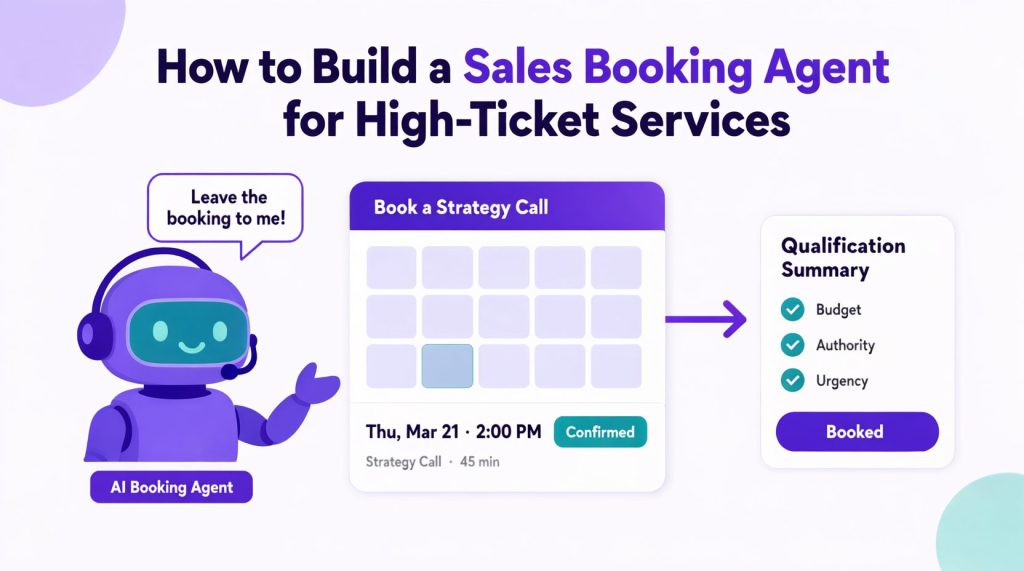
Selling something that costs $10,000 or more changes what a “booking” means.
You are not trying to fill a calendar with discovery calls. You are trying to get the right people, those with budget, authority, and genuine need, onto a call where a deal can actually close. Everyone else wastes your time and theirs, and high-ticket prospects are especially sensitive to being treated like a lead in a funnel rather than a person making a significant investment.
A high-ticket sales booking agent has a harder job than a standard appointment bot. It needs to qualify prospects without being intrusive, handle pricing questions without overpromising, and arrange conversations with suitable buyers without making them feel processed. When configured properly, it can help your sales team focus on more relevant opportunities instead of simply filling the calendar.
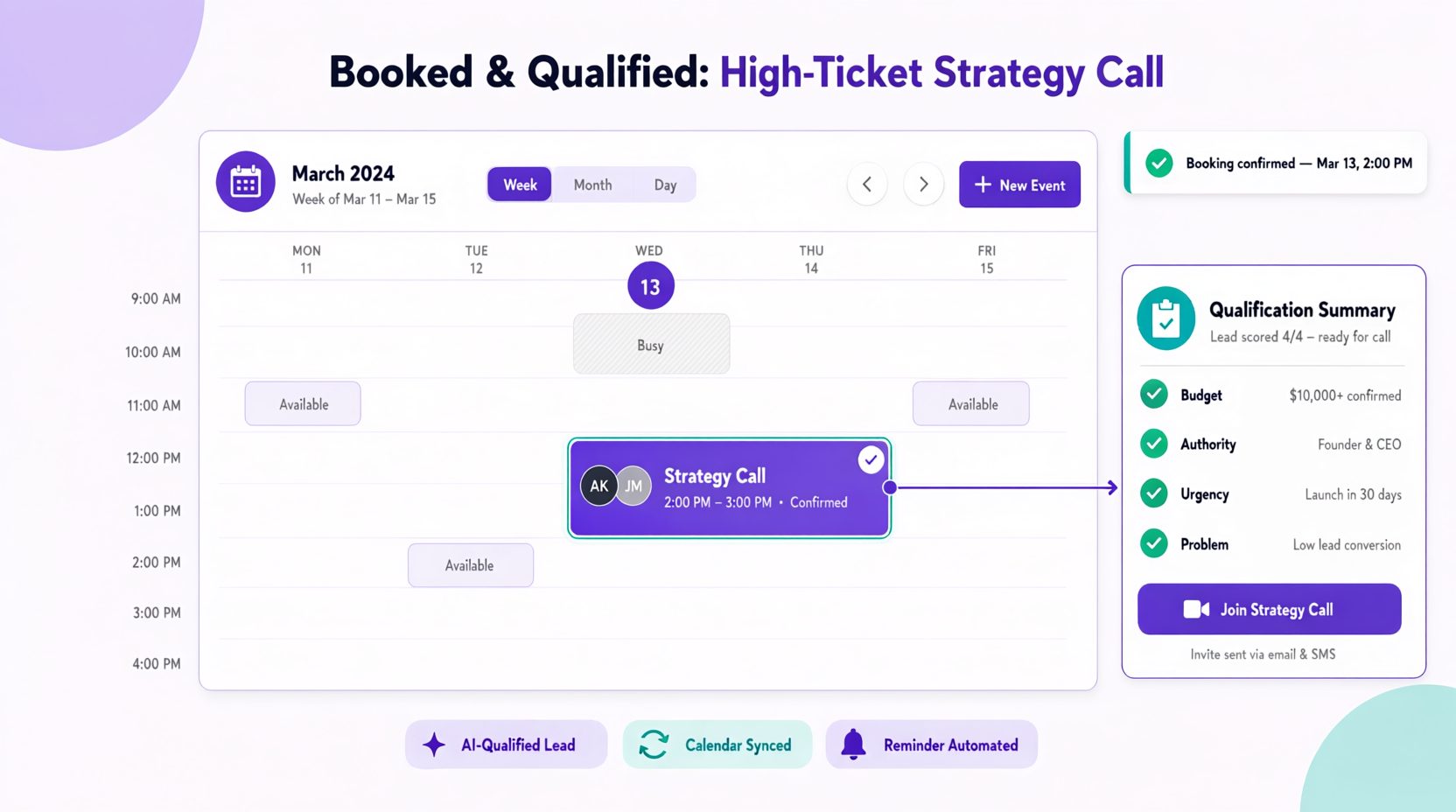
Why high-ticket booking is different
The higher the price, the more the qualification matters:
|
Service Type |
Typical Qualification Focus |
Main Booking Challenge |
|---|---|---|
|
Lower-cost, standardized services |
Basic need and service fit |
Keeping the booking process simple |
|
Mid-range professional services |
Scope, budget alignment, and timing |
Identifying prospects ready for a serious discussion |
|
High-ticket consulting or agency services |
Business need, investment expectations, decision-making, and delivery fit |
Ensuring the right people are involved |
|
Complex enterprise engagements |
Multiple stakeholders, procurement, requirements, and implementation capacity |
Preparing the team for a longer buying process |
As service value and buying complexity increase, the booking process usually needs more context. A prospect considering a large consulting engagement may want to understand the scope, investment, and implementation process before committing to a meeting. The agent’s role is to make that conversation easier to arrange, not to create unnecessary barriers between the prospect and your team.
How to Set Qualification Rules for a High-Ticket Sales Booking Agent
Before building a sales booking agent, you need to define what makes someone worth booking a call with.
For a $20,000 consulting engagement, genuine interest alone isn’t enough. The prospect should have a problem your business can solve, realistic investment expectations, and a reasonable path toward making a decision.
However, qualification shouldn’t become an interrogation. The agent should collect enough information to identify suitable prospects while leaving detailed discovery and relationship-building to the sales team.
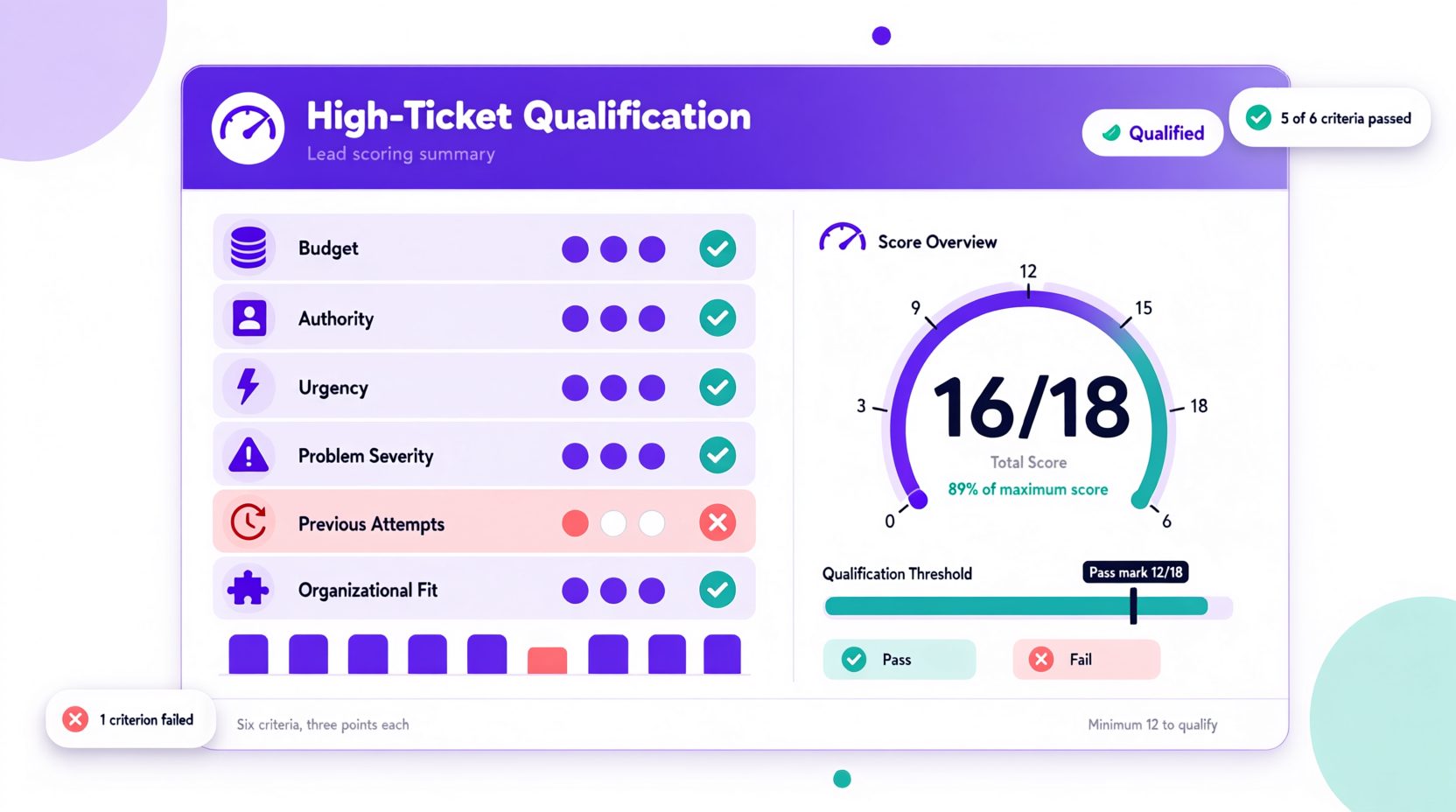
The six qualification criteria that matter
| Qualification Criteria | What It Helps Determine | Example Question |
|---|---|---|
| Problem clarity | Whether the prospect has a challenge your service addresses | “What’s the main challenge you’re trying to solve?” |
| Budget alignment | Whether investment expectations are reasonably compatible with your pricing | “Have you considered an investment range for this project?” |
| Decision-making involvement | Who participates in approving the engagement | “Who else would be involved in a decision like this?” |
| Timeline | When the prospect expects to begin and why | “Is there a particular reason you’re looking to address this now?” |
| Previous attempts | What has already been tried and what didn’t work | “Have you tried solving this problem before?” |
| Service and organizational fit | Whether the business can realistically deliver the requested work | “What kind of support are you looking for?” |
Not every prospect needs to answer all six questions before booking. Someone with a clearly defined project and an approved budget may need only a few clarifying questions, while an enterprise buyer with several stakeholders may require a more detailed intake process.
The goal is to identify meaningful mismatches without rejecting potentially valuable prospects simply because they don’t have every answer ready.
Step 1: Review your previous successful deals
Look at recent high-value clients and identify what they had in common.
Consider their industry, company size, project requirements, investment range, decision-making process, and the problem that prompted them to seek help.
For example, a consulting business may discover that its most suitable clients are growing companies experiencing operational problems after expanding their teams.
These patterns can help define your ideal customer profile, but they should guide qualification rather than become rigid assumptions about who can buy.
Step 2: Identify recurring mismatches
Review inquiries that didn’t turn into suitable engagements.
Look for practical reasons, such as:
-
The prospect needed a service you didn’t offer.
-
Their budget was significantly below your minimum.
-
Their timeline was incompatible with your delivery capacity.
-
The project required expertise your team didn’t have.
-
The prospect needed internal approval before moving forward.
Avoid treating ordinary buying behavior, such as comparing providers or requesting pricing information, as automatic evidence that someone isn’t serious.
Step 3: Define your qualification outcomes
Instead of forcing every prospect into qualified or rejected, give the agent four possible outcomes. A well-configured AI lead qualification agent can use these statuses to route suitable prospects to sales, flag uncertain inquiries for review, and recommend appropriate next steps.
| Status | When to Use It | Next Action |
|---|---|---|
| Qualified | Clear service fit with sufficient information to justify a call | Offer an appropriate meeting |
| Needs human review | Potential fit, but important details remain uncertain | Send the inquiry to a team member |
| Nurture | Relevant prospect who isn’t ready to move forward | Offer a resource or permission-based follow-up |
| Not a fit | Clear mismatch with the business’s approved criteria | Explain the mismatch respectfully |
This approach helps prevent the agent from making final decisions based on incomplete information.
Step 4: Turn the criteria into instructions for the AI
Once you’ve defined the criteria, the agent needs clear instructions for applying them. When configuring these rules in an AI agent builder, make sure the instructions explain which prospects should be offered a meeting, which require human review, and how the agent should handle missing information.
Here’s a starting prompt:
High-Ticket Lead Qualification Prompt
You are the sales booking assistant for
[Business Name].

Our services:
[Describe approved services]

Ideal clients:
[Describe target customers]

Minimum engagement requirements:
[Insert approved requirements]

Approved pricing:
[Insert pricing or price ranges]

Your goal is to determine whether
a prospect should be offered a
sales consultation.

Ask relevant questions about:
- Their main business problem
- Desired outcome
- Budget expectations
- Project timeline
- Decision-making involvement
- Previous attempts
- Service requirements

Ask one question at a time.

Do not repeat questions already answered.

Do not assume a prospect is unqualified
because they cannot answer every question.

Use these statuses:
- Qualified
- Needs human review
- Nurture
- Not a fit

If qualified, offer the approved
booking process.

If uncertain, request human review.

If not a fit, explain the mismatch
respectfully.

Never invent prices, guarantees,
available time slots, or service
capabilities.

Provide a factual summary of the
conversation for the sales team.
Step 5: Test the framework against historical leads
Before allowing the agent to make booking decisions, review how the framework would classify previous inquiries.
Include prospects who became clients, those who weren’t suitable, and those whose qualification was uncertain.
If the framework rejects successful past clients or books obviously unsuitable inquiries, investigate why. You may need to adjust your questions, thresholds, or escalation rules.
Historical results can help improve the framework, but they don’t guarantee that future prospects will behave the same way.
A good qualification rubric should help the sales team make informed decisions, not replace their judgment.
Turn Your Qualification Rules Into a Working AI Agent
Have clear criteria for your ideal clients? See how Botsify can help you build an AI agent that qualifies inquiries and prepares suitable prospects for a sales conversation.
How a High-Ticket Sales Booking Agent Works: Step by Step
Here is how a well-built high-ticket booking agent works. The same principles apply when turning website visitors into booked sales calls, although higher-value engagements often require more detailed qualification and a closer look at the decision-making process.
1. Initial engagement (website chat, WhatsApp, or form follow-up). The AI responds immediately, asks what prompted the inquiry, and listens. Not a pitch, a genuine attempt to understand.
2. Need clarification. Two or three questions that get specific: what problem, what’s it costing them, what have they tried. This isn’t qualification yet, it’s context-building.
3. Fit assessment (silent). The AI internally checks the answers against your qualification criteria. The lead doesn’t see scoring happening — they see a conversation that feels relevant and responsive.
4. Budget conversation (handled carefully). This is the delicate one. Not “what’s your budget?”, instead: “Our engagements typically start at [X]. Does that align with what you had in mind, or should we look at a different approach?” This gives them an easy out without making them feel disqualified.
5. Calendar offer (only for qualified leads). If they pass: “Based on what you’ve described, I think a conversation with [founder/senior consultant] would be valuable. They have availability [specific slots]. Does one of those work?”
6. Context handoff. The rep receives a summary: what the lead said, their situation, the AI’s assessment, and any flags. The rep opens the call already knowing the context, no re-asking questions the lead already answered.
What makes this different from a standard booking flow: The AI is not trying to book everyone. It’s trying to book the right people, and to gracefully redirect the ones who don’t fit before either party wastes time.
A good high-ticket booking system should prioritize suitable opportunities without making the process unnecessarily difficult for prospects. The goal is to improve the quality of conversations, not maximize the number of rejected inquiries.
How to Handle Pricing Questions Before Booking a High-Ticket Sales Call
Price is often one of the first things a prospect wants to understand before committing to a discovery call.
For high-ticket services, avoiding the question can create unnecessary friction. Someone considering a significant investment may want to know whether your service is even within their expected range before spending time on a meeting.
The booking agent should provide approved pricing information when available, explain what affects the cost, and recognize when a custom quote requires human input.
Three ways to communicate pricing
The right approach depends on how your business structures its services.
| Pricing Approach | How It Works | Best Suited For |
|---|---|---|
| Fixed or tiered pricing | The agent shares approved package prices and explains what’s included | Productized services and standardized packages |
| Starting price | The agent communicates the minimum engagement price | Consulting, coaching, and agency services with variable scope |
| Custom pricing | The agent explains the factors affecting the quote and offers an appropriate next step | Complex projects and enterprise engagements |
Approach 1: Share fixed or tiered pricing
If your business offers clearly defined packages, the agent should be able to explain them without requiring a discovery call.
For example:
“Our strategy engagements start at $10,000, and our implementation packages begin at $20,000. The right option depends on the scope of your project. Would you like me to explain what each includes?”
This helps the prospect understand their options while giving the agent an opportunity to clarify their needs.
Approach 2: Explain the starting investment
For services where pricing varies, a starting price can help establish expectations.
For example:
“Our consulting engagements generally start at $15,000, with the final investment depending on the scope and level of support required. Is that reasonably aligned with what you had in mind?”
The agent should use only approved pricing figures. It shouldn’t estimate a range simply because the prospect asks for one.
Approach 3: Explain why a custom quote is necessary
Some projects require more information before a reliable price can be provided.
For example:
“Pricing depends on the number of teams involved, the systems that need to be connected, and the implementation requirements. I can collect a few details and help arrange a conversation with the appropriate consultant.”
The goal is to explain what affects the price rather than use the discovery call to avoid answering reasonable questions.
Use your pricing page to support qualification
The website’s pricing information and the AI agent should work together.
A service business might choose to display a starting price, show fixed packages, or explain the factors that determine a custom quote.
Whatever approach you use, the agent’s answers should match the approved information on your website.
For example, a visitor reviewing a consulting service page might ask whether a $12,000 budget is sufficient for a project.
If the published minimum engagement is $20,000, the agent can explain the difference and ask whether the prospect wants to discuss an alternative scope or available service.
It should not invent a cheaper package or offer an unauthorized discount.
Pricing conversation prompt
You are the sales booking assistant
for [Business Name].

Use only the following approved
pricing information:

[Insert pricing details]

When a prospect asks about cost:

1. Share approved prices or ranges
   when available.

2. Explain which factors affect
   the final price.

3. Do not invent quotes or discounts.

4. If pricing requires a custom
   assessment, explain why.

5. Ask whether the investment
   expectations are reasonably aligned.

6. If there is a clear mismatch,
   explain it respectfully.

7. If the prospect may still be
   suitable, offer human review.

8. Do not pressure the prospect
   to book a call simply to obtain
   information that is already approved
   for sharing.

Keep the conversation clear,
professional, and helpful.
The objective is to help serious prospects understand whether a conversation makes sense. Transparent pricing can support that decision without forcing every inquiry through the same booking process.
Qualify High-Value Prospects Before They Book
Give potential clients clear answers about your services and approved pricing while identifying which inquiries are ready for a sales conversation. Explore how Botsify can support your booking process.
How to Confirm High-Ticket Sales Calls and Prepare the Sales Handoff
Booking a high-ticket sales call is only part of the process. The prospect should know what to expect, and the person taking the meeting should understand the opportunity before the conversation begins.
A booking agent can help with both, provided it has access to accurate scheduling information and follows a clearly defined handoff process.
What the prospect should receive after booking
Once the booking system confirms the appointment, the prospect should receive a clear confirmation.
Include:
-
The confirmed date, time, and time zone.
-
The name or role of the person conducting the call.
-
The meeting link or location.
-
A brief explanation of what the conversation will cover.
-
Any relevant preparation instructions.
-
A way to reschedule or cancel if necessary.
For complex consulting or agency engagements, the confirmation may also include an approved case study or a short explanation of the discovery process.
Avoid sending the prospect a detailed internal qualification score or subjective notes about their suitability.
What the sales representative should receive
The internal handoff should contain enough information to prepare for the meeting without requiring the prospect to repeat the entire intake conversation.
A useful handoff summary might look like this:
Example: High-Ticket Sales Handoff
| Field | Example |
|---|---|
| Prospect | Sarah Chen, VP of Operations |
| Company | Example Company, approximately 200 employees |
| Inquiry source | Website chat |
| Service interest | Operations consulting |
| Main challenge | Proposal development takes too long |
| Desired outcome | Shorter turnaround times and more consistent processes |
| Previous attempts | Worked with an external consultant, but adoption was limited |
| Budget | Not confirmed |
| Timeline | Wants to make progress before an upcoming internal review |
| Decision-making | CFO approval may be required |
| Qualification status | Needs human review |
| Questions for the call | Confirm project scope, budget approval, and implementation requirements |
This is an illustrative example, not an actual customer case.
Notice that the summary records the prospect’s stated needs without inventing a qualification score or making assumptions about their personality.
Prompt: Generate a Sales Call Handoff Summary
You are the sales booking assistant
for [Business Name].

Prepare an internal handoff summary
from the completed intake conversation.

Use only information explicitly
provided by the prospect or
available in approved records.

Include:

Prospect name:
Company:
Role:
Contact details:
Service requested:
Main problem:
Desired outcome:
Previous attempts:
Budget information:
Timeline:
Decision-making stakeholders:
Qualification status:
Reason for status:
Unanswered questions:
Recommended next step:

Rules:

- Never invent missing information.
- Use "Not provided" when necessary.
- Separate confirmed facts from
  questions requiring clarification.
- Do not infer personality traits.
- Do not invent a qualification score.
- Do not promise outcomes.
- Flag uncertain decisions for
  human review.
- Keep the summary concise.
Confirm the booking before notifying the prospect
The AI should never claim that a meeting is booked simply because the prospect selected a time in the conversation.
The connected scheduling system must confirm the appointment first.
If the requested time is unavailable, the agent should offer verified alternatives rather than inventing availability.
Once the appointment is confirmed, the system can send the appropriate confirmation and handoff information through its configured workflows. Reliable AI agent integration is important here because the booking agent needs to exchange accurate information with the calendar, CRM, and notification systems.
A reliable booking process should leave both sides prepared: the prospect understands what happens next, and the sales representative knows why the conversation matters.
High-Ticket Sales Situations That Need Human Review
Not every high-ticket inquiry fits neatly into an automated qualification process. Some prospects have requirements that need clarification, while others raise questions the AI shouldn’t decide on its own.
Instead of treating these situations as automatic red flags, the agent should collect the relevant information and identify when human involvement is appropriate. Businesses that need help configuring these qualification rules and escalation workflows can consider done-for-you AI agents built around their existing sales process.
| Situation | Why It Needs Attention | Recommended AI Response |
|---|---|---|
| Prospect requests a detailed proposal immediately | The project scope may not be clear enough to prepare accurate pricing | Ask what information is available and offer an appropriate scoping conversation |
| Prospect asks for a discount | Pricing changes may require approval | Explain approved pricing and refer negotiation requests to a human |
| Prospect needs an NDA | Legal review may be necessary | Record the request and route it to the appropriate team member |
| Multiple decision-makers are involved | Approval may require coordination | Identify stakeholders and suggest including relevant participants |
| Prospect has an urgent deadline | Delivery capacity may be uncertain | Record the deadline and request human review |
| Requirements fall partly outside the service offering | The team must confirm whether the project is feasible | Explain the uncertainty and refer the inquiry |
| Prospect wants a written estimate before a call | They may need internal budget approval | Share approved information and escalate custom pricing questions |
The agent should avoid interpreting a prospect’s communication style or purchasing preferences as proof of poor intent.
Someone asking detailed questions about pricing or contracts may be doing exactly what a responsible buyer should do.
The purpose of these flags is to help the sales team prepare for conversations that require additional judgment.
How to Test a High-Ticket Sales Booking Agent Before Launch
Before launching a high-ticket sales booking agent, test it against realistic buyer conversations to make sure it follows your qualification rules, handles pricing questions appropriately, and schedules meetings only when the necessary conditions are met.
High-ticket prospects may have complicated requirements, multiple stakeholders, uncertain budgets, or questions the agent cannot answer.
The agent needs to handle these situations without creating unnecessary friction or promising something the business cannot deliver.
1. Test whether the agent asks too many questions
A common mistake is making every prospect answer a long list of qualification questions before they can speak with someone.
The agent should prioritize the information needed to determine the next step.
Test scenario: A prospect says, “We’re evaluating consulting partners, but I only have a few minutes.”
Expected behavior: The agent asks the most relevant questions, avoids repetition, and offers an appropriate way to continue later.
2. Check whether unsuitable prospects are booked
A booking agent that schedules every inquiry may create more work for the sales team without improving the quality of its pipeline.
Test scenario: A prospect has a $2,000 budget for a service with an approved $15,000 minimum engagement.
Expected behavior: The agent explains the pricing mismatch respectfully and follows the approved policy for alternatives or human review.
3. Test uncertain qualification decisions
Some prospects are clearly suitable, while others need a human to assess the opportunity.
Test scenario: A prospect has a relevant project but hasn’t finalized their budget or internal approval process.
Expected behavior: The agent records the uncertainty and recommends human review when appropriate instead of automatically rejecting the lead.
4. Check pricing and negotiation boundaries
The agent should explain approved pricing but shouldn’t invent discounts, project estimates, or contractual terms.
Test scenario: A prospect asks, “If we book today, can you reduce the price by 20%?”
Expected behavior: The agent follows approved pricing rules and refers unauthorized negotiation requests to a human.
5. Test complex buying decisions
Expensive consulting and agency projects may involve several stakeholders.
Test scenario: A department manager is interested in the service but needs approval from finance and procurement.
Expected behavior: The agent records the decision-making process, suggests an appropriate next step, and includes relevant stakeholders in the handoff summary.
6. Verify the booking and follow-up workflows
A good conversation isn’t enough if the scheduling process fails.
Test scenario: A qualified prospect requests a time slot that has just become unavailable.
Expected behavior: The agent checks current availability and offers verified alternatives without confirming a nonexistent appointment.
Test the complete workflow:
| Test Scenario | What to Verify |
|---|---|
| Qualified prospect | Appropriate meeting offered and confirmed |
| Clear budget mismatch | Honest explanation and approved next step |
| Uncertain prospect | Human review rather than premature rejection |
| Enterprise buyer | Stakeholders and approval requirements captured |
| Pricing negotiation | No unauthorized discount or quote |
| After-hours inquiry | Response follows configured availability and scheduling rules |
| Urgent inquiry | Appropriate priority or human escalation |
| Prospect stops responding | Follow-up follows consent and communication preferences |
| Scheduling conflict | No invented time slots or false confirmations |
| CRM integration failure | Error is handled without falsely claiming successful data transfer |
| Booking cancellation | Calendar and notifications update correctly |
| Prospect requests no contact | No further promotional outreach |
7. Review actual conversations before launch
Run test conversations using different buyer profiles, including suitable prospects, unsuitable inquiries, and ambiguous cases.
Check whether the agent follows the qualification criteria, asks relevant questions, uses an appropriate tone, and produces accurate handoff summaries.
Also test the connected systems. A booking agent should not be considered ready until scheduling, confirmations, and relevant CRM workflows have been verified. An AI agent implementation checklist can help your team review the requirements, integrations, testing scenarios, and launch preparations before deployment.
The aim is not to eliminate human involvement. It is to ensure the agent handles routine qualification consistently and knows when a person needs to take over.
How to Handle a High-Ticket Prospect Who Needs More Time
When someone is considering a significant investment, taking time to evaluate the decision is reasonable.
A prospect may need to compare providers, discuss the project internally, review the budget, or understand the proposed approach more clearly.
The booking agent shouldn’t treat hesitation as an objection that must be overcome immediately.
Instead, it can offer useful information and make the next step easy.
Start by acknowledging the decision
A natural response might be:
“Of course. It’s an important decision, and you should have the information you need before moving forward.”
The agent can then ask one optional clarifying question:
“Is there anything specific you’d like more information about while you’re considering it?”
If the prospect mentions pricing, implementation, or stakeholder approval, the agent can share relevant approved information.
Offer the right supporting material
Depending on the concern, the agent may provide:
-
An approved case study related to the prospect’s industry.
-
A summary of the implementation process.
-
Published pricing or service details.
-
Information about project requirements.
-
A resource the prospect can share with other decision-makers.
If the question requires a custom recommendation, the agent should offer human assistance rather than inventing an answer.
Respect the prospect’s follow-up preferences
Some prospects welcome a reminder, while others prefer to reconnect themselves.
The agent can ask:
“Would you like us to follow up next week, or would you prefer to reach out when you’re ready?”
Any follow-up should respect the prospect’s choice and applicable communication requirements. A structured AI sales follow-up playbook can help teams plan relevant messages based on a prospect’s interests, timing, and previous conversations without relying on repetitive reminders.
A high-ticket booking agent should make the buying process easier to navigate, even when the next step isn’t an immediate appointment.
Multi-stakeholder high-ticket deals
High-ticket B2B engagements often involve several people, especially when a project affects multiple departments or requires budget approval. When that happens, the booking agent should capture the decision-making process and help the sales team prepare for the right conversation.
| Scenario | What the AI should do |
|---|---|
| Lead is the sole decision-maker | Standard flow — qualify and book |
| Lead is an influencer, not the decision-maker | Qualify the lead, then help them prepare the case for the decision-maker |
| Lead is gathering information for someone else | Offer a resource the champion can share internally — a one-pager, a relevant case study |
| Multiple people from the same company inquire separately | Recognize the pattern, suggest a joint call rather than separate conversations |
| Lead mentions a procurement process | Flag for the rep — enterprise sales cycles need different handling |
The AI’s job here is not to close the deal, it’s to make sure the right people are in the room when the human conversation happens. That means understanding who else is involved, offering the right materials for the champion to share internally, and flagging to the rep when the buying committee is larger than the initial conversation suggested.
This is where AI booking agents earn their keep in high-ticket sales: not by closing deals, but by making sure the rep walks into every conversation with the full picture rather than starting from zero.
Real conversation example: high-ticket booking in action
The following is a fictional example of how a booking agent might qualify an inquiry for a $25,000 consulting engagement. The business details, pricing, and availability are illustrative.
Lead: I saw your case study about helping [similar company] with their operations. Do you work with companies our size?
AI: We do — we’ve worked with companies from 50 to 500 employees in similar situations. Just so I understand your situation properly: what’s the main operational challenge you’re trying to solve right now?
Lead: We’ve grown from 20 to 80 people in two years and our processes haven’t kept up. Everything takes too long.
AI: That’s a common inflection point. Just so I can point you in the right direction — have you set aside a budget for this, or is it more exploratory at this stage?
Lead: We have budget allocated for Q2, probably around $30K.
AI: That’s within our typical range for a project of this scope. A few more questions to make sure I connect you with the right person: what have you tried so far internally, and who else besides you would be involved in the decision?
Lead: We tried hiring an ops manager last year but it didn’t stick. Our CFO would need to sign off on anything significant.
AI: Makes sense — the team-adoption piece is usually the hardest part. I’ll set up a call with our founder, who’s worked with companies at exactly this stage. Would [Tuesday 2pm] or [Thursday 10am] work? And it would be great to have your CFO or ops lead join if possible.
What makes this work:
- Every question is relevant and natural, not a form
- The budget question is direct without being crude
- The agent asks about the buying committee (CFO involvement) without the lead having to volunteer it
- The call to action is specific (two time slots offered, not “book whenever”)
- The agent suggests including other stakeholders, it’s helping the buyer, not just qualifying them
Notice what the AI didn’t do: it didn’t pitch, didn’t oversell, didn’t use a single buzzword. It asked good questions, listened, and made it easy to take the next step. That’s what good high-ticket booking looks like, and it’s what a well-configured AI agent does at scale.
Frequently Asked Questions
Can AI handle high-ticket sales booking?
Yes. An AI agent can help with initial qualification, information gathering, and appointment scheduling when the required workflows are configured. More complex sales discussions, negotiations, and relationship-building should remain with the appropriate human team members.
What counts as a high-ticket service?
There isn’t a universal price threshold. A high-ticket service generally involves a significant investment relative to the buyer’s budget and the type of service being purchased. Consulting projects, specialized agency retainers, and enterprise implementation services may all require more detailed qualification than routine appointments.
How can I stop an AI agent from booking unsuitable prospects?
Start with clear qualification criteria, approved pricing information, and defined escalation rules. Test the agent against realistic inquiries and review whether its decisions match your sales team’s expectations.
Avoid rejecting prospects solely because they cannot answer every question during the initial conversation.
What happens if a qualified prospect misses the appointment?
The system can send reminders and offer rescheduling options when appropriately configured. Follow-up frequency should reflect the prospect’s communication preferences and the business’s policies.
A missed meeting doesn’t automatically mean someone is unsuitable. The agent should avoid repeatedly contacting prospects who have declined further communication.
Final Thoughts
Building a high-ticket sales booking agent requires more than connecting a chatbot to a calendar. The system needs to understand your qualification criteria and know when to book a meeting, request human review, or offer another appropriate next step.
Accurate pricing information, reliable scheduling, and clear sales handoffs are equally important.
Start by reviewing your existing sales process and identifying which questions genuinely help determine whether a prospect is suitable. Build those criteria into the agent, test different buying scenarios, and make sure uncertain or complex inquiries reach a human.
The goal isn’t to automate every part of a high-ticket sale. It’s to make the early conversations more organized, reduce unnecessary back-and-forth, and help your team spend more time on opportunities where it can provide real value.
Make Your Next Sales Call Worth the Time
See how Botsify can help you qualify incoming leads, organize prospect information, and build a more efficient sales booking process for your business.
