


If you are an HR leader looking at AI agents right now, you have probably noticed that the category is all over the place. Some products specialize in recruiting, while others are built into large HCM suites and make the most sense if you already use that platform. A few are standalone assistants that sit on top of your existing systems and answer employee questions.
The term “AI agent” gets applied to all of them, but they solve completely different problems.
This article compares eight AI agents for HR teams. Rather than ranking them from best to worst, it explains what each one actually does, where it fits, and which type of HR team or use case it is best suited for.
Key Takeaways
- AI agents for HR are not all the same thing. Some are narrowly focused on recruiting, others on employee self-service, and others are embedded features of larger HCM platforms.
- The best tool depends on what problem you are solving. A company that needs recruiting automation needs a different product from one that wants to deflect employee policy questions.
- Existing software matters almost as much as AI capability. Companies already using Workday or ServiceNow may benefit from extending those ecosystems, while teams that want to keep their current HR stack can consider standalone platforms.
- Some HR AI agents mainly answer employee questions, while others can trigger workflows and complete actions across connected systems. That difference matters when comparing products.
Portable AI Agents In Seconds, Use Everywhere
Prompt, Test, and Deploy AI Agents Across Social Platforms and LLMs. Automate Everything.
Quick Comparison of AI Agents for HR
| Tool | Primary HR Function | Best For | Platform Type |
| Botsify | Employee self-service and HR support | Teams that want a configurable AI agent across chat channels | Standalone AI agent platform |
| Workday | AI agents embedded in HCM suite | Companies already running Workday HCM | Embedded in HCM platform |
| Eightfold AI | Talent intelligence and workforce planning | Talent acquisition and skills-based hiring | Standalone talent platform |
| Leena AI | HR service delivery | Large enterprises wanting pre-built HR agents | Standalone agentic AI platform |
| ServiceNow | Enterprise HR workflows and service delivery | Companies already on ServiceNow | Enterprise platform |
| Deel | Global workforce and HR operations | Global and distributed companies managing HR, payroll, and compliance | Global workforce platform with AI agents |
| HireVue | Recruiting, interviewing, and candidate assessment | Talent acquisition teams focused on skills-based hiring | AI-powered hiring platform |
| Workativ | Employee support and HR workflow automation | Teams wanting HR self-service and workflow automation in Slack or Teams | Standalone AI agent and automation platform |
1. Botsify — Best for employee self-service and HR support
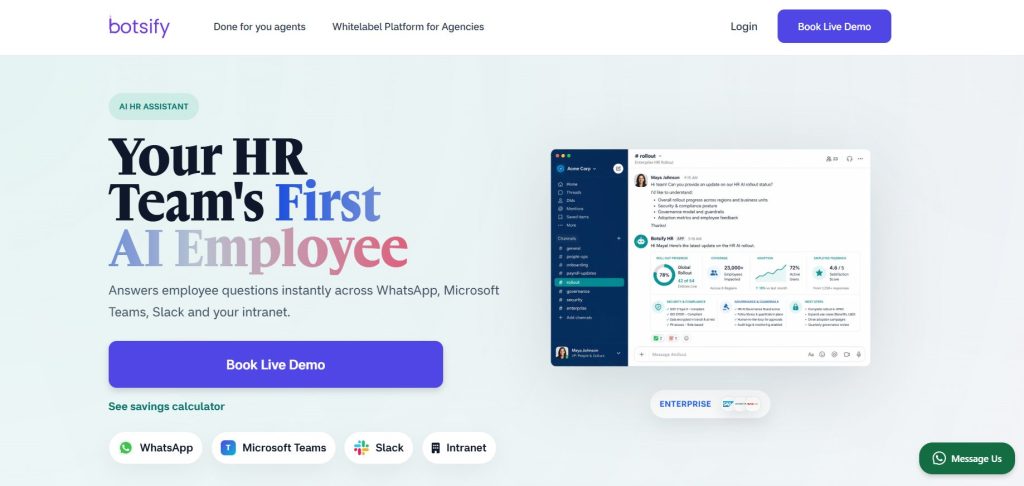

Botsify is an AI agent platform that can be configured for different business use cases. One of those use cases is the AI HR Assistant, which helps HR teams handle the steady stream of employee questions and requests that arrive every day.
The AI HR Assistant answers employee questions across WhatsApp, Microsoft Teams, Slack, and web intranet. It handles leave balance inquiries, policy searches, benefits questions, and payroll-related queries by pulling information from the company’s existing HR documents and systems. When a question is too complex or sensitive, it escalates to a human.
Beyond answering questions, the platform supports recruitment workflows like CV screening, candidate ranking, and interview scheduling. It can also handle onboarding tasks such as sending welcome messages, collecting documents, and scheduling inductions.
Unlike dedicated HR platforms, Botsify is a broader AI agent platform, with HR support being one of the ways it can be configured. It is not a replacement for an HRIS, ATS, payroll system, or benefits administration platform. Instead, it can provide an employee-facing AI layer around the information, tools, and processes a company already uses.
Best for: Teams that want a configurable, multi-channel AI agent for employee self-service and HR support without replacing their existing HR systems.
Consideration: The platform works best when your source-of-truth documents and HR processes are well defined. It is an employee-facing assistant, not a full HR management system.
2. Workday — Best for companies already running Workday HCM

Workday is one of the largest enterprise HCM platforms, and it has been building AI agents directly into its ecosystem to support different HR and workforce functions.
Workday’s AI agents include an HR Service Agent that answers routine HR questions and deflects tickets, a Talent Acquisition Agent that sources and grades candidates, a Talent Management Agent that handles performance cycles and retention signals, a Workforce Management Agent for scheduling and shift management, and a Total Rewards Agent for compensation and benefits guidance. There are also agents for payroll, organizational development, and employee self-service.
These agents draw on Workday’s own HCM and finance data. Each agent is purpose-built and scoped to one function. They are available through Workday Flex Credits, a consumption-based pricing model.
Best for: Organizations already running Workday HCM that want to add AI capabilities to specific workflows within their existing ecosystem.
Consideration: The agents are not standalone. They are features of the Workday platform and require a Workday HCM deployment. For organizations that do not already use Workday, adopting its broader HCM ecosystem simply to access the AI capabilities would be a much bigger decision than adding a standalone agent.
3. Eightfold AI — Best for talent intelligence and workforce planning
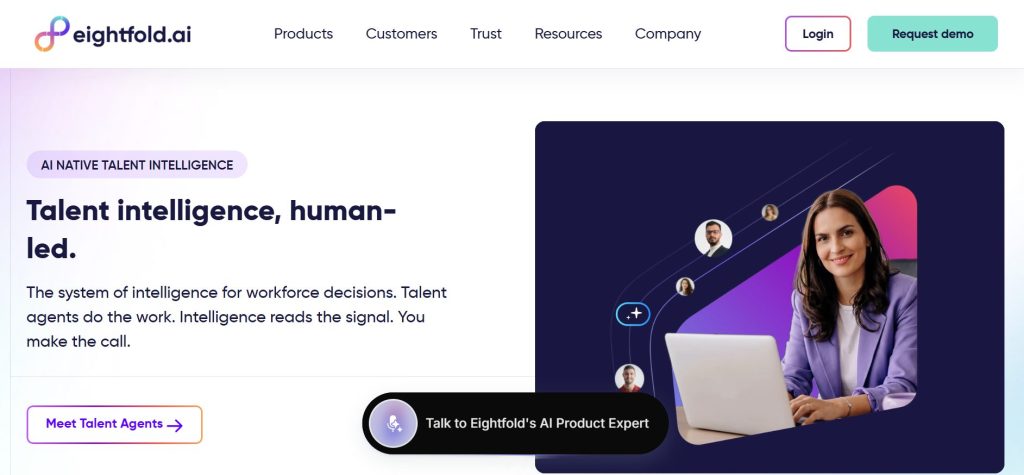

Eightfold AI is a talent intelligence platform, not a general HR assistant. It uses AI to match candidates to roles, identify internal mobility opportunities, and support workforce planning.
Eightfold’s talent agents include an AI Interviewer that evaluates candidates via video, audio, or text and returns scored results to recruiters. An AI Interview Companion joins human-led interviews to guide skills-based conversations and produces feedback drafts. A Candidate Agent handles the full candidate journey from job discovery to offer through SMS, WhatsApp, web, or voice. A Career Coach Agent helps employees explore development plans and internal opportunities.
The company also offers TalentForge, a platform for building custom talent applications and agents on top of its intelligence layer.
Best for: Talent acquisition teams and CHROs focused on skills-based hiring, internal mobility, and workforce planning.
Consideration: Eightfold is much more focused on talent intelligence than everyday employee self-service. Teams primarily looking to automate questions about leave, benefits, policies, or payroll should compare more employee-support-focused options. Eightfold is better suited to organizations with mature recruiting and HR analytics teams. It is best for organizations with mature recruiting and HR analytics teams.
4. Leena AI — Best for HR service delivery
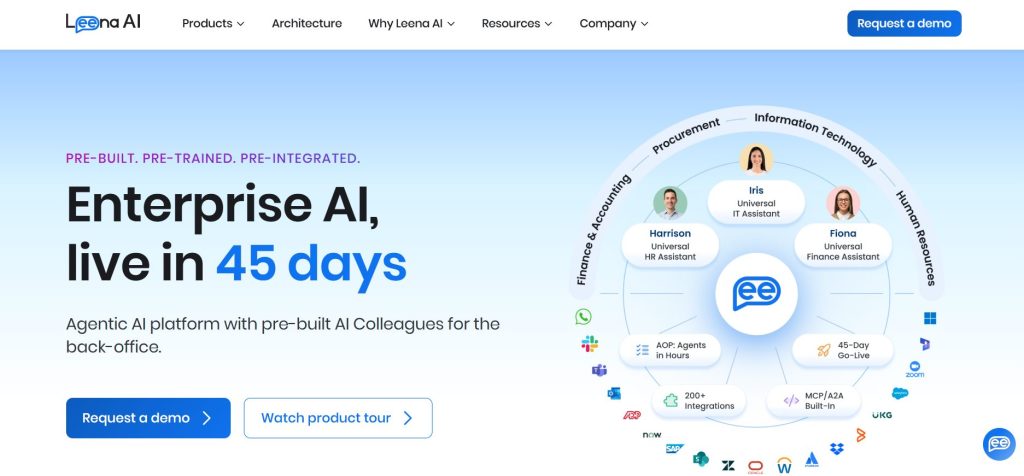
Leena AI is an agentic AI platform focused on enterprise back-office operations, with pre-built AI capabilities for HR, IT, and finance.
Its HR capabilities cover areas such as onboarding, leave management, benefits, payroll questions, policies, and employee letters. It can also connect with major enterprise systems and knowledge sources, making it more suited to organizations that want AI to work across established HR processes rather than simply answer employee FAQs.
Best for: Large enterprises that want a pre-built AI platform for HR service delivery across their existing systems.
Consideration: Leena AI is positioned toward enterprise deployments and broader HR service delivery. Teams with a narrower employee-support use case may not need that level of platform depth.
5. ServiceNow — Best for enterprise HR workflows and service delivery

ServiceNow is an enterprise platform for IT service management, employee workflows, and HR service delivery. Its HR Service Delivery module includes case management, employee service center, knowledge management, and workflow automation.
With the acquisition of Moveworks, ServiceNow now pairs its enterprise workflows with conversational AI. The combination lets employees request HR support through natural language chat while the platform handles case routing, approvals, and escalations in the background.
ServiceNow’s AI agents can support HR service desk automation, policy questions, onboarding workflows, case routing, and other employee-service processes. The platform is most valuable for organizations that already run ServiceNow and want to extend AI to their HR service operations.
Best for: Large enterprises already on the ServiceNow platform that want to add AI-powered HR service delivery to their existing workflows.
Consideration: ServiceNow is an enterprise platform, not a point solution. It requires the ServiceNow ecosystem to deliver value. Organizations that are not already invested in ServiceNow should compare the implementation scope with lighter standalone alternatives before committing to the broader platform.
6. Deel — Best for global workforce and HR operations
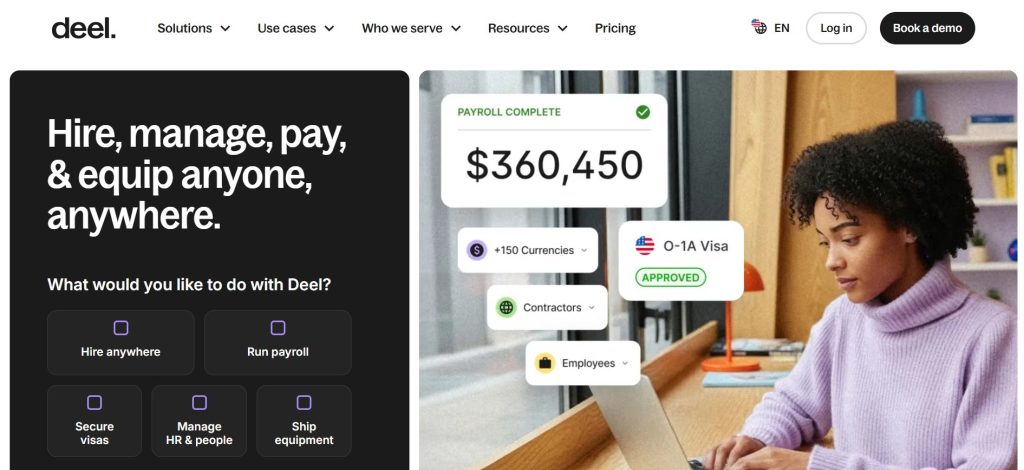

Deel is a global workforce platform that brings hiring, payroll, HR, compliance, and workforce management into the same ecosystem. Its AI agents extend those capabilities by helping HR teams work with employee data, answer questions, monitor routine processes, and automate tasks that would otherwise require someone to move between different systems.
This makes Deel particularly relevant for companies with employees and contractors spread across multiple countries. Instead of using an AI agent only as an employee FAQ assistant, HR teams can use Deel’s broader workforce infrastructure to support processes involving payroll, time off, compliance, and other operational work.
Best for: Global and distributed companies that want AI capabilities connected to their wider workforce, payroll, HR, and compliance operations.
Consideration: Deel makes the most sense when its broader global workforce platform is useful to the business. A company that only wants an AI agent for employee questions and routine HR requests may not need such a broad platform.
7. HireVue — Best for AI-assisted recruiting and candidate assessment
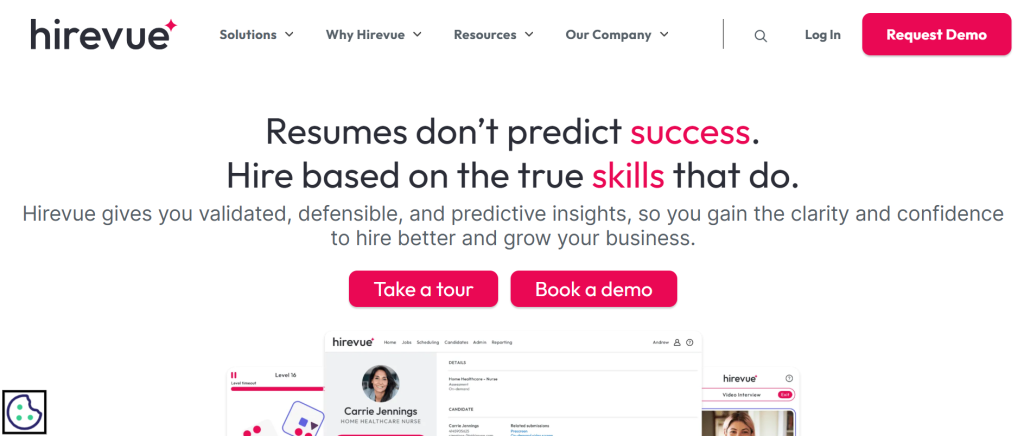

HireVue is a hiring platform focused on candidate screening, interviewing, and skills-based assessment. Its AI Hiring Agents bring more automation into the early stages of recruiting, helping employers engage candidates, identify suitable roles, and qualify applicants before recruiters need to step in.
Its Talent Engagement Agent uses conversational AI to interact with candidates and match them with relevant opportunities based on their skills. For companies taking a lighter conversational approach to hiring, a chatbot for recruitment can also handle candidate questions, initial interactions, and basic routing without requiring a full recruiting platform. HireVue also extends its AI capabilities into interviewing, combining conversational interactions with its existing assessment and hiring technology. This makes it different from broader HR agents that focus on employee support after someone has already joined the company.
Best for: Talent acquisition teams that want to use AI for candidate engagement, screening, interviewing, and skills-based hiring.
Consideration: HireVue is primarily a recruiting and hiring platform. Companies looking for an AI agent to handle everyday employee questions about leave, payroll, benefits, or company policies will need a different type of HR solution.
8. Workativ — Best for employee support and HR workflow automation
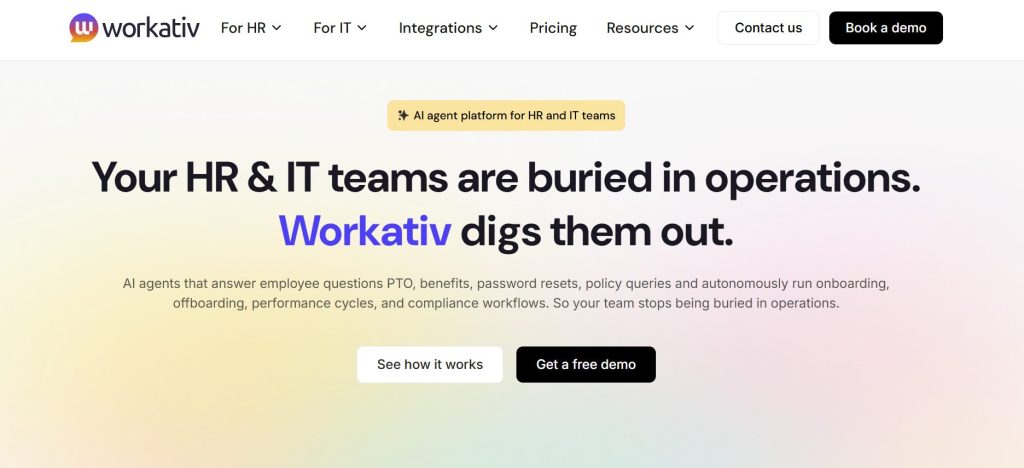

Workativ is an AI agent platform designed around employee support and workplace automation. For HR teams, its agents can answer questions about PTO, benefits, payroll, and company policies while also connecting with HR systems to complete actions rather than simply providing information.
For example, an employee can check their leave balance and submit a request through Slack or Microsoft Teams. Workativ can connect that conversation with the company’s HR system, route the request for approval, update the relevant record, and return the result to the employee. It can also support broader AI agent workflows around onboarding, offboarding, benefits enrollment, compliance training, and other recurring HR processes.
Best for: HR teams that want employee self-service combined with workflow automation inside tools such as Slack and Microsoft Teams.
Consideration: Workativ overlaps with platforms such as Botsify and Leena AI in employee support, so the differences become more important when choosing between them. Workativ is particularly focused on connecting employee conversations with HR systems and multi-step workflows, while companies looking for a broader AI agent platform or a more comprehensive enterprise HR service-delivery solution may prefer another option.
How to Choose the Right AI Agent for Your HR Team
The most important step is to start with the problem, not the product category.
If your main challenge is recruiting, HireVue and Eightfold AI are the most relevant options in this list, but they solve different parts of the problem. HireVue is more focused on candidate engagement, interviewing, and assessment, while Eightfold goes further into talent intelligence, candidate matching, internal mobility, and workforce planning. For repetitive employee questions and HR self-service, Botsify, Workativ, and Leena AI are more relevant. Companies already heavily invested in Workday or ServiceNow may find it more practical to extend those existing ecosystems rather than introduce another platform.
Three questions can help narrow the field:
What HR problem are you solving? Recruiting, employee self-service, talent intelligence, learning, and service delivery all require different types of tools. Be specific about where the pain point is.
What systems do you already run? If you are deeply invested in Workday or ServiceNow, their native agents will likely deliver faster value than a standalone product. If you want to keep your existing stack and add AI on top, standalone platforms like Botsify or Leena AI are more appropriate.
How much configuration are you prepared to do? Some products ship pre-built for specific use cases, while others give teams more control over how AI automation is configured around existing HR processes. Match the product to your team’s capacity for implementation.
Once you know the problem you are trying to solve, the shortlist becomes much smaller. The table below shows which tools are most relevant for some of the most common HR use cases.
| If your priority is… | Start with… | Why |
| Employee questions, policies and HR self-service | Botsify, Workativ, Leena AI | All three focus on employee support, but with different levels of workflow and enterprise complexity |
| Recruiting and candidate assessment | HireVue, Eightfold AI | HireVue focuses more on candidate engagement and assessment, while Eightfold covers broader talent intelligence |
| Internal mobility and workforce planning | Eightfold AI | Its strongest differentiation is talent intelligence rather than general HR support |
| Managing a global workforce | Deel | Best aligned with companies managing international employees, payroll and compliance |
| Extending an existing Workday environment | Workday | Keeps AI capabilities inside the existing HCM ecosystem |
| Extending an existing ServiceNow environment | ServiceNow | Makes sense when HR service delivery already runs through ServiceNow |
| Adding AI without replacing existing HR software | Botsify, Workativ, Leena AI | These can add an AI interaction or automation layer around existing systems |
Botsify vs Workativ vs Leena AI: What’s the Difference?
Botsify, Workativ, and Leena AI can all help reduce repetitive HR support work, but they approach the problem from different directions.
Botsify makes the most sense when you want custom AI agents that employees can interact with across channels such as Slack, Microsoft Teams, WhatsApp, or an intranet. HR is one use case of the wider AI agent platform rather than the entire product.
Workativ is more focused on connecting employee conversations with workflow execution across HR systems. It is particularly relevant when employees are already working inside Slack or Microsoft Teams and you want their conversations to trigger actions across connected HR systems.
Leena AI is positioned further toward enterprise HR service delivery. It is more appropriate for larger organizations looking for pre-built HR capabilities and deeper enterprise process coverage.
None is automatically better than the others. The choice depends on whether you prioritize a flexible AI agent, workflow execution, or a broader enterprise HR service-delivery platform.
FAQs About AI Agents for HR Teams
What is an AI agent for HR?
An AI agent for HR is software that can understand employee requests, retrieve information from HR systems, and take action across multiple steps without human guidance at every stage. This differs from traditional rule-based automation, where workflows generally follow predefined steps and conditions.
How is an AI agent different from a chatbot?
Traditional chatbots are generally designed around conversations, predefined responses, or structured flows. AI agents can go further by using context, connected tools, and decision logic to carry out multi-step tasks. For example, instead of only explaining a leave policy, an agent might check an employee’s balance, submit a request, route it for approval, and update the relevant system. The distinction is becoming less rigid as modern chatbot platforms increasingly add agentic capabilities.
Do I need to replace my HRIS to use an AI agent?
No. Many standalone AI agents for HR are designed to work alongside an existing HRIS, ATS, payroll system, or knowledge base rather than replace it. However, the level of integration varies considerably between platforms, so this should be checked before choosing a product.
Can AI agents handle sensitive employee situations?
AI agents can assist with sensitive employee situations, but consequential decisions should not be delegated to them without appropriate human oversight. Clear AI agent governance helps define which actions require approval, what data agents can access, and when work must be escalated to a person.
What security certifications should I look for?
Security requirements depend partly on what employee data the agent can access and what actions it is allowed to take. During evaluation, look at areas such as SOC 2 or ISO 27001 certification, encryption, role-based access controls, audit logs, data retention policies, and the vendor’s approach to privacy requirements relevant to your organization. These controls become even more important when the agent can modify records or trigger actions inside HR systems.
Can AI agents integrate with an existing HR system?
Many HR AI agents are designed to connect with existing HRIS, ATS, payroll, communication, and knowledge systems rather than replace them. The depth of those AI agent integrations varies considerably between platforms. Some tools mainly retrieve information, while others can write data back, trigger workflows, or complete actions. Before choosing a platform, check whether it supports the specific systems and actions your HR processes depend on.
Conclusion
The AI agents for HR category is growing fast, but the products within it serve very different needs. A recruiting agent will not help you deflect employee policy questions. An embedded HCM agent will not work outside its ecosystem. A standalone AI agent platform will not replace your payroll system.
The best tool is the one that matches the specific problem you are trying to solve. Start with the HR function that needs the most help, evaluate the tools that serve that function, and check how well they fit your existing systems and team capacity.
You do not need to compare every product on this list. Start by deciding whether your main problem is employee support, recruiting, talent intelligence, global workforce operations, or enterprise HR service delivery. From there, you should be able to narrow the field to two or three realistic options and evaluate those based on your existing systems, required level of automation, and need for human oversight.