
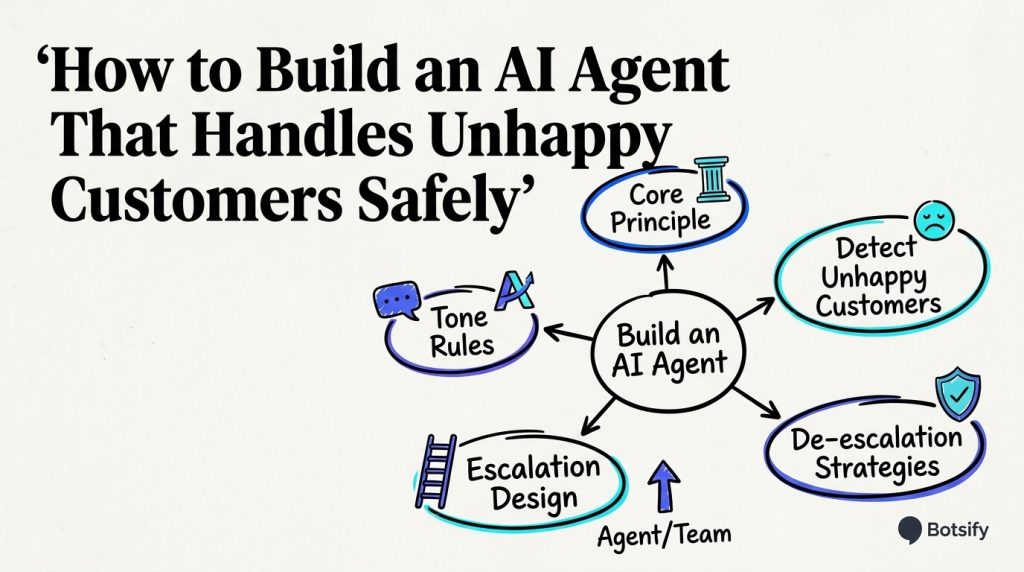
AI Complaint Handling Starts With a Useful First Response
A customer writes, “I’ve contacted you twice and my replacement still hasn’t arrived.” A support agent that replies with a generic refund policy can make the interaction worse, even if the policy is correct. The customer is asking for help with a specific unresolved problem, not a policy recital.
Good AI complaint handling starts by recognizing what the person says, checking whether the agent can help within its approved authority, and making the route to a person easy when it cannot. The goal is not to hide the AI or keep every interaction automated. It is to give customers a clear next step and give support staff enough relevant context to act.
Complaints range from a late delivery to an account security concern. One fixed response rule cannot fit every case. The business needs to define which requests an agent may answer, which actions it may take, and which situations need an authorized person. Those boundaries belong in a wider AI agent governance approach, with named owners and review responsibilities.
Give Customers a Clear Way to Reach a Person
An explicit request for a person should be treated as a clear routing signal. Avoid asking the customer to justify the request or forcing them through another answer first. The agent can acknowledge the request, explain what will happen next, and pass the conversation to a staffed route if one is available.
Other situations need a policy-based decision. Examples include a disputed payment that the agent cannot investigate, a request to change account access, a safety concern, or a case where the approved information does not answer the question. A model sounding confident does not grant it permission to make a restricted decision. Define those conditions in advance and connect each one to a real destination.
Frustration is more difficult to detect than a direct request. A customer may repeat an unresolved question, say that previous help did not work, or describe the same problem in increasingly urgent terms. Sentiment tools can miss sarcasm, language differences, or a calm but serious complaint. Use the customer’s actual words and the state of the issue as evidence; do not make a sentiment label the only gate to human help.
| Signal | Example | Practical response |
|---|---|---|
| Direct request for a person | “Please connect me with support.” | Start the configured human route without resistance. |
| Unresolved repeated issue | The customer says the same delivery problem remains after the suggested steps. | Stop repeating those steps; summarize what failed and offer escalation. |
| Unverified answer | The approved knowledge does not address the customer’s specific case. | State the limit plainly and route to an appropriate person or queue. |
| Restricted decision | The request requires an exception or approval the agent does not have. | Do not imply approval; route it to the authorized team. |
| Urgent safety or security concern | The customer reports potential harm or unauthorized access. | Follow the organization’s specialist response procedure. |
These are design examples, not universal legal or operational categories. Have the responsible support, security, and compliance owners set the conditions for their organization. Clear human handoff rules define when an agent should stop, where the request should go, and what the customer should be told.
When frustration is evident but no explicit request has been made, an offer can be better than an automatic transfer: “I can keep checking this, or connect you with our support team. Which would you prefer?” If an immediate specialist route is required by company policy, follow that rule instead of asking the customer to choose.
Write a Complaint Response That Acknowledges the Problem
A useful first response is short, specific, and honest about what the system can do. It should show the customer that the agent understood the unresolved issue, then either take an allowed next step or explain the handoff. It should not promise a result before someone has confirmed it.
For example, if the customer says a replacement has not arrived, the agent might say: “I’m sorry the replacement still hasn’t arrived after you contacted us. I can check the shipment status, and if it still needs attention I can send this to our support team.” This is more useful than a generic “We apologize for any inconvenience” because it reflects the actual issue and does not guarantee a delivery date.
If the agent can safely check an order status using an authorized connection, it can report what that source shows and when it was last updated. If the system is unavailable, it should say so rather than pretend the check succeeded. If the answer requires an exception, it should separate what it knows from what a person must decide.
A practical response pattern is:
- Reflect the issue: Briefly restate the concrete problem, without exaggerating the customer’s emotion.
- Own the next step: Say what the agent can do now, within its permissions.
- Offer or initiate the route: Make human assistance straightforward when requested or required.
- Set an accurate expectation: Name the actual queue, channel, or next update only when known.
- Keep the customer in control: Ask for confirmation when a choice is appropriate, and do not ask them to repeat details already available to the receiving team.
Avoid scripts that argue with the customer, blame them, or quote policy as a substitute for understanding. Policy may be relevant to the outcome, but the agent should explain it neutrally and only when the source is current and the agent is allowed to do so. Avoid “I’ll get this sorted right now” unless the agent can actually complete the fix.
A complaint response should make the next step clearer, not make the customer prove that they deserve help.
Design a clearer complaint path for your support team
Set clear complaint boundaries, escalation paths, and customer next steps.
Pass the Context a Human Needs, With Appropriate Limits
A handoff is useful when a human can begin from the customer’s actual issue instead of starting the conversation over. But “send everything” is not a good default. Transfer the information the receiving team is authorized to see and needs to take the next step.
A concise handoff can include:
- The customer’s stated problem and requested outcome.
- Relevant identifiers that the customer provided or that an approved system verified.
- The steps the agent attempted and the result of each attempt.
- Any information the agent gave the customer, especially a correction or commitment that needs follow-up.
- Why the agent stopped and what decision or action remains.
- A reference to the original conversation or relevant messages, when the receiving workflow supports it and access is appropriate.
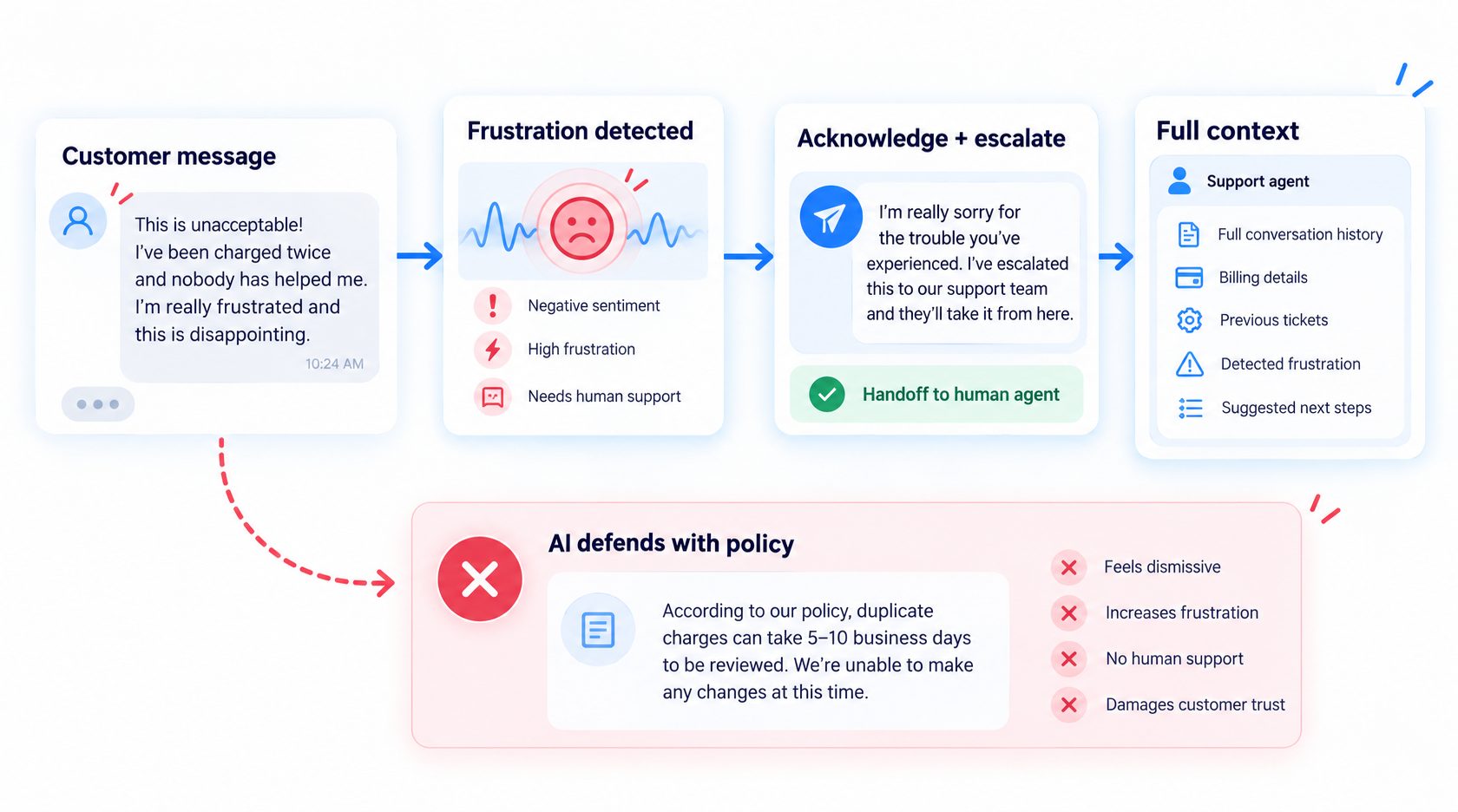
A summary is not a replacement for the source conversation when a human needs to verify what was said. It is a navigation aid. A recent customer discussion about handoffs emphasized showing the receiving person the issue, what had already been tried, relevant details, and the unresolved question while keeping the original messages accessible. That is a useful design principle, but teams should confirm that the tools and access rules they use can support it.
Use data minimization: omit unrelated account history, sensitive details, or personal information that the receiving person does not need. Apply the organization’s access, retention, and privacy rules to both summaries and transcripts. Do not claim a system retains, deletes, or protects particular data unless that behavior has been verified for the specific deployment.
A sample handoff note might look like this:
Customer issue: Replacement order has not arrived.
Requested outcome: Confirm delivery status or arrange the next step.
Verified reference: Order ending 4821, checked in the approved order system.
Actions tried: Checked the latest carrier event; no new scan was available.
Customer has been told: The latest scan is unchanged; no delivery date was promised.
Reason for handoff: Shipment needs review by the support team.
Still needed: Confirm the appropriate resolution under the delivery policy.
Source: Link to the relevant conversation, subject to team access rules.
The details should be factual and distinguish verified information from customer statements. A summary that turns “customer says they were charged twice” into “duplicate charge confirmed” can mislead the human and create a second problem. If the handoff mechanism cannot include a source link or structured note, use the safest available workflow and tell the customer what information has actually been passed.
Make the Transfer Real and Plan for Failure
A transfer message must match what the system has done. There is a meaningful difference between “I’ve sent this to the billing team” and “I can help you contact billing.” Only use the first statement after the transfer or ticket creation has succeeded.
Before launch, define the destination for each route, who owns it, when it is staffed, and what the customer should expect outside those hours. The wait estimate should come from the team’s actual service commitment or current queue information. If neither is available, say that the request has been queued and explain how the customer can follow up. Do not invent a one-hour promise or name an individual who has not accepted the case.
| Transfer state | Customer-facing message should | Workflow owner should verify |
|---|---|---|
| A representative accepts the live transfer | Explain that the person is joining and summarize what was shared. | The correct conversation and relevant context reached them. |
| A request enters a staffed queue | Confirm the request was queued and share a reliable wait estimate if available. | Queue acceptance and ownership are visible. |
| Support is closed | Explain the next available support window or another real channel. | The request is preserved and routed to the right team. |
| The transfer fails | Say the transfer did not complete and give the next available option. | A fallback exists, and the customer is not left at a dead end. |
| The system cannot verify submission | Do not say the request was sent. Offer a permitted retry or another contact route. | Failures are visible to the team responsible for the integration. |
A failed handoff is an operational issue, not something a warmer sentence can fix. The fallback could be an approved alternate channel, a callback request, or instructions to contact support directly. Choose only a route that exists and that the business can support. If an urgent concern has a separate response procedure, make that path available to the agent and test it.
The broader AI customer service escalation process can help teams decide how an angry or unresolved customer reaches the right human. The details still need to reflect the staffing model and support tools in the actual deployment.
Define What the Agent May Resolve and What It Must Escalate
Complaints often mix several requests. A customer may report a late delivery and ask for a refund, or describe a login issue and mention suspicious activity. The agent should separate the parts it can answer from decisions it cannot make.
For each complaint category, document:
- Allowed information: Which source is approved for the answer, and how current must it be?
- Allowed actions: Can the agent check status, update a record, or only explain the process?
- Approval boundary: Which changes, refunds, credits, or exceptions require a person?
- Escalation route: Which team handles the decision, and what context can be shared?
- Customer explanation: What can the agent accurately say before and after handoff?
- Fallback: What happens if the source system or human route is unavailable?
A refund request does not automatically mean the AI must refuse all assistance. Depending on company rules, it may be able to explain the standard policy, check an order date, or route an exception request. It should not approve a discretionary refund if it lacks authority. Similarly, legal, health, safety, or security language does not have one universal response across every business. Define specialist procedures with the owners responsible for those issues.
A complaint path should also have a stop condition. When the agent has repeated an unsuccessful step, lacks reliable evidence, or cannot make the decision requested, it should not continue producing variations of the same answer. Stop conditions for AI agents help make those boundaries concrete and testable.
Prepare Support Staff to Receive the Handoff
The human experience is part of the design. A transfer can reach the right queue and still frustrate a customer if the representative does not know what happened or asks for details already in the summary.
Give receiving staff a short operating guide that explains:
- Where escalated conversations appear and how priority is assigned.
- Which fields in the handoff note are verified and which are customer-reported.
- How to open the original messages when more detail is needed.
- How to correct inaccurate AI information or address an unsupported commitment.
- What to do if a route, summary, or customer identifier is missing.
- Who owns a case that crosses team boundaries.
The first human reply can confirm the summary without making the customer repeat the story: “I see the replacement still has no new delivery scan, and you’d like us to confirm the next step. I’ll review the shipment now.” If the summary is uncertain, ask one targeted confirmation question rather than assuming it is correct.
For multilingual support, define whether the human route should match the customer’s language, whether translation is used, and how the customer is told about any change. Do not silently switch languages if that would make the customer less able to explain the issue. Language routing should reflect the support team’s actual coverage, as described in a broader multilingual AI customer support plan.
Ownership also matters after the customer leaves. Decide who reviews recurring complaint themes, who can change the agent’s instructions or connected knowledge, and how updates are approved. A practical AI agent audit trail can help teams reconstruct important decisions, but the records should match real capabilities and data policies.
Test Complaint Scenarios Before Customers Depend on Them
A prompt that sounds sensible is not proof that the workflow works. Test the receiving team’s view, the system response, and the customer-facing message from beginning to end. Use fictional or appropriately protected test data.
Include scenarios such as:
| Test case | Expected behavior |
|---|---|
| Customer directly asks for a person | The agent routes or explains the real available human option without arguing. |
| Customer reports the same unresolved problem again | The agent stops repeating failed steps and offers the appropriate route. |
| Customer reports a charge but evidence is incomplete | The agent distinguishes the report from a verified transaction and routes the investigation if needed. |
| Agent cannot find an approved answer | It says what it cannot verify and avoids guessing. |
| Customer requests an action outside the agent’s authority | It does not claim the action is approved; it sends the request to an authorized person. |
| Handoff queue is unavailable | The customer gets an honest fallback, and the issue is not falsely described as transferred. |
| Summary contains an uncertain or mistaken detail | The representative can inspect the source and correct the record. |
| Complaint arrives in another supported language | The agent follows the configured language and routing policy. |
| Sensitive information appears in the message | Only necessary, permitted details are sent to the intended receiving team. |
For every test, compare the agent’s claim with the actual event. Did the correct queue receive the request? Did a representative see the relevant details? Was the customer told a realistic next step? Did a failure leave a recoverable record? A successful chat bubble alone does not answer those questions.
Keep a test set that covers normal cases and difficult edge cases, and rerun relevant scenarios after changing instructions, knowledge, routing, or integrations. A structured AI agent testing routine can help teams catch regressions before deployment. Use an implementation checklist to assign launch owners and confirm operational dependencies.
Measure Whether Complaints Move Toward Resolution
A low handoff rate is not automatically good. It may mean that the agent resolved routine complaints, or it may mean customers could not reach a person. Pair automation measures with outcomes that reflect the customer and receiving team experience.
Useful measures include:
- Handoff completion: Of the cases where the agent said it transferred the request, how many reached the intended destination?
- Time to first useful human response: How long until a person meaningfully addresses the issue, not merely joins the thread?
- Repeat-explanation rate: How often does a customer have to restate information already available to the receiving team?
- Resolution and reopen rate: Was the complaint resolved, and did the same issue return shortly afterward?
- Escalation reason: Which triggers are routing cases, and are some categories over- or under-routed?
- Customer effort or feedback: Did the person understand the next step and feel able to get help?
- Transfer failure rate: How often were queues, integrations, or records unavailable?
Define each measure consistently. For example, a repeat contact should refer to the same issue, not merely the same customer returning for a different reason. Review a sample of conversations alongside aggregate results so the team understands why a metric changed. Track measures in context with customer support metrics beyond deflection, rather than using deflection as a stand-in for resolution.
Do not optimize for fewer escalations at any cost. A well-designed agent may route more cases when its answer is uncertain or the customer asks for a person. The useful question is whether the route is appropriate, the transfer actually completes, and the issue reaches a fair next step.
A Practical Complaint-Handling Checklist
Before enabling an AI complaint workflow, confirm that:
- Customers can request a person without being trapped in repeated automation.
- Trigger rules use observable conversation and policy conditions, not sentiment alone.
- The agent knows which information sources and actions are allowed.
- The handoff summary separates verified facts from customer statements.
- Only relevant information is transferred to authorized recipients.
- The original conversation can be consulted when the receiving workflow permits it.
- Every customer-facing transfer claim reflects a successful system event.
- Staffing hours, wait estimates, and after-hours routes are accurate.
- A failed transfer has a safe, honest fallback.
- Support staff know how to receive and correct an AI-generated summary.
- Complaint scenarios are tested end to end, including unavailable systems.
- Someone reviews outcomes and owns changes to the workflow.
The right sequence varies by business, channel, and support policy. Use this checklist to surface decisions that need an owner, not as a substitute for those decisions.
Build a complaint workflow with a clear human handoff
Plan a practical human handoff for unresolved customer complaints.
Frequently Asked Questions
Should an AI agent respond to a complaint?
It can acknowledge the issue, answer within approved information and permissions, and help route the request. A human should handle decisions outside the agent’s authority, cases requiring specialist review, and conversations where the customer asks for a person.
Should every frustrated customer be transferred immediately?
Not necessarily. Frustration signals can be imperfect, and the right response depends on the issue and company policy. Make a human option easy to reach, treat repeated unresolved attempts as a reason to stop looping, and follow any required specialist route.
What should be included in a complaint handoff?
Share the customer’s issue and requested outcome, relevant verified identifiers, actions already attempted, any commitments or corrections needed, and the unresolved decision. Include a link to the relevant source conversation when available and appropriate. Follow access and privacy rules, and avoid unrelated data.
What if no human is available?
The agent should state that clearly, use a real queue or alternate route if one exists, and give an accurate expectation for the next step. It should not promise a live representative or specific response time without confirmation.
How can a team tell whether the workflow is working?
Review whether transfers complete, customers have to repeat themselves, human responses move the complaint forward, and unresolved cases reopen. Pair those measures with conversation review and customer feedback so the team understands what the counts mean.
Final Thought
AI complaint handling works best when the agent knows where its authority ends and the customer knows what happens next. Acknowledge the specific issue, avoid repeating failed answers, offer a real human route, and pass only useful, authorized context. Then measure whether the customer’s problem moved closer to resolution. That is a more dependable goal than trying to automate every complaint.
