


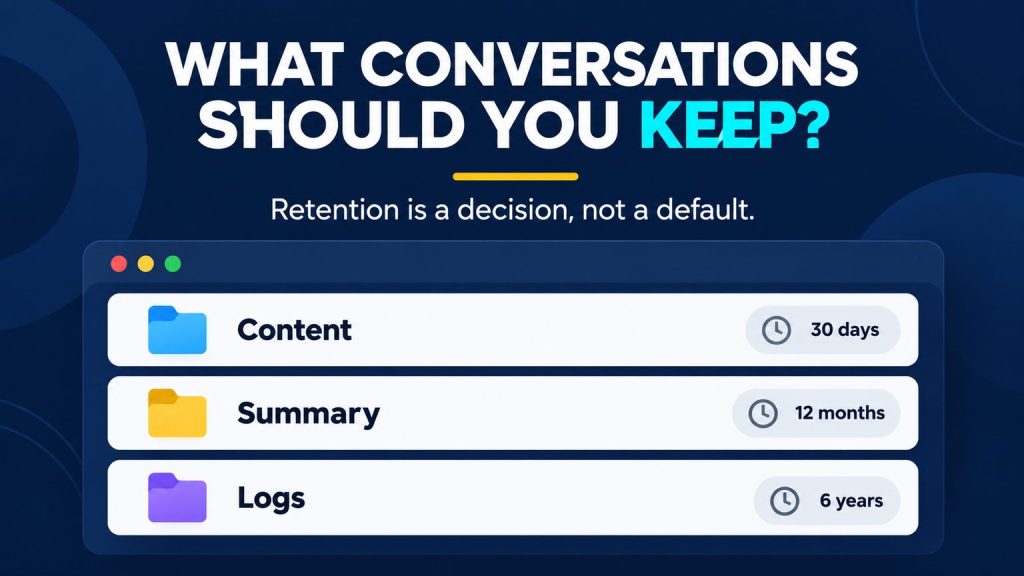
Ask a team about its AI agent data retention policy,how long the agent keeps conversation data,and you get one of two answers.
The first is a shrug. “Forever, I think? It’s in the platform somewhere.” The second is a confident number that nobody can trace to a decision: “Ninety days, I believe. Or is it a year? Whatever the default is.”
Both answers describe the same situation. The retention window was never chosen. It was inherited. It came from a platform default, a developer’s habit, or a plugin setting nobody opened. And it will be discovered, by a customer who asks for their data to be deleted, by a security questionnaire from an enterprise buyer, by a lawyer asking you to produce every conversation about an incident, or by a regulator who wants to know why you are still holding a transcript from two years ago.
Keeping everything feels safe. It is actually the riskiest position you can hold, because it maximizes the two things that hurt: the volume of data you must defend and the length of time you must defend it.
This guide answers the question in the title with a framework instead of a slogan. It covers the four different kinds of data an agent produces, a tiered retention model, what the rules actually require, how vendor defaults differ, how to delete without breaking your own audit trail, and how agencies can turn retention from a liability into a sellable feature.
Why “keep everything” became the default
Nobody chose to keep everything. It accumulated.
When a team deploys an agent, the conversation log is the cheapest and most obvious artifact. It arrives for free, it lives wherever the platform put it, and deleting it is a task with no visible reward. Keeping it, on the other hand, feels prudent. What if we need it later?
That instinct was reasonable when conversation volume was small and the data was shallow. It stopped being reasonable the moment agents became the front door for support, sales, and intake. Now the conversation log contains names, emails, phone numbers, order numbers, appointment times, health complaints, payment references, and the exact words a frustrated customer used at 2 a.m., replicated across the agent platform, a CRM, a help desk, a spreadsheet export, and a backup.
Three forces turned this from an untidy habit into a business problem:
- Regulators started naming conversation data specifically. Rules now in force or phasing in across the EU and several US states treat conversational AI and automated decision-making as their own category, with logging duties, disclosure duties, and retention limits attached.
- Buyers started asking. Security questionnaires now routinely request your conversation retention period, your redaction practice, and your deletion procedure. “We keep it indefinitely” is a failing answer.
- The cost showed up on the invoice. Storage, indexing, embedding, and re-processing costs scale with the archive. Companies are paying monthly to keep transcripts they will never read again.
The default is not neutral. If you did not choose a retention window, someone else chose it for you, a vendor, a plugin, or an engineer on a deadline.
The distinction everyone misses: your agent produces four kinds of data
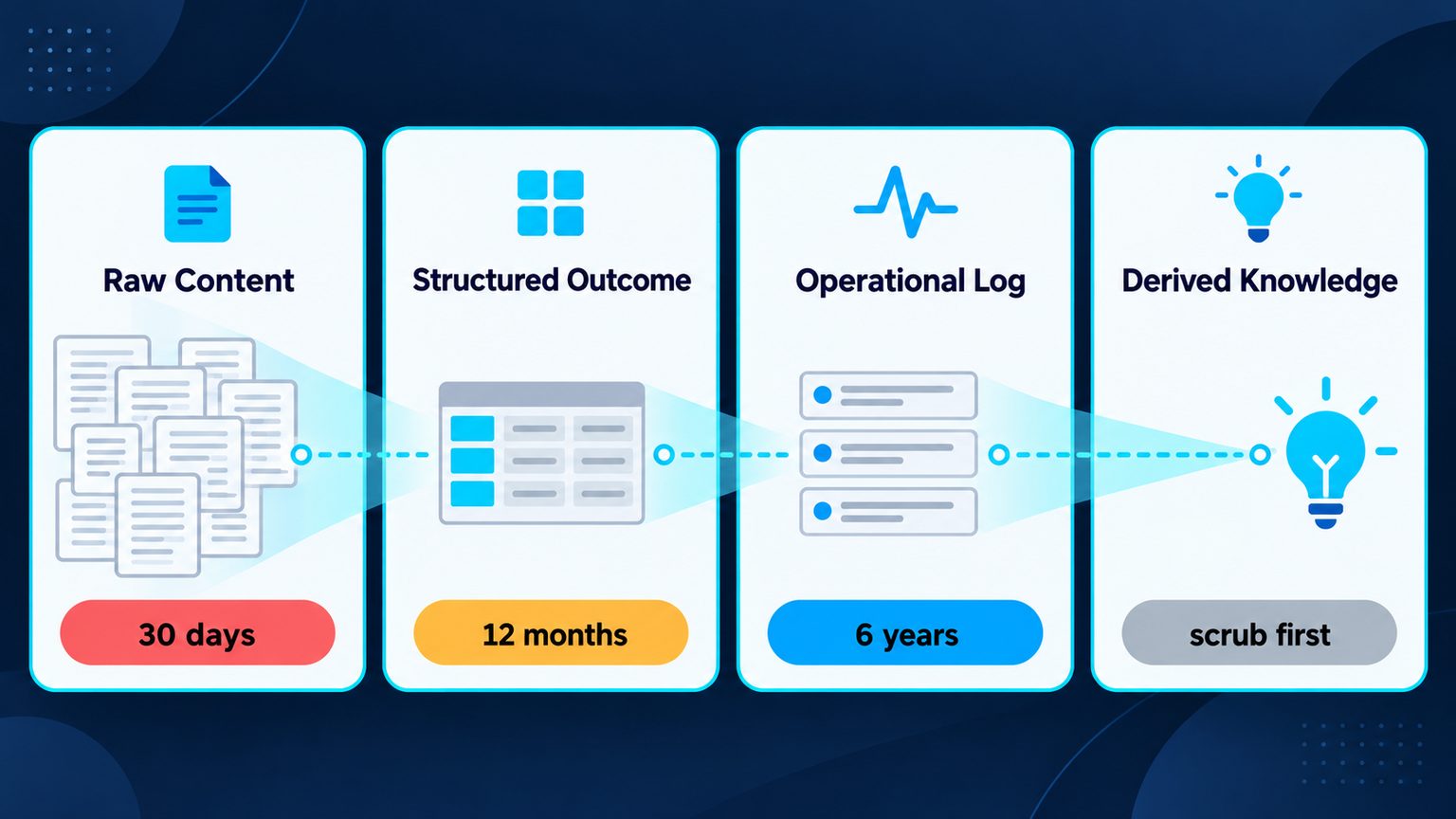
Most retention arguments go in circles because two people are talking about different data while using the same word. “Conversation data” is not one thing. An AI agent produces at least four distinct artifacts, and they deserve four different lifetimes. That split is the foundation of a defensible AI agent data retention policy.
| Data type | What it contains | Typical consumer | Sensitivity |
|---|---|---|---|
| Raw content | Full transcripts, voice recordings, uploaded files, attachments | Investigators, QA, legal | Highest, usually full PII |
| Structured outcome | Intent, disposition, fields captured, ticket created, appointment booked | CRM, analytics, reporting | Medium, often PII-light |
| Operational log | Timestamps, tool calls, handoffs, prompt/version, errors, who changed what | Engineers, auditors | Low to medium, metadata |
| Derived knowledge | Summaries, embeddings, evaluation labels, prompt improvements, FAQ candidates | Product, training, knowledge base | Variable, inherits source PII unless scrubbed |
The mistake is treating these as one bucket with one deletion date. The raw content and the structured outcome have almost nothing in common from a risk standpoint. A transcript can contain a customer’s account number. The structured outcome might only say “billing, refund requested, escalated.” One of those you might keep for years. The other you should be deleting in weeks.

The three questions that replace a blanket retention setting
Before you pick a number, answer three questions for each data type. They are the same three questions a regulator, an auditor, or a plaintiff’s lawyer will ask, in roughly that order.
- Why do we have it? Name the purpose. “In case we need it” is not a purpose. “To resolve billing disputes for 90 days” is. “To meet our logging obligation for high-risk decisions” is. “To improve the agent’s answers” is, but it usually does not require keeping identifiable transcripts.
- Who can see it? Retention and access are different dials, but they multiply. A seven-year archive that nobody can read is a smaller problem than a thirty-day archive that everyone can export. Decide who sees full content versus summaries versus metadata only, and log those reads.
- When does it die, and what kills it? A retention window is only real if something enforces it. If the answer is “when someone remembers,” the actual window is forever. Deletion needs a schedule, an owner, and a mechanism, including for backups and downstream copies.
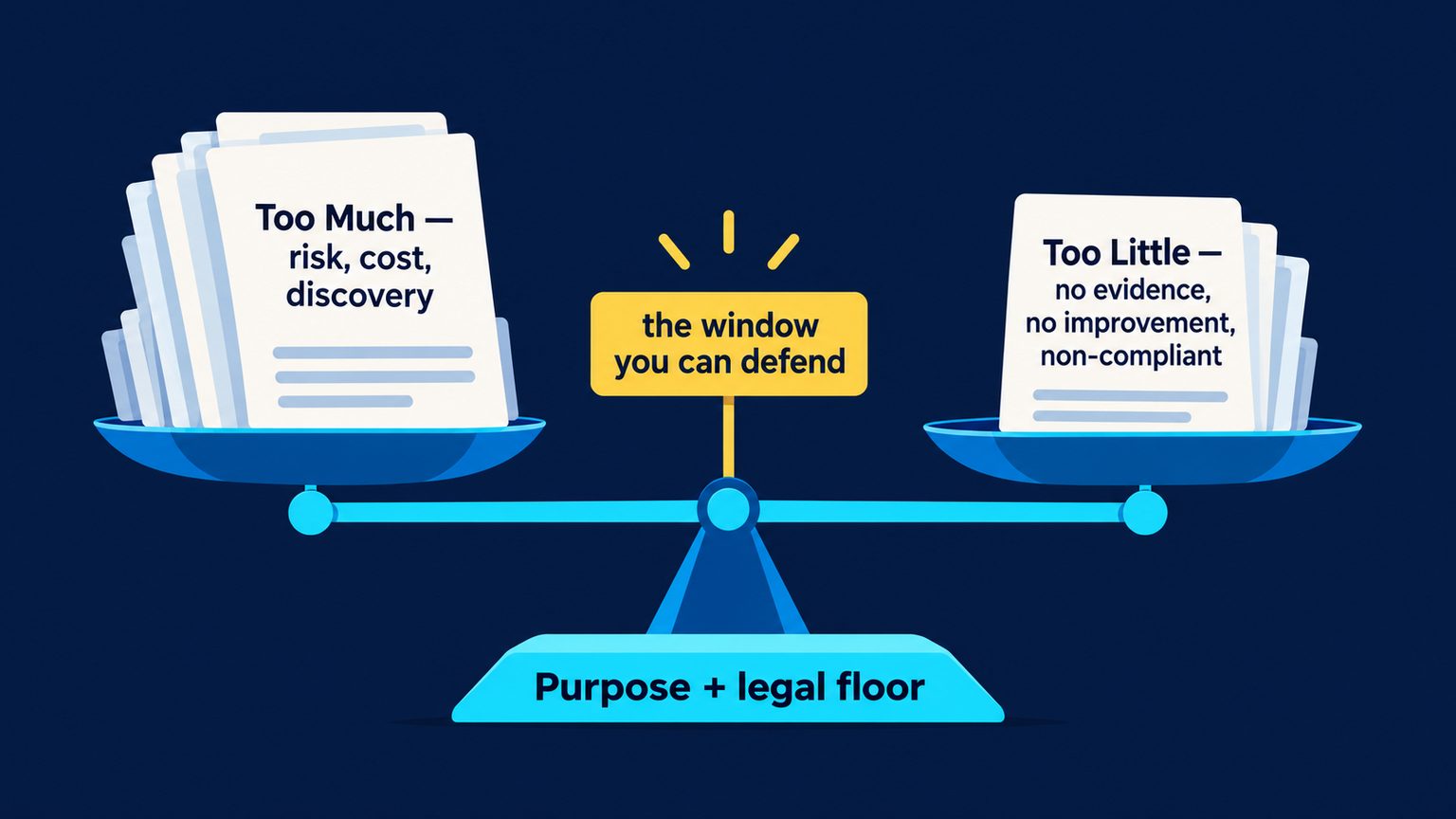
Write the purpose before the period. A retention window you cannot justify is a liability with a timestamp on it.
A tiered retention model you can implement this week
You do not need a legal department to start. You need a table with three columns, data type, default window, enforcement, and an owner with the authority to change it. The windows below are reasonable starting points for a typical support, sales, or intake agent. They are defaults to review, not legal advice, and regulated industries should set stricter or longer windows based on their own obligations.
| Tier | Data | Default window | Access | Enforcement |
|---|---|---|---|---|
| T0 | Live session state (in-progress conversations, scratch memory) | Hours to days | Agent runtime only | Auto-expire at session close |
| T1 | Raw transcripts, recordings, attachments | 30 to 90 days | Support leads, QA; full access logged | Scheduled purge; export requires approval |
| T2 | Structured outcomes (intent, fields, disposition) | 12 to 24 months | CRM users, analysts | Synced to CRM, not duplicated in the agent platform |
| T3 | Operational logs (tool calls, handoffs, versions, errors) | 6 months minimum; longer if regulated | Engineers, auditors | Immutable, append-only, periodically reviewed |
| T4 | Derived knowledge (summaries, embeddings, evals) | Source window, or de-identified | Product, training | Re-derived, never a second copy of PII |
Two rules make this model work in practice.
Rule one: shorten the top, extend the bottom. Most teams have this backwards. They keep raw transcripts for years and keep operational logs for days. Invert it. The raw content is the expensive, sensitive part; the operational log is the cheap, defensible part. If you must retain something for investigative or compliance reasons, retain the metadata and the summary, not the full text.
Rule two: one canonical copy. Every additional copy of a conversation is another place a deletion request has to reach and another place a breach can surface. Decide where the canonical transcript lives, usually the CRM record or the agent platform, not both, and make everything else a reference.
Plan Your AI Agent Workflow with Botsify
Explore Botsify for practical AI agent workflows built around your business.
Agent memory and audit logs are two different decisions
Here is where teams confuse themselves most. “Should the agent remember?” and “Should we keep the transcript?” feel like the same question. They are not, and answering them as one creates both privacy risk and bad customer experience.
Agent memory is a product feature. It lets the agent carry context across sessions, this customer prefers WhatsApp, they are on the pro plan, they complained about delivery last month. Memory should be deliberate, scoped, and visible. It should store what the agent needs to serve the customer better, and nothing else. It should be inspectable, editable, and clearable on request. If memory scope is new ground for your team, start with how AI agent memory works.
Audit logs are an accountability record. They exist to answer “what did the agent do, when, why, and who changed it” after the fact. They are not for personalization and should never feed the conversation.
| Question | Agent memory | Audit / operational log |
|---|---|---|
| Purpose | Better service continuity | Accountability and investigation |
| Contains | Customer preferences, scoped facts | Events, tool calls, versions, timestamps |
| Lifetime | As long as the relationship needs it | Minimum window fixed by policy or law |
| Deletable on request? | Yes, should be easy | Often constrained by legal duty |
| Visible to customer? | Should be, ideally | Not usually |
| Feeds the reply? | Yes | No |
The practical test: if a customer asked “why do you know that about me?”, could you answer in one sentence and delete it in one click? If not, memory has quietly become a shadow retention problem. If a regulator asked “who approved the change that made the agent quote the wrong price?”, could you answer from the log? If not, you have no audit trail.
What breaks when you keep too much
Volume is not a neutral asset. Every extra month of retained conversation adds four kinds of risk at once.
- Breach surface. A database you deleted cannot leak. The 2010s-era breach playbook assumed attackers wanted credit cards; conversation archives are now more valuable because they contain identity, intent, and often authentication details exchanged in chat.
- Discovery and litigation exposure. If a dispute reaches legal process, “we keep everything” means everything may be in scope. Producing three years of transcripts is expensive; the transcripts themselves may contain statements that help the other side.
- Compliance obligation creep. The moment you hold data, you inherit duties about it, accuracy, access, correction, and erasure. Data you never kept is data you never have to correct.
- Cost and drift. Storage is cheap until it is indexed, embedded, replicated, and re-processed. Teams routinely discover they are paying to maintain an archive that no longer matches the agent’s current version, so it cannot even be used to reproduce a past decision.
Retention is not a storage decision. It is a risk-exposure decision.
What breaks when you keep too little
Short retention is not automatically virtuous. Delete too aggressively and you lose the ability to run the business.
- You cannot investigate. When a customer disputes what the agent promised, a 7-day window leaves you with nothing to check. The dispute becomes your word against their memory.
- You cannot improve. The best prompt improvements come from reading real failures. If the failures are gone, you learn the same lesson repeatedly.
- You cannot demonstrate compliance. For high-risk AI systems in the EU, logging is not optional, the regime expects records to exist. Deleting below the required floor is itself a violation.
- You break continuity. If your agent’s memory expires mid-relationship, customers re-explain themselves, which is the single most common complaint about automation.
The goal is not the shortest window. It is the shortest window that still serves every legitimate purpose, plus the floor that the law sets.
PII: minimize at capture, redact at rest
Retention is downstream of collection. The most effective way to reduce what you must protect is to collect less in the first place.
At capture, minimize:
- Ask for only the fields the workflow needs. If the agent books an appointment, it needs a name and a time, not a full address.
- Never let an agent collect card numbers, passwords, or government IDs in a chat unless the workflow and contract genuinely require it, and route those to a compliant payment or identity flow instead.
- Detect and refuse sensitive categories the agent has no reason to hold, health details for a restaurant booking, for example.
- Make the disclosure real. Colorado’s Chatbot Safety Act, signed in May 2026, is one of several rules now requiring operators to tell users they are talking to AI and to build safeguards for younger users. Disclosure is part of collection hygiene.
At rest, redact:
- Replace direct identifiers (name, email, phone, account number) with tokens in the archived copy; keep the mapping in a separate, tightly controlled store, or don’t keep it at all.
- Rebuild analysis from de-identified exports. You can measure deflection and intent distribution without a single real name.
- Treat free text as the highest-risk field. Customers type their own data into open boxes, which is exactly where a scrubber matters most.
Minimize at capture. Redact at rest. Delete on schedule. In that order, retention stops being a cleanup project.
What the rules actually require
You do not need to read every regulation to design a sensible policy, but you should know which ones point at conversation data, and where they set a floor rather than a ceiling. Verify each of these against the primary source before you cite them in your own policy document.
| Rule | What it says about retention | Practical implication |
|---|---|---|
| EU AI Act, Art. 12 | High-risk AI systems must have automatic logging capabilities that record events across their lifecycle. | If your agent is in scope, you need logs by design, not by accident. |
| EU AI Act, Art. 19 (providers) and Art. 26 (deployers) | Automatically generated logs must be kept for a period appropriate to the system’s purpose, and at least six months, unless other law says otherwise, in particular data-protection law. | Six months is a floor for logs, not a target for transcripts. The same article points you back to privacy limits. |
| EU AI Act timeline | Phase-in dates continue to move; the transparency deadline for AI-generated content was shortened to 2 December 2026, and national regulatory sandboxes were pushed to 2 December 2027. | Re-check dates before you rely on them; obligations are arriving in stages. |
| GDPR | Storage limitation, personal data must not be kept longer than necessary for its purpose. Purpose limitation and data-protection-by-design apply from the start; controllers should set time limits for erasure or periodic review. | “Indefinite” is not a lawful retention period. You must be able to state a purpose and a limit. |
| GDPR Art. 17 (right to erasure) | Individuals can request erasure; you must be clear with them about what happens to their data, including backups, and put data beyond use if it cannot be immediately overwritten. | Deletion must be a documented workflow, not a support-ticket improvisation. |
| CCPA / CPRA (California) | Californians have deletion and access rights; service providers may not retain personal information beyond the service; automated decision-making technology rules carry a 1 January 2027 compliance date. | If you are a processor for a California business, your retention must follow their instruction. |
| HIPAA (US) | The Privacy Rule does not set a medical-record retention period, but the Security Rule requires covered entities to retain required documentation for 6 years. | In healthcare, the documentation floor and the transcript window are different questions. Check both. |
| FTC enforcement | In August 2026, the FTC announced a $930,000 settlement with CMG Media, MindSift, and 1010 Digital Works over claims about AI-powered ad targeting based on conversations captured from consumers’ devices. | How you describe data collection matters as much as what you collect. Deceptive framing is enforceable on its own. |
The pattern across all of them: a floor for logs, a ceiling for content. Legal duties almost never require you to keep full transcripts; they frequently require you to keep metadata. If your policy keeps the transcript and discards the log, it is upside down.
Vendor baselines: what “default” means before you change it
Your platform’s default is not a policy. It is a starting point someone else chose. Two useful reference points, both verifiable on the providers’ own pages:
| Provider | Default behavior | Enterprise control |
|---|---|---|
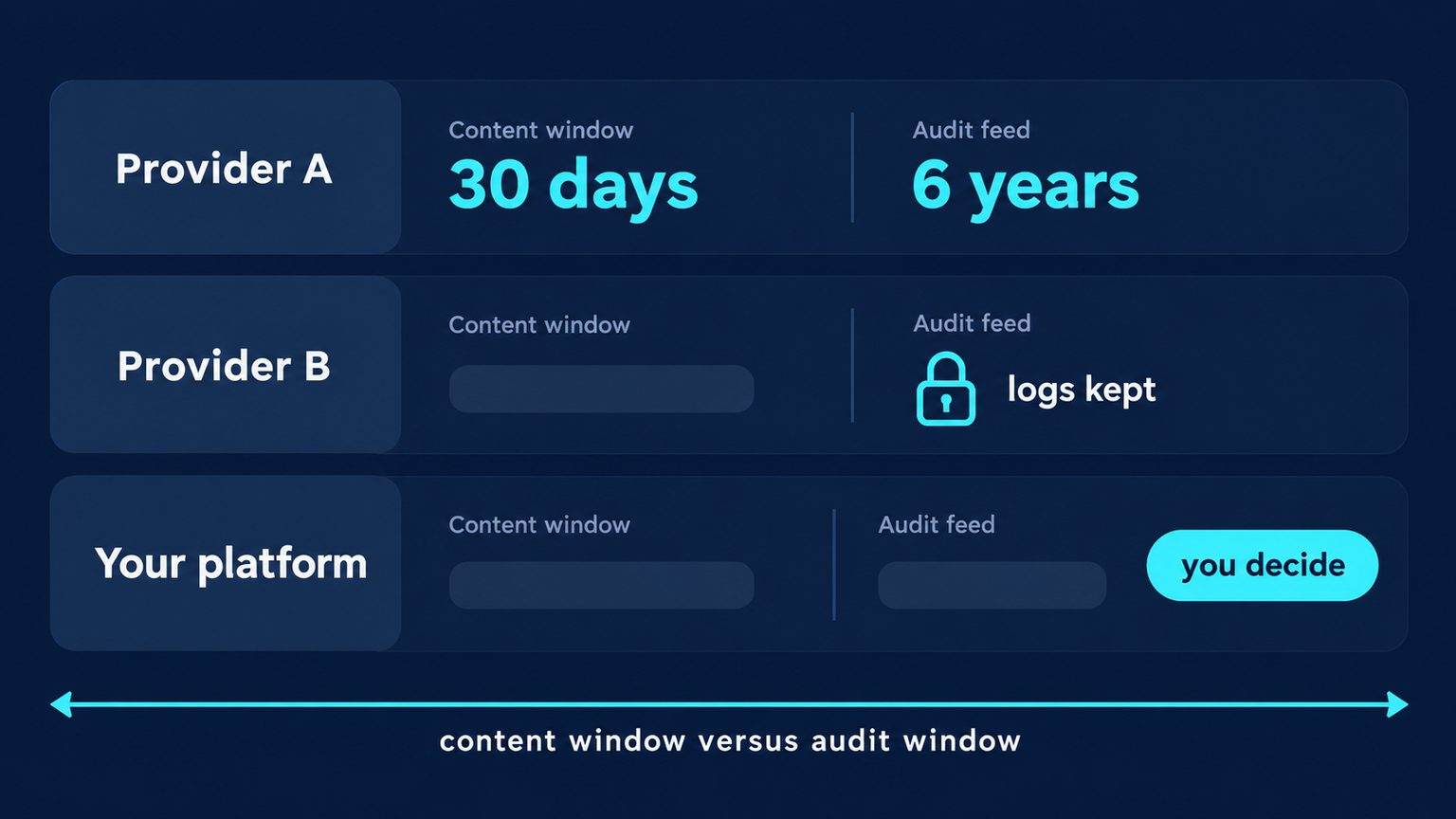
| Anthropic (API) | Inputs and outputs are automatically deleted from the backend within 30 days by default. | Custom retention controls for enterprise; zero-data-retention arrangements available; Compliance API activity feed and session transcripts retain for 6 years. |
| OpenAI (Enterprise/Edu) | Conversation message logs available through the Compliance Platform; a new conversation logs system shipped 5 March 2026. | Compliance API logs kept for internal audit and security are not deletable through that API. |
| Your agent platform | Whatever the default happens to be. | Yours to configure and document, including per-channel differences. |
The lesson: even the most mature AI vendors keep more in the audit layer and less in the content layer. Copy that shape. And check your own stack carefully, because a default you never read is a default you are accountable for anyway.
The deletion workflow that survives an audit
A retention policy without a deletion workflow is a wish. Deletion is the hard part, because conversation data is copied everywhere by design, CRM, help desk, analytics, exports, backups, and the model provider’s own logs.
- Define the trigger. Deletion happens on a schedule (purge after the window) and on request (a data-subject erasure). Both paths need an owner and a ticket type.
- Find every copy. Map the canonical store plus every derived copy: CRM fields, help-desk tickets, analytics exports, email notifications, and the AI platform itself. Anything you cannot find, you cannot delete.
- Delete, then verify. Run the deletion, then re-query the same record to prove it is gone. A delete call that returns success is not evidence; an empty read is.
- Handle the backups honestly. Most systems cannot surgically edit a backup. Follow the approach regulators expect: set the backup copy “beyond use”, don’t restore it into an active system except for disaster recovery, and confirm it expires on its normal cycle. Document that policy so your answer to “what about backups?” is a plan, not a pause.
- Tell downstream processors. Deletion requests do not stop at your boundary. Send the instruction to every sub-processor and client system, and record that you sent it.
- Retain the proof, not the content. Keep the audit record that a deletion happened, request ID, date, scope, executor, while removing the content itself. This is the one place where a log outlives a conversation, and it should.
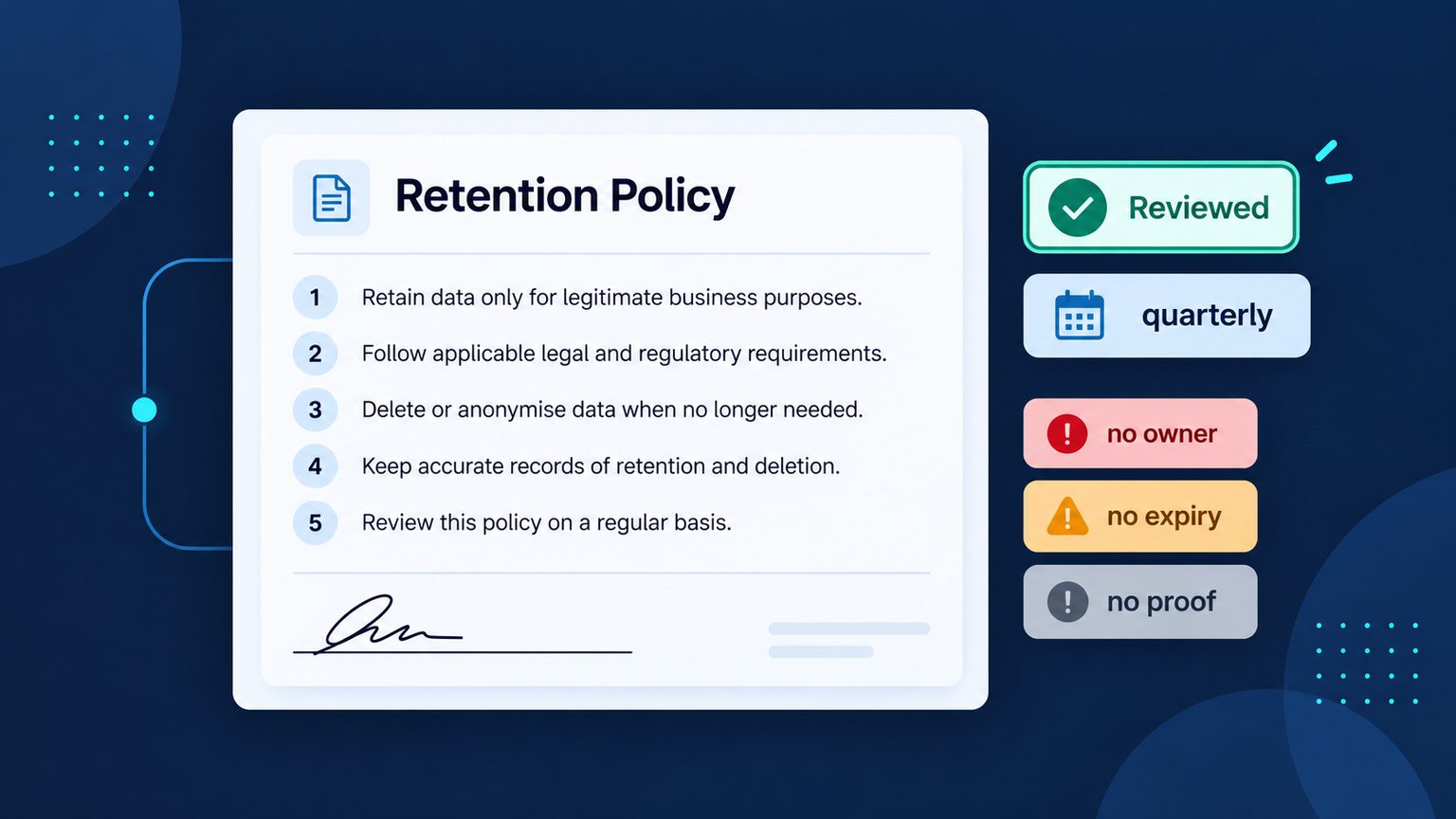
- Review the schedule quarterly. Windows drift as products and laws change. A quarterly review with a named owner keeps the policy current.
Deletion you cannot prove is deletion you cannot defend.
If you are an agency: retention is a product feature
Here is the flip side that most white-label agencies miss. Every client you serve with an AI agent is asking a variant of the same question, usually on a security questionnaire: what happens to our customers’ conversations?
If your answer is a confident one, here is the retention window, here is who can access it, here is our redaction practice, here is our deletion process, you have turned a procurement blocker into a differentiator. Retention stops being a box you tick and becomes a line item you can charge for: a data-handling addendum, a compliance pack, a documented SLA.
Three things make that credible:
- Per-client configuration. Different clients have different obligations. A clinic, a real-estate brokerage, and an e-commerce brand should not share one retention window. If your platform lets you set windows per agent or per workspace, use it, and say so.
- Bring-your-own-key (BYOK). When a client’s data stays inside infrastructure tied to their own model keys, you shrink the surface you personally hold. That is a strong answer in regulated deals.
- Channel-aware rules. WhatsApp, Instagram, SMS, and voice each carry their own retention and consent expectations. Build those into the deployment, not into a policy document nobody reads. If your agents run across multiple channels, a single brain spanning many channels changes where data lands and what you must govern. The same channel decisions appear in a multi-channel lead qualification workflow.
Botsify’s white-label AI agent platform is built around exactly this model. Agencies build, brand, deploy, and bill agents under their own domain, with BYOK available, so the retention decision stays with the party who owns the client relationship. That is a selling point, but only if you can describe it before someone asks.
Explore Botsify for Your Use Case
See how Botsify helps teams build and deploy AI agents.
A retention policy template you can copy
Replace every bracket, then have someone accountable sign it. One page beats a document nobody reads.
AI Agent Conversation Retention Policy, [Company]
Owner: [Name and role] Last reviewed: [Date] · Next review: [Date]
- Scope. Applies to all AI agents deployed by [Company] across [channels].
- Data categories. We distinguish raw content, structured outcomes, operational logs, and derived knowledge. Each has its own window.
- Purposes. We retain conversation data only to [resolve disputes / meet legal duties / improve the agent], and nothing else.
- Windows. Raw content: [X] days. Structured outcomes: [X] months. Operational logs: minimum [X] months, or longer where a regulation requires it. Derived knowledge: de-identified, re-derived from source.
- Access. Full content is limited to [roles]; every full-content read is logged. Summaries and metadata are available to [roles].
- Minimization. The agent collects only [fields]. Prohibited categories: [list]. Sensitive data is routed to [compliant flow].
- Redaction. Archives are redacted for [identifiers] before long-term storage.
- Memory. Customer-facing memory stores [scope] and is clearable on request.
- Deletion. Scheduled purges run [cadence]. Erasure requests are completed within [X] days across the canonical store and all downstream copies, including backups put beyond use.
- Proof. Deletion events are logged (request ID, date, scope, executor) without retaining the deleted content.
- Sub-processors. The policy is flowed down to [list] under contract.
- Exceptions. Any departure requires [approval role] and is time-limited.
Metrics: how to know the policy is working
Track a small set, on a cadence, and report them alongside the agent’s support metrics beyond ticket deflection.
| Metric | What it tells you | Warning sign |
|---|---|---|
| Median age of stored content | Whether the purge is actually running | Age creeping past the window |
| Copies per conversation | Whether minimization is real | More than one canonical store |
| Erasure requests completed on time | Whether deletion is operational | Any request completed late or partially |
| Full-content reads | Whether access control is tight | Reads with no recorded reason |
| Redaction coverage | Whether archives are scrubbed | Free-text fields unredacted |
| Retention exceptions open | Whether the policy is eroding | Exceptions with no expiry date |
Common failure modes
| Failure | What it looks like | Fix |
|---|---|---|
| The inherited default | Nobody can name the retention window | Set and document windows per data type |
| Transcripts in, logs out | Full content kept for years, events kept for days | Invert the tiers |
| Shadow copies | CRM, help desk, and exports each hold a version | One canonical copy; reference everywhere else |
| Memory creep | The agent “remembers” things no one approved | Scope memory; make it visible and clearable |
| Backup hand-waving | “We’ll get to backups eventually” | Put backups beyond use; write the procedure |
| Undeletable audit logs | Requested data cannot be reached | Map sub-processors; document legal holds |
| Cross-channel blind spot | WhatsApp data handled under a website policy | Set rules per channel |
FAQ
How long should we keep AI agent conversations? As short as your legitimate purposes allow, subject to any legal floor. Many teams land on 30 to 90 days for raw content, 12 to 24 months for structured outcomes, and at least six months for operational logs where a logging duty applies. Your window should follow your purpose and your industry, not a vendor default.
Do we have to keep conversation logs at all? For some systems, yes. The EU AI Act requires high-risk systems to have logging capability and obliges providers and deployers to keep automatically generated logs for at least six months in most cases, unless other law says otherwise. For most support and sales agents, logs are kept because they are useful, for investigation, improvement, and accountability, not only because they are required.
Is keeping everything actually a problem if we never look at it? Yes. Retained data still counts as data you hold: it can be breached, subpoenaed, requested for access or erasure, and must be kept accurate and secure. The risk is proportional to volume and duration, not to whether anyone reads it.
What is the difference between agent memory and conversation logs? Memory is a product feature that helps the agent serve the customer across sessions; it should be scoped, visible, and clearable. Logs are an accountability record of what the agent did; they are not for personalization and are often subject to a minimum retention duty. Keep them separate.
How do we handle deletion requests if the data is in backups? Follow the approach regulators expect: put the backup copy beyond use, do not restore it into an active system except for disaster recovery, and let it expire on its normal cycle. Document the procedure so you can describe it clearly to the person who asked.
Can we delete the transcript but keep a summary? Usually, yes, and often you should. The summary and the structured outcome carry far less risk than the raw text. Just make sure the derived copy is genuinely de-identified and is not simply a second cache of the original.
Does redaction mean we lose analytics? No. You can measure deflection, intent distribution, resolution rate, and escalation rate from de-identified data. If your reporting depends on names and phone numbers, that is a data-design problem worth fixing.
Who should own retention in a small team? One named person, even if it is a part-time responsibility. Ownership matters more than the org chart: someone must be able to state the windows, approve exceptions, and prove deletions happened.
How does an agency answer “what happens to our customers’ conversations?” With a specific, documented answer: the retention window, who can access full content, the redaction practice, and the deletion process, ideally configured per client and backed by BYOK where it reduces the agency’s own exposure.
The decision, stated plainly
AI agent data retention comes down to one rule: keep what you can defend, in the form you can defend, for as long as you can defend keeping it. Nothing longer.
That means: short windows for raw content, longer ones for structured outcomes, a real floor for operational logs, and memory that is deliberate rather than incidental. It means a policy with a name on it, a purge that runs on a schedule, and a deletion path that reaches backups and sub-processors. It also means being able to say all of this out loud, in one page, to a client, a buyer, or a regulator.
Do that and retention stops being the question that empties the room. It becomes one more thing your team got right before anyone asked.
Build the Right AI Agent with Botsify
Talk with Botsify about an agent suited to your workflow.