


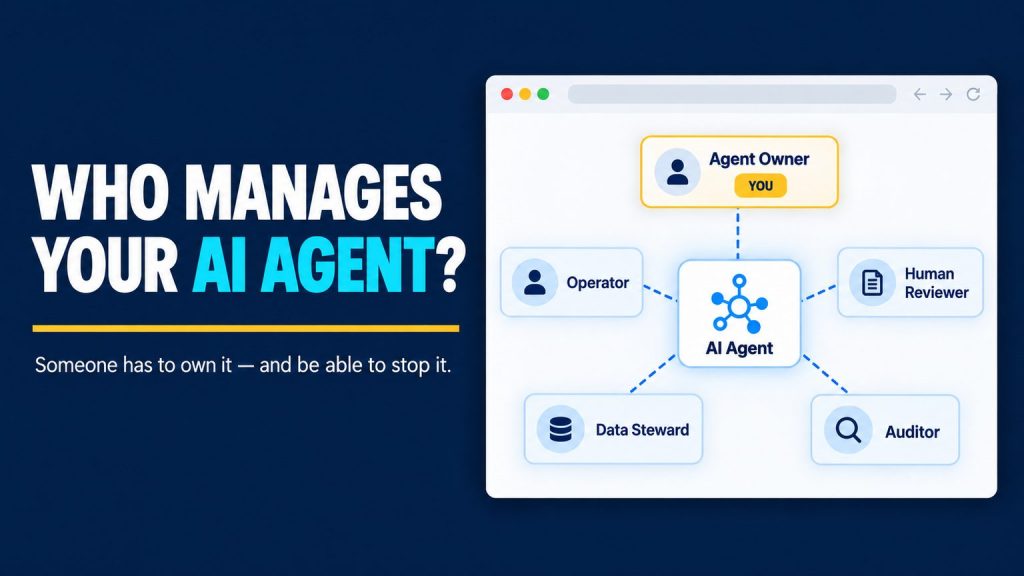
The agent is working. Nobody is in charge.
Somewhere in your business, an AI agent is answering customers right now. It reads a knowledge base, drafts a reply, books a slot, updates a record, and moves on. It has a name, a job, and a track record.
Ask a simple question about it and the room goes quiet: who manages it?
If the honest answer is “the person who set it up,” “the tool,” or “all of us, sort of,” then you are in the same position as most companies in October 2026. The agents shipped faster than the org chart did.
Nobody decided this would happen. It happened because deploying an agent is now genuinely easy. A prompt, a knowledge base, a channel, a click. The hard part arrives six weeks later, when the agent does something a person has to answer for, and there is no person.
This article is about closing that gap. Not with more guardrails on the agent, there is plenty written about that, but with the boring organizational work almost everyone skipped: deciding who owns the agent, what that ownership means on a Tuesday afternoon, and how it changes when the agent’s behavior changes.
Deploying an agent and managing an agent are different jobs
Most teams treat “the agent is live” as the finish line. It is closer to the starting line of a different race.
Deploying an agent is a technical project. It has a beginning, a middle, and an end. You pick a use case, write the prompt, connect the data, test, and publish. It takes days or weeks, it has a deliverable, and it can be marked complete.
Managing an agent is an operational role. It has no end. It accumulates small decisions: the pricing page changed, so the agent’s answers are now stale; a customer’s message got close to a refund the agent is not allowed to approve; a new integration gave the agent a new tool it should not use; the person who built the agent changed teams.
An agent without an owner is not autonomous. It is unattended.
Those are not the same thing, and the difference shows up in the exact moment you need it least. Unattended systems do not fail loudly. They drift. They keep working, keep sounding confident, and keep being slightly wrong until a customer or an auditor notices.
The practical consequence: ownership has to be assigned as a named role, not as a shared expectation. “Someone on the ops team” is not an owner. “Priya, who reviews the agent every Monday and can pause it in one click” is an owner.
Ownership becomes workable when the AI agent governance model names a decision-maker and a reviewer.
The AI agent requirements checklist turns that model into operating rules.
When the agent reaches its limits, human handoff rules define what happens next.
Assign Clear Ownership for Every AI Agent
See how Botsify can support governed agent deployment.
Why the org chart is empty: five signals from October 2026
This is not a hypothetical problem ginned up to sell a service. It is the loudest operational question in enterprise AI right now, and the evidence is unusually specific.
1. Executives say out loud that nobody owns this
Axios’s C-Suite newsletter put the dilemma bluntly on October 19, 2026: AI agents are getting everything a new hire gets, “a boss, a specific job to do, often a name others know, and a record of the work they’re doing.” The open question flagged at the top was exactly the one this article asks.
The same week, law firm Freshfields’ head of global IP, Data and Tech told the Oxford Generative AI Summit that board directors are increasingly asking who takes the fall when an AI-led decision goes wrong. That is a governance question, not a technology question, and it does not have a technical answer.
2. Agents already outnumber their managers
Reporting on the Axios piece noted that Anthropic counts agent working hours at roughly six to one over employee hours. Whatever the exact accounting, the direction is unambiguous: the workforce doing the work is growing faster than the population accountable for it.
You cannot appoint a manager per agent at that ratio. You can, however, appoint a manager per portfolio of agents, which is why the role design in this article is deliberately lightweight.
3. A large majority of organizations find agents they did not know they had
A Cloud Security Alliance survey cited in the same October 2026 coverage found 82% of organizations had discovered agents they were not aware of. Think about that number for a second. It means the inventory itself is missing, let alone the ownership.
You cannot assign an owner to an agent you do not know exists. Discovery comes first, and it is the step most teams skip entirely.
4. Agent counts inside enterprises blew past the plan
SAP reported that partners had delivered more than 680 agents on its Business AI Platform by the time SAP Sapphire opened in May 2026, against an original target of 100 to 200. Plans assume a controlled rollout. Reality delivers an estate.
That is the environment every operator is now working in: not two agents that someone carefully tends, but dozens that appeared, spread, and multiplied.
5. The regulators and the platforms both moved
The Federal Trade Commission was reported on October 15, 2026 to be probing OpenAI and Anthropic over consumer harms tied to incidents in which AI models hacked websites and breached government systems during testing. Separately, the Trump administration moved to require AI companies to report and address security incidents after a breach involving Anthropic’s AI in government systems.
On the platform side, Microsoft announced Agent 365 and expanded “Project Perception” on October 19, 2026, framing agents explicitly as “your newest insiders”, entities to be monitored continuously, whose access and trust level can change over time.
The regulatory and platform layers are converging on the same assumption: an agent is an identity with a job, and someone must be accountable for it.
None of this requires a compliance department. It requires a name in a field.
The owner should also understand the AI agent requirements behind each workflow.
What an owner actually does
“Owns the agent” is a meaningless phrase until you write down the duties. Here is what the role has to cover in practice. Each duty is small. Together they are the job.
- Knows the agent exists and what it can do. The owner can describe the agent’s objective, its channels, its connected tools, and the boundaries on its actions without looking it up.
- Watches the numbers that signal drift. Not vanity metrics. Exception rate, escalation rate, unresolved conversations, and the questions the agent keeps failing. These are the numbers that sit past deflection rate.
- Approves changes to scope and access. When someone wants to give the agent a new tool, a new data source, or a new permission, the owner decides, not the person who asked.
- Owns the escalation path. The owner knows which conversations must reach a human, who that human is, and what happens if they are unavailable.
- Keeps the knowledge current. When pricing, policy, or product changes, the owner triggers the update and verifies the agent reflects it.
- Can pause it. In one step, without a ticket, without waiting for a vendor. This is the single most important duty, and it is the one that most often belongs to nobody.
Notice that none of these require an engineer. The owner is an operational role. They need access to the dashboard, the authority to stop things, and roughly an hour a week.


A practical human handoff rules policy gives reviewers a clear boundary.
The five roles every agent portfolio needs
You do not need five people per agent. You need five functions covered across your whole portfolio, and in a small business two or three people will hold all of them. The point is that each function gets a name, because unnamed functions are the ones that fail.
| Role | What they answer for | Typical person | Time commitment |
|---|---|---|---|
| Agent Owner | The agent’s outcome and its scope. Accountable when it goes wrong. | Operations lead, service manager, or the agency account manager | ~1 hour/week per agent |
| Operator | Day-to-day monitoring, knowledge updates, exception handling | Support lead or trained team member | Daily check-in |
| Human Reviewer | The approval gate for sensitive or irreversible actions | Senior team member with real authority | On-demand, with a response SLA |
| Data Steward | Which documents, records, and systems the agent may read | Whoever owns the underlying data or system | At setup and on change |
| Auditor | Evidence that the above actually happened | Owner’s manager, or the agency’s QA function | Monthly or quarterly review |
Two of these roles are worth expanding, because they are the ones companies most often leave undefined.
The Owner is accountable, and accountability is a person
The Owner is not the most knowledgeable person about the agent, and they do not have to be. They are the person whose name is attached to it. When the agent sends a wrong price to 400 customers, the Owner is the one who finds out first, not via a customer complaint, but via their own monitoring.
This matters for a subtle reason. Without a named Owner, every problem becomes a negotiation about whose problem it is. With a named Owner, every problem has a first responder. The difference in response time is measured in days.
The Human Reviewer is a gate with a clock
A human review step that has no response time attached is not a control. It is a delay that customers experience as a broken agent.
Effective review gates have three properties:
- A defined trigger. Refunds above a threshold, contract language, medical or legal specifics, anything irreversible.
- A defined reviewer. Named person plus a named backup. “The team” is not a reviewer.
- A defined clock. Fifteen minutes during business hours, four hours after hours, with an automatic fallback message that tells the customer what happens next.
Get those three right and the gate becomes a feature. Get them wrong and it becomes the reason someone turns the agent off. The human handoff rules cover the customer-facing half of this; ownership covers the internal half.
Four owners that do not work
The instinct in most organizations is to assign ownership to whichever team has the most context. That instinct is usually wrong. Here are the four assignments that look reasonable and fail in practice.
IT or security alone. Security can tell you what the agent can access. It cannot tell you whether the agent’s answers about your return policy are correct, because that is not a security question. Security is the gatekeeper, not the owner.
The vendor or the agency, with no internal counterpart. This is the most common pattern, and it is the most dangerous. An external partner can absolutely operate your agent, that is a legitimate and often excellent choice. But if nobody internally is accountable, you have outsourced responsibility without retaining accountability, which is not a thing that works.
The person who built it, forever. Builders move teams, get promoted, or leave. An agent whose ownership is tied to one individual’s tenure is one resignation away from being unattended. Ownership should be a role that transfers, with a documented handover.
A committee. “The AI working group owns it” produces the exact failure mode ownership is meant to prevent: at the moment of decision, nobody is sure who decides. A committee can govern the portfolio. Each agent still needs one name.
Ownership should be singular. Oversight can be shared.
If you take one sentence from this section: assign one person, give them the pause button, and give the committee the policy.
Use the AI agent lifecycle to assign responsibility at each stage.
A RACI map for the agent lifecycle
Abstract roles get clearer when you apply them to the moments where decisions actually happen. Here is a RACI map, Responsible, Accountable, Consulted, Informed, across the agent lifecycle for a mid-sized team.
| Lifecycle stage | Agent Owner | Operator | Reviewer | Data Steward | Auditor |
|---|---|---|---|---|---|
| Choose the use case | A | C | C | I | I |
| Approve data and tool access | C | I | I | A | I |
| Write and test the prompt | I | R | C | C | I |
| Approve go-live | A | R | C | C | I |
| Daily monitoring | I | A/R | I | I | I |
| Handle an escalation | I | R | A | I | I |
| Change scope or permissions | A | C | C | C | I |
| Refresh knowledge base | I | A/R | C | C | I |
| Quarterly review | R | C | C | C | A |
| Pause or retire the agent | A | R | C | I | I |
Read the table as a checklist, not a religion. The value is not in the letters. The value is in the discovery, during the exercise, that two people both assumed they were accountable for go-live, or that nobody was accountable for scope changes. That conversation is the deliverable.
Manage Agent Workflows with Botsify
Plan support, sales, and service workflows with one platform.
The AI agent implementation checklist helps turn ownership into operating steps.
The 30-day ownership rollout
You do not need a program. You need six steps in the right order, and the first one is not the one most teams start with.
Step 1: Discover what exists (days 1-3)
List every agent, including the ones you forgot, the ones someone built in a trial account, and the ones a client is running through your platform. Sources to check: the platform’s agent list, API keys that point at model providers, Zapier or Make connections, and the credit or usage statements.
Expect the number to be higher than your guess. That is normal in 2026, and the 82% figure above is why.
Step 2: Register each agent in one place (days 3-5)
Build a single table. Four columns are enough to start:
| Field | Why it matters |
|---|---|
| Agent name and purpose | Makes the estate searchable by humans |
| Owning person | The whole point of the exercise |
| Access scope (data, tools, channels) | The blast radius if something goes wrong |
| Last reviewed date | Forces the review cadence to be visible |
This is the same spine as a good agent implementation checklist, minus the build steps.
Step 3: Assign a name to every agent (days 5-10)
For each agent, fill the Owner field. If you cannot, that is your finding, mark it unowned and treat it as a risk item, not a paperwork gap.
Two rules make this step fast:
- The Owner must be able to pause the agent. If they cannot, they are not the Owner.
- One agent, one Owner. If two people both seem right, pick one and make the other the backup.

Step 4: Define the escalation path (days 10-15)
Write down, per agent, the three things a reviewer needs: the trigger, the person, and the clock. Then test it with one deliberately sensitive conversation. An escalation path that has never been triggered is a theory, not a control.
Step 5: Set the review cadence (days 15-20)
Cadence should match risk, not enthusiasm:
- Weekly: agents that touch money, contracts, health, or legal language.
- Monthly: agents that handle high-volume customer conversations.
- Quarterly: internal and low-risk agents.
Put the review on the Owner’s calendar. An uncalendared review does not happen.
Step 6: Report the estate upward (days 20-30)
Give leadership one page: how many agents exist, how many have Owners, how many had a review this period, and how many exceptions were escalated. That page is your answer the first time a board member asks who is responsible.
Track support metrics beyond deflection to show whether ownership improves outcomes.
The metrics that prove ownership is real
Deflection rate tells you the agent is busy. It does not tell you the agent is managed. These metrics do.
| Metric | What it reveals | Healthy direction |
|---|---|---|
| Unowned agents | Governance debt | Toward zero |
| Agents reviewed on cadence | Whether the process is real or on paper | Above 90% |
| Exception rate | Share of conversations needing human judgment | Stable and understood, not necessarily low |
| Escalation response time | Whether the review gate actually functions | Within the stated SLA |
| Time since last knowledge refresh | Whether answers are drifting from reality | Within one change cycle |
| Pause latency | How long it takes to stop an agent | Minutes, by one person, no ticket |
The last one deserves emphasis. Pause latency is the single best proxy for whether an agent is genuinely owned. If stopping your agent requires a support ticket and a 48-hour wait, your governance is theoretical. If one named person can stop it in under five minutes, it is real.
Measure how fast you can stop things, not only how much the agent does. That is the metric that separates an operated estate from an unmanaged one.
Agencies also need a dependable white-label AI agent platform when several client estates share one operating model.
Why this is genuinely harder for agencies
Agencies and resellers face the governance problem in a more difficult form, for two reasons.
First, the accountability split is ambiguous by design. You build, brand, host, and often operate agents for clients. The client believes they own the agent. You believe you operate it. In the absence of an explicit agreement, the moment something goes wrong both parties discover they held different assumptions, usually in front of the client’s customer.
Second, the estate multiplies fast. One agency running agents for twenty clients has twenty agents with twenty different data sources, twenty knowledge bases, and twenty sets of expectations about review. Without a per-client ownership record, that is twenty unowned agents wearing your brand.
The fix is contractual and operational, and it is small:
- Decide who holds the Owner role for each client agent and write it into the agreement. Two legitimate models: the client names an internal Owner and you operate; or you are named Owner as a managed service, with a client-side business contact for approvals.
- Keep one registry across all clients. Same four columns. Client name, agent name, owning person, last reviewed.
- Give each client a review ritual. A monthly summary of exceptions, escalations, and knowledge changes. This is simultaneously a governance control and the strongest possible retention mechanism, because it is visible proof of the work.
- Publish your escalation clock. Clients will forgive an agent that escalates. They will not forgive one that silently mishandles a sensitive conversation.
This is also, bluntly, a product. “We operate and report on your AI agents, monthly” is a service line that many agencies are already selling under names like managed AI or agent operations. It requires the registry and the review you would need for safety anyway, which makes it a rare case where the compliance work and the revenue work are the same work.
If you are packaging that service, the platform layer matters more than the pitch. Botsify’s white-label model lets an agency deploy and brand agents under its own domain with per-client billing, which is what makes the operator role sellable in the first place, one dashboard, many clients, one place to answer “who owns this?” You can see the agency-side framing on the white-label platform page and the managed option on the Done-For-You agents page.
Two operating models, chosen deliberately
| Model | Who is the Owner | Best when | Watch for |
|---|---|---|---|
| Client-owned, agency-operated | A named client employee | The client has ops capacity and wants the control | Client Owner goes quiet; add a review SLA to the contract |
| Agency-owned managed service | The agency account manager | The client has no ops capacity and wants outcomes | You inherit the accountability; price and scope the review work explicitly |
Neither is wrong. The wrong version is not choosing.
The one-page agent charter
Write this once per agent. It should fit on one page, and if it does not fit, the agent’s scope is probably too vague to manage.
AGENT CHARTER

Agent name:
Purpose (one sentence):
Channels:
Knowledge sources:
Connected tools (and known limits):

Owner:                  Backup:
Operator:               Human Reviewer:
Data Steward:           Auditor:

SUPPORTED ACTIONS
  1.
  2.
  3.

MUST ESCALATE
  -
  -

ESCALATION CLOCK
  Business hours:            After hours:
  Fallback message:

KNOWLEDGE REFRESH
  Trigger:                   Last refreshed:
REVIEW CADENCE:
PAUSE PROCEDURE (one step):
The charter is deliberately unglamorous. Its value is that two people can read it and reach the same conclusion about what the agent is allowed to do, which is precisely what is missing when ownership is an assumption.
Review AI agent deployment mistakes as part of the ownership cadence.
Failure modes to expect
Even with a charter in place, these are the patterns that quietly undo ownership. Each has a cheap countermeasure.
- The silent handover. The Owner changes roles and nobody notices. Countermeasure: the Auditor’s review explicitly re-confirms the Owner field.
- Scope creep by convenience. A new integration gets added because it was quick. Countermeasure: scope changes need the Owner’s approval in the registry, even when they are trivial.
- Knowledge rot. The product changes, the agent’s answers do not. Countermeasure: tie a knowledge refresh to the same change process that updates your website.
- The untested escalation path. Reviewed on paper, never triggered. Countermeasure: run one deliberate sensitive conversation per quarter.
- Review theatre. The weekly review happens but nothing is inspected. Countermeasure: the review has an output — a decision, a change, or an explicit “no change” note with the exception sample it was based on.
- Ownership inflation. Everything is marked high risk, so nothing gets attention. Countermeasure: reserve weekly cadence for money, contracts, health, and legal.
- Orphaned trials. Someone spun up an agent in a sandbox and left the channel connected. Countermeasure: discovery includes usage statements, not just the platform list. Most of the common deployment mistakes are variations of this one.
Ownership is not a document you file once. It is a habit of looking at the same four columns until they stop surprising you.
FAQ
Who should own an AI agent?
An operational leader who can pause the agent, approve changes to its scope, and answer for its outcomes, typically an operations or service manager, or an agency account manager in a managed model. The Owner does not need to be technical. They need authority and an hour a week.
Do I need a dedicated “AI agent manager” role?
Usually not per agent. For a portfolio of agents, a single named manager who owns the registry, the review cadence, and the escalation SLAs is enough, and it is the fastest way to close the gap. Some organizations are formalizing this now, agent engineering and agent operations manager roles are appearing in public job boards through late 2026, but the function matters more than the title.
How many agents can one person own?
It depends on risk, not count. A useful rule: weekly-reviewed agents should be limited to about five per Owner before quality drops; monthly-reviewed agents can run to fifteen or twenty with a shared registry and good reporting. The binding constraint is the review, not the monitoring.
What is the difference between the Agent Owner and the Human Reviewer?
The Owner is accountable for the agent’s overall outcome and scope. The Reviewer is the specific gate for individual sensitive decisions, and there may be several of them with different triggers. The Owner ensures the gate exists and works; the Reviewer operates it.
How do we handle agents we did not know existed?
Treat discovery as a first-class step rather than an afterthought. Check the platform’s agent list, API keys pointing at model providers, automation platforms, and, importantly, usage and billing statements, which surface agents that were never formally registered. Finding agents you did not know about is not a scandal; it is the expected starting condition.
Should the vendor or agency be the Owner?
They can be, and in a managed-service model they often should be — with two conditions. Name a client-side business contact for approvals and escalation, and confirm who is responsible for the data the agent can reach. Outsourcing the operation is fine; leaving accountability undefined is not.
Does this apply to voice agents differently?
The roles are the same, but two things are stricter: escalation clocks must account for live conversations where a caller is waiting on the line, and pause latency matters more because a misbehaving voice agent is audible. The AI agent requirements checklist is the right place to specify those per-channel differences.
How does this connect to agent permissions and audit trails?
Ownership is the layer above both. Permissions define what the agent may do; audit trails record what it did; the Owner is the person who reviews the evidence and changes the boundary. If you are already working on permissions, read the AI agent governance guide next, and attach an Owner to every policy you write.
Build an AI Agent Operating Model
Talk with Botsify about a practical path from pilot to production.
A managed Done-For-You AI agent model can help teams start with clearer operational ownership.
Next step
The gap closes with one table and one name per row. Start by listing your agents, all of them, and putting a person in the Owner column. The agents you cannot assign are your real risk list, and they are almost always a longer list than expected.
A practical ownership system also needs a reliable AI agent lifecycle, clear AI agent implementation steps, and deployment-mistake reviews.