
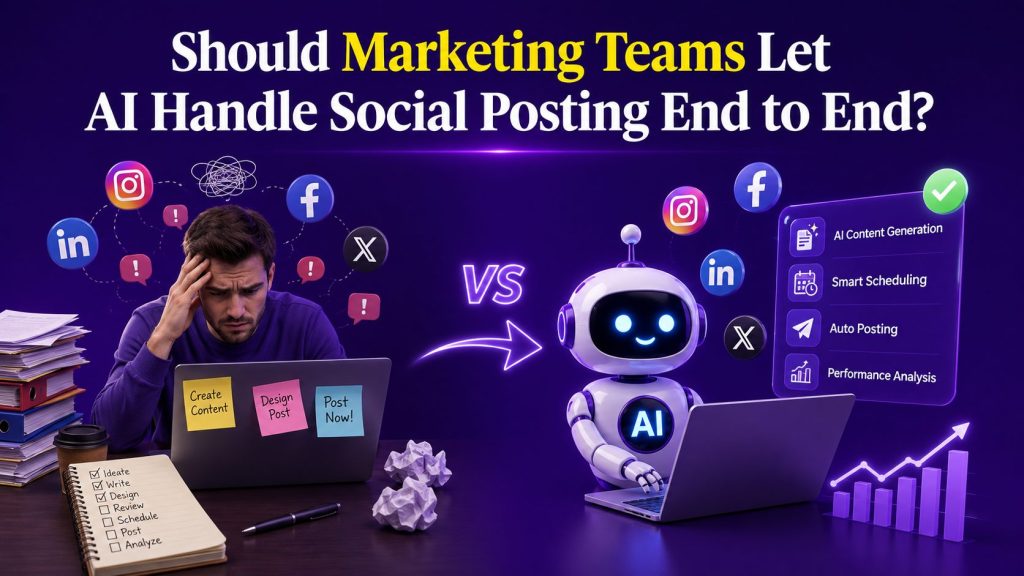
You’ve seen the pitch. Type in a brief, click a button, and a full week of social content goes live across every platform without another human touching it.
It sounds great in a demo. But should you actually do it.
If you’re a marketing lead, or you run an agency managing small to mid size teams, this question comes up more than almost any other right now. And the honest answer isn’t yes or no. It is more nuanced than that, so let’s actually walk through it.
That nuance is exactly why platforms like Insika AI exist as something closer to a decision layer than a full autopilot, and why the “end to end, no humans” version of this pitch rarely holds up once you look closely at how AI in marketing actually gets used well.
What AI Already Does Well in Social?
Let’s give credit where it is due first. AI in marketing has genuinely changed what a small team can pull off.
According to a Harvard Division of Continuing Education report on AI in marketing, tasks like writing copy, mining consumer data, and generating visuals that once took hours now take minutes. Instructors there point out that most marketers are still underusing AI, not overusing it, because the technology genuinely removes friction from repetitive work.
AI social media management tools are strong at drafting captions in your brand voice, building out a content calendar in minutes instead of a full afternoon, resizing and adapting assets across platforms, and analyzing which posts are actually performing so you’re not guessing at what to do next.
That is real, meaningful time saved. None of it requires you to hand over full control.
Portable AI Agents In Seconds, Use Everywhere
Prompt, Test, and Deploy AI Agents Across Social Platforms and LLMs. Automate Everything.
Where Full Automation Starts Getting Risky?
Here is where it gets less comfortable. Posting end to end means no human reviews what goes out before it is public.
That is a bigger risk than it sounds like. A well known case study in AI oversight involves Sports Illustrated, whose CEO was let go after it came out that the outlet had published AI generated content without disclosing it to readers. The issue wasn’t that AI was involved. It was that nobody was checking, and nobody was telling anyone.
Social media moves faster than almost any other channel you manage. A tone miss, an outdated reference, or a post that lands wrong culturally spreads before anyone at your company even sees it happened. Full automation removes the one checkpoint that used to catch that kind of thing before it went live.
There is also a bias risk worth taking seriously. AI models learn from existing data, and when that data carries skew, the output can quietly repeat it. Responsible use of AI in marketing generally means keeping a human in the loop specifically to catch these blind spots, not because AI is untrustworthy in general, but because nobody has fully solved this yet.
That is where AI Agent Governance becomes important. Teams need clear rules around what AI can publish independently, what requires approval, and who is accountable when automated systems interact with customers or represent the brand publicly.
The Smarter Middle Ground
So where does that leave you? Not fully manual, and not fully automated either.
The teams getting the most out of AI social media management treat it as a fast first draft engine, not a publisher. AI handles the repetitive lift, the drafting, the scheduling logic, the initial performance analysis. A human still makes the final call before anything goes out, especially on anything timely, sensitive, or tied to a live news cycle. This is also a good example of how AI agent workflows can be structured: automation handles repeatable steps, while human approval is built in wherever judgment or brand risk is involved.
This same logic extends past social into how good ai tools for marketing teams are actually built more broadly. The strongest systems function like a command center, surfacing recommendations and drafts for your team to approve, rather than quietly acting without anyone watching. Forrester has written about this exact shift, describing a digital command center model where marketing leaders get a unified view of activity and decisions, instead of disconnected tools each operating in their own silo.
Where Does This Connect to the Rest of Your Marketing Stack?
Social posting doesn’t happen in isolation. It is one output of a much bigger decision making process.
This is where ai driven media mix modeling actually connects back to your social strategy. If your MMM shows social is underperforming relative to spend this month, that should shape what your team posts and how much budget backs it, not just get filed away in a report nobody reads until next quarter. When your social execution and broader marketing intelligence are actually talking to each other, different AI skills such as content creation, performance analysis, and campaign optimization can work together as part of one coherent system rather than operating as disconnected tools.
Should You Let AI Handle It End to End?
Mostly, no. Not because the technology can’t draft and schedule reliably, it can. But because removing the human checkpoint removes your last line of defense against the mistakes that are hardest to walk back once they’re public.
The better move is letting AI handle the volume and the busywork, while a person keeps final judgment over what actually represents your brand in public. That is not a compromise. It is genuinely the version that scales better, because it lets your team move fast without losing the thing that makes your brand sound like your brand in the first place.
Summing Up
AI can absolutely carry the weight of social media management. Drafting, scheduling, analyzing, all of it. What it shouldn’t carry alone is the final decision of what goes public in your name.
Keep a human in that last step, and you get the speed of automation without gambling your brand’s credibility on a system that is still learning where the lines are.
AI Agentic Platform For Building Portable AI Agents
Say Hello To Agentic AI That Connects With Your CRM And Even Other Agents
