


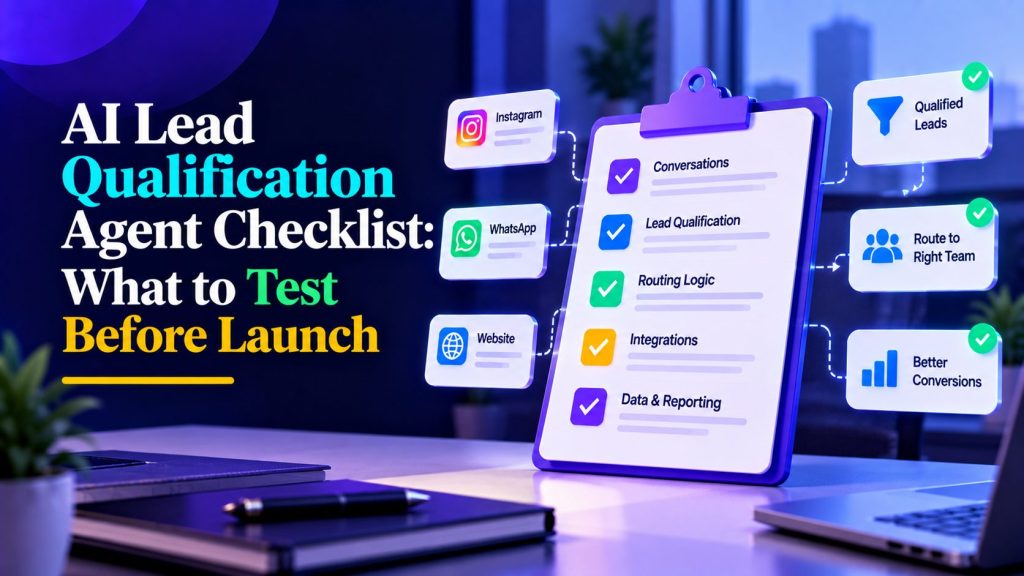
Building an AI lead qualification agent is relatively straightforward. Making sure it handles real sales conversations correctly is where the work begins.
An agent might perform perfectly during a demonstration, answering common questions and collecting qualification details without hesitation. But what happens when a prospect shares their budget before being asked, requests a discount that isn’t available, or wants to speak with someone in sales while the assigned representative is offline?
These are the situations that reveal whether an agent is ready for real customers. A poorly tested system can misclassify leads, provide incorrect information, or lose valuable inquiries because the CRM integration fails without anyone noticing.
This AI lead qualification agent checklist covers the essential tests to run before launch, from qualification logic and knowledge base accuracy to human handoffs, integrations, and performance monitoring. You’ll also find practical test scenarios and a sign-off process to help your team decide when the agent is ready.
Why testing matters more than building
The hard part of an AI agent is not the initial setup. It is making it reliable under real, messy, unpredictable input.
Real leads do not:
- Answer questions in order.
- Use the exact keywords you anticipated.
- Stay on topic.
- Say what they mean the first time.
They mention unrelated products, ask about things outside your knowledge base, get frustrated, or type two words and go quiet. An agent that only handles the happy path will fail on most real conversations.
The AI agent testing guide covers testing methodology in general; this checklist is specific to lead qualification agents.
AI Lead Qualification Agent Checklist: 10 Essential Tests
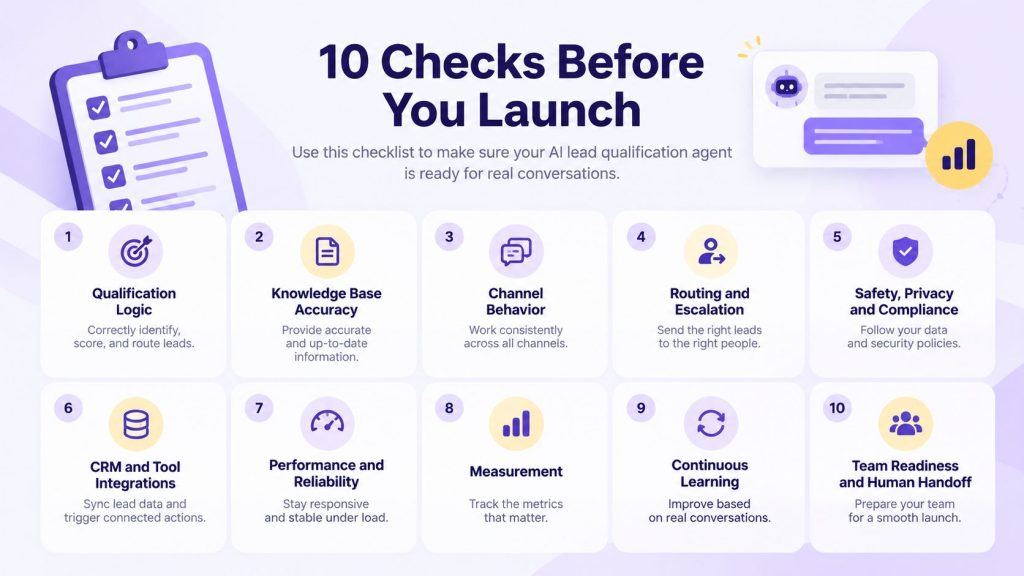
Use this lead qualification agent checklist to review the ten areas that matter most before launch. Each section covers a different part of the agent’s performance, from collecting prospect information to routing qualified leads and handling unexpected requests. Work through the tests with your team and record any issues that need to be resolved before the agent starts handling real inquiries.
1. Qualification Logic
The first thing to test is whether the agent can recognize a qualified prospect without forcing every conversation through the same set of questions. A lead may explain their budget, timeline, and requirements in one message, while another may need several follow-up questions before the agent has enough information to recommend a next step.
Before launch, verify that:
- The agent identifies the prospect’s main need before collecting additional details.
- It asks only for information needed to qualify or route the inquiry.
- It recognizes details the prospect has already shared and avoids asking for them again.
- It can handle multiple qualification answers provided in one message.
- It asks clear follow-up questions when important information is missing.
- It distinguishes between new prospects, existing customers, and support requests.
- It applies the business’s predefined scoring or qualification rules consistently.
- It does not invent missing information to make a prospect appear more qualified.
- It recommends the correct next step based on the prospect’s needs and readiness.
How to test it: Run the same qualification scenario in several different ways. First, provide the information one answer at a time. Then provide everything in a single message. Finally, leave out an important detail and see whether the agent asks an appropriate follow-up question.
For a detailed explanation of qualification criteria, lead scoring, and routing rules, see our guide to building an AI lead qualification agent.
The objective is consistent qualification decisions, not identical conversations. An agent that collects the correct information naturally is more useful than one that follows a script perfectly but ignores what the prospect has already said.
2. Knowledge base accuracy
- Every answer the agent gives traces back to a document or URL in the knowledge base.
- Outdated information (old prices, discontinued features, past promotions) has been removed.
- The agent cites sources or says “I’m not sure” rather than guessing.
- Pricing questions defer to a human or link to the pricing page, never quote a number the knowledge base does not contain.
- Document formatting has been tested: PDFs with tables, DOCX with footnotes, CSVs with edge cases.
Knowledge base quality is the single biggest driver of agent quality. If your documents are messy, the agent will be too. The AI agent requirements guide covers how to structure source material properly.
3. Channel behavior
- The agent responds correctly on every channel it is deployed to.
- Response length adapts to the channel (short on WhatsApp, longer on website chat).
- Media, links, and formatting render correctly on mobile.
- The agent does not send messages outside the channel’s allowed window.
- Language detection works for every language your audience uses.
Channel quirks cause more real-world failures than model quality. A perfect agent that breaks on mobile is useless. Test on real devices, not just a desktop browser.
If you’re deploying the same agent across Instagram, WhatsApp, and website chat, test each channel independently before checking whether the overall qualification process remains consistent. Our guide to multi-channel lead qualification explains how channel-specific conversations, shared lead records, and routing rules fit together.
4. Routing and escalation
- Hot leads reach a human within your target SLA (aim for under 5 minutes during business hours).
- Escalation triggers are clearly defined: frustration, legal questions, repeat confusion, or explicit request for a human.
- The agent never argues with an angry lead, it hands off.
- Routing rules handle absence: if the assigned rep is unavailable, the lead goes to someone else.
- A backup escalation path exists if the primary one fails.
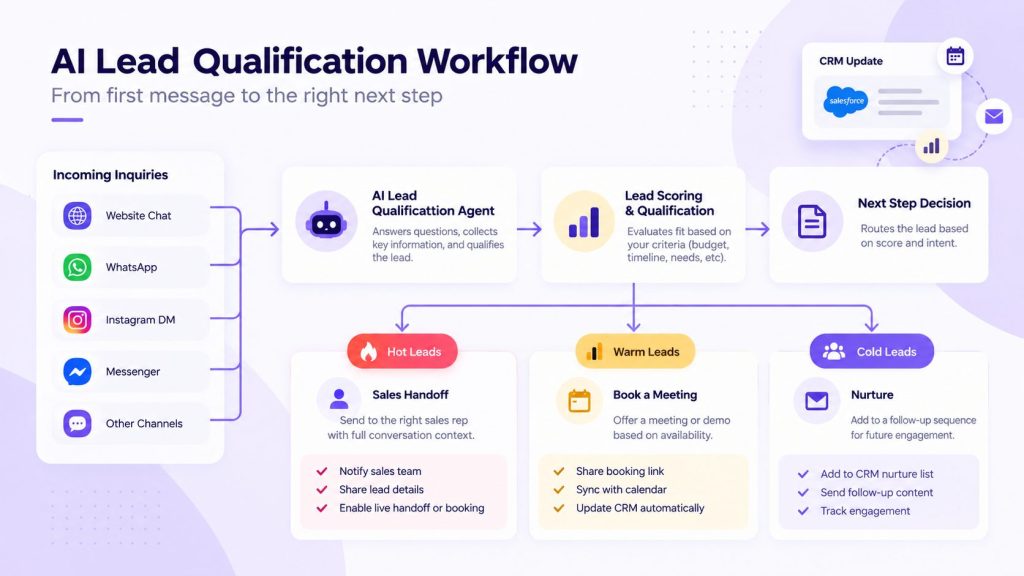
Routing is where the money is. A brilliant agent that routes hot leads to a full inbox has failed. Test the full path: conversation → score → route → human receives it with context.
Human handoff is particularly important when a sales inquiry turns into a support request. If your agent handles both types of conversations, review the escalation practices covered in our customer support AI agents guide before finalizing your routing rules.
For businesses that qualify prospects through WhatsApp, it’s also worth testing how the agent handles follow-ups, booking requests, and conversations that need human attention. The WhatsApp lead generation playbook covers these workflows in more detail.
5. Safety, Privacy, and Compliance
Lead qualification agents frequently handle contact details, business requirements, budgets, and other information that customers may not want shared outside the intended conversation. Before launch, test both what the agent is allowed to say and how it handles the information it collects.
Accuracy and response safety
- The agent does not invent pricing, discounts, product features, delivery dates, or guarantees.
- It acknowledges when information is unavailable rather than making assumptions.
- Competitor comparisons use verified information without unsupported claims.
- It redirects unrelated questions appropriately instead of generating misleading answers.
- It follows the business’s approved escalation rules for sensitive or high-risk inquiries.
Privacy and data handling
- The agent collects only the personal information needed for qualification or follow-up.
- Sensitive information is not requested unless the business has an authorized, secure process for handling it.
- Customer information is available only to the people and systems that need access.
- Conversation storage, retention, and deletion practices have been reviewed.
- The agent does not reveal another customer’s information when handling a new inquiry.
Messaging and compliance
- The business has reviewed applicable privacy requirements for the regions where it operates.
- Any required AI disclosures are included in the customer experience.
- Automated follow-up messages respect applicable consent requirements and channel-specific rules.
- Opt-out requests are recorded and honored.
- There is a documented process for handling requests to access or delete personal information where required.
How to test it: Try asking the agent for an unapproved discount, another customer’s contact information, or a guarantee the business has never offered. Test how it responds when a prospect declines marketing messages or asks for their information to be removed.
These checks should be based on your actual business policies and applicable laws, not generic assumptions. If a legal requirement is unclear, get it reviewed before launch.
The AI agent governance guide covers how businesses can establish permissions, oversight, and operational rules for AI agents.
6. Integrations
- CRM records are created automatically for every qualified lead.
- Conversation transcripts are attached to the CRM record, not stored separately.
- Booking links work end-to-end, including timezone handling.
- Failure alerts exist: if a record fails to save, someone is notified.
- Integrations are tested with realistic data volumes, not one test record.
Integrations are where quiet failures live. A broken CRM write-back does not produce an error the agent notices, it just silently loses leads. Test it with a real form submission, a real chat, and a real calendar slot.
7. Conversation Quality and Brand Voice
An AI lead qualification agent can collect the right information and still leave a poor impression if its responses feel repetitive, confusing, or disconnected from how your business normally communicates. Testing conversation quality means checking whether the agent sounds natural while keeping the discussion useful.
Before launch, verify that:
- The agent understands common misspellings, abbreviations, slang, and incomplete messages.
- It acknowledges the prospect’s question before moving into qualification.
- It avoids repeating questions or information the prospect has already provided.
- Its responses match your brand’s preferred tone, whether that is professional, friendly, or conversational.
- It handles frustration, confusion, and urgency without becoming defensive or overly promotional.
- It does not overuse emojis, generic greetings, or repetitive phrases.
- It answers multiple questions in one message without losing track of the qualification process.
- It identifies itself accurately when asked whether it is an AI assistant.
- It offers a human handoff when the conversation requires one.
How to test it: Review at least 20 realistic test conversations, including short inquiries, lengthy explanations, frustrated prospects, and customers who change their requirements halfway through. Ask someone from your sales team to review the responses as well. They can often spot awkward wording or missed buying signals that a technical tester might overlook.
The goal is not to make the agent sound exactly like a salesperson. It is to make sure customers receive clear, relevant answers without feeling that they are being pushed through a rigid questionnaire.
8. Performance and reliability
- Response time under 5 seconds in real conditions, including peak load.
- The agent works during business hours, after hours, and weekends.
- Rate limits are understood and won’t be hit by a busy day.
- There is a plan for what happens if the AI service is temporarily unavailable.
- Logs are retained and accessible for troubleshooting.
Load testing matters more than most teams expect. A lead form that works with 10 test submissions can fail at 500. If your traffic is seasonal, test at peak, not average.
9. Measurement
- You can answer: how many conversations started today?
- How many completed qualification?
- How many were routed to a human?
- How many booked a meeting?
- What was the average response time?
If you cannot answer those five questions from a dashboard, set that up before launch. Without measurement, you are guessing whether the
agent helps.
10. Team Readiness and Human Handoff
An AI lead qualification agent is only as useful as the process surrounding it. Before launch, sales representatives, support staff, and managers should understand what the agent handles, when it escalates conversations, and who is responsible when something goes wrong.
Use this checklist to prepare the team:
- A specific person owns the agent’s performance and ongoing improvements.
- Sales representatives understand what qualifies a lead and which details they will receive.
- Team members know how to take over a live conversation when the agent escalates.
- Someone is responsible for reviewing transcripts and identifying recurring problems.
- Knowledge base updates and changes to qualification rules have assigned owners.
- The team knows how to report incorrect answers, missed opportunities, or routing failures.
- Only authorized team members can modify prompts, knowledge sources, and routing instructions.
- A documented process exists for pausing the agent or switching to a fallback workflow.
- The team understands which performance metrics will be reviewed after launch.
How to test it: Run a short handoff exercise before going live. Have one team member act as a prospect who requests human assistance, then verify that the correct representative receives the conversation and can see the information already collected.
Repeat the exercise when the assigned representative is unavailable. A backup routing rule is only useful if someone has confirmed that it works.
For teams building more complex routing processes, the AI agent workflows guide explains how conversational agents can connect inquiries to business actions.
The goal is to make the agent part of the sales process rather than another tool that employees must monitor separately.
If you’re still configuring your qualification workflow, Botsify’s AI agent builder lets you create agents with business knowledge, instructions, and supported integrations. Once the agent is configured, use the testing process below to verify that its conversations and connected actions work as expected.
Build an AI Agent That’s Ready for Real Leads
Create an AI agent with your business knowledge, qualification rules, and connected tools using Botsify.
How to Test an AI Lead Qualification Agent Before Launch
A practical sequence:
| Phase | What to do | Time |
|---|---|---|
| 1. Internal testing | Team members try to break it with weird inputs | 1–2 days |
| 2. Sample conversations | Run 20+ realistic scenarios from real past leads | 1 day |
| 3. Soft launch | Live on one channel, small traffic, daily review | 3–5 days |
| 4. Fix and expand | Fix what broke, expand to more traffic and channels | Ongoing |
Do not skip the soft launch. It catches issues that internal testing never will, real customers phrase things in ways nobody predicts.
Red flags that mean “do not launch yet”
If any of these are true, delay:
- The agent has invented a price, feature, or timeline in any test conversation.
- Nobody has reviewed 20 full transcripts from testing.
- The CRM write-back has not been verified with a real lead.
- Nobody can say who is responsible when something goes wrong.
- There is no rollback plan if the agent misbehaves publicly.
Launching with any of those unresolved will cost more than the delay. A broken agent that promises wrong pricing is worse than having no agent, because it actively damages trust with people who were ready to buy.
After launch: the first two weeks
The work does not stop at launch. In fact, the first two weeks are where the real improvement happens.
| Day | Focus |
|---|---|
| 1–3 | Review every transcript daily; fix the top three issues |
| 4–7 | Look for patterns: questions the agent handles poorly |
| 5–10 | Update knowledge base; tighten prompts |
| 8–14 | Compare metrics against targets; adjust routing or escalation |
Expect to make changes daily for the first week. That is normal. The agent’s quality improves primarily through transcript review, not through initial setup.
15 AI Lead Qualification Agent Test Scenarios
Copy these 15 test scenarios into a spreadsheet and run each one against your agent. Record what happens. Any failure is a fix before launch, not a “we’ll watch it” item.
| Test Input | Expected Agent Behavior |
|---|---|
| 1. “I need help with pricing.” | Shares verified pricing information or offers an appropriate next step without inventing numbers. |
| 2. “What’s included in the free trial?” | Checks approved plan information and does not assume a free trial exists. |
| 3. “My budget is $50. Do you have anything?” | Evaluates the prospect’s needs without dismissing them based on budget alone. |
| 4. “I need this for 500 users.” | Collects relevant requirements and applies the business’s actual lead-scoring and routing rules. |
| 5. “How does this compare to [competitor]?” | Provides factual comparisons using verified information without unsupported claims. |
| 6. “Can you guarantee ROI?” | Avoids unrealistic guarantees and explains potential benefits using approved information. |
| 7. “Is my data safe?” | Shares verified security information without inventing certifications or compliance claims. |
| 8. “I already use [competitor product].” | Asks about the prospect’s current challenges without criticizing the competitor. |
| 9. “Send me a quote.” | Collects requirements and follows the configured quotation or sales handoff process. |
| 10. “Just browsing.” | Offers relevant information without pushing for an immediate booking. |
| 11. Send a long, frustrated complaint. | Responds calmly, acknowledges the concern, and offers human assistance when appropriate. |
| 12. Ask a question in another language. | Responds in a supported language or explains the available language options. |
| 13. Ask two questions in one message. | Answers both accurately without losing track of qualification. |
| 14. “What happens after I sign up?” | Explains the actual onboarding process using approved business information. |
| 15. “Can I talk to someone in sales?” | Initiates the configured booking or human handoff workflow without unnecessary questions. |
How to evaluate the results: Mark each test as Pass, Fail, or Needs Review. Resolve critical failures involving incorrect pricing, privacy, lead routing, or missing customer records before launch. Retest failed scenarios after making corrections.
How to Record AI Lead Qualification Test Results
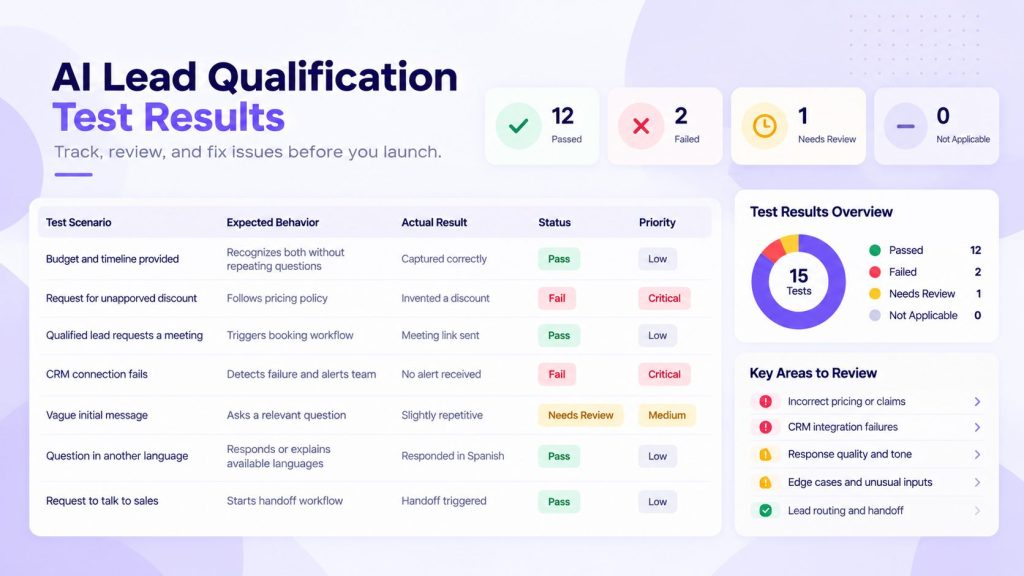
Running test conversations is only useful when you can identify what passed, what failed, and what needs to change before launch. Instead of relying on memory or reviewing transcripts without a clear system, record the outcome of each test in a simple spreadsheet.
Use the following format:
| Test scenario | Expected behavior | Actual result | Status | Priority |
|---|---|---|---|---|
| Prospect provides budget and timeline together | Agent recognizes both without repeating questions | Both details captured | Pass | Low |
| Prospect requests an unapproved discount | Agent follows the approved pricing policy | Agent invents a discount | Fail | Critical |
| Qualified lead requests a meeting | Correct booking or routing workflow starts | Assigned rep receives the lead | Pass | Low |
| CRM connection fails | Failure is detected and a fallback is triggered | No alert received | Fail | Critical |
| Prospect sends a vague message | Agent asks a relevant clarifying question | Response is slightly repetitive | Needs review | Medium |
Use four possible statuses:
- Pass: The agent behaved as expected.
- Fail: The agent did not meet the defined requirement.
- Needs review: The response requires human judgment or further testing.
- Not applicable: The scenario does not apply to the agent’s configured responsibilities.
Prioritize failures based on their impact. Critical issues include invented pricing, unauthorized disclosure of customer information, incorrect lead routing, and missing CRM records. These should block launch until resolved.
Minor wording problems or stylistic inconsistencies can be addressed according to their severity, provided they do not mislead customers or interfere with qualification.
For each failed test, record the conversation reference, the person responsible for the fix, and the date of the retest. Once the issue is corrected, rerun the original scenario and a few related variations to make sure the change has not introduced another problem.
A useful testing process does not end when the agent produces a good response. It ends when the team can demonstrate that important scenarios work consistently.
Scoring and routing test scenarios
Beyond the conversation itself, test what happens after qualification:
| Lead type | Simulated answers | Expected outcome |
|---|---|---|
| Hot lead | Ready now, budget confirmed, decision maker | Booking link immediately, CRM record flagged hot |
| Warm lead | Interested, 3-month timeline, no budget yet | Resource sent, nurture sequence starts |
| Cold lead | Vague, browsing, no urgency | Polite close, added to nurture, no push |
| Unqualified | Student researching, no buying intent | Politely ends, no follow-up |
| Existing customer | Mentions current account | Routed to support or account manager, not sales |
Run each scenario through the actual agent, not just on paper. What looks correct in a spec often behaves differently in a live conversation.
Test Whether Lead Scoring Stays Consistent
A lead qualification agent should not classify the same prospect differently simply because they provide information in a different order.
For example, run three conversations using the same underlying details:
- The prospect explains their requirements, budget, and timeline in a single message.
- The prospect shares those details gradually as the agent asks questions.
- The prospect begins with a pricing question and reveals their requirements later.
The final qualification decision should follow the same business rules in all three cases, even if the conversations take different paths.
Also test what happens when a prospect changes their requirements midway through the conversation. If someone initially needs a solution for five employees but later clarifies that it must support 500, the agent should update the relevant qualification details and routing decision rather than relying on the earlier information.
If your team uses numerical lead scoring, compare the scores against a predefined rubric and investigate unexpected differences. The objective is not to produce identical wording in every conversation, but to make consistent decisions from equivalent information.
If your team is still defining how to score prospects, review the different data points used in AI-powered lead scoring. Having clear scoring criteria makes it easier to identify whether a failed test is caused by the agent’s response or by the qualification rules themselves.
AI Lead Qualification Agent Integration Testing
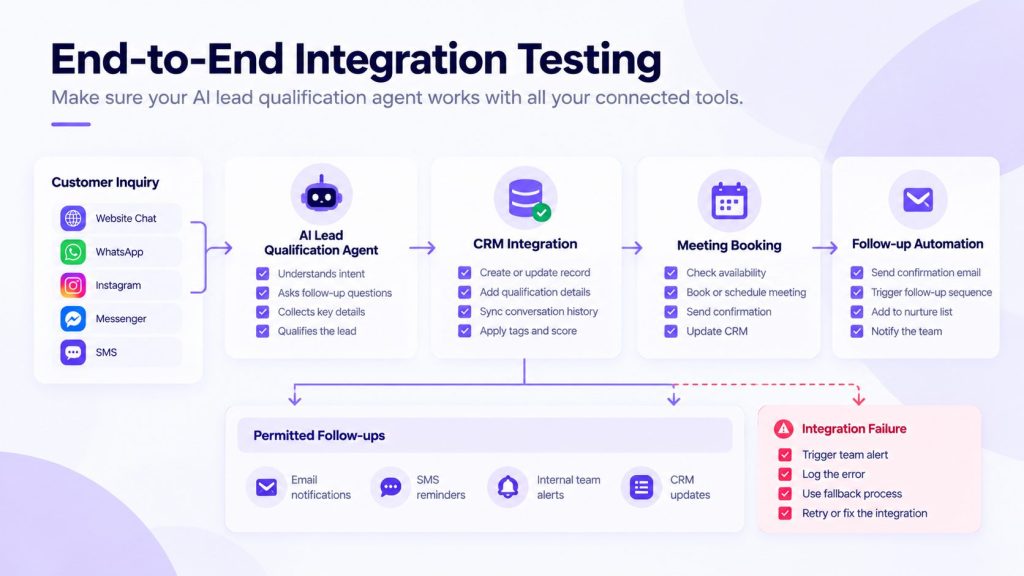
Integration testing is an important part of any lead qualification agent checklist because a successful conversation means little if the collected information never reaches your sales team. Run the following sequence to verify that your CRM, booking system, and follow-up workflows behave as expected.
- Start a conversation as a new lead on your primary channel.
- Answer all qualification questions.
- Verify a CRM record is created with the correct data.
- Check that the transcript is attached to the record.
- Verify the routing rule assigned the correct owner.
- Complete a booking through the agent’s link.
- Confirm the calendar event appears for the right person.
- Verify that any configured follow-up email or message is triggered only when the lead has the necessary consent and the messaging channel permits it.
- If cross-channel identity matching is configured, repeat the test on another channel and verify that records are linked only when the prospect’s identity can be reliably established.
- Simulate a failure: disconnect the CRM briefly and verify someone gets alerted.
- Repeat a submission or simulate a duplicate integration event to verify that the system does not create unnecessary duplicate lead records.
If step 10 fails silently, you will lose leads eventually. Silent integration failures are the most expensive kind because nobody notices until a customer complains.
Rollback plan: what to do if it goes wrong
Have this written down before launch, not after:
- Pause the agent — know exactly how to disable it in under a minute.
- Fallback message — what should visitors see if the agent is off? A contact form or a “we’ll reply soon” message is better than silence.
- Notify the team — who tells whom that something went wrong.
- Fix and relaunch — document what broke, fix it, and run the failing test case again before reactivating.
Having this written down in advance turns a bad hour into a manageable incident. Not having it turns a bad hour into a day of panic and a damaged reputation.
Cost and Usage Checks Before Launch
A lead qualification agent needs to be financially sustainable as well as technically reliable. Before launching, estimate how much usage the agent is likely to generate and understand how your platform charges for the models, tools, and features involved.
Use this checklist:
- Estimate the number of conversations your business expects each month.
- Review how the selected AI model and connected features affect usage.
- Check the credits or usage allowances included in your current plan.
- Confirm whether your plan supports bringing your own API keys and how that affects billing.
- Understand what happens when usage limits are reached.
- Test how the agent behaves if a required service becomes unavailable.
- Assign someone to monitor usage and costs during the first month.
For Botsify users, the current pricing and plan options provide a starting point for understanding available features and usage allowances.
Running a few test conversations is not enough to estimate the cost of a busy month. Review your expected traffic, account for periods of higher demand, and monitor actual usage during the initial rollout. This helps identify unexpected costs before they become an operational problem.
Final Lead Qualification Agent Pre-Launch Checklist
Before you go live, someone senior should be able to answer yes to all of these:
- The agent handles all test scenarios without inventing facts.
- Integration with CRM and calendar is verified end-to-end.
- Someone is assigned to review transcripts daily for the first two weeks.
- There is a rollback plan and it has been tested.
- Compliance and data handling have been reviewed.
- The team knows what to do when something goes wrong.
If any answer is no, delay launch. The cost of a week’s delay is always less than the cost of a public failure with real leads.
What good looks like after 30 days
You will know the launch worked when:
- First-response time is consistently under a minute, on every channel.
- Sales reps stop asking “what did they want?” because the context is already there.
- Nobody manually copies leads between tools.
- Transcript review has become routine rather than a chore.
- The qualification rate is stable or improving week over week.
At that point, the agent has become infrastructure rather than a project. That is the goal, not a demo, a system that quietly makes the pipeline better every week.
Final thought
The difference between an agent that helps and an agent that hurts is almost entirely testing quality.
The build is the easy part. The testing, the unglamorous work of reading transcripts, finding failures, and fixing them, is what separates a launch from a liability.
Use the checklist. Do not skip the soft launch. And when something breaks, because it will, fix it before more leads see it.
FAQ
How long does proper testing take?
About a week of focused work for a straightforward qualification agent. Teams that skip it usually spend that week after launch fixing problems in front of real customers.
What if the agent works fine in testing but fails in production?
That is why the soft launch exists. Run at low traffic for three to five days, review transcripts daily, and only scale after the first week’s error rate is acceptable.
Should I launch on one channel or all at once?
One channel first. Fix what breaks, then expand. Multi-channel launches before the conversation is stable multiply every problem.
How do I know when the agent is “good enough”?
An agent is ready for a controlled launch when it passes the critical tests for qualification accuracy, safe responses, CRM updates, routing, and human escalation. Not every conversation needs to be automated successfully. Some should be handed to a human. What matters is that the agent recognizes those situations and follows the correct process.
Ready to Put Your AI Agent to Work?
See how Botsify can help you qualify leads, connect your business tools, and route conversations to the right people.