
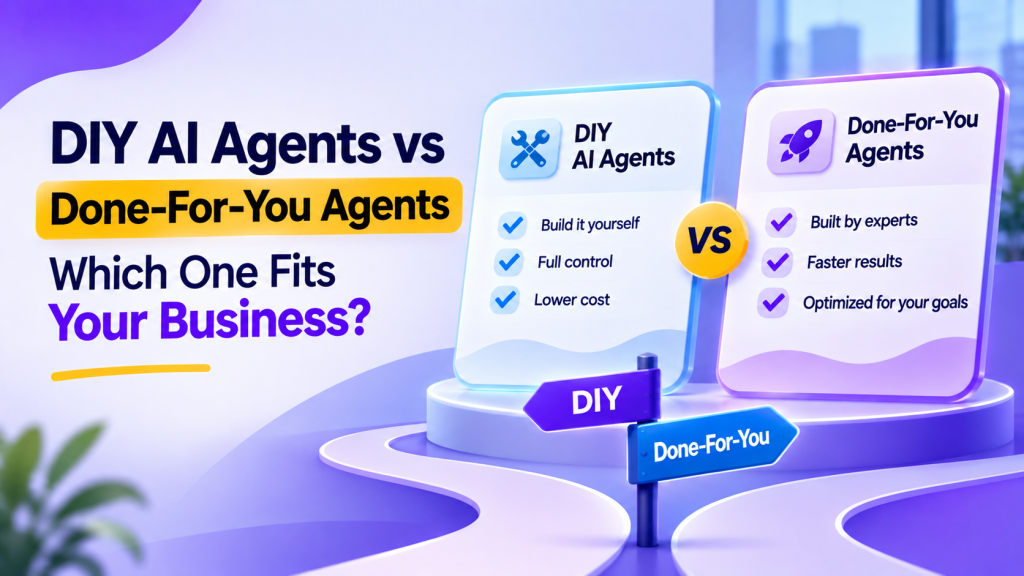
Choosing between building an AI agent yourself and hiring a provider depends on your team’s time, technical ownership, risk tolerance, and launch goals. DIY gives your team direct control and learning. Done-for-you shifts much of the setup and implementation work to a provider. Neither path guarantees results: both require clear scope, accurate source information, testing, and ongoing review.
Use the framework below to decide what your organization can sustain, what to ask a provider, and how to start with a manageable first use case.
A practical decision framework
Score each item from 1 (not true) to 5 (very true).
| Statement | Higher score suggests |
|---|---|
| We have a named owner with time to configure, test, and maintain the agent. | DIY |
| We want to build internal skills through hands-on experimentation. | DIY |
| We need implementation help or structured onboarding. | Done-for-you |
| Several channels, knowledge sources, or integrations are in scope. | Get implementation support |
| We can define what the agent may answer and when it must hand off. | Either path is more feasible |
| We can review performance and update source material regularly. | Either path is more feasible |
Do not treat the total as a scientific score. If you have an owner, a bounded use case, and review capacity, a DIY pilot may be reasonable. If ownership or implementation capacity is missing, arrange support or narrow the project before selecting a platform.
What DIY requires in practice
DIY means owning the full operating loop, even when the platform makes setup accessible. Your team needs to:
- Select one job the agent should perform, such as answering a defined set of support questions or collecting lead details.
- Gather current, approved source material and decide who maintains it.
- Configure the agent’s instructions, channels, and any required integrations.
- Test representative questions, ambiguous requests, incorrect assumptions, and requests that need a person.
- Review real interactions, correct gaps, and repeat testing after meaningful changes.
An AI agent implementation checklist helps surface missing owners, content, and escalation paths before deployment. For response quality, define how to test AI agents and what the agent should do when its sources do not answer a question. Avoid promising that prompts alone can eliminate errors.
DIY is a stronger fit when the first use case is limited, the team has a capable owner, and learning the system is valuable. It is a weaker fit when the project has multiple dependencies and no one can maintain it after launch.
What done-for-you should include
“Done-for-you” is not a standard scope across vendors. Compare the deliverables with this guide to AI agent development services. Ask what work the provider actually performs, what your team must supply, and what remains yours after launch. Clarify:
- Discovery and use-case scoping
- Knowledge preparation and approval
- Channel and integration configuration
- Test scenarios and acceptance criteria
- Human handoff behavior and escalation ownership
- Training, documentation, and access after launch
- Ongoing monitoring, changes, and support boundaries
Botsify describes its Done-For-You Agents service as a managed option where its team builds and manages agents. Confirm current inclusions, scope, and pricing on the official service page before making a purchasing decision. For comparison, the white-label platform serves agencies that want to brand and resell an agent platform; it is a different offer from a business buying a managed agent.
A provider should be able to explain assumptions and limits plainly. Request a written scope, success measures, data responsibilities, change process, and exit or handover terms. Do not assume that “managed” means your team has no review responsibilities.
Launch a focused AI agent with implementation support
Discuss your use case, scope, and team responsibilities with Botsify.
Compare the full cost, not just the subscription
A fair comparison includes staff time, provider fees, integration work, content maintenance, review, and the cost of correcting a poor fit. Estimate your own numbers rather than relying on generic setup-hour claims.
| Cost area | DIY questions | Done-for-you questions |
|---|---|---|
| Initial work | Who configures and tests it, and what work is deferred? | Which deliverables and revisions are included? |
| Internal time | How many hours can the owner allocate each week? | How much time is still needed from subject matter experts? |
| Ongoing work | Who updates documents and reviews conversations? | What monitoring and tuning are included, and at what cadence? |
| Integrations | Can your team configure and support each connection? | Are integrations included, and who maintains them? |
| Risk and recovery | How will errors be spotted and escalated? | What support is available if behavior needs correction? |
Compare the total expected cost over the same period and scope. Include the value of internal learning if it is a goal, but do not treat it as free labor. Ask each provider to separate one-time work, recurring fees, usage limits, and optional services.
A low-risk way to start
Whether you build or buy support, begin with one bounded workflow. Review the AI agent lifecycle and AI implementation roadmap to map ownership from planning through deployment.
- Choose a frequent, well-documented task. Browse practical AI agent use cases for examples that can be bounded clearly. Avoid starting with decisions that require sensitive judgment or incomplete records.
- Set a measurable baseline. For example, record current response time, handoff rate, or the share of inquiries resolved without repeat contact. Pick measures that fit your process.
- Define AI agent governance boundaries. List what the agent can answer, what it must not claim, and the human handoff rules for cases that go to a person.
- Prepare and review source material, and use an AI readiness assessment to identify gaps. Assign an owner and a schedule for updates.
- Test before wider rollout. Use realistic and edge-case scenarios, then have the responsible team review results.
- Expand only after review. Use observed performance and user feedback to decide whether to improve, pause, or broaden the workflow.
This staged approach keeps the decision reversible. It also helps you compare DIY and provider support based on the work your actual use case requires.
When DIY is a sensible choice
Consider building internally when your team has a clear owner, a narrow use case, reliable source material, and time to maintain the system. DIY can also make sense when developing internal capability is part of the project outcome and the organization can tolerate an iterative rollout.
Before choosing, compare no-code AI agent builders and check that the platform supports the channels and integrations you need, offers access appropriate to your team, and makes it practical to review and update the agent. A feature list cannot substitute for a small hands-on evaluation using your own content.
When outside implementation support helps
Get implementation help when your team lacks time or experience to scope the workflow, connect systems, prepare knowledge, or establish a sensible test plan. Support can also be useful when multiple departments must agree on boundaries and handoffs.
That does not remove your organization’s responsibility to approve source material, decide what outcomes matter, and review the agent’s behavior. Keep a named internal owner even when a provider handles configuration or ongoing management.
Questions to ask before signing
Use these questions to compare providers consistently:
- What exactly will you configure, test, and deliver?
- What materials and decisions must our team provide?
- How do we approve the agent’s answers and escalation behavior?
- Which channels and integrations are included in this scope?
- What are the usage limits, recurring charges, and additional fees?
- Who can access and update the configuration after launch?
- What support and change requests are included?
- What happens to our data and setup if we end the engagement?
- How will we measure whether this workflow is useful?
Ask for answers in writing and compare like-for-like scopes. Map the selected system with practical AI agent workflow design. If the vendor cannot explain how a failure is identified and corrected, the proposed plan is incomplete.
Frequently asked questions
Is DIY always cheaper?
No. It may reduce provider fees, but it still uses staff time and may require integration, review, and maintenance work. Compare the total cost for the same scope and period.
Does done-for-you mean we can ignore the agent after launch?
No. Your team still owns business decisions, source accuracy, approvals, and escalation handling. Confirm the provider’s responsibilities and review cadence.
Can we start with support and take over later?
Possibly, if access, documentation, configuration ownership, and handover are agreed in advance. Put these terms in the scope rather than assuming they are included.
What is the best first use case?
Choose a frequent task with clear source material, a low consequence for an incorrect response, and an available human fallback. Define a baseline and success measure before rollout.
Make the choice around ownership
DIY AI agents fit teams that can own configuration, testing, and maintenance. Done-for-you support fits teams that need implementation capacity, provided the scope and handover are clear. Start with one bounded workflow, verify what the provider includes, and keep an accountable internal owner whichever route you choose.
Plan a managed AI agent pilot around your team’s workflow
Discuss your use case, scope, and team responsibilities with Botsify.
