
An AI-first service business does not begin by buying several AI tools and looking for something to automate. It begins with a customer problem and a service process, then decides where software can do repeatable work, where AI can assist a person, and where a human should remain responsible.
That distinction matters. A service firm may use an agent to collect an inquiry, search approved information, draft a response, or prepare a report. The business still needs people to set the service promise, verify important outputs, handle exceptions, and own the relationship. AI-first means these roles are designed into the offer from the start, not added after the business has promised hands-off results.
This guide gives freelancers, consultants, and small agencies a step-by-step method for building that kind of service business. The broader AI automation agency guide covers services and business models. Here, the focus is how to design the actual service, delivery process, and human responsibilities around AI.
What an AI-first service business is
An AI-first service business deliberately uses AI and automation in the delivery of a service, while keeping people accountable for decisions that need expertise, context, approval, or care. It is a way to design operations, not a claim that every task is performed by an agent.
A useful test is to ask four questions about each stage of the service:
- What information starts the task?
- What action or decision is needed?
- What is the acceptable result?
- What happens when the information is missing, the result is uncertain, or an exception occurs?
If the answers are unclear, the task is not ready to be handed to an agent. Document the workflow and clarify the service boundary first. An AI agent requirements checklist can help define inputs, permitted actions, success measures, and handoff conditions before implementation.
“AI-first” also does not mean “AI-only.” Some tasks can be automated end to end under stable, low-risk conditions. Others can be accelerated by a model while a person checks the result. Relationship work, high-impact decisions, and unusual exceptions may remain human-led. The design should reflect the customer’s needs and the consequences of a mistake.
Step 1: Start with a service problem customers already have
Do not begin with “we build AI agents.” Begin with a problem a defined group of customers recognizes and wants solved. A service offer becomes easier to explain when it is tied to a concrete workflow, such as responding to routine service questions, qualifying inbound inquiries, preparing recurring reports, or organizing information before a human consultation.
Use these questions to select a starting point:
- Who experiences the problem and who approves the purchase?
- How does the work happen today?
- Which parts create delay, repetition, rework, or missed follow-up?
- What does the customer consider a good result?
- What information and systems are needed to deliver it?
- What must stay under human judgment or approval?
Avoid assuming that a high-volume process is automatically the best use case. A task may be frequent but sensitive, inconsistent, or difficult to verify. Another process may happen less often but have a clearer input, output, and recovery path.
List two or three candidate workflows, then score them against importance, repeatability, information quality, error impact, integration effort, and the client’s ability to review results. The score is a prioritization aid, not a scientific prediction. Its purpose is to expose why a task appears suitable and what still needs investigation.
For example, a service firm that receives website inquiries might first automate the intake of contact details and request type. It could use an AI-assisted step to summarize the inquiry or suggest a category. A consultant might still decide whether the request is a good fit, what advice to provide, and whether to accept the client. A lead qualification workflow shows how intake, qualification, and routing can be separated into explicit steps.
Step 2: Map the service from first contact to completion
A common mistake is to automate the most visible interaction while ignoring the work around it. Map the whole service journey, including what the customer sees and what the team does behind the scenes.
A simple map might include:
| Stage | Customer experience | Internal work | Decision or exception |
|---|---|---|---|
| Inquiry | Customer explains a need | Capture request and identify service type | Missing contact details or unsupported request |
| Qualification | Customer answers relevant questions | Check fit and urgency | Human decides whether to proceed |
| Proposal | Customer receives a scope and fee | Gather context and prepare a draft | Human approves scope, price, and terms |
| Delivery | Customer receives the service | Complete repeatable steps and track progress | Escalate changes or quality concerns |
| Follow-up | Customer receives results and next steps | Prepare report or renewal discussion | Human interprets results and recommends action |
Map both the happy path and the exceptions. Include where information comes from, where it is stored, which person owns the next step, and how the customer is told about delays or handoffs.
A multi-step process may combine deterministic rules with model-based interpretation. For example, the system may always send a receipt after a form submission, while an AI agent categorizes the request based on its content. Keep those steps distinct in the map. AI workflow automation can combine steps, but not every step requires an agent or model judgment.
Before choosing software, write down the current process in plain language. If two experienced team members describe it differently, resolve that disagreement before expecting a system to perform it consistently.
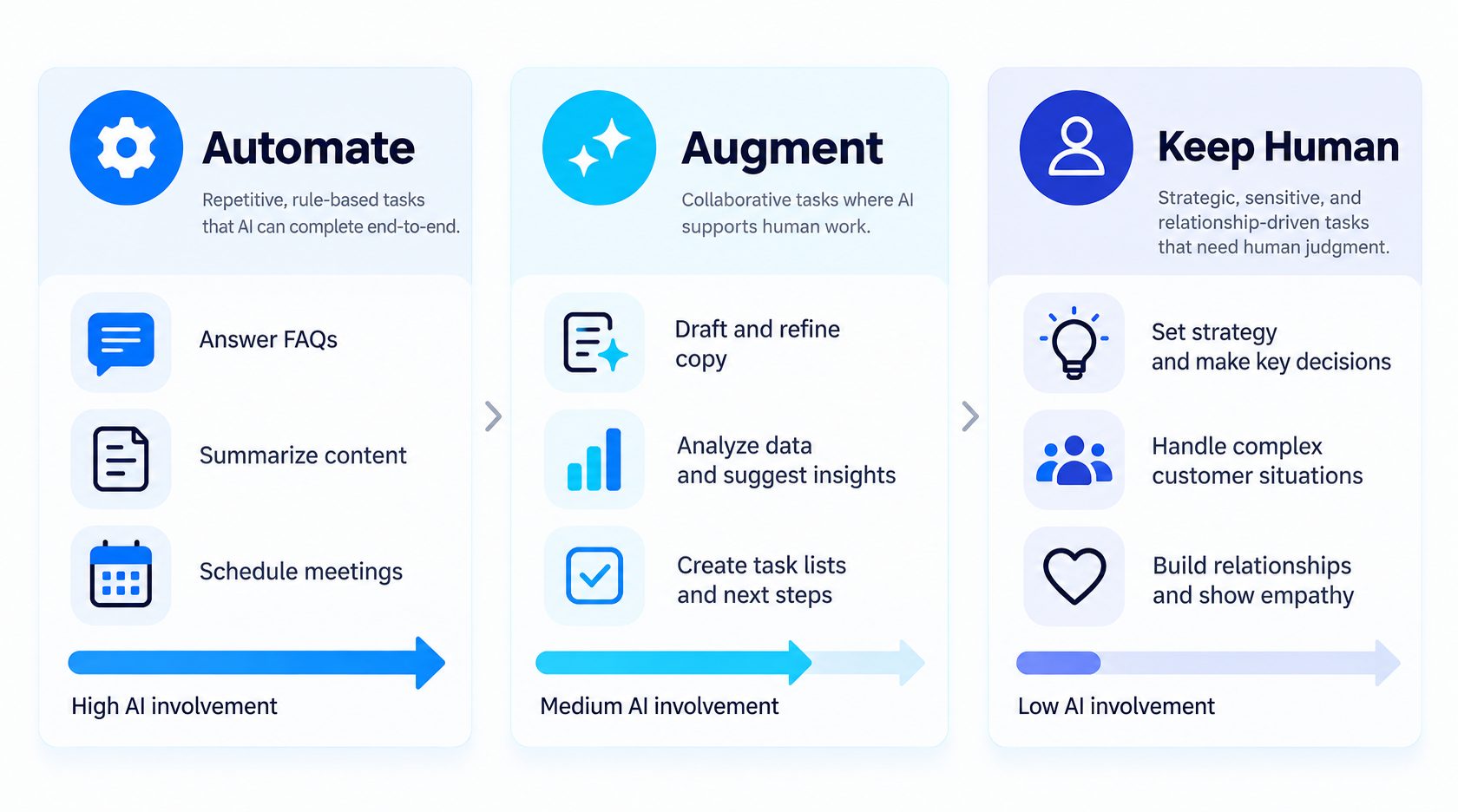
Step 3: Sort work into three operating modes
Use a task inventory to decide where automation, AI assistance, and people belong. The categories are not permanent. A task may move to a different mode after it is documented, tested, and reviewed, or if its risk changes.
| Mode | Good fit when | Examples | Human responsibility |
|---|---|---|---|
| Automate | The task follows stable rules, inputs are structured, and errors are recoverable | Send a booking confirmation, create a ticket, remind a client of a missing file | Set the rule, monitor failures, and resolve exceptions |
| AI-assisted | The input varies, a model can help interpret or draft, and a person can review the result | Summarize a client request, draft a proposal section, categorize an inquiry | Check accuracy, edit, approve, and make the final decision |
| Human-led | The task depends on context, accountability, negotiation, empathy, or high-impact judgment | Set strategy, advise on trade-offs, handle a complaint, approve a commitment | Own the decision and explain it to the customer |
The buckets describe a starting design, not a claim about what every AI product can do. An AI feature may draft content, but the service provider still owns what is sent under its name. An integration may update a record, but the client must decide whether that action is authorized.
Use the diagram as a discussion aid with your team. Place each task where it belongs today, then mark which ones may move after a test or a change in controls.
There is no universal threshold for how many times a task must occur before it should be automated. Consider volume together with consistency, risk, customer impact, review effort, and the cost of maintaining the automation. The AI agent use-case guide can help generate possibilities, but each candidate still needs to be tested against the real workflow.
Step 4: Redesign the offer and customer promise
A customer buys a service outcome, not your internal automation diagram. Explain what the client receives, what the system does, what your team does, and what the client must provide.
A clear offer statement can follow this template:
We help [specific customer] achieve [service outcome] by using AI for [bounded tasks] and expert review for [human-led decisions]. We measure [defined indicators] and escalate [named exceptions] to [responsible person or team].
For example:
We help small property managers respond to routine tenant questions by using an AI assistant to find answers in approved building information and collect requests. A property manager handles emergencies, policy exceptions, and decisions about repairs. We review unresolved questions and service response times each month.
This is more credible than promising a fully autonomous property manager or a fixed reduction in workload. It also gives the client a way to assess whether the service is working.
Make the service boundary explicit
Before launch, state:
- Which tasks are included and which are excluded.
- What data, policies, and systems the service can use.
- What actions the agent may take without approval.
- Which outputs are drafts for a person to review.
- What events trigger a human handoff.
- What response times apply to both automated and human steps.
- How changes in the client’s process or content will be handled.
Set expectations about setup and ongoing work as well. Discovery, configuration, testing, training, monitoring, updates, and support may be separate parts of the offer. Do not describe platform access as full-service management unless the provider actually performs the management work.
If your service handles support, do not define success as “the agent answered more conversations.” Track whether customers got useful answers and whether unresolved requests reached a person. The AI customer support metrics guide explains why a deflection count alone can conceal repeat contacts and poor resolution.
Step 5: Choose tools after you know the workflow
Once the process and responsibilities are clear, evaluate the platform or tools required to deliver it. A service business may need a customer-facing agent, a knowledge source, an integration with a client system, a review step, and a way to measure the work. Those needs differ by service, so avoid buying a broad stack before confirming what the first use case actually requires.
Compare tools against your written requirements:
- Can the tool use the information sources the service depends on?
- Does it connect to the customer’s required channel and systems?
- Can you limit what actions it may take?
- Can a person review or approve an output where needed?
- How are errors, unavailable systems, and unsupported requests handled?
- What usage, support, data, or configuration limits apply?
- Can you test the workflow with representative cases before launch?
A no-code AI agent builder comparison can help create a shortlist, but validate capabilities directly against the actual use case. Feature lists do not show whether a particular integration, permission, or recovery path will work in the customer’s environment.
Botsify’s AI agent builder describes an onboarding process that includes business information, connectors, a knowledge base, and deployment channels. Those are useful components to evaluate when they fit the service. The presence of a platform feature does not by itself make a process safe, accurate, or commercially viable; your team still needs to configure and test the service boundary.
If the service includes a branded client experience, clarify who owns the account, client support, billing, and operating responsibilities. A white-label AI service model may support reseller packaging, but the agency remains responsible for describing its own service accurately.
Explore an AI service workflow built around real requirements
Map the use case, platform needs, and human review.
Step 6: Price the service from its actual work
AI may change the time and tools needed to deliver a service, but it does not automatically create a higher margin. The new work may include defining the workflow, maintaining source information, checking outputs, resolving exceptions, paying for usage, and supporting the client. Measure those costs before you build a pricing promise around them.
Start with a baseline for the current process:
- Time spent by each role on the task.
- Volume and seasonality of the work.
- Rework, delays, missed requests, or quality issues.
- Tools, contractors, or operating costs already involved.
- Customer experience measures that matter to the service.
Then estimate the cost of the proposed service. Include setup effort, platform or model usage, integrations, human review, support, maintenance, and any other ongoing expense. Separate project work from recurring service work so clients know what the monthly fee covers.
A simple internal model is:
Contribution per client = client fee − direct tools and delivery costs − allocated operating costs
Use this as a planning formula, not a claim about the client’s savings. Track the hours and costs after delivery begins and revise the estimate when your evidence changes.
Common offer structures include a fixed project fee for discovery and launch, a recurring service fee for ongoing support or reporting, and a separate estimate for substantial scope changes. If you charge by outcome or usage, define the outcome, measurement source, exclusions, and what happens when the result cannot be verified.
Avoid promising that an AI-first service will save a specific number of hours, guarantee a margin, or deliver a fixed return without evidence that supports the claim. The FTC’s advertising substantiation guidance explains the general U.S. principle that objective advertising claims should have a reasonable basis. Specific claims and local requirements may need qualified legal review.
Step 7: Pilot, test, and keep a person accountable
Do not launch a broad service transformation all at once. Select one bounded workflow and run a pilot with a clear baseline and decision point. The pilot should answer whether the process works under realistic conditions, what effort it adds or removes, and what still needs human attention.
Before the pilot, agree on:
- The exact workflow and the users affected.
- The information and system access the test requires.
- A sample of ordinary, incomplete, and unusual cases.
- The expected output and what counts as a failure.
- Which actions require review or approval.
- The person responsible for exceptions and service continuity.
- The measures and time period used to evaluate the pilot.
- A stop condition if quality, privacy, or service continuity is at risk.
Test more than the happy path. Try an incomplete request, a contradiction in the source information, a request outside the offer, a system outage, a user asking for a person, and a case where the correct response is to stop. A structured AI agent testing guide can help organize these cases.
Keep human ownership visible. A review step should identify who checks the result, how often, what they do when something is wrong, and whether they have enough context and time to do the review. AI agent governance practices can help teams define controls, responsibilities, and escalation as the service evolves.
Step 8: Build an operating rhythm for delivery
An AI-first service still needs operating routines. The system may be automated, but someone must check that the information remains current, failures are noticed, and the service stays within its agreed scope.
A practical cadence might include:
| Timing | Team activity | Client-facing output |
|---|---|---|
| Daily or per shift | Review urgent exceptions and failed actions, if the service requires it | Confirm receipt or explain the next step when needed |
| Weekly | Review selected cases, update approved information, test a change | Share notable issues or decisions that need the client |
| Monthly | Compare results with the baseline, review costs and open requests | Provide a short service report and next priorities |
| When a material change occurs | Recheck affected instructions, integrations, and test cases | Confirm the change, impact, and any client approval needed |
Set the actual schedule based on the use case and service agreement. Do not imply that all accounts need daily review or that every platform offers the same monitoring or reporting functions.
Document what changed, why it changed, and what was tested. This can be a simple internal change log. Avoid claiming formal audit, retention, or governance features unless the tool and service actually provide them.
A phased AI agent implementation roadmap can help organize work beyond the initial pilot. Start with the smallest service that can be delivered responsibly, learn from it, and expand when the workflow and team can support the added scope.
Step 9: Build the team skills around the service
People in an AI-first service business need to do more than write prompts. They need to understand the service process, know the source information, test outputs, recognize exceptions, communicate limitations, and make decisions that remain under human control.
Useful skills include:
- Process mapping: Describe how work moves from request to completion.
- Knowledge stewardship: Keep source information accurate and approved.
- Evaluation: Build realistic tests and assess results against explicit criteria.
- Exception handling: Recognize when the workflow should stop or hand off.
- Client communication: Explain what the system can do, what it cannot do, and what has changed.
- Commercial judgment: Scope work, price delivery responsibly, and set limits on included changes.
Update role descriptions and quality procedures so that staff know who approves an output and who is accountable when the service fails. Do not replace a clear owner with a vague instruction to “check the AI.”
A four-week starting plan
Use this as a planning sequence, not a guarantee that a production service will be ready in four weeks. Some workflows need more discovery, security review, or integration work.
Week 1: Select and map
Choose one customer group and one service problem. Map the current process, record a baseline, and identify information, decisions, exceptions, and owners.
Week 2: Define the offer and test plan
Write the client promise, scope, exclusions, human responsibilities, and measures. Select a representative set of test cases and agree on stop conditions.
Week 3: Configure and evaluate
Configure only the workflow needed for the pilot. Test normal and edge cases, review results with the people who will operate the service, and fix or remove unsafe steps.
Week 4: Pilot and decide
Run a contained pilot if the workflow is ready. Compare results with the baseline, account for human review and operating cost, and decide whether to continue, revise, expand, or stop.
The key output is not a launch date. It is an evidence-based decision about whether the service works for the customer and whether your business can deliver it consistently.
Common mistakes when building an AI-first service business
- Buying tools before defining the service. Start with the client’s workflow and requirements, then evaluate tools.
- Automating unclear work. If experienced staff disagree about the process, document and resolve the disagreement first.
- Treating drafts as approved outputs. State which content or actions need human review.
- Ignoring failure recovery. Decide what the customer experiences when a connected system is down or an answer is unavailable.
- Measuring activity instead of service quality. Track successful outcomes, rework, escalations, and effort, not just messages processed.
- Underpricing human work. Include review, support, maintenance, and client communication in the cost model.
- Selling a guaranteed business result. Distinguish measured pilot results from estimates and forecasts.
- Expanding too early. Add workflows only when the current service has clear ownership, suitable tests, and enough delivery capacity.
FAQs about AI-first service businesses
Can a one-person business be AI-first?
Yes. A solo operator can use automation and AI assistance in selected parts of a service, but still needs to decide what to review personally and how to handle exceptions. Start with one bounded workflow that frees attention for higher-value service work, and measure the actual time and quality impact before adding more tools.
Which tasks should I automate first?
Start with work that is repeatable, well-documented, low-risk, and easy to verify or recover. Consider intake, scheduling coordination, routine status updates, or preparing a first draft. Keep judgment-heavy and high-impact decisions under clear human ownership until the service has been reviewed and tested for that specific use.
Does an AI-first business need an AI agent for every workflow?
No. A fixed rule or ordinary automation may be more predictable for a stable, repeatable task. Use model-based interpretation when inputs vary and the workflow benefits from that flexibility. Choose the simplest approach that meets the service requirement.
How do I know whether the pilot succeeded?
Agree on a baseline, a success definition, and a sample before the pilot begins. Evaluate quality, customer impact, time, cost, human review, and exception handling together. Do not treat a single usage or deflection number as proof of business value.
What should I tell customers about AI use?
Explain AI’s role in the service in a way that matches the actual workflow and applicable obligations. Be clear about when a person reviews or makes decisions, how customers can reach a person, and what information the system uses. Consult qualified legal or privacy advisers for requirements specific to your industry and jurisdiction.
Final checklist
Before you sell or launch an AI-first service, confirm that:
- The offer begins with a real customer problem.
- The workflow, information, actions, and handoffs are documented.
- Tasks are assigned to automation, AI assistance, or human ownership deliberately.
- The service promise matches what has been tested.
- People know what they are responsible for and how to recover from failures.
- Pricing includes setup, usage, review, support, and maintenance costs.
- Measures distinguish verified outcomes from estimates.
- Expansion depends on evidence, capacity, and client approval.
An AI-first service business is designed around a better allocation of work, not around maximizing automation. Start with a clear customer need, let AI help where the task and evidence support it, and keep people accountable for the decisions and relationships that define the service. If you are planning a service around AI agents, a strategy conversation can help map the workflow, boundaries, and first pilot.
Plan an AI-first service workflow with clear human ownership
Discuss a bounded workflow and practical pilot steps.
