
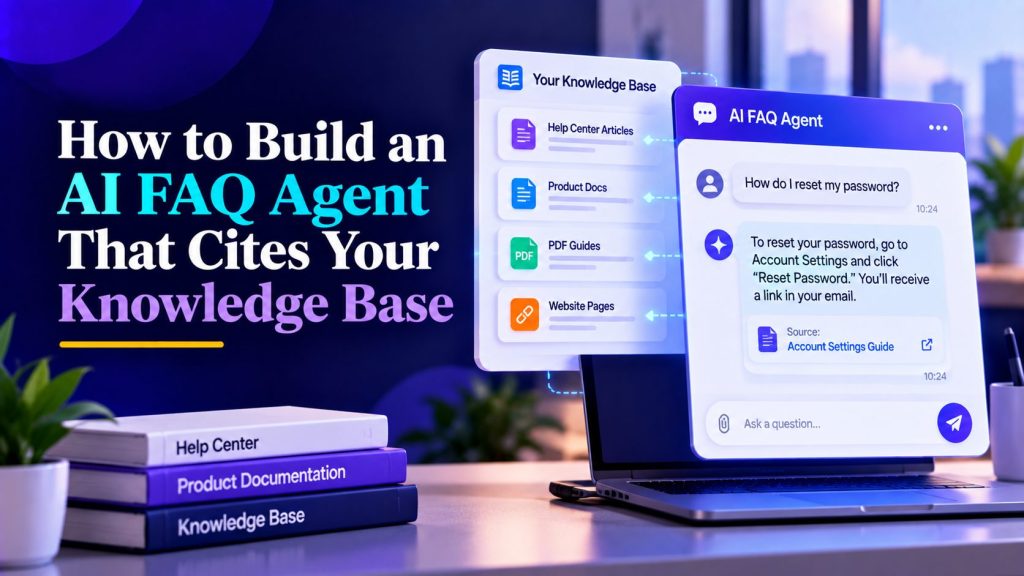
Most teams have two versions of their product knowledge: the official version in their documentation and the answers that live in someone’s head.
The problem starts when customers ask questions that aren’t easy to find in those documents, or when the person who knows the answer isn’t available.
An AI FAQ agent helps by retrieving information from your knowledge base and answering questions with citations to the relevant sources. Instead of relying on generic responses, it uses your approved documents to explain policies, features, pricing, and other common questions.
This guide shows you how to build an AI FAQ agent, prepare its knowledge base, configure citation rules, and test whether its answers are accurate enough for real customers.
Why citation matters more than intelligence
A chatbot that answers from a generic model will eventually say something wrong. A retrieval-based agent that answers from your documents has a different failure mode: it either finds the right answer in your documents or says it does not know.
That second behavior is what builds trust:
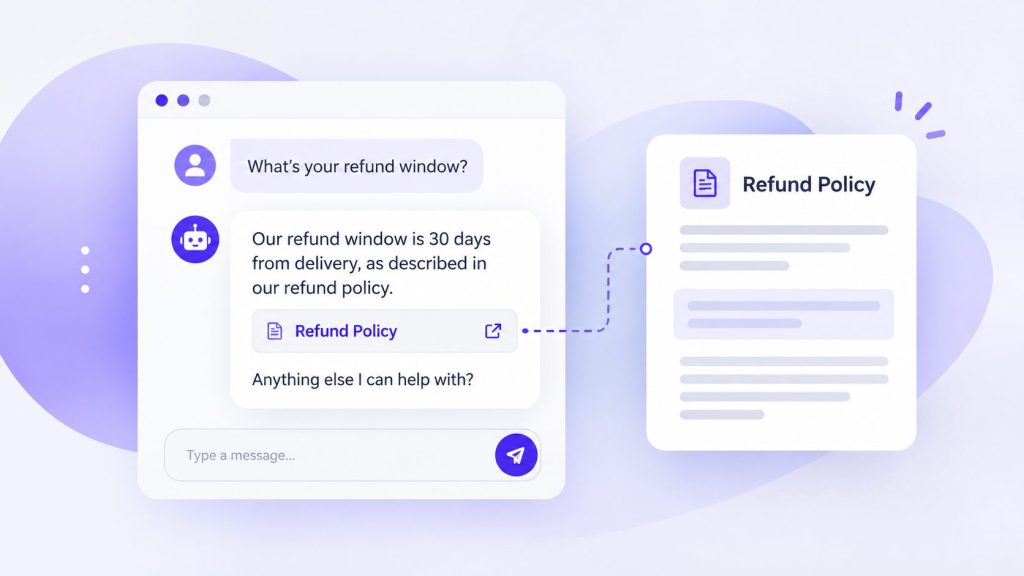
Customer: “What’s your refund window?”
Agent: “Our refund window is 30 days from delivery, as described in our refund policy. Here’s the link: [policy URL]. Anything else I can help with?”
The customer can verify the answer themselves. That is the difference between an agent people trust and one they screenshot when it gets something wrong.
The AI agent requirements guide covers how to structure source documents so retrieval works well, this post assumes that structure and focuses on the agent itself.
Preparing Your Knowledge Base for an AI FAQ Agent
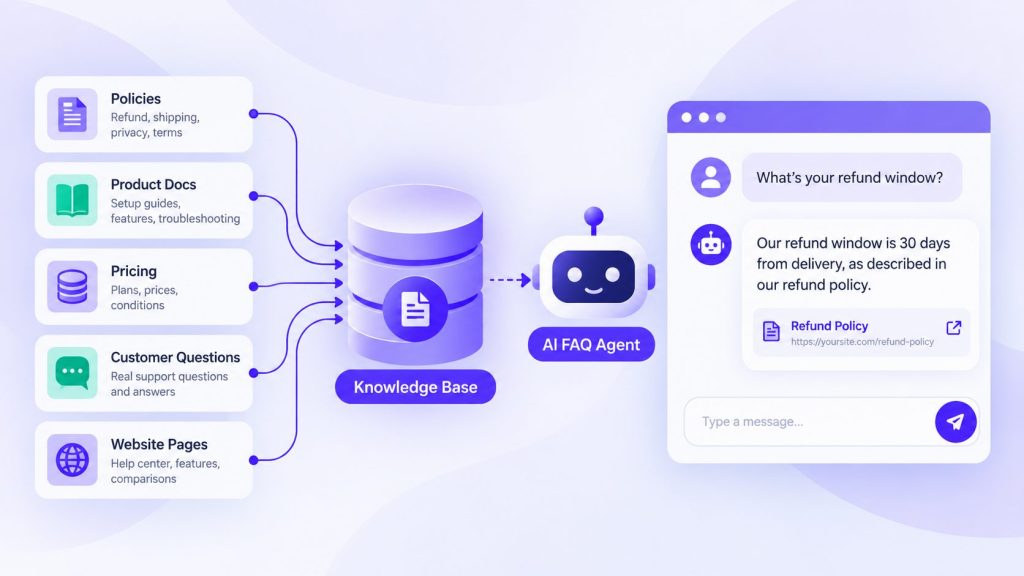
An AI FAQ agent is only as reliable as the documents it can retrieve. Before uploading anything into your AI agent builder, identify the sources customers should be allowed to use and remove information that is outdated or contradictory.
What to include
- Policies: Current refund, shipping, cancellation, and privacy information.
- Product documentation: Setup instructions, feature explanations, and troubleshooting guides.
- Pricing: Current plans, prices, and published conditions.
- Customer questions: Verified answers to recurring questions from your support team.
- Public website pages: Relevant product, help center, and policy pages.
Keep drafts, discontinued pricing, outdated feature guides, and unsupported marketing claims out of the customer-facing knowledge base. Internal documents should be stored separately with appropriate access controls.
Structure documents for accurate retrieval
Use descriptive titles, clear headings, short paragraphs, and self-contained answers. Put important conditions close to the information they qualify, and use consistent terminology across documents.
Before uploading, check that:
- Every document has a last-updated date.
- Old versions have been removed or clearly excluded from retrieval.
- Pricing and policies match the current published information.
- PDFs, tables, and other file formats are parsed correctly.
- Conflicting answers have been resolved.
- Customer-facing sources do not expose confidential information.
For example, if a refund policy says customers have 30 days to return an item, keep the eligibility conditions and exceptions in the same section. Otherwise, the agent might retrieve the deadline without the restrictions.
Review your source material whenever products, prices, or policies change. Better document organization reduces the risk of incorrect answers, although the agent still needs testing before launch.
Setting Up Knowledge Base Retrieval Rules
An FAQ agent does not answer from a general model. It searches your documents and answers from what it finds. That means two settings matter enormously:
1. Source priority
When multiple documents could answer a question, the agent needs clear source priorities. These decisions should be reflected in your AI agent workflows so the system knows which information to use:
| Document | Priority |
|---|---|
| Current pricing page | Highest |
| Product documentation | High |
| Policy documents | High |
| Old help articles | Low — remove or deprecate |
| Blog posts | Low — informational, not authoritative |
If your old blog posts contradict your current pricing page, the agent will sometimes quote the blog. Audit for conflicts before launch.
2. Confidence thresholds
Set a rule: if the agent cannot find a confident answer in the knowledge base, it says so and offers a human. This rule reduces the risk of unsupported answers, although the agent still needs testing to catch retrieval and citation errors.
“I don’t have that information in my knowledge base. Let me connect you with someone who can help.”
That response is better than a plausible-sounding wrong answer, every time.
How to Make an AI FAQ Agent Cite Its Sources
An AI FAQ agent should do more than provide an answer. It should show customers where that information came from so they can verify it.
A useful citation workflow has four steps:
- Retrieve the relevant information from the approved knowledge base.
- Answer the customer’s question using the retrieved information.
- Include the supporting document name or URL.
- If the evidence is missing or conflicting, explain the limitation instead of guessing.
For example:
Customer: “What’s your refund window?”
Agent: “Our published refund policy allows returns within 30 days of delivery, subject to the listed conditions. You can check the full policy here: [refund policy URL].”
For public documentation, link directly to the relevant page when the platform supports it. For internal sources, use an accessible document name or section reference.
Citations also need verification. A source link is not proof that the answer is correct unless the linked document actually supports the statement.
This becomes especially important with compliance and security questions.
If someone asks whether your product is HIPAA compliant and the approved documents do not establish that status, the agent should respond:
“I couldn’t verify that from our documentation. Let me connect you with someone who can confirm.”
Never allow the agent to invent compliance certifications, policy exceptions, or other claims simply because a confident answer sounds more helpful.
Writing the AI FAQ Agent Prompt and Safety Rules
Your agent’s instructions should define which sources it can use, how to cite answers, and when it must involve a human.
Start with this prompt and adjust it to match your business:
You are an AI FAQ assistant for [COMPANY].

Your purpose is to answer questions using the approved knowledge base.

RULES

1. Use only approved knowledge base information for factual answers.
2. Cite the supporting document name or URL.
3. Never invent prices, policies, features, dates, or guarantees.
4. If information is missing, unclear, or contradictory, say so.
5. Never confirm compliance certifications without supporting documentation.
6. Never disclose confidential information or another customer's details.
7. Never claim to be human.
8. Match the customer's preferred language and appropriate brand tone.
9. For questions requiring professional judgment or authorization, offer human assistance.
10. If a customer requests a human, follow the escalation process.

WHEN TO ESCALATE

- Unsupported security or compliance questions
- Refund approvals or exceptions
- Legal, medical, or financial advice requiring professional judgment
- Questions about unpublished product plans
- Sensitive account-specific requests
- Conflicting or insufficient source information

If you cannot answer reliably, say:
"I couldn't verify that from our available information. Let me connect you with someone who can help."
These instructions should be treated as enforceable workflow requirements wherever the platform supports them, not merely suggestions in a prompt.
Test the agent with difficult questions such as “Can you guarantee this will work?” or “Do you offer nonprofit discounts?” A safe response depends on what the approved documents actually establish.
For sensitive actions, combine AI agent guardrails with access controls, approval requirements, and human review rather than relying on prompt instructions alone.
Build an AI FAQ Agent That Answers From Your Knowledge Base
Give customers accurate answers from your business documents with source citations and human handoff when needed.
Testing Your AI FAQ Agent for Accuracy and Citations
Before launch, test the agent against real customer questions, including situations where it should refuse to answer.
Use this checklist:
| Test question or scenario | Expected behavior |
|---|---|
| Question answered by one document | Correct answer with a supporting citation |
| Two documents contain conflicting information | Flags uncertainty instead of silently choosing |
| Information is missing | Acknowledges the gap and offers human help |
| Customer asks about discontinued features | Uses current documentation |
| Customer asks about a discount not listed publicly | Does not invent an offer |
| Customer asks about SOC 2 or HIPAA | Cites approved evidence or escalates |
| Customer asks about a competitor | Uses verified, permitted information only |
| Customer asks a follow-up question | Maintains context and cites the relevant source |
| Customer writes in another language | Preserves the meaning of the source information |
| Customer asks for a guarantee | Avoids unsupported promises |
Check both the answer and its citation. A correct-sounding answer with an irrelevant source should fail the test. Regular AI agent testing also helps catch problems after documents, prompts, or retrieval settings change.
Where to Deploy Your AI FAQ Agent and How to Roll It Out
Start with the channel where customers ask the most repetitive questions. For many businesses, a website AI chatbot is a practical starting point for answering product questions directly from approved documentation. Launching everywhere at once makes it harder to identify problems.
| Channel | Suitable use |
|---|---|
| Website chat | Product questions and basic customer support |
| Documentation or help center | Answers alongside technical guides |
| Short answers to common policy or service questions | |
| Internal Slack | Employee questions about approved internal documentation |
| Initial responses before a human reviews the request |
Example Four-Week Rollout
| Week | Focus |
|---|---|
| 1 | Audit documents, configure retrieval, and prepare the agent |
| 2 | Test real questions, citations, and escalation behavior |
| 3 | Launch on one channel and review conversations daily |
| 4 | Correct recurring issues and consider adding another channel |
Treat this as an example rather than a guaranteed implementation timeline.
Once the first channel performs reliably, expand gradually. Rushing the rollout is one of several avoidable AI agent deployment mistakes, especially when different channels require different response lengths, tone, and escalation procedures.
For example, website visitors may appreciate a detailed answer with documentation links, while WhatsApp customers often prefer a shorter response.
Keep the same approved knowledge sources and citation standards across channels. That helps prevent customers from receiving conflicting information depending on where they ask.
How to Measure AI FAQ Agent Performance
Once the FAQ agent is live, review its answers regularly instead of relying only on the number of conversations it handles.
Track these metrics:
| Metric | What to measure |
|---|---|
| Answer accuracy | Whether answers match the approved source material |
| Citation correctness | Whether the cited source supports the answer |
| Fallback rate | Percentage of questions the agent cannot answer |
| Customer satisfaction | Whether customers find the answers useful |
| Knowledge base freshness | Whether source documents remain current |
| Support time saved | Reduction in repetitive questions handled manually |
For an initial quality review, sample 20 conversations and verify both the answers and their citations. Increase the sample when usage grows or problems appear.
A high fallback rate may indicate missing information or retrieval problems. A low fallback rate is not automatically good if the agent is confidently providing incorrect answers.
Use these findings to update documents, improve retrieval rules, and identify questions that should be escalated.
The goal is not to eliminate every fallback. It is to give reliable answers when evidence exists and recognize when it does not. Teams that need help configuring, testing, and improving these workflows can explore done-for-you AI agents instead of managing the entire setup internally.
Let Botsify Build Your AI FAQ Agent
Turn your existing knowledge base into an AI support agent that handles routine questions and knows when to involve your team.
Common mistakes
- Dumping every document into the knowledge base. More is not better; conflicting sources reduce accuracy.
- Letting the agent answer pricing questions from memory instead of citing the current pricing page.
- Not reviewing citations. If the agent cites a document that no longer exists, the answer is wrong.
- Using the FAQ agent for complex questions it was never designed to handle.
- Never updating the knowledge base. A stale FAQ agent actively misleads customers.
The AI agent governance guide covers how to formalize what the agent is allowed to claim.
Copyable document templates
If you are starting from scratch, these document templates give the agent what it needs. Copy the structure and fill in your own details.
Policy document template
[Document: Refund Policy] Last updated: [DATE] Applies to: [product/service]

Refund window: 30 days from delivery Eligible: unopened items, faulty goods Not eligible: digital products, custom orders Process: email hi@[company].com with order number Timeline: refund issued within 5–7 business days of receipt Exceptions: sale items are exchange-only
Short, dated, and explicit. The agent can quote this accurately because it is written for retrieval, not for persuasion.
FAQ document template
[Document: Frequently Asked Questions] Last updated: [DATE]

Q: How long does shipping take? A: Standard shipping is 3–5 business days. Express is 1–2 days. Orders placed after 2 PM ship the next business day.

Q: Do you ship internationally? Yes, to [countries]. International shipping takes 7–14 days. Duties are the customer's responsibility.

Q: Can I change my order after placing it? Yes, within 2 hours of ordering. After that, the order is processed.
Notice what makes these usable: each answer is self-contained, current, and does not require context from another document. If an answer needs context from a second document, merge them.
Pricing document template
[Document: Current Pricing] Last updated: [DATE] Source: https://botsify.com/pricing

Plan: Starter — $X/month — includes A, B, C Plan: Growth — $Y/month — adds D, E Plan: Enterprise — custom — includes F, G

Annual discount: 2 months free (17%) Trials: 14 days, no credit card required
The last line, the source URL, lets the agent cite the pricing page directly, which is what customers can verify themselves.
What to do when the agent gives a wrong answer
It will happen eventually. Have a process:
- Correct the answer — update the knowledge base or the prompt so it does not recur.
- Apologize to the customer if they were affected.
- Add the failure to your test set so the same mistake is caught in future testing.
- Check the root cause — was it a missing document, a conflicting source, or a prompt gap?
The teams that handle wrong answers gracefully build trust; the teams that pretend it did not happen lose customers quietly.
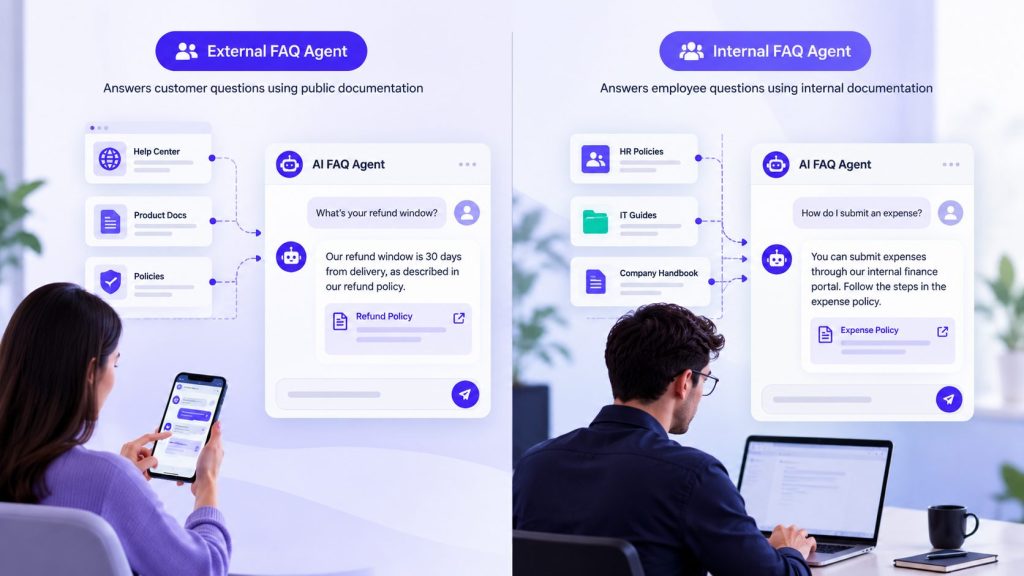
Internal vs external FAQ agents
The same pattern works for internal knowledge:
| Use case | External agent | Internal agent |
|---|---|---|
| Source | Public docs and policies | Internal docs, SOPs, HR policies |
| Audience | Customers | Employees |
| Tone | Polished, brand-aligned | Practical, direct |
| Failure cost | Customer trust | Employee confusion |
| Access control | Public knowledge only | Role-based permissions |
Internal FAQ agents are often the faster win, onboarding, expense policies, and HR questions are high-volume and easy to document. If you are unsure where to start, building the internal version first is usually lower risk and faster to prove value.
Handling multilingual FAQ agents
If your customers speak multiple languages, the FAQ agent should too. The pattern:
- Load your documents in each supported language, or verify the agent translates accurately from the source language.
- Test each language with real customer questions, not just translated test cases.
- Define escalation per language, some languages may need human review more than others.
- Watch for mixed-language conversations and handle them gracefully.
Translation quality can vary, particularly when policies contain exceptions or specialized terminology. Test translated answers against the original source and escalate sensitive questions when necessary.
Botsify’s multilingual support handles language detection natively, so a single agent can serve English, Spanish, and Arabic customers from the same knowledge base. Test each language with real questions before launch, short phrases sometimes get misdetected.
FAQ
Can an AI FAQ agent answer questions outside its knowledge base?
For a citation-focused FAQ agent, factual answers should come from approved sources. If the information is unavailable, the agent should acknowledge the gap and offer human assistance.
What happens when two documents contradict each other?
The agent should avoid choosing an answer without sufficient evidence. Update the conflicting documents and retest the affected questions.
Can the agent handle follow-up questions?
Yes, provided the platform supports conversational context. Each factual response should still be grounded in relevant source material.
How do I handle frequently updated pricing?
Maintain one authoritative pricing source and make sure the agent retrieves its current contents. Check that updates are reflected in the agent before relying on it for customer-facing answers.
Can an FAQ agent replace a help center?
No. A help center remains an important source of documentation. The agent makes that information easier to access through conversation.
How accurate can an AI FAQ agent be?
Accuracy depends on source quality, retrieval configuration, instructions, and testing. Citations make answers easier to verify, but do not guarantee correctness.
Can the agent answer competitor questions?
It can provide supported factual information from approved sources. Avoid unsupported comparisons or claims about competitors.
How often should I update the knowledge base?
Update it whenever relevant products, prices, or policies change. Schedule regular reviews to identify outdated or conflicting documents.
Building an AI FAQ Agent Customers Can Trust
A useful AI FAQ agent doesn’t need to answer every question. It needs to give customers accurate information from approved sources and make those answers easy to verify.
That starts with a clean knowledge base, clear retrieval rules, and citations that actually support what the agent says. When information is missing or conflicting, the agent should acknowledge the limitation instead of guessing.
Start with your most common customer questions, test the answers against real documents, and improve the agent as your knowledge base changes. That is how you build an AI FAQ agent that customers can rely on.
AI Agentic Platform For Building Portable AI Agents
Say Hello To Agentic AI That Connects With Your CRM And Even Other Agents
