
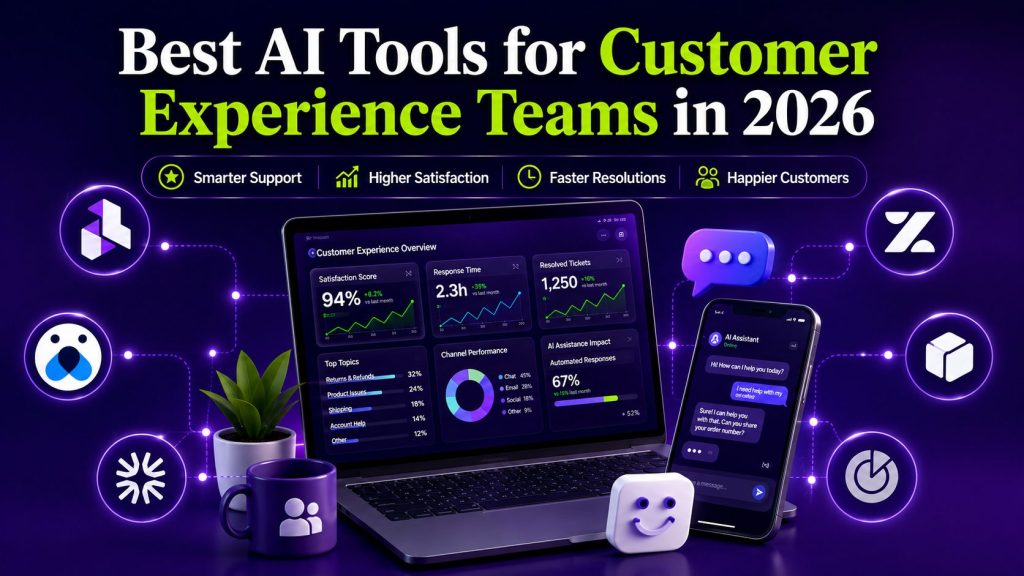
Every customer experience team is being asked the same question right now: what has AI actually changed about how you work?
For most CX teams, the honest answer is three things, some tickets get resolved without a human touching them, customer calls get captured and searched instead of half-remembered, and mountains of feedback finally get read instead of piling up in a spreadsheet.
Below are the AI tools actually doing that work in 2026, what they cost once you get past the sticker price, and where each one fits, from ticket automation to customer call capture to voice-of-customer analysis. Together, these tools cover practical AI customer service use cases, from answering routine questions and routing tickets to capturing customer conversations and analyzing feedback.
Here’s what’s covered:
- The best AI tools for customer experience teams, organized by what job they do,
- The real 2026 pricing, including the per-resolution and credit-based costs vendors bury in the fine print, and
- Which tool fits a lean CX team versus an enterprise support org.
Key Takeaways
- Bluedot is the top pick for capturing customer conversations — QBRs, onboarding calls, in-person site visits, and support escalations — with bot-free recording and a searchable library. For more general-purpose options, see this roundup of best AI note taker Apps.
- Botsify is the best AI customer service platform for businesses that want to build custom AI agents across websites, WhatsApp, Slack, and other channels without being locked into a single helpdesk ecosystem.
- Fin (formerly Intercom) is the most mature AI customer-facing agent, priced per resolution at $0.99 — transparent, but the bill scales directly with how well it performs.
- DevRev (Support App) is a fit for CX teams that want AI to triage, route and escalate tickets as well as answer them; it is an add-on on the Pro and Max plans, with usage metered in credits.
- Zendesk AI folds AI agents into the ticketing platform you may already run, but Advanced AI is a $50/agent/month add-on plus $1.50–$2.00 per automated resolution on top.
- Gorgias is built for ecommerce support and Shopify data, with AI resolutions from $0.90–$1.00 — but a fully-automated conversation can be billed as both a ticket and a resolution.
- Freshdesk (Freddy AI) is a lower-cost helpdesk alternative, with AI Agent sessions from roughly $0.10–$0.49 depending on channel, and Copilot as a separate $29/agent/month add-on.
- Dovetail turns interviews, support tickets, and call transcripts into a searchable customer intelligence repository — the tool for teams drowning in qualitative feedback.
- Grain turns customer calls into shareable video clips and testimonials, useful for building a voice-of-customer library CX and marketing can both use.
What “AI for customer experience” actually covers in 2026
CX teams don’t have one AI problem, they have three, and the tools that solve them look nothing alike:
- Customer support automation — AI agents for customer support can answer questions, retrieve customer information, perform approved actions, route requests, and hand conversations to human agents when needed.
- Conversation capture — recording and transcribing customer calls, QBRs, and site visits so nothing depends on someone’s memory or manual notes.
- Feedback synthesis — turning scattered interviews, tickets, surveys, and call transcripts into insights a product or leadership team can act on.
Most teams end up with one tool from each category rather than relying on a single AI Agent Platform to manage every aspect of customer experience. The list below is organized the same way.
What to check before you commit
- How “resolution” is actually defined. Several vendors bill per resolved conversation, and the definitions differ — some don’t count a conversation as billable until 72 hours pass with no human follow-up, which can make your dashboard lag reality.
- Whether AI features are bundled or metered separately. A cheap base plan with AI sold in credits or per-resolution packs often ends up costing more than a higher sticker price with AI included.
- What the AI can actually do. Some tools primarily answer questions, while others can retrieve customer data, update records, process approved requests, or trigger workflows. Compare platforms based on the customer service tasks you actually want to automate rather than the number of AI features on the pricing page.
- How the platform uses your support knowledge. Customer-facing AI depends heavily on the quality and accessibility of the information behind it. Check what knowledge sources the platform supports, how updates are handled, and whether teams can control which sources the agent is allowed to use.
- Double-billing risk. A few platforms count a fully-automated resolution as both an AI charge and a standard ticket, worth modeling before you commit to volume.
- Where recordings and transcripts are stored, especially for customer calls that might include PII, contracts, or anything under an NDA.
- Whether the tool trains its models on your customer data by default, and whether you can opt out.
AI Customer Support Tools vs. Other CX AI Tools
Not every AI tool used by a customer experience team is an AI customer support agent. Platforms such as Botsify, Fin, DevRev, Zendesk AI, Gorgias, and Freshdesk can participate directly in support workflows by answering questions, retrieving customer information, routing requests, or taking approved actions.
Tools such as Bluedot, Dovetail, and Grain solve different parts of the customer experience workflow. They capture conversations, organize customer feedback, or turn interactions into information that CX, product, and marketing teams can use.
That distinction matters when comparing the tools below. A business trying to automate support conversations should evaluate very different capabilities from a team trying to capture QBRs or analyze customer research. The goal is not to find one AI tool that does everything, but to identify which part of the customer experience workflow actually needs improvement.
AI Agentic Platform For Building Portable AI Agents
Say Hello To Agentic AI That Connects With Your CRM And Even Other Agents
Best AI tools for customer experience teams—quick overview
| Tool | Category | What it does | Pricing model | Starts from |
| Bluedot | Conversation capture | Records and transcribes customer calls, QBRs, in-person visits | Per seat | $14/user/mo |
| Botsify | AI customer support / service | Build custom AI agents for websites, WhatsApp, Slack and customer support | Subscription | Custom pricing / Free trial |
| Fin (Intercom) | AI customer support / service | AI agent resolves customer conversations | Per resolution | $0.99/resolution |
| DevRev | AI customer service platform | Answers, triages, routes and escalates support tickets | Consumption-based credits | Pro or Max plan plus the Support App add-on |
| Zendesk AI | AI customer support / service | AI agents inside the Zendesk ticketing suite | Seat + per resolution | $55/agent/mo + $1.50–$2/resolution |
| Gorgias | Ticket/chat automation (ecommerce) | AI agent for Shopify-native support | Ticket volume + per resolution | $10/mo + $0.90–$1/resolution |
| Freshdesk (Freddy AI) | Ticket/chat automation | AI agent and copilot inside Freshworks helpdesk | Seat + session packs | $19/agent/mo + ~$0.10–$0.49/session |
| Dovetail | Feedback synthesis | Repository and AI synthesis for customer research and feedback | Per seat | ~$29/user/mo |
| Grain | Conversation capture + clips | Turns customer calls into shareable video highlights | Per seat | $15/user/mo |
#1. Bluedot — best for capturing customer conversations
Every CX team runs conversations that never touch a ticketing system, onboarding calls, quarterly business reviews, in-person site visits, and escalations that get resolved on the phone. Bluedot exists to make sure none of that gets lost.
It records bot-free from your phone, Apple Watch, or desktop, so a support lead visiting a customer’s office or taking an escalation call on their cell gets the same transcript and summary as a scheduled Zoom review. Every conversation comes back as a transcript, an AI summary, and a drafted follow-up email, searchable across your whole team’s meeting history.
For teams that want a broader comparison of note-taking tools before choosing one, this roundup of best AI note taker Apps breaks down 11 options side by side, including which ones fit compliance-heavy CX environments.
Who Bluedot is for
Best for: CX and customer success teams that need one tool to capture calls, QBRs, and in-person conversations without a bot joining every meeting.
Key features
- Bot-free recording everywhere — phone, Apple Watch, desktop, and browser, for online calls and in-person visits alike.
- Transcript, summary, and follow-up email — a clean recap after every customer conversation, sent automatically.
- Voice-to-CRM — syncs call notes into HubSpot or Salesforce so account context stays current without manual entry.
- 100+ languages — accurate transcription for global customer bases.
What Bluedot does well
✅ Covers every kind of customer conversation — scheduled calls, phone escalations, and in-person visits — with one account.
✅ Private by default: EU or US data storage, no AI training on your recordings.
✅ No bot on the call, which matters for sensitive escalations and executive-level customer meetings.
Bluedot pricing
- Free — $0: 5 recordings for the life of the account, one hour each.
- Basic — $14/user/mo (annual): unlimited meetings, audio only.
- Pro — $20/user/mo (annual): unlimited-length recordings with video, custom AI summary templates.
- Business — $32/user/mo (annual): adds CRM sync for HubSpot and Salesforce.
#2. Botsify — Best for custom AI customer service agents
Unlike AI support tools that only work inside a specific helpdesk, Botsify is designed for businesses that want to build and deploy custom AI agents across multiple customer touchpoints. Teams can create AI assistants for websites, WhatsApp, Slack, Facebook Messenger, and other channels while connecting them with their existing knowledge base, business workflows, and CRM systems.
Botsify supports retrieval-augmented generation (RAG), custom knowledge sources, multilingual conversations, human handoff, and workflow automation, making it suitable for organizations that need more flexibility than a traditional ticketing AI. Rather than replacing an existing helpdesk, it can complement existing customer support operations by automating repetitive questions, qualifying leads, booking appointments, and providing instant responses across multiple communication channels.
Who Botsify is for
Best for: Businesses looking to build custom AI customer service agents that work across multiple channels, automate customer interactions, and integrate with existing business systems.
Key features
- Multi-channel deployment — deploy AI agents on websites, enable WhatsApp automation, connect Slack, Messenger, Telegram, and other communication channels from a single platform.
- Custom knowledge base — train AI agents using documents, websites, PDFs, FAQs, and internal resources.
- Workflow automation — connect AI conversations with CRMs, calendars, APIs, and third-party business tools.
- Human handoff — seamlessly transfer conversations to human agents whenever needed.
What Botsify does well
✅ Supports multiple communication channels instead of being limited to a single helpdesk.
✅ Flexible enough for customer support, lead generation, appointment booking, and internal business assistants.
✅ Easy deployment without requiring extensive technical expertise.
Drawbacks
❌ Advanced integrations and custom workflows may require additional configuration.
❌ Pricing depends on deployment requirements and business needs rather than a simple per-resolution model.
Pricing
- Free trial available
- Custom pricing based on business requirements
- Enterprise plans available for larger organizations.
#3. Fin (formerly Intercom) — best mature AI customer service agent
Fin — the AI agent built by the company formerly known as Intercom, which Salesforce agreed to acquire in June 2026 — is one of the most capable customer-facing AI agents on the market, with genuine multi-channel reach and workflow automation, not just a scripted chatbot.
Its pricing model is unusually transparent for the category: $0.99 per outcome, where an outcome is a resolution, a workflow handoff, or a lead disqualification. You’re not charged for conversations Fin escalates to a human by default, and if a customer reopens a “resolved” conversation later, the original charge is reversed.
Fin can run inside Intercom’s own inbox, or as a standalone AI layer on top of Zendesk, Salesforce, HubSpot, Freshworks, or Gorgias — useful if you don’t want to migrate your whole helpdesk to get the AI.
Who Fin is for
Best for: teams that want a proven, outcome-priced AI agent and are comfortable with a bill that scales as automation succeeds.
Key features
- Outcome-based pricing — $0.99 per resolution, procedure handoff, or disqualification; $9.99 per lead qualification.
- Standalone mode — runs on top of Zendesk, Salesforce, HubSpot, Freshworks, Dixa, Front, Zoho, or Gorgias without switching helpdesks.
- AI Briefer and Data Extractor — gives agents context before a call and pulls structured data from conversations into CRM fields.
- Copilot — real-time reply drafting and summaries for human agents.
What Fin does well
✅ Genuinely transparent pricing you can model against your own ticket volume.
✅ Doesn’t bill for conversations it escalates rather than resolves.
✅ Works on top of a helpdesk you already run, avoiding a full migration.
Drawbacks of using Fin
❌ The bill grows directly with automation success — there are no volume discounts or caps.
❌ Using Fin inside Intercom’s own inbox requires at least one paid Intercom seat on top of resolution costs.
❌ The pending Salesforce acquisition (announced June 2026) could shift pricing or packaging once it closes.
Fin pricing
- $0.99 per outcome (resolution, handoff, or disqualification), with a 50-outcome monthly minimum (~$49.50/month floor).
- $9.99 per lead qualification outcome.
- Requires an Intercom seat if used inside Intercom’s own inbox; no seat fee if run standalone on another helpdesk.
#4. DevRev (Support App): best for AI triage and routing in support
DevRev’s Support App answers customer questions over email, Slack or wherever they come in, and automates triage, routing, updating and record-keeping. It maps tickets to the right product parts, classifies them as bugs or feature requests, and adds data from systems such as Salesforce and Jira.
When an issue needs expert attention, it escalates to the right person or team, taking SLAs, customer sentiment and business impact into account. It also catches at-risk tickets before they escalate and spots gaps in the knowledge base.
Who DevRev is for
Best for: CX teams whose queue needs sorting as much as answering.
Key features
- Answers across channels: customer questions over email, Slack or wherever they come in
- Triage and routing: tickets mapped to product parts and classified as bugs or feature requests
- Escalation: to the right person or team, taking SLAs, customer sentiment and business impact into account
- Quality reviews: the team’s customer interactions scored for quality
What DevRev does well
✅ Real-time sentiment analysis spots customer frustration and escalation risks, and alerts the right people
✅ Agents built in DevRev’s Agent Studio can be tested in a sandbox and set to require human approval before a high-stakes action
Drawbacks of using DevRev
❌ The Support App is not in the free Mini plan; it is an add-on on the Pro and Max plans
❌ Usage is metered: each AI customer support conversation draws credits from the team’s pooled balance
DevRev pricing
- Mini: free, without the Support App
- Pro and Max: paid plans; the Support App is an add-on (on Max, the Max Support App)
- Billing: consumption-based credits, pooled across the organization
#5. Zendesk AI — best if you’re already on Zendesk
Zendesk folded AI agents into every Suite and Support plan as of May 2026, which sounds like it’s included, and for basic deflection, it is. The advanced, autonomous version most CX teams actually want still runs on a separate meter.
Zendesk’s current model uses three tiers of automated resolution: assisted escalations and contained resolutions are free, but Verified Resolutions, the fully automated ones, bill at roughly $1.20–$1.50 per resolution above your plan’s included allowance, on top of a base Suite plan that runs $55–$169 per agent per month.
For teams already standardized on Zendesk’s 1,500+ marketplace apps and workflow engine, this is the path of least resistance. For teams evaluating AI-first from scratch, it’s worth comparing the real all-in cost against a standalone agent like Fin running on top of a cheaper base helpdesk.
Who Zendesk AI is for
Best for: support orgs already running Zendesk who want AI agents inside the same ticketing workflow, without switching platforms.
Key features
- Visual dialogue builder — branching flows with AI messages, conditionals, and escalation logic.
- Generative procedures — goal-oriented flows the AI adapts in real time, rather than rigid scripts.
- 80+ language support, with generative replies extending further.
- AI Dynamic Pricing Plan — an enterprise contract option that lets you shift budget between agent seats and automated resolutions.
What Zendesk AI does well
✅ Sits inside the ticketing system your agents already use daily, with no separate tool to learn.
✅ Deep marketplace and integration ecosystem, useful for complex, multi-system support operations.
Drawbacks of using Zendesk AI
❌ The real cost is two-layered: a per-agent Suite fee plus per-resolution charges that scale independently.
❌ Overage billing on automated resolutions has applied automatically since January 2026, with limited advance notice.
Zendesk pricing
- Suite plans — $55–$169/agent/mo (annual), depending on tier.
- Verified Resolutions — roughly $1.20–$1.50 each above your plan’s included allowance.
- Add-ons: Copilot (~$50/agent/mo), QA (~$25–$35/agent/mo), Workforce Management (~$25/agent/mo).
#6. Gorgias — best for ecommerce and Shopify support
Gorgias is the default helpdesk for Shopify-native brands, and its AI Agent is built specifically around ecommerce workflows, order lookups, WISMO (where is my order) questions, returns, and shopping assistance pulled straight from live store data.
Unlike per-agent helpdesks, Gorgias bills by ticket volume, which means adding agents costs nothing extra, useful for brands that staff up seasonally. The AI Agent itself runs $0.90 (annual) to $1.00 (monthly) per resolved conversation, with one quirk worth knowing: a conversation the AI fully resolves can be billed as both an AI resolution and a standard helpdesk ticket, since Gorgias’ own FAQ confirms each AI resolution also counts as a ticket.
Who Gorgias is for
Best for: Shopify and ecommerce brands that want AI support tightly integrated with order and product data.
Key features
- Two AI skill modes — Support Agent for post-sale service, Shopping Assistant for pre-sale conversion.
- Actions — the AI can look up orders, process returns, and take store actions directly, not just answer questions.
- Vision — reads and responds to images customers send, like damaged product photos.
- Unlimited agent seats — cost scales with ticket volume, not headcount.
What Gorgias does well
✅ Deep native integration with Shopify order and customer data.
✅ No per-seat cost, which suits brands with seasonal staffing swings.
Drawbacks of using Gorgias
❌ The double-billing quirk on fully-automated resolutions understates the real per-resolution cost.
❌ Published resolution rates vary widely by brand, case studies show a 26–56% range, not the “up to 60%” headline figure.
Gorgias pricing
- Starter — $10/mo: 50 tickets.
- Basic — $50/mo: 300 tickets.
- Pro — $300/mo: 2,000 tickets.
- Advanced — $750/mo: 5,000 tickets.
- AI Agent — $0.90–$1.00 per resolved conversation, plus $1.50 per interaction beyond your allowance.
#7. Freshdesk (Freddy AI) — best lower-cost helpdesk alternative
Freshdesk pricing makes it a more budget-friendly entry point into AI-assisted support than Zendesk, with base ticketing plans starting at $19/agent/month, but like its competitors, the AI itself is unbundled into separate products with their own pricing.
Freddy AI Copilot (agent-assist: reply drafting, summaries, translation) is a flat $29/agent/month add-on, available only on Pro and Enterprise plans. Freddy AI Agent (the customer-facing bot) is billed per session, and the rate varies sharply by channel — roughly $0.49 per session on classic Freshdesk’s email agent, versus about $0.10 per session on Freshdesk Omni’s chat agent, a 5x difference worth checking before you commit to a channel mix.
Who Freshdesk is for
Best for: smaller or budget-conscious CX teams that want AI-assisted support without Zendesk-level per-agent and add-on costs.
Key features
- Freddy AI Copilot — real-time reply drafting, ticket summarization, and tone adjustment for human agents.
- Freddy AI Agent — autonomous resolution via email or chat, depending on the product line.
- Freddy AI Insights — anomaly detection and performance analytics, currently free in beta with a Copilot license.
- Freshdesk Omni — adds live chat, SMS, and social channels beyond email ticketing.
As support teams adopt more AI skills, capabilities such as reply drafting, conversation summaries, and intelligent routing are becoming standard across modern customer service platforms.
What Freshdesk does well
✅ Lower base seat price than Zendesk, useful for smaller support teams.
✅ Copilot can be enabled for a subset of agents rather than the whole team, which suits a pilot rollout.
Drawbacks of using Freshdesk
❌ AI is split across three separately billed products (Copilot, Agent sessions, Omni), which makes true cost hard to estimate upfront.
❌ Copilot is locked to Pro and Enterprise plans, Growth-tier users can’t access it at all.
Freshdesk pricing
- Growth — $19/agent/mo, Pro — $55/agent/mo, Enterprise — $89/agent/mo (annual, classic Freshdesk).
- Freddy AI Copilot — $29/agent/mo (annual), Pro and Enterprise only.
- Freddy AI Agent sessions — ~$0.49/session (email, classic Freshdesk) or ~$0.10/session (chat, Freshdesk Omni).
#8. Dovetail — best for turning feedback into decisions
CX teams generate an enormous amount of qualitative data, support tickets, interview transcripts, survey responses, call recordings, that mostly goes unread once the conversation ends. Dovetail exists to fix that, functioning as a searchable repository where AI tags, summarizes, and surfaces patterns across all of it.
Bring transcripts, recordings, or notes from wherever you collected them, and Dovetail’s AI codes and clusters the content so a product or leadership team can search “what are customers saying about pricing” and get a real answer, not a folder of individual tickets to read manually.
It’s a repository and synthesis tool, not a collection tool, Dovetail doesn’t run the interviews or surveys for you, so it works best alongside whatever you already use to talk to customers, including a notetaker like Bluedot for the calls themselves.
Who Dovetail is for
Best for: CX, product, and research teams that need to turn scattered customer feedback into a searchable, shareable source of truth.
Key features
- AI-powered synthesis — automatic tagging, sentiment analysis, and thematic clustering across studies.
- Centralized repository — one searchable home for interviews, tickets, surveys, and call transcripts.
- Highlight reels — clip and share specific customer moments, similar in concept to a sales conversation tool.
- Stakeholder sharing — publish findings to teams outside CX without giving them raw transcript access.
What Dovetail does well
✅ Genuinely useful for surfacing patterns across a large volume of scattered feedback.
✅ Strong search and tagging make it easy to answer a specific question quickly, rather than re-reading old research.
Drawbacks of using Dovetail
❌ Per-seat pricing scales quickly, and some reviewers report steady price increases over time.
❌ It only starts working after your data is already collected — it doesn’t run interviews or calls itself.
Dovetail pricing
- Free — limited seats and storage, for small teams testing the platform.
- Professional — around $29/user/mo (annual).
- Business — scales with seat count, quote-based.
- Enterprise — custom, for larger CX and research organizations.
#9. Grain — best for turning customer calls into shareable proof
CX and marketing overlap more than either team likes to admit, a great customer quote from a support call or a QBR is often exactly what a marketing team needs for a testimonial, and Grain is built to make that handoff painless.
Instead of handing you a transcript to comb through, Grain lets you mark a moment during or after a call and turns it into a short, shareable video clip. String several together into a playlist, and you’ve got a “voice of customer” reel that’s genuinely more persuasive than a quote pulled out of context in a slide deck.
The free plan is generous on raw recording volume but caps AI-highlighted clips at 3 hours a month, which CX teams doing several customer calls a week will hit quickly.
Who Grain is for
Best for: CX teams that regularly pull customer quotes and moments for case studies, testimonials, or internal coaching.
Key features
- One-click clip creation — mark a moment live or find it later in the transcript.
- Playlists and stories — assemble clips from multiple calls into a single customer-voice narrative.
- CRM sync — pushes clips and call notes into HubSpot or Salesforce automatically.
- AI summaries — standard call recap alongside the clip workflow.
What Grain does well
✅ Makes repurposing a great customer quote dramatically faster than scrubbing a full recording.
✅ Playlists build a reusable library CX and marketing can both draw from.
Drawbacks of using Grain
❌ No in-person recording — it only works on scheduled video calls.
❌ The free plan’s 3-hour highlight cap is tight for teams doing multiple customer calls a week.
Grain pricing
- Free — $0: unlimited recordings, 3 hours of AI highlights a month.
- Starter — $15/user/mo: unlimited AI highlights, shareable clips, HubSpot sync.
- Business — $39/user/mo: coaching analytics, custom clip branding, deeper CRM rules.
How to build a realistic CX AI stack
Don’t try to solve all three CX problems, automation, capture, and synthesis, with a single platform. The tools that specialize in each job consistently outperform the all-in-one option, and stacking two or three focused tools is usually cheaper than one enterprise suite that does everything adequately.
A common, workable setup is an AI customer service platform such as Botsify, Fin, Zendesk AI, Gorgias, or Freshdesk for automating customer conversations, a conversation capture tool like Bluedot for meetings and support calls, and a feedback analysis platform such as Dovetail to identify trends and customer insights across every interaction.
Before rolling anything out at scale, model the real monthly cost at your actual ticket and call volume, not the number on the pricing page. Per-resolution and per-session pricing looks cheap in a demo and can double your bill once automation actually starts working.
AI Agentic Platform For Building Portable AI Agents
Say Hello To Agentic AI That Connects With Your CRM And Even Other Agents