
A shopper may know what they want to solve without knowing which product fits. They may ask whether a device works with a particular model, which size is right, or how two options differ. A static “customers also bought” panel cannot answer those questions. An AI product recommendation agent can interpret the request, look up approved catalog information, and guide the shopper through a short list of suitable choices.
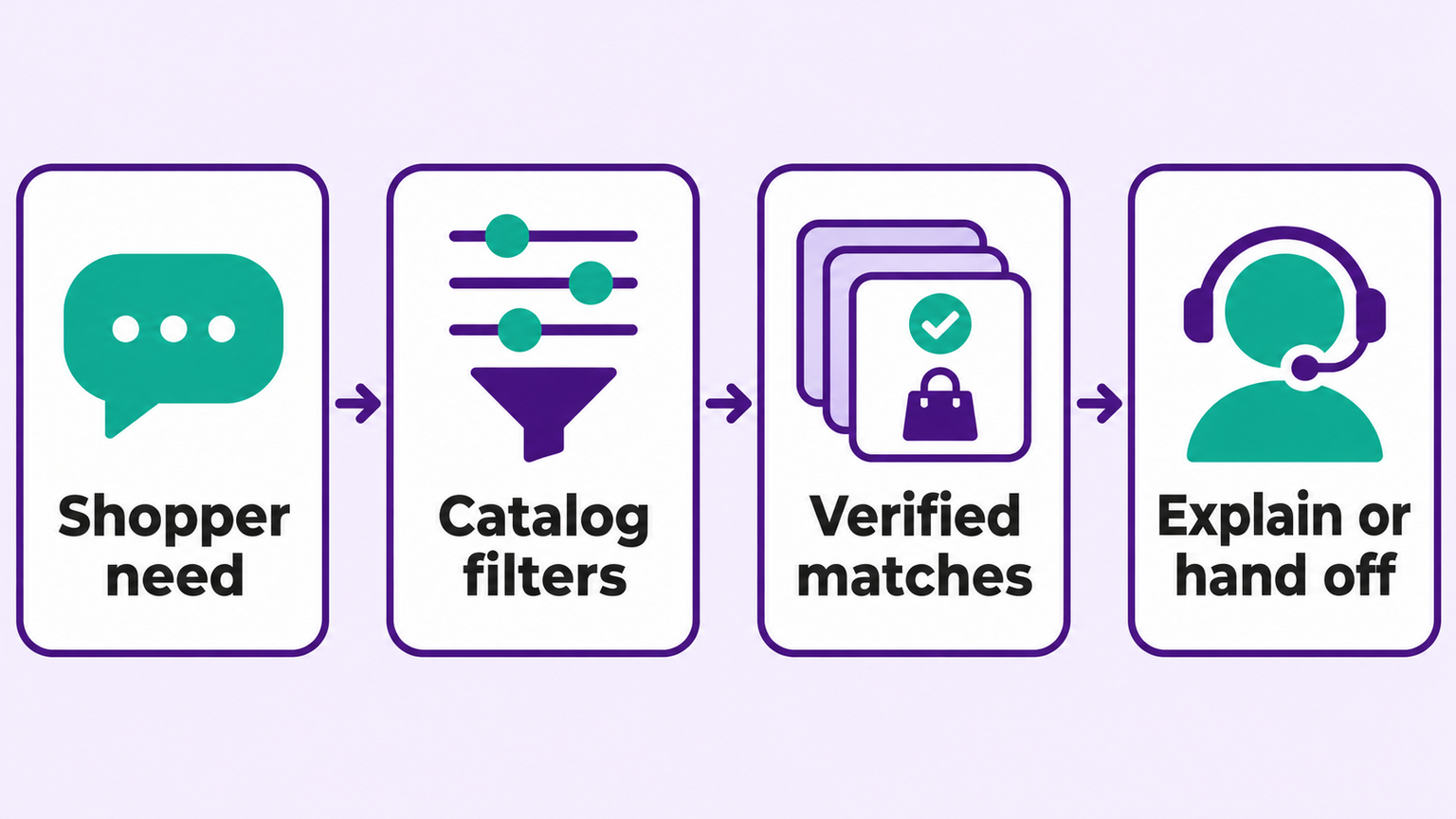
That only works when the product data is trustworthy and the agent knows when to ask, explain, or stop. This guide shows how to build a bounded product-discovery workflow with accurate catalog details, relevant questions, clear recommendations, and a human fallback. The goal is to help shoppers choose, not to promise a conversion or sales lift.
Good recommendations support the wider e-commerce customer experience: shoppers should understand why an item is suggested, see accurate details, and remain free to compare or continue without pressure.
What an AI product recommendation agent does
An AI product recommendation agent helps a shopper narrow a catalog to products that fit their stated needs. It can interpret a question, retrieve relevant product facts, ask for missing information, and explain why a small set of items may be appropriate. A separate commerce system remains the source of truth for live price, stock, compatibility, and any order action.
This is different from a conventional recommendation widget. A widget may display related items based on a fixed rule, such as a product category or purchase history. A conversational agent can respond to a specific request, like “I need a lightweight backpack that fits a 16-inch laptop and works for a weekend trip.” The system should turn that request into explicit requirements, search only approved product data, and make uncertainty visible.
It is also different from an upsell workflow. A recommendation agent helps the shopper find or compare a suitable item. An upsell or cross-sell workflow suggests a higher-tier or complementary purchase after a product context is already established. Start with the shopper’s question and intended job, then decide whether a recommendation surface is useful.
Conversational AI in e-commerce may support product questions as well as service tasks, but the details vary by store and platform. The guide to conversational AI in e-commerce provides broader context; this article focuses on the product-selection decision itself.
Step 1: Pick one discovery problem
Choose a narrow problem that shoppers already experience. “Recommend products” is too broad to configure or evaluate. Instead, define who is shopping, what decision they need to make, and what information determines a good fit.
Possible starting problems include:
| Shopper problem | Information that may matter | Useful next step |
|---|---|---|
| Choosing between two models | Intended use, required features, budget | Explain meaningful differences and let the shopper compare |
| Finding the right size | Measurements, sizing chart, fit preference | Ask only for the missing measurement and link the chart |
| Checking compatibility | Product model, generation, connector, region | Verify against a maintained compatibility table |
| Finding a product for a task | Use case, environment, constraints | Ask one focused question, then show a few suitable options |
| Replacing an item | Existing model, reason for replacement, current stock | Find a compatible alternative without assuming the customer wants an upgrade |
| Choosing from a large category | Must-have features, price range, delivery needs | Filter the catalog and explain the remaining options |
Write a one-sentence purpose, such as: “Help shoppers find a compatible replacement filter by confirming the appliance model and checking the current compatibility table.” That statement gives the team a clear basis for defining data, questions, boundaries, and tests.
Define what success means for the shopper. It could be a correct product match, a completed comparison, fewer unanswered product questions, or a useful handoff. Store outcomes may include add-to-cart or completed purchase, but those are separate business measures and do not prove that the agent caused a change.
If the task is simply to show a fixed set of related products, a rules-based widget may be enough. An agent is more appropriate when shoppers use varied language, the system must clarify needs, or product choice depends on multiple attributes. The store’s broader e-commerce UX principles should guide where the conversation appears and how it fits with existing navigation.
Step 2: Build a dependable product catalog for the agent
A product recommendation system should retrieve facts from a source the business can maintain. Do not rely on a language model’s general knowledge for current items, prices, variants, compatibility, or policy. A plausible answer can still be wrong for a specific product.
Start by listing the fields needed for the chosen use case. Common fields include:
- Product name, SKU, category, and canonical product URL
- Variant details such as size, color, capacity, or model generation
- Verified attributes such as dimensions, material, compatibility, or supported use
- Current price, market, currency, and approved promotion terms
- Inventory state and any backorder or preorder status
- Shipping constraints or delivery region where relevant
- Product availability dates and discontinued-item status
- Return, warranty, and installation information from approved sources
- A product owner or team responsible for keeping the record current
For each field, identify the system of record and how quickly it changes. The catalog may own product attributes, an inventory system may own stock, and a policy page may own returns. If two systems disagree, decide which one wins and what the agent should do while the conflict is unresolved.
Normalize important attributes. A size value stored as free text in one product and a numeric field in another is difficult to compare reliably. Use consistent units, controlled option names, and explicit compatibility relationships. Keep the original product identifier with every retrieved fact so a reviewer can trace the recommendation back to its source.
Decide how to handle incomplete or stale data. If stock status is unavailable, the agent should not say “in stock.” If compatibility is missing, it should ask for a model number or refer the shopper to support. If a price source is stale, it should avoid quoting the price and point to the current product page. These behaviors are part of the product, not optional refinements.
A maintained AI knowledge base for customer support can organize approved product and policy information when the store uses a knowledge source. For each answer, the agent should be able to identify the catalog record, product page, or approved document that supports it. A well-scoped FAQ agent that cites its knowledge base offers a useful pattern for showing sources and handling missing information.
Step 3: Turn shopper needs into catalog filters
The agent needs a repeatable way to convert a natural-language request into product requirements. Start with a small set of attributes for the chosen category. For a laptop bag, these might be laptop size, carry style, and weather resistance. For a replacement appliance part, the model number and part compatibility may be mandatory.
Separate requirements into three groups:
- Must match: Attributes that determine whether a product is suitable at all, such as voltage, device compatibility, or a required size.
- Preferences: Attributes that help rank suitable items, such as color, material, or preferred brand.
- Unknowns: Information the shopper has not provided and the catalog cannot infer.
Use hard filters for must-match constraints. A product with the wrong connector should not outrank a compatible product because its description sounds more appealing. Preferences can shape ranking, but they should not override compatibility or safety requirements.
Ask a clarifying question only when its answer can change the result. If the shopper has already specified the exact model and budget, do not ask them to repeat it. If one key detail is missing, ask one focused question rather than presenting a long intake form. Explain why the question matters when that will help the shopper answer it.
For example:
Shopper: “I need a charger for my camera.”
Agent: “What camera model do you have? The charger connection differs by model.”
After the answer, the system should verify the model and filter the catalog. It should not assume a brand or connector from the word “camera.” If the catalog contains no verified match, say that clearly and provide the store’s support path.
Step 4: Rank and explain a small set of matches
Once the catalog is filtered, rank the remaining candidates using factors the store can explain. A practical order might be:
- Meets all must-match requirements.
- Available in the shopper’s market.
- Fits the stated use case and preferences.
- Has current, complete product details.
- Offers a meaningful distinction from the other suitable options.
Avoid ranking by popularity alone. Best-selling products may be useful as a tie-breaker, but they are not necessarily right for a shopper’s stated use. Do not let a commercial priority silently override a required fit. If sponsored placement or paid ranking affects the order, disclose it in the manner required by the store’s policies and applicable rules.
Show a short list rather than an unfiltered catalog dump. The right number depends on the category and interface. In a conversation, a few clear options may be easier to compare than a long product feed. Each card should include the product name, current price if verified, one or two decision-relevant attributes, an accurate image or link, and a clear comparison or product-page action.
Explain the match with evidence: “This model supports the 16-inch device size you provided and is available in the selected color.” Avoid reasons such as “best choice for you” unless the agent can state which criteria support that judgment. Make it easy to compare alternatives and revise the answer if the shopper changes a requirement.
A conversational answer should link to the correct variant, not only the generic product page, when the store can reliably identify that variant. Do not add an item to the cart unless the shopper requests it, the integration is authorized, and the system confirms the action. A recommendation is not a purchase confirmation.
Step 5: Set privacy, safety, and stop rules
Personalization can use information from the current conversation, product selection, or a shopper profile, but the store should decide which sources are permitted and explain their use appropriately. Use the least personal data required to answer the chosen question. A one-time size question does not automatically justify storing a long-term shopper profile.
Write explicit boundaries for the agent:
- Do not invent specifications, compatibility, price, inventory, shipping, discount, or warranty terms.
- Do not infer sensitive traits or use unrelated personal data to rank products.
- Do not treat a shopper’s question as permission to subscribe them to marketing.
- Do not make health, safety, legal, or financial claims outside approved product information.
- Do not place an order, change a cart, or apply a promotion without a specific authorized action and confirmation.
- Do not continue recommending after the shopper declines or asks for a person.
- Escalate when product identity, compatibility, policy, or source data cannot be verified.
Define the fallback path for each boundary. Depending on the case, the agent can ask one question, display the official product page, say it cannot verify the match, or hand the conversation to staff. If it escalates, pass along the shopper’s question, collected requirements, products already checked, and the reason for the transfer. The AI human handoff rules can help teams decide when to stop and what context to include.
A useful stop rule is: “If no product satisfies all required attributes, do not rank near matches as compatible. Explain what information is missing or that no verified match was found, and offer a person.” The guide to stopping AI agents from over-automating conversations provides additional examples of customer-preference and stop conditions.
Scope a product discovery agent with Botsify
Review catalog data, shopper questions, and safe actions with our team.
Step 6: Choose where the agent belongs
Place the agent where it can answer a real question without interrupting the shopper’s task. Different pages support different kinds of help.
| Placement | Useful for | Design consideration |
|---|---|---|
| Search results or category page | Narrowing a broad catalog | Do not cover filters or product results |
| Product detail page | Understanding specifications or comparing variants | Keep price, selected variant, and purchase controls visible |
| Website chat | Answering a question across several products | Let the shopper see sources and product options |
| Cart | Resolving an outstanding product concern | Avoid disrupting checkout or steering the shopper to unrelated items |
| Post-purchase support | Setup or finding a compatible accessory | Do not turn every service request into a sales pitch |
| WhatsApp or another messaging channel | Continuing a conversation where the shopper has chosen that channel | Respect channel consent and keep a clear route back to the store or a person |
Start with one placement and one product family. Confirm how the agent receives the page or cart context and whether the channel supports the exact product links and actions you intend to use. A connector listing does not establish that every account can read every field or change a cart. Verify available permissions in the actual store setup.
The Shopify conversational commerce solutions guide gives platform-specific context. For customer-service questions after a purchase, separate the service flow from product discovery; the AI customer service use-case guide outlines tasks that may need support rather than a recommendation.
Step 7: Test answers, matches, and handoffs
Create a test set before showing recommendations to shoppers. Use examples from real product questions when permitted, and remove unnecessary personal data. Include clear requests, ambiguous requests, conflicting requirements, and cases where there is no suitable item.
| Scenario | Expected behavior |
|---|---|
| Shopper provides all required attributes | Filter by must-match fields and show suitable choices with evidence |
| One required attribute is missing | Ask one focused question that can change the results |
| Catalog contains a similar but incompatible item | Exclude it and do not describe it as a match |
| Two approved sources disagree on price or stock | Follow the source-of-truth rule or suppress the claim |
| No item meets every required attribute | Explain that no verified match was found and offer the fallback path |
| Shopper changes a preference | Update the shortlist without making them restart |
| Shopper asks about a safety or warranty exception | Use approved wording or hand off to staff |
| Product page or integration is unavailable | Do not claim that a link, cart action, or order succeeded |
| Shopper declines assistance or asks for a person | Stop the recommendation and follow the requested route |
| Catalog includes discontinued or duplicate variants | Suppress invalid entries and log the data issue for its owner |
Have a merchandiser verify the product matches and a customer-service owner review the language and handoffs. Measure whether product facts are correct, required clarifications are useful, links point to the right item, and the shopper can dismiss or change the recommendation. Also test mobile layout, keyboard access, screen-reader labels, and page performance.
Rerun the affected cases after a change to product fields, ranking rules, instructions, permissions, or integrations. The AI agent implementation checklist can support launch planning, but the product-specific test cases should stay tied to your own catalog and policies.
Step 8: Measure discovery quality and business outcomes
Measure what shoppers and the store need to learn. Do not treat the number of recommendations shown as success. A useful measurement plan can separate three layers:
- Answer quality: Was the product information supported by the current catalog? Were variant, price, availability, and compatibility claims correct?
- Discovery quality: Did the shopper find an item that met the stated requirements? Did they compare products, click through, or ask for a person?
- Business outcomes: Did eligible shoppers add items, complete a purchase, return the product, or contact support afterward?
When the store wants to estimate whether the agent changed behavior, define a fair comparison before launch. Where practical, compare a group that receives the recommendation experience with a similar group that does not. Keep the product selection, eligibility rules, and time window consistent. If that is not possible, describe the results as observational and state what else changed, such as price, inventory, advertising, or seasonal demand.
Include guardrails such as product returns, cancellations, customer complaints, negative feedback, and requests for human support. A recommendation that receives clicks but leads to mismatched purchases may require better catalog data or more careful questions. Review performance by product family only when there is enough evidence to interpret differences responsibly.
Track data-quality failures separately from recommendation decisions. If many sessions end because compatibility fields are missing, fix the catalog before changing the ranking model. If shoppers repeatedly ask the same comparison question, improve product details or the answer template. The measures should help owners choose a concrete change, not just produce a dashboard.
Step 9: Keep product information and ownership current
Assign an owner for each part of the workflow: catalog attributes, compatibility, price and stock, product content, channel permissions, customer-service handoff, and outcome review. Decide who can approve ranking changes and who can pause the agent if a source becomes unreliable.
Review representative conversations and outcomes on a schedule that suits the store’s traffic and risk. Look for unsupported claims, repeated questions, missing products, wrong variants, abandoned handoffs, and recommendations that customers consistently dismiss. Update the catalog or logic where evidence points to a specific problem. Keep logs limited to what the business needs to troubleshoot and improve the experience, and follow its retention and access policies.
Expand to another category only when the store can maintain the needed product attributes and repeat the test process. A recommendation workflow for clothing sizes may need different data and fallback rules than one for electronics compatibility. The same model prompt should not be assumed to fit both.
Common mistakes to avoid
- Treating a product name as a complete catalog. Attributes, variants, compatibility, and availability often determine the actual fit.
- Ranking “popular” above “suitable.” Popularity may be one signal, not a substitute for the shopper’s requirements.
- Asking too many questions. Ask only for details that change the candidate set or the answer.
- Showing a near match as a confirmed match. Be explicit when a constraint cannot be verified.
- Confusing recommendations with upsells. Help the shopper choose before proposing a more expensive or complementary purchase.
- Assuming an integration grants broad permissions. Verify the exact data and actions the connection supports.
- Measuring clicks alone. Check product fit, completed purchases, returns, customer feedback, and support needs.
- Leaving catalog changes unowned. New variants and discontinued items can make a previously accurate answer wrong.
Frequently asked questions
Does an AI product recommendation agent replace a recommendation engine?
Not always. A conventional recommendation engine may rank items from rules or behavioral data. A conversational agent may interpret what the shopper asks, clarify a requirement, retrieve product details, and explain options. A store can use both, or it may only need a simple rules-based widget.
How many products should the agent recommend?
Choose a small number that shoppers can compare in the available interface, then test it. A conversation may work better with a short list than a long carousel, but the right count depends on category complexity and how much context the shopper provided. Do not force three items when only one is a verified fit.
Can the agent recommend across categories?
It can if the catalog has consistent attributes and the store defines useful cross-category relationships. Start with one category, confirm the data and test behavior, then add another. Avoid matching products by name alone.
Should it add products to the cart?
A first version can provide product links and let shoppers decide. If the store later enables a cart action, require a clear shopper request, explicit integration permission, confirmation from the commerce system, and a way to correct mistakes. Never tell the shopper an action succeeded without a confirmed result.
What if the agent cannot find a suitable item?
It should say it could not verify a match, explain what detail is missing if relevant, and offer a human route or a useful catalog search. It should not recommend a similar-looking item as a substitute for a requirement it cannot satisfy.
How do I know whether the agent is helping?
Check recommendation accuracy and shopper progress first. If measuring sales impact, use a consistent comparison when practical and include returns, complaints, and other changes that could affect the result. A click or purchase after a recommendation does not by itself prove that the agent caused it.
Make product discovery easier to verify
An AI product recommendation agent should help shoppers move from an unclear need to a verified product choice. Begin with one product family, make the catalog dependable, ask only useful questions, explain each match, and stop when the evidence is incomplete. Then review both the shopper experience and the store’s results before expanding.
Plan a conversational product recommendation agent with Botsify
Turn a product-selection problem into a bounded, testable workflow.
