


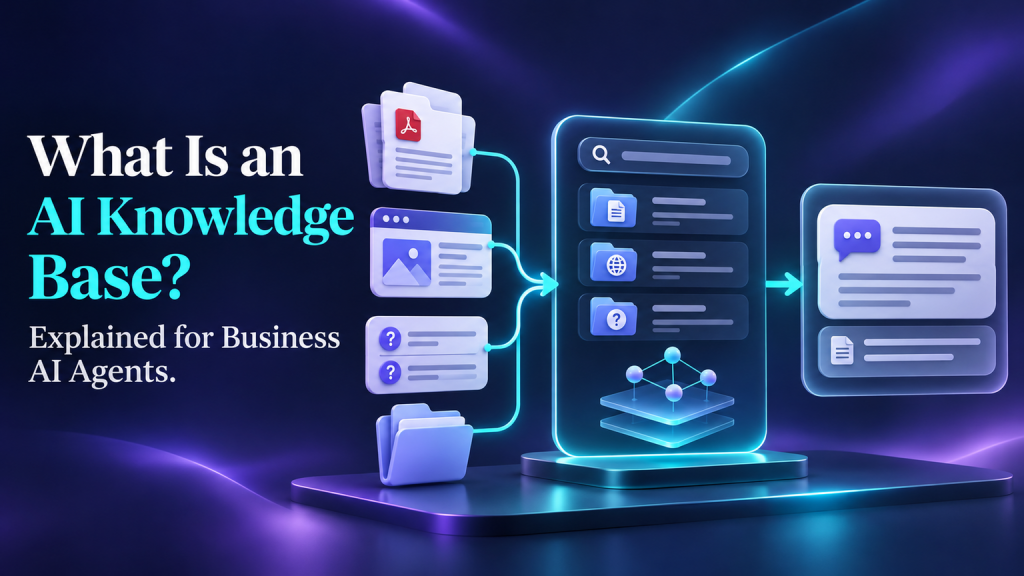
An AI knowledge base is a collection of selected information that an AI system can search or retrieve when answering a question or completing a task. It might include product guides, policies, procedures, FAQs, or other approved sources. The purpose is to give an agent access to information specific to a business, instead of relying only on what a general-purpose model learned during training.
The knowledge base is not the AI model itself, and it does not guarantee that every answer will be correct. A system still has to find the right information, decide whether it applies, and communicate it accurately. If the source is missing, out of date, or restricted, a polished answer can still be wrong.
This guide explains what an AI knowledge base is, how it fits into an agent system, and how it differs from model training, retrieval, connected tools, and memory. It focuses on the business concept and the decisions that make a knowledge base useful.
Plain definition: An AI knowledge base is a curated set of information made available to an AI system so it can find relevant business knowledge while responding to a user or performing a defined task.
What an AI Knowledge Base Contains
The simplest way to understand a knowledge base is to ask what the agent needs to know. A company may need its agent to answer questions about product features, explain a service policy, or provide a standard troubleshooting step. The approved information for those answers becomes part of the knowledge layer.
A knowledge base can contain or connect to different kinds of information, depending on the product and implementation:
- Reference documents: Product manuals, service descriptions, operating procedures, and internal guides.
- Question-and-answer content: Frequently asked questions and approved responses.
- Policies and rules: Refund terms, eligibility requirements, scheduling conditions, or escalation criteria.
- Website content: Public pages that explain services, products, locations, or support options.
- Structured records: Tables or databases with defined fields, such as an approved product catalog.
- Connected information sources: Systems that an agent can query when it needs current or user-specific information.
These sources are not interchangeable. A policy document may explain the rule for a refund. A billing system may contain the current status of a particular customer’s payment. One is general guidance; the other is a record about an individual case. A business should decide whether each kind of information belongs in a searchable knowledge source, a live connected system, or neither.
The collection should reflect a purpose. A support agent may need public help articles and selected troubleshooting guidance. An internal operations assistant may need approved procedures and process definitions. The content should be limited to what the system is intended and permitted to use.
For a customer-support-specific walkthrough, see the guide to building an AI knowledge base for customer support. The broader question here is how knowledge fits into an AI-enabled business system.
How an AI Knowledge Base Works With an Agent
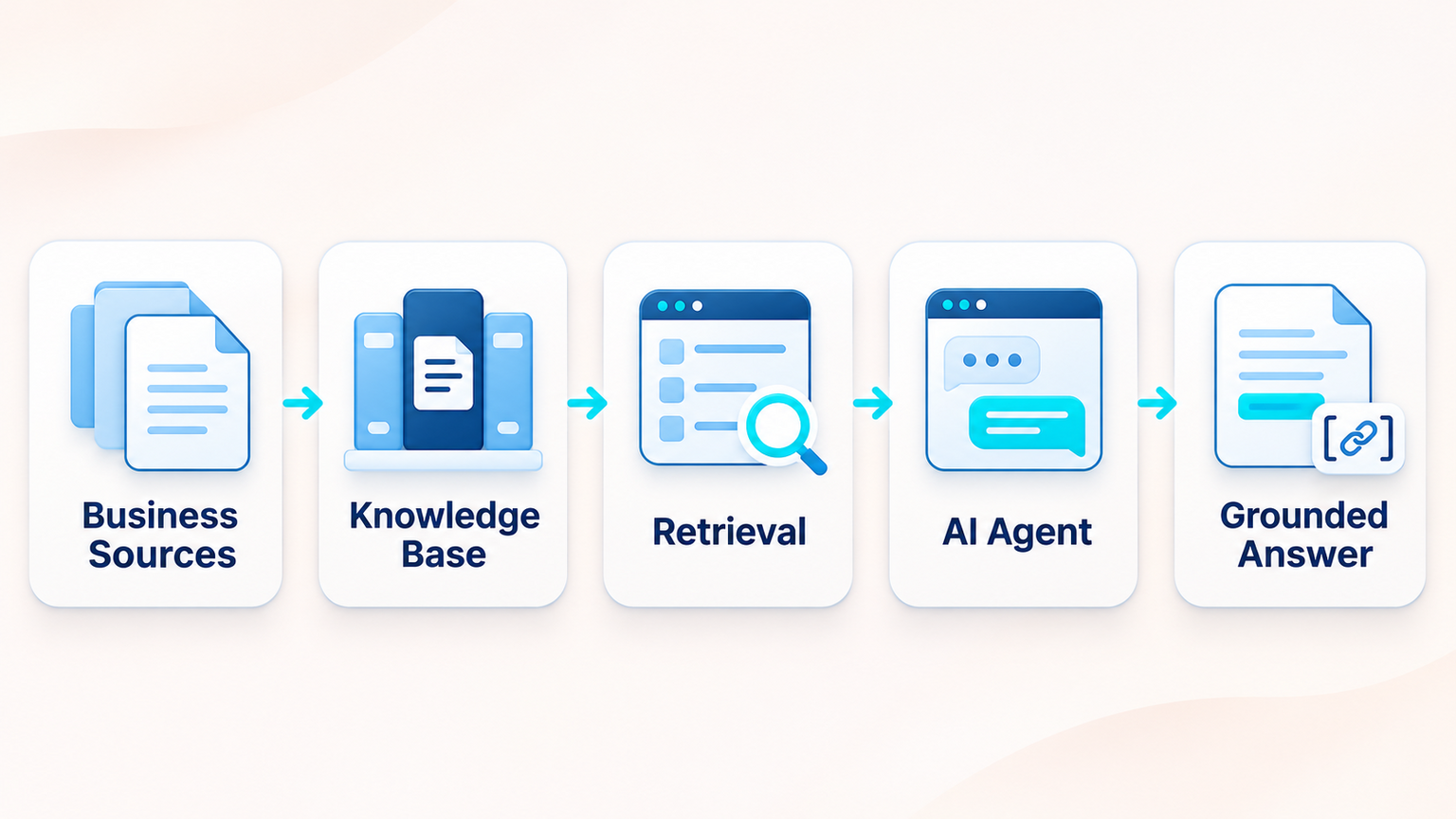
An AI agent usually does not read an entire company archive from beginning to end each time someone asks a question. Instead, a knowledge workflow selects relevant information for the current request and provides it to the model or agent. Retrieval is one common way to do this.
A simplified path looks like this:
- Prepare the sources. The business selects information that is current, approved, and appropriate for the intended audience.
- Make the sources searchable. A platform processes the files or pages so it can find relevant passages or records later.
- Receive a request. A user asks a question or requests an action.
- Find useful context. The system searches available information for passages or records related to the request.
- Generate or take the next step. The agent uses the retrieved context to form a response, ask a clarifying question, call an authorized tool, or hand off to a person.
- Present the result. The system answers, cites a source if supported, confirms a completed action, or explains that it cannot answer from the available information.
For example, a customer asks, “Can I return an opened item?” The agent may retrieve a policy that distinguishes opened products from sealed items, identify whether a missing detail needs clarification, and explain the relevant rule. It should not guess about the customer’s individual purchase. If the answer depends on the order date or item, the agent may need to ask for information or query an authorized order system.
The knowledge base supplies information; the agent’s instructions and tools shape what it does with that information. A useful set of AI agent requirements defines the task, the sources the agent may use, the actions it may take, and the situations that require a different response.

AI Knowledge Base, RAG, Model Training, Tools, and Memory
These concepts are related, but they describe different parts of an AI system. Mixing them up can lead a team to choose the wrong solution or expect the wrong result.
| Concept | What it means | Example business question |
|---|---|---|
| AI knowledge base | Selected information made available for an AI system to use | “What is our current cancellation policy?” |
| Retrieval | The search or selection step that finds relevant information | “Which passage best answers this question?” |
| RAG | A common pattern that retrieves information and gives it to a generative model as context | “Can the model explain the policy using the retrieved passage?” |
| Model training | Changing model parameters using training data and a training process | “Should the model learn a behavior or pattern across many examples?” |
| Connected tool or system | An integration that reads current data or performs an action | “Is this customer’s appointment still available?” |
| Agent memory | Information retained from a conversation or previous interactions, according to system design | “What did the user tell the agent earlier?” |
A knowledge base is the information set. Retrieval is one way to locate relevant content in it. Retrieval-augmented generation, often called RAG, combines retrieval with generation so a model can use selected source material while answering. Some products combine these steps in a managed feature; other implementations assemble them separately. Neither term tells you by itself which file types, security rules, citation behavior, or update process a particular product supports.
Model training is different. Adding a document to a searchable source does not necessarily retrain the model. Many business questions concern information that changes, such as service terms or product instructions. Retrieval can make updated sources available without retraining the model, provided the source is processed and indexed as required by the system.
Tools are also different from static knowledge. A knowledge source might explain the rules for booking an appointment. A calendar tool can check live availability and create the booking. A knowledge source may say which products are eligible for a refund; an order system can return whether a specific purchase meets those criteria. Use the right mechanism for each need.
Memory is about retained context, such as details from the current conversation or prior interactions. A knowledge base is usually a business-managed source of information. Memory may be user-specific or conversational, and requires its own retention and access decisions. Neither should be treated as a place to casually store everything an agent encounters.
Choosing the Right Way to Give an Agent Information
A knowledge base is one option in a wider information design. The right choice depends on the size of the information set, how often it changes, and whether the answer is general or specific to a user. This distinction helps prevent a common mistake: placing every fact into the same store and expecting the agent to know what to retrieve.
| Information need | Common fit | Why it may fit |
|---|---|---|
| A few stable instructions about tone or task boundaries | Agent instructions or configuration | Small, global rules do not require a searchable library |
| A large set of product or procedure documents | Searchable knowledge base | The system can find relevant passages without loading every document into every request |
| Current user-specific facts, such as a booking or order status | Authenticated API or business-system tool | The value may change and must be checked for the person or record in question |
| Facts or patterns used broadly in the model’s behavior | Model training or fine-tuning, when justified | Training can shape behavior, but it is a poor substitute for frequently changing policies or records |
| A caller’s earlier answer in the same conversation | Conversation context or memory | The agent needs continuity for this interaction, not a permanent policy source |
These approaches can work together. An agent might follow task rules in its configuration, retrieve a public service policy from a knowledge base, check a live account through an API, and remember the caller’s selected date while the conversation continues. Each source has a different job and should have an owner and access boundary appropriate to that job.
The more frequently a fact changes, the more important it is to know how updates reach the agent. A published PDF copied into a knowledge store may not update when the source file changes. A website source may need to be recrawled or reprocessed. A live API can return current values, but only if the tool has the right permissions and handles errors correctly. Ask the product provider exactly what “connected” or “synced” means for each source.
Why a Knowledge Base Does Not Guarantee Correct Answers
A knowledge base can improve an agent’s access to business information, but it does not make the system automatically reliable. Several separate failures can lead to a poor result:
- The answer does not exist in an approved source.
- The source is inaccurate or no longer current.
- Multiple sources conflict and no priority is defined.
- The right content exists, but the system retrieves a different passage.
- The retrieved information is incomplete or missing a condition.
- The agent misunderstands or misstates the retrieved material.
- The answer is correct in general but does not apply to this user or situation.
- The user should not be allowed to access the information at all.
This is why “we uploaded our documents” is not an evaluation result. A good response depends on source quality, access rules, retrieval quality, model behavior, and the user’s context. Microsoft’s RAG evaluation guidance treats retrieval, groundedness, relevance, and response completeness as distinct questions to assess.
Citations can help a reviewer trace an answer to a document or page, when the specific system supports that feature. A citation is evidence of a source connection, not proof the answer is complete or applicable. The AI FAQ agent guide for cited knowledge-base answers explores source-backed responses for a particular use case.
A useful system also needs a fallback. If it cannot find a suitable answer, it can ask a clarifying question, explain that it could not verify the information, or transfer the request. “Answer something anyway” is not a safe default for pricing, policy, eligibility, or account-specific questions.
When a Business Needs a Knowledge Base
A knowledge base is useful when an AI system needs reliable access to business-specific or frequently updated information that is not already available in its general model. It can also help make information available across more than one channel or workflow.
Common examples include:
- A website agent answering questions about a company’s services and hours.
- A support agent explaining product setup from approved help content.
- An internal assistant finding the current process for a standard task.
- A sales assistant retrieving approved product comparisons or qualification guidance.
- A service agent locating instructions before asking a technician to take over.
The AI customer-service use case guide shows where support information can help an agent respond to routine requests. A related AI customer support agent guide covers how knowledge, escalation, and tracking fit together in that workflow.
Not every AI use case needs a document knowledge base. If the agent only needs to classify a message or draft text from instructions in its prompt, a separate knowledge store might not add value. If it needs an exact current inventory count, an authorized live system is usually more appropriate than a static document. If it needs to answer questions across a large changing archive, a searchable knowledge system may be a better fit than putting all of that content directly into an instruction prompt.
The decision should start with the task. List what the agent must know, how often it changes, who may access it, and whether a source should be retrieved, queried live, or left unavailable. Then choose the simplest system that satisfies those needs.
What Makes a Knowledge Source Useful
A useful knowledge base is not measured only by the number of files it contains. The important question is whether the system can return appropriate information for the questions it is meant to answer.
Consider these qualities when selecting or preparing sources:
| Quality | What to check | Example |
|---|---|---|
| Authority | Is this the approved source for the topic? | Current policy page instead of an old email attachment |
| Currency | Who updates the content when facts change? | Product owner reviews release notes and help content together |
| Clarity | Does the document state conditions, exceptions, and definitions? | “Within 30 days of delivery” instead of “within 30 days” |
| Coverage | Does it answer the actual questions people ask? | Include the “what if I already opened the package?” case |
| Audience | Is this information public, internal, or limited to specific users? | Staff-only escalation notes are not available to a public agent |
| Retrievability | Can the system find the relevant passage for common wording? | A distinct section titled “Change or cancel an appointment” |
| Traceability | Can a person identify where an answer came from? | Source title and relevant passage shown to an authorized reviewer |
Authority and audience deserve particular attention. A business might have a public return policy and an internal exception process. The internal process could guide a staff agent without being appropriate to quote to a customer. Determine whether the system supports the required access separation and context before connecting sensitive sources.
For ongoing oversight, the AI agent governance guide can help define who approves information, who reviews the agent, and who can intervene. An AI agent audit trail can also be useful when reviewers need to understand what source or event influenced a result, provided the platform exposes the records required for your use case.
How to Evaluate an AI Knowledge Base
Test the knowledge workflow with representative requests before relying on it. A small, carefully chosen evaluation set can reveal whether the source is appropriate and whether the system uses it correctly.
For each important topic, write down:
- A realistic user question in the language people use.
- The source that should answer it, if one exists.
- The key facts or conditions an acceptable answer should include.
- What the system should do if the information is missing or conflicting.
- Whether the user is allowed to receive the answer.
Include several question types:
- A direct question with a clear source.
- A vague question that should cause the agent to clarify.
- A question using a synonym or informal term not used in the document.
- A question with two conditions, such as product type and purchase date.
- A question whose answer is intentionally absent.
- A question where an old source conflicts with a new one.
- A request for internal or restricted information from an unauthorized user.
- A question that requires a live tool rather than a static source.
When a response fails, diagnose the stage before changing content. Did the correct source get selected? Was the relevant passage included? Did the agent follow the passage? Did it apply the right user permissions? Did an integration return current data? Different causes need different fixes.
A simple guide to testing AI agents offers additional testing patterns. For a searchable system, test retrieval and generated answers separately where possible. Microsoft’s evaluation guidance makes this same distinction through retrieval evaluation and response evaluation.
A practical scorecard can track:
| Check | Pass condition |
|---|---|
| Source relevance | The retrieved content is relevant to the question |
| Answer support | Important claims are supported by the retrieved content |
| Required details | Conditions and exceptions are not omitted |
| Abstention | The system does not invent an answer when evidence is insufficient |
| Access control | Restricted content is not returned to an unauthorized user |
| Freshness | The answer uses the current approved version |
| User fit | The answer addresses the request in understandable language |
Avoid optimizing one metric in isolation. A system that retrieves more documents may include irrelevant details. A concise answer may omit a critical condition. A citation can point to the correct source while the response misreads it. Review failures with someone who understands the business policy.
Choosing a Knowledge-Base Platform
A platform can make it easier to connect documents and websites to an agent, but feature labels vary. Before choosing one, ask what sources it accepts, how updates work, what the agent can retrieve, and what evidence administrators can inspect.
Questions to ask include:
- Which file types, websites, data sources, and languages are supported?
- What file-size, page, source-count, or usage limits apply to the plan?
- How does the system process a source, and how do I know ingestion succeeded?
- How does it respond when a source changes or is removed?
- Can sources be prioritized or excluded by agent or channel?
- Can public and internal information be kept separate?
- Are citations, source links, or retrieval details available to the user or reviewer?
- Can the agent query live systems for account-specific or changing data?
- What happens when it cannot find an answer?
- Which logs, transcripts, or administrative controls are available?
Botsify’s current AI agent builder page describes a knowledge-base setup step that accepts PDF, DOCX, and TXT files up to 50 MB, and a website URL source. Confirm the current product behavior and limits for the exact account and workflow you intend to use. The page also shows knowledge-base setup as one step in the broader process of configuring an agent, connecting tools, and choosing a deployment channel. If agents will answer in multiple languages, confirm that the relevant source content and terminology are available and tested; the multilingual customer-support guide covers related considerations.
Give Your AI Agent a More Reliable Knowledge Base
Discuss your documents, website sources, and retrieval needs.
Keeping Knowledge Useful Over Time
A knowledge base needs ownership because business information changes. A one-time upload can become stale after a policy update, product release, new service, or process change. Define who owns each high-impact source and how updates reach the agent.
A lightweight maintenance model can include:
- A named owner for every important source or subject area.
- A change trigger for pricing, policies, product releases, service terms, or procedures.
- A way to remove superseded content and confirm the replacement is available.
- A recurring review for content that changes less predictably.
- A record of major source changes and who approved them.
- A feedback route for staff to report missing, outdated, or confusing answers.
- A test that checks a changed source before the agent is relied on again.
Set review frequency according to the information’s risk and change rate. A product policy might need review whenever it changes. A stable company-history page may need less frequent attention. A scheduled review is useful, but it should not replace event-based updates when something material changes.
Monitor the questions the agent cannot answer, the sources it uses for important answers, and cases where people correct or override the response. Those signals can reveal content gaps, retrieval problems, or workflows that should use a live tool or human review instead. A knowledge base improves when the organization treats these findings as operational feedback, rather than repeatedly adding more documents without checking their effect.
Plan a Knowledge Base for Your AI Agent
Review your agent’s sources, access, and update plan.
Frequently Asked Questions
Is an AI knowledge base the same as a database?
Not necessarily. A database usually stores structured records that can be queried by fields or rules. An AI knowledge base often includes documents or passages that can be searched semantically or textually. An AI system may use both: a knowledge source for general guidance and a database or API for current, user-specific records.
Does an AI knowledge base train the AI model?
Usually, adding documents to a knowledge base does not change the model’s trained parameters. The system makes relevant information available at response time through retrieval or another context mechanism. Product designs differ, so ask the provider whether source changes trigger indexing, model training, or a separate update process.
Can a knowledge base stop hallucinations?
It can provide relevant evidence and reduce reliance on unsupported answers, but it cannot guarantee that a model will retrieve or use the evidence correctly. Test missing information, conflicting sources, and cases where the system should decline or hand off.
Should every company document go into the knowledge base?
No. Use approved information that serves the agent’s purpose and that its intended users are permitted to access. Drafts, redundant copies, confidential material, and outdated documents can create confusion or expose information inappropriately.
How often should an AI knowledge base be updated?
Update important sources when their underlying facts change, and set a review schedule for information that does not have a clear change trigger. Assign owners so updates are not dependent on someone noticing a stale answer by chance.
Does a knowledge base need citations?
Citations are useful when users or staff need to verify where a response came from. Their availability depends on the product. Even with citations, test whether the cited source supports the answer and whether the response includes the relevant conditions.
What is the difference between knowledge and memory?
Knowledge is usually a business-managed collection of sources used to answer questions. Memory refers to information retained from a conversation or prior interactions. They have different purposes and may need separate access, retention, and deletion rules.
Final Thought: Treat Knowledge as Part of the Agent
An AI knowledge base gives an agent a way to use business-specific information, but the source collection is only one part of the system. The information must be approved, searchable, current, accessible to the right users, and applied correctly to each request.
Start by defining what the agent needs to know and what it must not reveal. Then decide whether each need belongs in a document source, a live business system, or an agent instruction. Test real questions, including cases where the answer is absent, and keep an owner responsible for changes.
A knowledge base is not just a folder attached to AI. It is a governed information layer that helps an agent answer and act within the limits your business intends.
Explore a Knowledge Base Setup for Your Agent
See how approved knowledge can support agent answers.