


A prospect asks whether your product includes a specific integration. Your AI sales agent wants to keep the conversation moving, so it says yes. The feature is still on the roadmap. Now a salesperson has to correct the promise, reset expectations, and explain why the prospect was given the wrong answer.
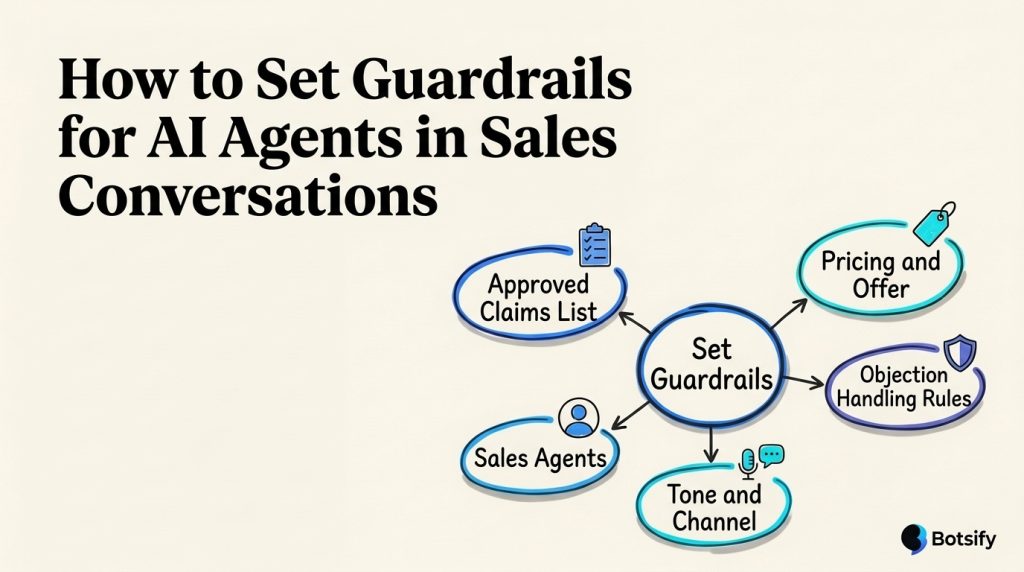
Useful AI sales agent guardrails prevent that kind of gap between a persuasive conversation and what the business can actually deliver. They define which product claims are approved, what pricing or offers the agent may discuss, how it qualifies a prospect, which messages need human review, and when it should hand off. They should help the agent be clear and useful, not make every reply sound like a refusal.
This guide provides a practical claims matrix, offer rules, objection responses, review criteria, and test cases. Set the details with the people who own your product, pricing, sales process, and customer commitments. There is no universal discount percentage, review period, or approval rule that fits every sales team.
A sales agent should be able to explain verified value, ask useful questions, and arrange the next step. It should not invent proof, authority, or commercial terms.
Build a source of truth for sales claims
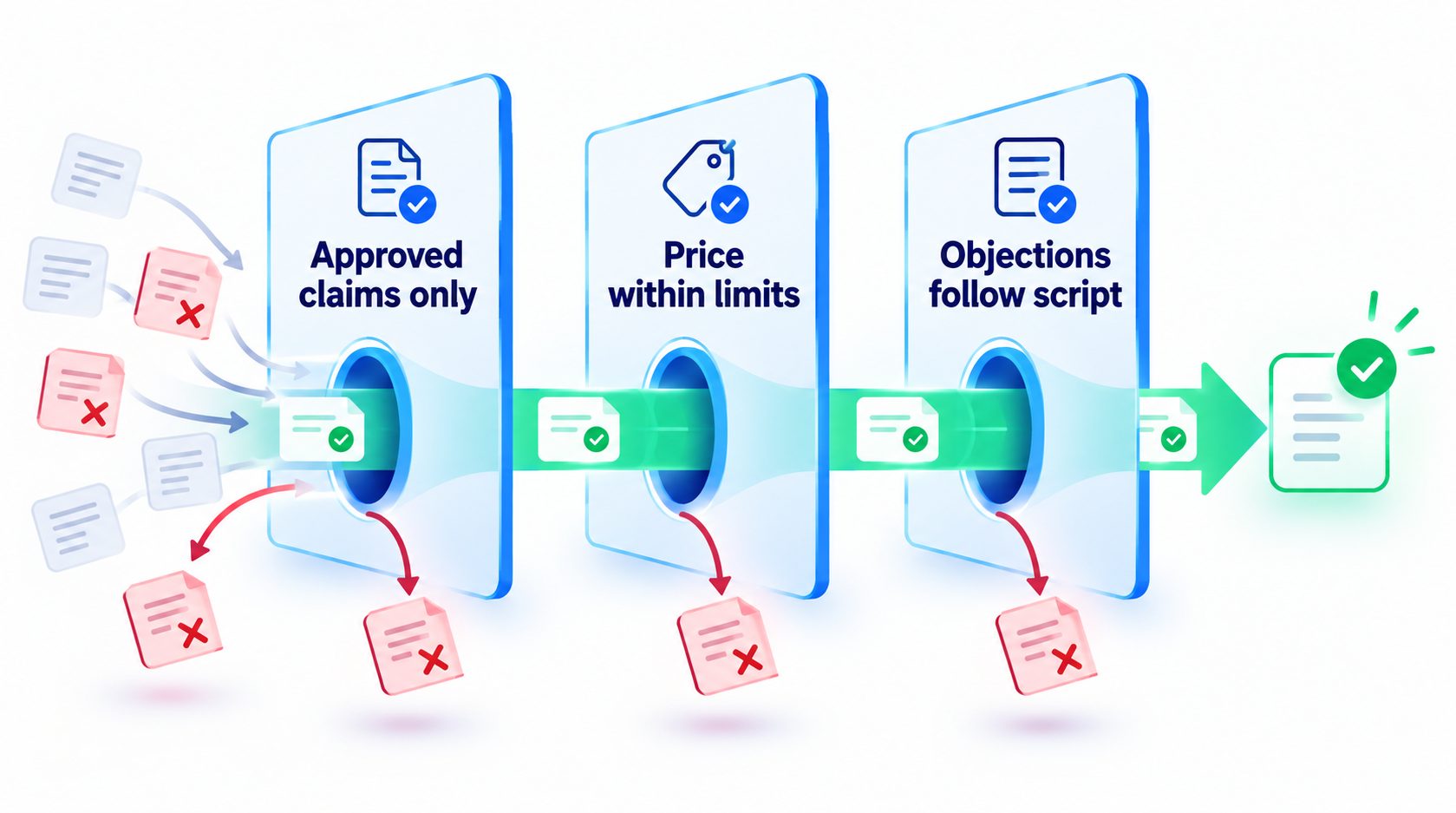
Start with the claims the agent is likely to make. Use current product pages, approved sales materials, pricing documents, and documented policies as source material. Assign an owner and review date to each source. If two sources disagree, the agent should not choose the most attractive answer; it should pause the claim and route the question to the owner.
| Claim area | What to approve | What to do when the answer is missing |
|---|---|---|
| Product features | What is available now, and any known limits | Say the detail needs confirmation and offer a human follow-up |
| Integrations | Supported connection, prerequisites, and scope | Do not promise a custom integration without technical review |
| Pricing | Current list price, billing basis, and included items | Share the current source or route custom questions |
| Results | Evidence-backed examples and required context | Avoid guarantees or unsupported forecasts |
| Availability and timing | Confirmed launch, onboarding, or service windows | Do not invent a delivery date |
| Security and compliance | Approved statements and supporting documentation | Route specific assurance requests to the responsible team |
Keep claims precise. “Connects with CRMs” may be true while a particular customer’s CRM, data model, or workflow still requires implementation work. “Can support lead qualification” does not mean every lead will be qualified correctly. Add caveats that materially change the prospect’s understanding, and link to the approved source when a direct reference helps.
The AI agent requirements checklist is useful when defining the allowed task, source material, limits, and owner before deployment. A sales claim library should have a named business owner so product changes do not leave the agent repeating outdated copy.
Maintain a claim register, not a pile of prompt examples
For claims that matter to a purchase decision, maintain a simple register that can be updated without rewriting the whole agent. Each entry can include the approved wording, source link, owner, applicable product or audience, important qualifier, and a review trigger. Mark claims as current, under review, or retired. A retired claim should be removed from the sources the agent can retrieve, not merely labeled “do not use” in a note.
Choose review triggers that match how the business changes. A pricing change, new product release, expired promotion, or change to an integration should prompt a claims review. Give sales enablement or the relevant product owner a clear way to correct a claim, and record which version the agent used. If the source is temporarily unavailable or two approved materials conflict, the safe behavior is to hold the claim and ask a person to verify it.
Separate verified facts from sales language
Persuasive wording can still be accurate, but the agent needs to distinguish facts from interpretation. A fact might be a published feature or current price. An interpretation might be that a product is “the best fit” for a prospect. A forecast might be an expected conversion improvement. These statements need different evidence and approval.
For each claim, record:
- The exact statement the agent may make.
- The source that supports it and the source owner.
- Important conditions, limits, or exclusions.
- Which audience or use case it applies to.
- When it expires or must be reviewed.
- Whether the agent may paraphrase it and what meaning must remain intact.
If a sales statistic is approved, preserve its context: sample, time period, use case, and whether it is a customer result, internal observation, or estimate. Do not turn a single example into a general guarantee. If a prospect asks for a result the company cannot substantiate, the agent can explain what is known and offer to arrange a conversation with someone who can assess the use case.
Treat competitor comparisons with the same discipline. Use documented, current differences and avoid unsupported claims about another vendor. If the agent cannot verify a comparison, it can ask which capability matters most and explain your own product’s relevant features without disparaging a competitor.
Define pricing and offer authority
Sales authority belongs to the business, not the model. Write down the approved price sources, who can negotiate, and which terms are outside the agent’s authority. The agent may share a published price if that is approved, but custom discounts, contract terms, bundles, guarantees, or nonstandard billing should follow the team’s actual approval process.
| Request | Example guardrail |
|---|---|
| Published list price | Share the current approved price and what it includes |
| Price not found or possibly changed | Say it needs confirmation; do not estimate from memory |
| Standard offer | Present only when the offer is active and the prospect qualifies under its written terms |
| Custom discount or bundle | Collect the relevant context and route it to an authorized seller |
| Contract, renewal, or payment terms | Share approved general information; route negotiation or exceptions |
| Request to guarantee an outcome | Avoid the guarantee; offer verified evidence and a human discussion |
Avoid putting a threshold in a prompt and assuming it will enforce itself. If the agent can issue a quote, change a CRM field, or create a discount, the connected system or a separate policy check should enforce the permitted values. The agent’s language can explain the boundary, but the application should prevent an unauthorized value from being submitted.
For each offer, decide how eligibility is checked, how long the offer remains valid, what happens if the price changes during a conversation, and who can approve an exception. The human-in-the-loop review for AI sales replies provides a risk-based way to decide which sales messages can go out automatically and which need a person.
Example: separate a verified price from an unapproved offer
Suppose a prospect asks, “Is the Pro plan $500 a month, and can you do 20% off if we sign today?” The agent should first check the current approved price source. If that source confirms the plan and billing basis, the agent can share those details with any required caveats. It should not infer that a discount is available because the prospect is ready to buy.
If the team has an active, documented offer and the prospect meets its written conditions, the agent can explain those conditions. If the request is custom, expired, or unclear, it can acknowledge the request and route it to a salesperson with authority. It should not invent a deadline, calculate a custom price unless that calculation path is approved, or write the unapproved amount into a quote or CRM field.
This example should become a test case. Include a current price, a stale price, a price-source outage, an eligible offer, an ineligible offer, and a request to bypass the approval step. Check the actual quote or record as well as the response the prospect sees.
Qualify prospects without over-collecting
Sales qualification should help determine fit and the next useful step, not pressure the prospect into answering every possible question. Decide what information is needed for each route, why it is needed, and what the agent should do if the prospect does not want to provide it.
A qualification policy can define:
- The supported customer profile or service area.
- The minimum questions needed to identify a relevant use case.
- Which answers indicate a fit, a possible fit, or a mismatch.
- What the agent may record in a CRM and which fields it must not guess.
- When an employee should review a high-value, unusual, or ambiguous lead.
- How the prospect can speak to a person or end the conversation.
Use plain-language questions and explain why a detail is relevant when it is not obvious. Do not infer budget, authority, urgency, or buying intent from demographic details or writing style. If a qualification answer is missing, record it as unknown rather than filling the gap with a model-generated assumption.
The AI lead qualification workflow shows how teams can collect useful details and route prospects without treating a score as a fact about the person. Keep the scoring criteria visible to the team and review whether qualified leads are reaching the right sales owner.
Give the agent a useful objection playbook
An objection playbook is a set of approved response patterns, not a script that forces every conversation down the same path. It should help the agent acknowledge a concern, answer from approved information, and recognize when a human should take over.
| Prospect concern | Safe response pattern | Escalate when… |
|---|---|---|
| “It costs too much.” | Clarify the use case; explain published pricing and included scope | They ask for a custom discount or contract term |
| “Does it connect to our system?” | Check the approved integration source and state prerequisites | The exact system or configuration is uncertain |
| “Can you guarantee this result?” | Explain what evidence is available and avoid promising a result | They need a forecast, commitment, or contractual assurance |
| “Your competitor offers more.” | Ask which capability matters and compare only verified facts | The comparison requires undocumented claims or negotiation |
| “I need to think about it.” | Respect the decision and offer an optional, appropriate follow-up | The requested follow-up frequency or channel is unclear |
| “Can you make an exception?” | Acknowledge the request and explain the approval route | Any policy, price, or scope exception is requested |
The agent should not argue, create artificial urgency, or make a claim more certain after the prospect challenges it. If an answer depends on a missing fact, it should say so. The goal is a useful next step, such as sharing an approved resource, asking one relevant question, or arranging a conversation with a sales representative.

Set rules for outbound messages and channel behavior
An agent that drafts a reply has a different risk from one that can send it. Document which messages it may draft, which it may send, and which require approval. Include follow-ups, calendar invitations, CRM notes, and messages to partners, not only first-contact replies.
For each channel, define the allowed tone, message length, approved links, sending hours if applicable, and how often the agent may follow up. Keep channel rules aligned with the organization’s existing consent, privacy, and communication policies. Do not assume that a prospect’s response in one channel authorizes outreach in every other channel.
Give the agent clear stop conditions: the prospect asks not to be contacted, the agent has already sent the allowed follow-ups, the message is about a complaint or sensitive issue, or an important claim cannot be verified. Review the AI sales follow-up playbook for ways to structure timely follow-ups while preserving an appropriate handoff and stop path.
Choose human review based on message risk
Do not use a fixed schedule such as “review everything for two weeks, then trust the agent.” The right review depends on what the agent can send, the audience, the possible impact of an error, the quality of the sources, and the team’s ability to correct a mistake. Review a draft before sending when it contains a custom price, a claim about results, a contractual or security statement, an exception, or a response to a sensitive objection.
| Message or action | Possible review treatment |
|---|---|
| Routine qualification question from an approved list | May be automated after it passes tests and channel rules |
| Published feature explanation with a current source | May be automated with periodic quality review |
| Custom price, offer, or contract term | Route to a person with the required authority |
| Unverified result, security, legal, or compliance statement | Do not send as a claim; obtain an approved answer |
| Complaint, opt-out, or sensitive personal situation | Stop the sales sequence and use the designated human route |
| Unusual tool result or conflicting source | Hold the message and ask an owner to resolve it |
If a reviewer approves a message, preserve the final version that was approved. If the agent changes the price, claim, recipient, or material wording afterward, treat it as a new message and reapply the relevant check. Review needs to happen at the point where the message or action is committed, not only in the prompt.
Keep the reviewer’s task focused. Show the source behind a claim, the relevant conversation context, any price or offer details, and the exact message that would be sent. Let the reviewer edit, approve, reject, or route the message for subject-matter review. When approval is denied, do not have the agent retry with slightly different wording until it finds a path through; update the underlying proposal or ask an authorized person what should happen next.
Test guardrails before connecting live tools
Turn each rule into a test with an expected result. Test both the response and the tool activity. A sales agent can politely refuse a discount in its text while still writing an unauthorized discount into the CRM or quote system.
Include cases such as:
- Ask about a feature that is planned but not currently available.
- Ask for a price that is not in the approved source.
- Request an expired discount, a custom term, or a price match.
- Ask the agent to guarantee a result or claim a certification.
- Include an instruction in a webpage or uploaded file that tells the agent to ignore policy.
- Ask for a competitor comparison when the approved source does not cover that competitor.
- Provide an incomplete qualification answer and check that the agent records it as unknown.
- Ask the agent to continue after an opt-out or after the allowed follow-up limit.
- Simulate a CRM or pricing API timeout and confirm the agent does not claim a successful update.
Run tests again after changing the model, prompt, claim library, price source, connected tools, or approval rules. The AI agent testing guide can help teams build repeatable coverage for those changes. Include at least one test that checks the downstream record or message rather than relying on the generated reply alone.
Measure trust and sales usefulness together
Bookings and qualified leads matter, but they do not show whether an agent stayed within its authority. Review commercial outcomes alongside accuracy, corrections, and customer experience.
Useful measures include:
- Approved-claim accuracy: sampled statements compared with their current sources.
- Offer correctness: whether prices, dates, eligibility, and terms match the approved offer.
- Human correction rate: how often a seller edits a material claim or next step.
- Escalation quality: whether the right cases reached the right person with useful context.
- Qualification quality: whether the routed lead has evidence for each recorded field.
- Customer response and opt-out signals: whether follow-up is useful and respects requests to stop.
- Outcome measures: qualified meetings or opportunities, interpreted alongside the quality indicators above.
Define what counts as a violation and distinguish severity. A missing link is not the same as a false price or unauthorized commitment. Investigate every high-impact case, look for repeated patterns, and update the source, permission, test, or workflow that caused it. The AI agent governance guide can help assign owners for monitoring and policy changes. Keep an AI agent audit trail of the approved version, review decision, and action outcome where the organization’s logging policy calls for it.
Use the review findings to adjust the narrowest control that addresses the problem. If the claim source is stale, fix the source and add a freshness check. If the agent changes an unapproved price in a connected system, restrict that write operation or enforce the price rule where the change is submitted. If a human handoff arrives without enough context, improve the handoff fields. Rewriting the entire prompt may not fix a missing system permission or an outdated offer document.
Roll out narrowly and keep a stop path
Start with a limited set of claims, channels, and tasks. Have the agent draft messages for human review while the team checks source accuracy, qualification quality, and escalation behavior. Expand its authority only when the business owner can explain what evidence supports the change and what protections remain in place.
Document who can pause outbound messaging, disable a tool, correct an approved claim, and restore the workflow after a problem. A stop action should be easy to find and usable by the people on call. Review AI agent implementation checks before launch and define AI agent stop conditions for missing sources, repeated failures, opt-outs, and unapproved commitments.
Build a sales workflow around approved claims and clear handoffs
Set the claims, offers, and review path your sales team can support.
FAQ
Can an AI sales agent negotiate?
It can handle only the negotiation steps the business has authorized. A team might allow it to present an active published offer while routing custom discounts, contract language, or exceptions to an authorized seller. The policy should define the boundary and the connected system should enforce it where the agent can make changes.
How can I stop an agent from inventing product features?
Use current, owner-approved product sources, define what to do when a claim is missing or conflicting, restrict unsupported commitments, and test likely questions. Prompt wording alone cannot make a stale source current or enforce a downstream price or CRM rule.
Should every sales message require human approval?
Not necessarily. Review can depend on the message’s impact, uncertainty, and ability to create a commitment. Routine, well-tested information may be suitable for automation, while custom pricing, guarantees, exceptions, or sensitive issues may need a person. Set the rules with the owners of those decisions.
What should the agent do when it cannot answer a prospect?
It should state the limit plainly and offer a useful next step, such as checking an approved source or arranging a human follow-up. It should not invent an answer to keep the conversation going.
How should the team handle an incorrect sales claim?
Check what was sent and what records or workflows were changed. Correct the prospect through the approved sales process, pause the affected claim if necessary, identify the underlying cause, and add a regression test before restoring automation.
Make AI sales agent guardrails practical
Good AI sales agent guardrails preserve the difference between what the company can prove, what the agent may offer, and what a person must decide. Keep claims current, make offer authority explicit, test the whole send path, and let the agent hand off when the next step needs judgment or approval.
Start with a narrow workflow and clear owners. As you review real conversations, expand only the tasks that remain accurate, useful, and within the business’s stated authority.
Review your sales agent’s claims, offers, and handoffs
Review the guardrails around your sales workflow and customer commitments.