


Every sales team receives inquiries that look promising at first but never turn into real opportunities. Some prospects aren’t ready to buy, others don’t have the budget, and a few simply need information rather than a sales conversation.
The problem is that sales representatives often discover these details after spending time on calls, emails, and follow-ups.
AI agents can help by handling the initial qualification process before a lead reaches the sales team. They ask relevant questions, assess the prospect against your qualification criteria, and determine whether the next step should be a sales conversation, further nurturing, or human review.
This guide explains how to build an AI lead qualification workflow, create a practical scoring model, connect it to your CRM, and measure whether it’s helping your sales team focus on suitable opportunities.
Why Qualifying Leads Before Sales Matters
When every inquiry goes directly to a sales representative, the team spends time figuring out whether each prospect is worth pursuing.
That may work when lead volume is low. As inquiries increase, however, the same process can become difficult to manage.
Here are some of the problems that appear when qualification happens too late.
| Problem | How It Affects Sales |
|---|---|
| Unnecessary discovery calls | Representatives spend time speaking with prospects who aren’t suitable for the service |
| Slow responses | Promising inquiries may wait while the team handles lower-priority conversations |
| Inaccurate pipeline data | Early-stage inquiries can be mistaken for genuine sales opportunities |
| Repetitive questions | Representatives repeatedly collect information that could have been gathered earlier |
| Missed after-hours inquiries | Prospects who contact the business outside working hours may not receive an immediate response |
| Inconsistent qualification | Different representatives may evaluate similar leads using different criteria |
An AI qualification agent can handle initial inquiries across supported channels, collect relevant information, and apply consistent routing rules.
For example, a prospect visiting your website at night could explain their requirements, answer a few qualification questions, and receive an appropriate next step without waiting for the sales team to return.
The agent still needs clear instructions and reliable integrations. Its value comes from organizing the early stages of the sales process so representatives can spend more time on conversations that require human judgment.
How an AI Lead Qualification Workflow Works
An AI lead qualification workflow moves a prospect from the initial inquiry to an appropriate next step without requiring a sales representative to review every conversation manually.
A practical workflow has five stages.
Stage 1: Respond to the inquiry
When someone contacts the business through a connected website chatbot, messaging channel, or lead form, the AI agent begins the conversation.
It should acknowledge the inquiry and ask a relevant opening question.
For example:
“What are you hoping to improve about your current sales process?”
The objective is to understand why the prospect reached out rather than immediately pushing them toward a meeting.
Stage 2: Collect qualification information
The agent asks a few questions based on the prospect’s answers.
Depending on the business, these may cover:
-
The problem the prospect wants to solve.
-
Company or project requirements.
-
Expected timeline.
-
Budget expectations.
-
Who will be involved in the decision.
The agent shouldn’t ask questions the prospect has already answered or require every lead to complete an identical questionnaire.
Stage 3: Evaluate the prospect against your criteria
As the conversation progresses, the agent compares the information collected with your qualification framework.
It can assess service fit, urgency, budget alignment, and other relevant criteria.
The assessment should distinguish confirmed information from missing or uncertain details. A prospect shouldn’t receive a low score simply because they haven’t answered a question yet.
Stage 4: Route the lead to the appropriate next step
Once the agent has enough information, it can recommend an action.
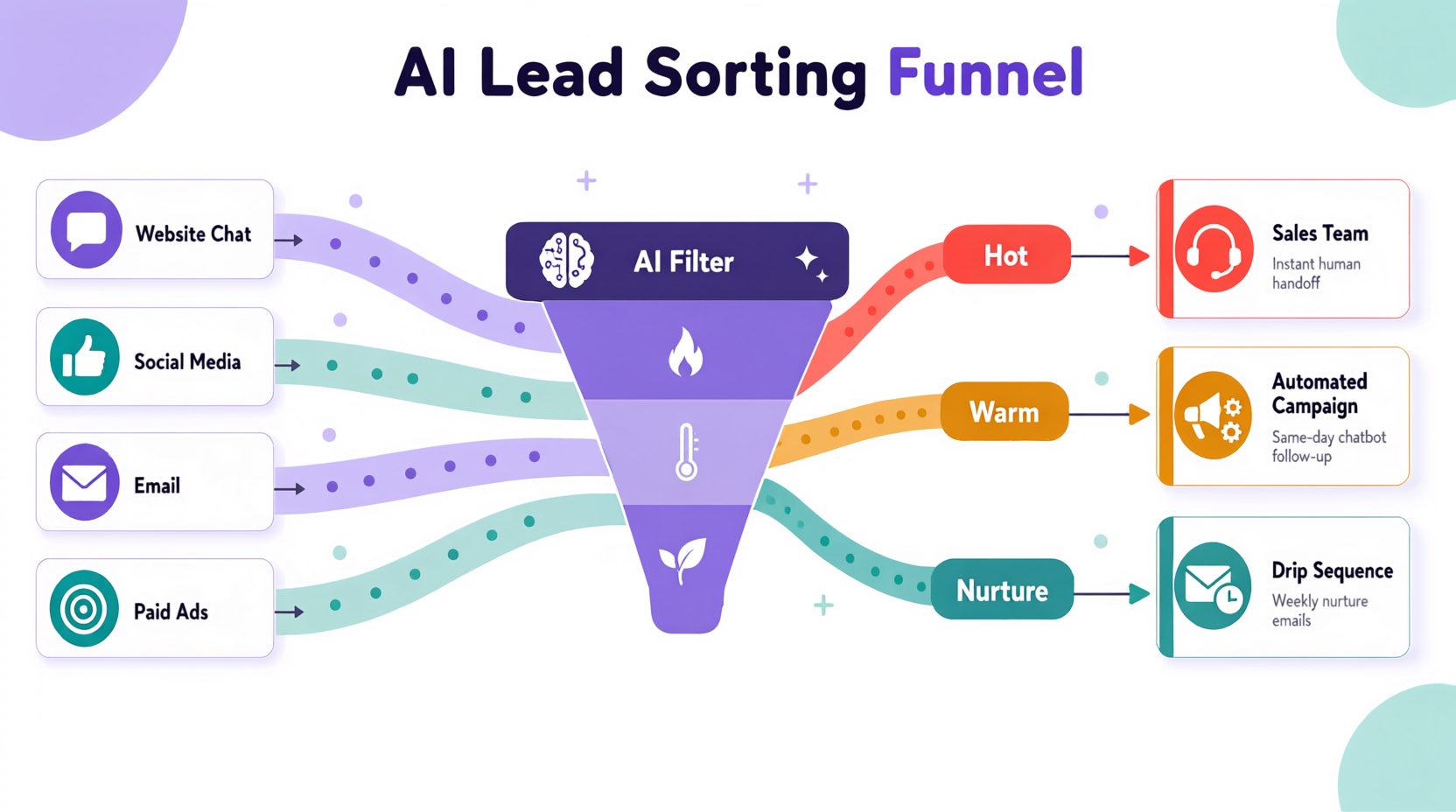
| Lead Status | What It Means | Recommended Action |
|---|---|---|
| Sales-ready | Strong fit with enough information to justify a conversation | Notify or assign a sales representative |
| Needs clarification | Potential fit, but important details are missing | Ask another relevant question |
| Needs human review | Uncertain or complex opportunity | Send the conversation to an appropriate team member |
| Nurture | Relevant prospect who isn’t ready to proceed | Offer useful information and permission-based follow-up |
| Not a fit | Clear mismatch with approved qualification criteria | Explain the mismatch and offer an appropriate alternative |
The routing rules should reflect your actual sales process rather than treating every low score as a reason to reject someone.
Stage 5: Record the outcome and follow up appropriately
The agent should save the qualification outcome, relevant answers, and recommended next step in the connected system.
For leads routed to sales, the representative should receive a concise summary so they don’t have to repeat the initial conversation.
Prospects who aren’t ready to book can receive relevant follow-up when they have agreed to it.
This workflow helps teams respond consistently while keeping human involvement available for complicated decisions.
Stop Sending Unqualified Leads to Sales
Let AI qualify prospects before your sales team spends time on them.

How to Build an AI Lead Scoring Model Using Real Sales Data
An AI lead qualification workflow needs clear criteria for deciding which prospects deserve sales attention.
Lead scoring helps organize that decision by assigning values to relevant characteristics, such as service fit, business needs, timing, and purchasing readiness.
However, a scoring model shouldn’t be built entirely around assumptions about what a good customer looks like. Your previous sales conversations and deal outcomes can provide a useful starting point.
Step 1: Review your previous sales opportunities
Start by examining recent opportunities that became customers and those that didn’t.
For each opportunity, look at information available during the initial qualification stage:
-
Industry and company size.
-
Lead source.
-
Problem or business requirement.
-
Contact’s role in the buying process.
-
Budget information, when available.
-
Expected timeline.
-
Whether the opportunity eventually closed.
Look for patterns that distinguish suitable opportunities from poor-fit inquiries.
For example, you may discover that prospects who describe a specific operational problem are more likely to become customers than those making general inquiries about your services.
Remember that a lost deal isn’t necessarily an unqualified lead. Some suitable prospects choose another provider, delay a purchase, or face unexpected internal changes.
Step 2: Choose your qualification criteria
Start with a small set of factors that matter to your business. A practical AI lead scoring framework for B2B can help you identify which signals deserve more weight.
Here’s an illustrative scoring framework for a B2B service provider:
| Qualification Criterion | Example Weight | What to Evaluate |
|---|---|---|
| Company and service fit | 25% | Whether the prospect matches the types of businesses you can serve |
| Problem-solution fit | 25% | Whether your offering addresses the stated challenge |
| Decision-making involvement | 15% | Whether the prospect can influence or participate in the purchase |
| Timeline | 15% | Whether the expected timeline is compatible with the sales process |
| Budget alignment | 15% | Whether investment expectations match your service |
| Engagement | 5% | Whether the prospect is actively participating in the conversation |
| Total | 100% |
These weights are examples, not universal benchmarks.
A company selling enterprise software may prioritize technical requirements and procurement readiness, while an agency may place greater weight on service fit and project scope.
Step 3: Define how each criterion receives points
The scoring model needs clear instructions for converting information into a score.
For example, if problem-solution fit carries 25 points:
| Assessment | Points |
|---|---|
| Clear problem that the business can solve | 25 |
| Potential fit requiring clarification | 15 |
| Weak or uncertain fit | 5 |
| Confirmed mismatch | 0 |
Apply a similar approach to the other criteria.
Treat missing information separately from a confirmed negative answer. If the prospect hasn’t discussed budget, that doesn’t necessarily mean they have no budget.
The agent should request clarification or mark the information as unknown rather than inventing an answer.
Step 4: Define disqualification and escalation rules
Some inquiries may fall outside the business’s approved service boundaries.
Examples include requests for services you don’t offer, projects in unsupported locations, or requirements your team cannot meet.
Other situations require human review rather than automatic rejection.
A prospect who needs procurement approval, cannot provide a budget yet, or has unusual requirements may still represent a suitable opportunity.
Create clear instructions for both situations.
Step 5: Connect scores to qualification outcomes
A numerical score becomes useful when it helps determine the next action.
You can begin with example ranges like these:
| Score | Initial Classification | Suggested Next Step |
|---|---|---|
| 80–100 | High priority | Route to sales when essential criteria are confirmed |
| 50–79 | Potential opportunity | Continue qualification or request human review |
| 20–49 | Early-stage or uncertain | Clarify missing information or offer relevant nurturing |
| 0–19 | Low fit | Review the reasons before deciding whether to decline |
These ranges should be adjusted based on your actual sales results.
A score alone should never override a confirmed service mismatch or automatically reject an opportunity with missing information.
Step 6: Test the model against historical leads
Apply the scoring framework to previous inquiries and compare its classifications with what your sales team knew at the time.
Ask:
-
Would the model have identified suitable opportunities?
-
Did it incorrectly reject any prospects who later became customers?
-
Did it classify unsuitable inquiries as high priority?
-
Which criteria created misleading scores?
-
Were important details missing during initial qualification?
Use the findings to refine your weights and routing rules.
Step 7: Review and improve the model after launch
Once the workflow is active, compare AI qualification outcomes with sales feedback and actual deal progression.
If representatives consistently report that high-scoring leads aren’t suitable, investigate the scoring criteria.
Similarly, if prospects classified as low priority later become valuable customers, review whether the model relies too heavily on assumptions about budget, company size, or urgency.
Lead scoring should improve as the team gathers more evidence. The purpose isn’t to predict every purchase perfectly, but to give sales representatives a more consistent way to prioritize opportunities.
How to Route AI-Qualified Leads to Your CRM and Sales Team
A lead score becomes useful when it changes what happens next.
Your AI lead qualification workflow should send relevant prospect information to your CRM and trigger the appropriate next step. This requires reliable AI agent integration with your existing sales systems.
For example, a sales-ready prospect might be assigned to a representative, while an early-stage prospect may receive an approved follow-up sequence.
What information should be recorded?
The CRM record should include:
-
Prospect name and contact details.
-
Lead source.
-
Business requirements.
-
Qualification score, if used.
-
Qualification status.
-
Known budget and timeline information.
-
Decision-making involvement.
-
Conversation summary.
-
Recommended next action.
The system should distinguish confirmed facts from information that still needs clarification.
Example: Routing leads in HubSpot
A HubSpot workflow could use a custom lead-score property and qualification status to determine what happens next.
| Condition | Example Action |
|---|---|
| Sales-ready and required criteria confirmed | Assign an owner and create a follow-up task |
| Potential opportunity with missing information | Create a review task or continue qualification |
| Nurture status with appropriate consent | Add the contact to a relevant follow-up workflow |
| Confirmed service mismatch | Record the reason and follow the approved disposition process |
The exact setup depends on the properties, workflows, permissions, and integrations available in your HubSpot account.
Example: Routing leads in Salesforce
In Salesforce, the business can use approved lead fields, assignment rules, and connected automation to support a similar process.
For example:
-
Update the lead’s qualification score and status.
-
Assign sales-ready opportunities according to the business’s routing rules.
-
Attach a factual conversation summary.
-
Flag uncertain inquiries for human review.
-
Track how qualified leads progress through the sales pipeline.
The important part isn’t which CRM you use. It’s ensuring the qualification outcome is visible to the person responsible for the next step.
A representative should be able to understand why a prospect was prioritized without searching through an entire conversation transcript.
Before launch, test the integration to confirm that records update correctly, assignments work as expected, and failures don’t result in lost or misleading lead information.
What If Your Best Leads Reached Sales First?
Discover how AI can qualify and route promising leads automatically.
What AI Agents Should Ask, Verify, and Learn From CRM Data
A good qualification conversation doesn’t require the prospect to answer every question from scratch.
If the business already has reliable information in its CRM or connected systems, the agent can use that context to make the conversation more relevant.
However, it needs to distinguish between confirmed information, third-party data, and assumptions that require clarification.
What should the AI ask directly?
Some information is best collected from the prospect.
| Information | Recommended Approach | Reason |
|---|---|---|
| Main business problem | Ask directly | The prospect can explain what they need |
| Desired outcome | Ask directly | Clarifies what success would look like |
| Project timeline | Ask when relevant | Helps determine readiness |
| Budget expectations | Ask respectfully when needed | Company size doesn’t establish available budget |
| Decision-making process | Ask naturally | Job title alone doesn’t confirm purchasing authority |
| Technical requirements | Clarify when necessary | Avoids assuming requirements from a general problem description |
The agent should ask only the questions needed to determine an appropriate next step.
What information can come from connected systems?
Depending on the integrations available, the agent may have access to:
| Data Source | Potentially Useful Information |
|---|---|
| CRM | Previous conversations, inquiry history, assigned owner, qualification status |
| Company enrichment provider | Industry, company size, and other available business details |
| Website analytics | Relevant engagement information, where available and appropriately collected |
| Previous form submissions | Requirements and contact details already provided |
| Connected support or sales systems | Existing customer relationships or unresolved inquiries |
External data should be treated as context, not guaranteed truth.
For example, a company enrichment tool may list an employee count that is outdated. The agent shouldn’t use that number to make a final qualification decision without considering its reliability.
Avoid making assumptions about budget or authority
A prospect working at a large company doesn’t necessarily have an approved budget.
Likewise, someone with a junior job title may be researching solutions on behalf of a senior decision-maker.
Instead of assuming purchasing authority, the agent could ask:
“Who else would be involved in evaluating a solution like this?”
For budget alignment, it might ask:
“Have you already considered an investment range, or are you still exploring what’s available?”
These questions collect useful information without making the prospect feel interrogated.
Example prompt for contextual qualification
You are qualifying an inbound lead
for [Business Name].

Your goal is to understand the
prospect's requirements and determine
the appropriate next step.

Use approved CRM information and
connected business data as context.

Ask about:
- The main problem
- Desired outcome
- Relevant requirements
- Timeline
- Budget expectations when needed
- Decision-making involvement

Do not repeat questions already
answered.

Do not assume:
- Budget from company size
- Purchasing authority from job title
- Urgency from website activity
- Service fit from industry alone

Distinguish confirmed facts from
missing or uncertain information.

If qualification is uncertain,
request human review.

Use only approved qualification
criteria and routing rules.

Provide a factual conversation
summary for the sales team.
Use enrichment to improve the conversation, not replace it
When reliable information is available, the agent can use it to ask more relevant questions.
For example:
“I understand your team is exploring ways to improve inbound lead handling. What’s the biggest challenge with your current process?”
This is more helpful than opening with a long questionnaire.
The objective is to combine available context with the prospect’s own answers while avoiding inaccurate assumptions. An AI agent builder can help you configure these instructions for your qualification workflow.
Common Mistakes in AI Lead Qualification
Even a well-designed qualification workflow can produce poor results when the agent uses unclear criteria or makes decisions based on incomplete information.
Here are the mistakes worth checking before launch.
Asking too many questions
A long qualification conversation can discourage prospects from continuing. Prioritize questions that help determine the next step, and avoid asking for information already provided.
Scoring keywords instead of understanding context
Two prospects might use similar language to describe completely different requirements. The agent needs to evaluate the actual business problem rather than assigning points simply because certain words appear in the conversation.
Treating missing information as a negative signal
A prospect who hasn’t discussed budget or purchasing authority isn’t necessarily unqualified. The agent should distinguish unknown information from a confirmed mismatch.
Automatically rejecting uncertain prospects
Some opportunities require human judgment. Include a review process for complex requirements, unusual buying situations, and incomplete qualification information.
Using the same criteria for every service
A business offering several products or services may need different qualification rules. The requirements for an enterprise implementation project may be very different from those for a standard monthly subscription.
Ignoring sales feedback
Review how AI-qualified leads perform after reaching the sales team. If representatives repeatedly receive unsuitable opportunities, investigate whether the scoring criteria or routing rules need adjustment.
The most useful qualification workflows improve as the business learns more about its prospects. An AI agent implementation checklist can help teams catch configuration and testing issues before launch.
How to Measure AI Lead Qualification Performance
Launching an AI qualification workflow is only the beginning. You also need to know whether it is improving the sales process.
Start by measuring performance before deployment, then compare those results with the outcomes after the agent begins handling inquiries.
| Metric | What It Measures | Why It Matters |
|---|---|---|
| Lead qualification completion rate | Percentage of started qualification conversations that reach an outcome | Helps identify unnecessary friction |
| Sales acceptance rate | Percentage of AI-routed leads accepted as suitable by representatives | Shows whether qualification aligns with sales expectations |
| Qualified lead conversion rate | Percentage of qualified leads that progress or become customers | Helps evaluate the quality of qualification |
| Time to first response | How quickly inquiries receive an initial response | Shows whether responsiveness is improving |
| Time to sales handoff | How long suitable prospects wait to reach the sales team | Helps identify routing delays |
| Human review rate | Percentage of inquiries requiring manual assessment | Shows where the agent encounters uncertainty |
| Incorrect qualification decisions | Suitable leads rejected or unsuitable leads routed to sales | Helps identify scoring and routing problems |
Compare results with your previous process
If possible, run the AI workflow alongside your existing qualification process during an initial testing period.
Review whether the agent identifies suitable opportunities, collects useful information, and routes leads appropriately.
Pay attention to false positives and false negatives.
A false positive occurs when the agent identifies a prospect as suitable but the sales team finds a clear mismatch. A false negative occurs when the agent rejects or deprioritizes a prospect who should have received further consideration.
Review performance regularly
During the initial rollout, review a sample of conversations frequently and collect feedback from sales representatives.
As the workflow becomes more stable, you can move to periodic reviews based on lead volume and business needs.
Avoid judging the system only by the number of leads it rejects or the speed at which it responds.
A successful qualification workflow should help the sales team identify relevant opportunities without creating unnecessary barriers for potential customers.
Real Conversation Example: How AI Qualifies a Lead Before Sales
Here’s a fictional example of how an AI agent might qualify an inbound inquiry for a lead management solution.
Lead: Hi, I found your website while looking for ways to automate lead qualification.
AI: Welcome! What are you hoping to improve about your current lead qualification process?
Lead: We’re getting around 200 leads a month from paid ads, but our sales team can’t keep up with the inquiries.
AI: That sounds like a lot to manage. What’s happening with those leads right now? Are responses getting delayed, or is the team spending too much time on people who aren’t a good fit?
Lead: Both, actually. There are only two of us handling sales, and we spend a lot of time following up with people who aren’t serious.
AI: Understood. Are you mainly looking for help identifying suitable leads, automating follow-ups, or both?
Lead: Ideally both. We’d like the system to qualify people first and then send the promising ones to our team.
AI: That helps clarify what you’re looking for. Do you have a particular timeline or budget in mind for implementing something like this?
Lead: We’d like to get started next month, and we have about $2,000 per month available.
AI: Thanks, that’s useful context. Your requirements sound relevant to the solutions we discuss with businesses, although our team would need to confirm the right setup and pricing. Would you like me to check available times for a conversation with a specialist?
What makes this conversation effective?
The agent begins by understanding the business problem rather than immediately presenting a product.
It asks relevant questions about lead volume, team capacity, requirements, timing, and budget without forcing the prospect through a long questionnaire.
It also avoids promising that a particular solution will work before the necessary details have been confirmed.
Once enough information has been collected, the agent offers an appropriate next step.
This is the purpose of AI qualification: helping the sales team understand the opportunity before the human conversation begins.
How to Scale an AI Lead Qualification Workflow
As lead volume grows, businesses may need to adjust how qualification, routing, and follow-up are managed.
However, the number of inquiries alone doesn’t determine whether you need a more complicated AI system.
The right setup depends on conversation complexity, the number of services offered, CRM requirements, and how much human involvement is necessary.
| Business Situation | Recommended Approach |
|---|---|
| Low lead volume with simple requirements | Start with a basic qualification workflow and review outcomes manually |
| Growing inbound inquiries | Automate repetitive qualification questions and lead routing |
| Multiple sales teams or service categories | Introduce service-specific qualification rules and assignment workflows |
| Complex enterprise inquiries | Add human review, stakeholder tracking, and more detailed handoffs |
| High-volume, multi-channel inquiries | Improve data synchronization, monitoring, and workflow reliability |
Start with a manageable workflow
Begin by automating a clearly defined part of the qualification process.
For example, the agent might collect basic requirements, identify service fit, and route suitable prospects to a sales representative.
Once that process works reliably, you can introduce CRM enrichment, appointment scheduling, and follow-up automation. A structured AI sales follow-up playbook can help you plan the next steps for prospects who aren’t ready to buy.
Review the systems supporting the agent
As the workflow expands, pay attention to data accuracy and integration reliability.
The agent needs access to current information, and the sales team should be able to understand how qualification decisions were made.
Adding more agents or automation steps won’t solve problems caused by unclear criteria or inaccurate CRM records.
A scalable qualification process starts with dependable rules and systems. Businesses needing implementation support can consider done-for-you AI agents configured around their sales workflows.
Frequently Asked Questions
How accurate is AI lead qualification?
Accuracy depends on the qualification criteria, information available, and how the agent has been configured. AI can apply defined rules consistently, but it may misunderstand a prospect’s situation or lack important context. Regular testing and human review help identify and correct these problems.
Will AI lead qualification replace SDR teams?
AI can automate parts of initial qualification, information gathering, and routing. Sales development representatives can continue handling complex inquiries, building relationships, and evaluating opportunities that require human judgment.
What happens when a lead doesn’t fit the scoring model?
The agent should identify the missing or uncertain information and request clarification when appropriate. If the opportunity remains unclear, it can route the conversation to a human rather than forcing a qualification decision.
How can I get my sales team to adopt AI qualification?
Start with a limited pilot and involve representatives in defining the qualification criteria. Compare AI recommendations with manual assessments, review conversation quality, and use sales feedback to improve the workflow before expanding deployment.
Final Thoughts
AI agents can help sales teams spend less time sorting through unsuitable inquiries and more time understanding prospects who may genuinely benefit from their services.
But effective qualification depends on more than asking a few questions and assigning scores. The agent needs clear criteria, reliable information, sensible routing rules, and a way to involve humans when the situation requires judgment.
Start with your existing sales process, identify which qualification tasks are repetitive, and build a workflow around those needs. Test it against real conversations, collect feedback from your sales team, and improve the criteria as you learn what works.
The goal isn’t to remove people from the sales process. It’s to give them better information before the conversation begins.
Your Sales Team Deserves Better Leads
See how Botsify can turn incoming inquiries into qualified sales opportunities.