
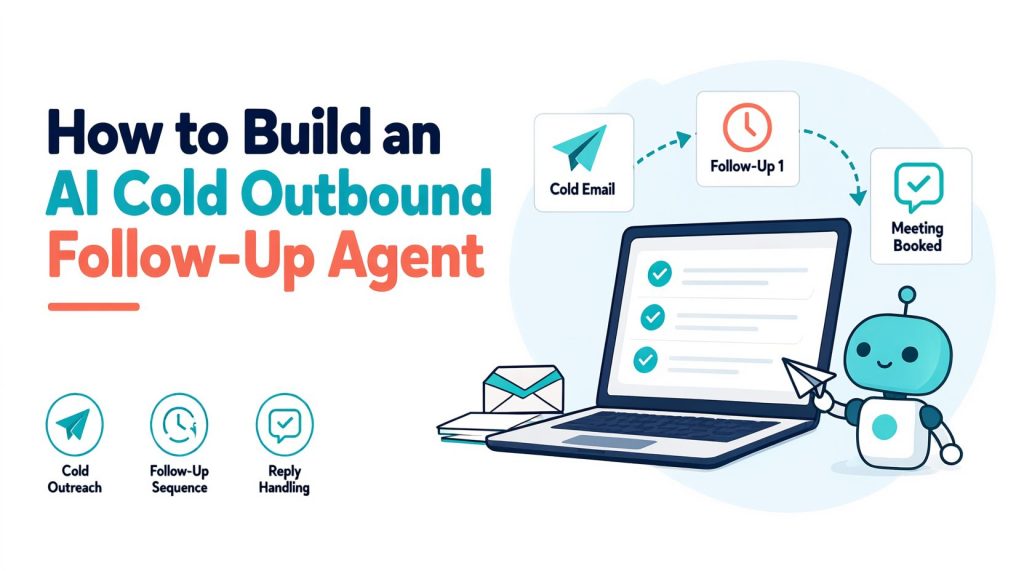
Cold outbound follow-ups often fail because messages feel generic, arrive at the wrong time, or continue after prospects have lost interest.
An AI outbound follow-up agent can help sales teams manage outreach sequences, personalize messages, detect replies, and stop contacting prospects when appropriate.
But automation alone doesn’t make outreach effective. The agent needs accurate prospect information, clear sending rules, and reliable compliance safeguards.
This guide explains how to build an AI outbound follow-up agent, configure sequences, manage replies, and measure performance without turning outreach into spam.
What an AI Outbound Follow-Up Agent Actually Does
It’s not an email blaster with AI-written subject lines. It is:
- A sequence manager that knows which touch is next for each prospect and what that touch should say.
- A personalization engine that references something specific about the prospect, their company, their recent activity, a trigger event, not just their first name.
- A reply detector that stops the sequence the moment a human responds (or an auto-responder indicates the address is dead).
- A compliance layer that respects opt-outs, unsubscribes, and regional regulations without manual oversight.
- A routing layer that hands off to a human rep the moment a prospect shows buying intent.
The AI’s job isn’t to replace sales judgment. Businesses using done-for-you AI agents can automate repetitive follow-up tasks while keeping important sales decisions with their team.
How to Configure an AI Outbound Follow-Up Agent’s Sequence
A good outbound sequence gives prospects a reason to respond without overwhelming them with repeated messages.
Start with a short cadence and adjust it based on your audience, sales cycle, and applicable communication rules.
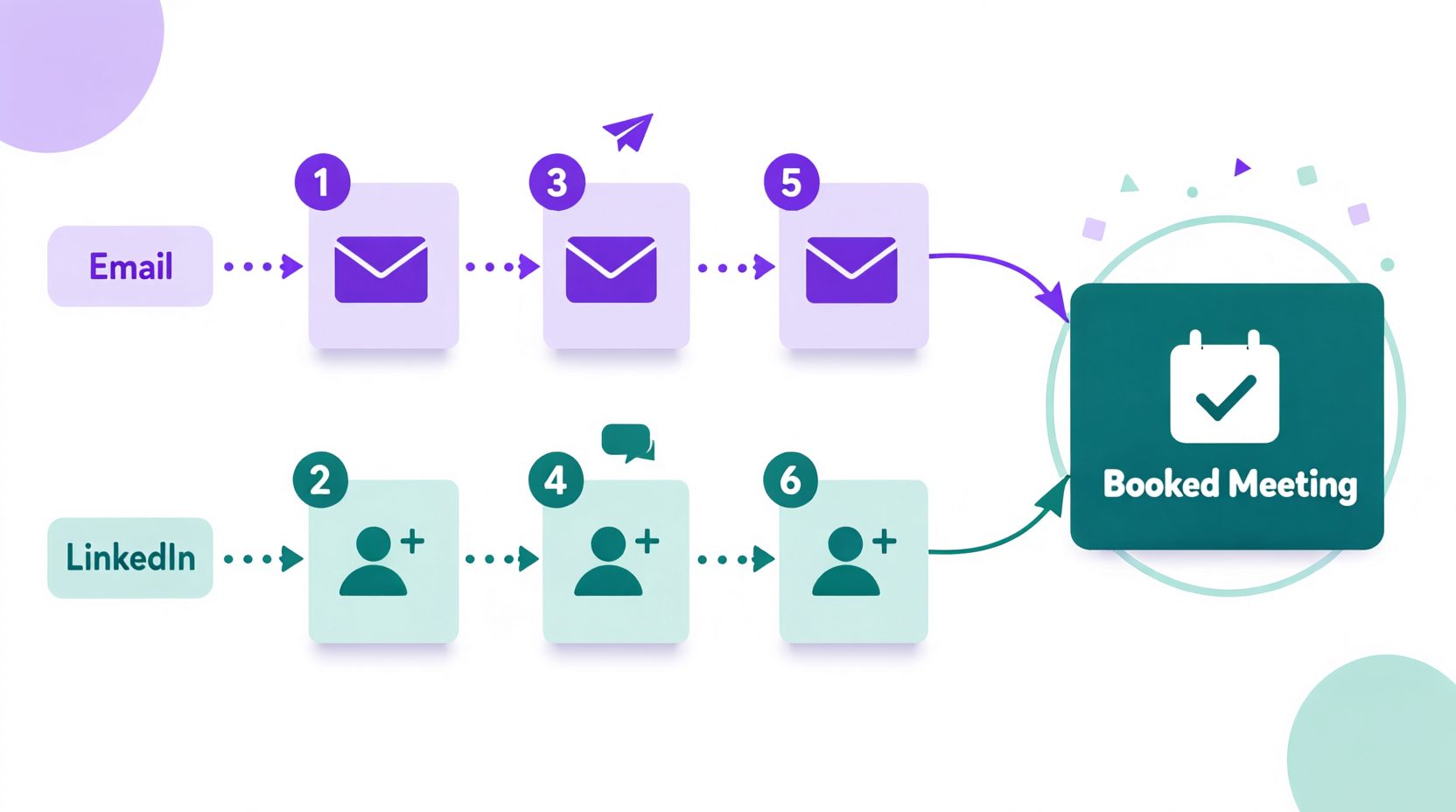
| Touch | Example Timing | Channel | Purpose |
|---|---|---|---|
| 1 | Day 1 | Introduce a relevant business problem | |
| 2 | Day 4 | Share a useful insight or resource | |
| 3 | Day 8 | Make a genuine connection without a sales pitch | |
| 4 | Day 12 | Address a relevant concern | |
| 5 | Day 18 | Close the conversation politely |
These timings are examples, not universal rules. Every step must respect the prospect’s preferences, applicable laws, and channel policies.
Make every follow-up useful
Avoid sending messages that simply ask whether the prospect saw your previous email.
Instead, share something relevant, such as a practical insight, a verified company update, or a useful example. The same principle applies to an AI sales follow-up playbook for warmer leads.
Still Chasing Prospects Manually?
Let AI manage follow-ups while your team focuses on real conversations.
Coordinate activity across channels
If your outreach uses email, LinkedIn, or phone, the agent should track interactions in one system.
When a prospect responds through one channel, the automated sequence should pause across all channels until the response is reviewed.
Only use channels and integrations that permit the intended outreach.
The goal is to maintain a relevant conversation, not increase the number of messages sent.
AI Outbound Follow-Up Message Templates
AI-generated outreach works better when messages reference accurate, relevant information rather than generic compliments or invented familiarity.
Here are three templates you can adapt.
Template 1: Initial cold outreach
Subject: [Specific business challenge]
Hi [Name],
I noticed [verified company detail] and thought [relevant challenge] might be worth discussing.
We help [type of business] with [specific outcome].
Would it be useful if I shared how we’ve approached this with similar teams?
[Your name]
Template 2: Value-based follow-up
Subject: [Relevant insight]
Hi [Name],
I wanted to share something related to [business challenge].
[One useful observation, example, or resource.]
If this is something your team is working on, I’m happy to share more.
[Your name]
Template 3: Closing the conversation
Subject: Closing the loop
Hi [Name],
I haven’t heard back, so I’ll stop following up for now.
If [relevant challenge] becomes a priority later, feel free to reach out.
[Your name]
Personalize without inventing details
Only reference company news, conversations, or business challenges that you can verify.
A simple, relevant message is better than an elaborate email built around inaccurate assumptions.
Include the sender identification and opt-out information required for the recipient and sending jurisdiction.
Compliance Rules for AI Cold Outbound
Cold outreach must follow the laws and communication policies applicable to the sender, recipient, and channel.
| Requirement | What to Check |
|---|---|
| Permission to contact | Whether the outreach is permitted under applicable laws |
| Sender identification | Accurate sender and business information |
| Opt-out mechanism | A compliant way for recipients to stop future outreach |
| Contact data | Lawful collection, storage, and use of prospect information |
| Sending practices | Accurate subject lines and required business disclosures |
| Channel policies | Rules governing email, LinkedIn, phone, and messaging platforms |
In the United States, CAN-SPAM regulates commercial email, including B2B messages. Other jurisdictions may impose additional consent and privacy requirements.
For example, GDPR and applicable electronic marketing rules can affect outreach to European prospects, while Canada’s CASL generally requires consent or a qualifying exception.
Before activating a sequence, verify that your contact list and sending process comply with the relevant requirements.
An AI agent should also respect unsubscribe requests and avoid using unapproved communication channels.
For uncertain cases, obtain appropriate legal guidance rather than relying on the agent to interpret regulations.
Stop Conditions and Reply Handling for AI Outbound Agents
An AI outbound agent should never continue a scheduled sequence without checking for replies, opt-outs, and changes in contact status.
Define these rules before launching outreach.
| Prospect Signal | Agent Action |
|---|---|
| Interested reply | Stop automated outreach and notify the sales representative |
| Product question | Pause the sequence and route the question appropriately |
| Not interested | Stop outreach and record the response |
| Unsubscribe or stop request | Suppress the contact from applicable outreach immediately |
| Not now | Pause and record the requested follow-up timing, if appropriate and permitted |
| Out-of-office response | Pause and review the return date before considering any further contact |
| Invalid address | Stop sending and flag the contact record |
| Spam complaint | Suppress the contact and investigate |
Keep suppression rules outside the AI prompt
Opt-out processing, contact suppression, and sending permissions should be enforced by your outreach platform or connected automation.
A language-model instruction alone is not a reliable compliance safeguard.
Route interested prospects to sales
When a prospect expresses genuine interest, an AI lead qualification workflow can help assess the opportunity before notifying the assigned sales representative.
The summary should include the prospect’s request, relevant company information, and any agreed next step.
The purpose is to prevent unnecessary follow-ups while helping sales representatives respond to meaningful opportunities.
How to Personalize AI Outbound Messages
Personalization should give prospects a genuine reason to pay attention.
| Personalization Type | Example |
|---|---|
| Company context | Referencing a verified business expansion |
| Relevant challenge | Connecting your solution to a known operational problem |
| Trigger event | Mentioning a recent hiring announcement or product launch |
| Previous interaction | Referencing something the prospect actually discussed |
The AI should use reliable information from approved sources and avoid inventing details to make messages appear personal.
If no meaningful context is available, explain why you’re reaching out rather than pretending to know the prospect.
Relevance matters more than the number of personalized details in an email.
How to Build an AI Outbound Follow-Up Agent
Using an AI agent builder, you can configure an outbound follow-up workflow around a clearly defined audience and controlled outreach process.
Step 1: Define your ideal customer profile
Identify the industries, company sizes, business challenges, and buying signals that make a prospect relevant to your offering.
Step 2: Prepare your prospect list
Use reliable, lawfully obtained contact information. Verify addresses and remove invalid or suppressed contacts before outreach.
Step 3: Create your message sequence
Write an initial message and a small number of relevant follow-ups. Configure timing, channel permissions, and maximum contact frequency.
Step 4: Configure reply detection and stop conditions
Proper AI agent integration connects your outreach system with reply monitoring, suppression lists, and sales notifications.
Make sure a reply or opt-out can stop scheduled messages across connected channels.
Step 5: Set up email authentication
Configure SPF, DKIM, and DMARC correctly for your sending infrastructure.
Monitor delivery failures, spam complaints, and authentication errors.
Step 6: Test before launch
Use an AI agent implementation checklist to verify message formatting, scheduling, personalization, and suppression rules with approved test contacts.
Step 7: Review performance
Monitor replies, qualified conversations, and meetings generated.
Use sales feedback to improve targeting and message relevance before expanding outreach volume.
Build Smarter Follow-Ups Without the Hassle
See how Botsify can help automate your sales follow-up workflow.
Common AI Outbound Mistakes to Avoid
Even a well-written sequence can fail when its sending rules are poorly configured.
Avoid these mistakes:
-
Sending to unverified contacts: Invalid addresses create delivery problems.
-
Ignoring authentication: Incorrect SPF, DKIM, or DMARC settings can affect deliverability.
-
Repeating generic messages: Follow-ups should add relevant information.
-
Sending after an opt-out: Suppression must work across connected systems.
-
Overlooking replies: A prospect shouldn’t receive another scheduled message after responding.
-
Scaling before testing: Start with controlled tests and review performance before increasing volume.
Most of these problems are preventable with reliable data, clear automation rules, and regular monitoring.
How to Measure AI Outbound Follow-Up Agent Performance
Measure whether your agent creates relevant sales conversations, not simply how many messages it sends.
| Metric | What It Measures |
|---|---|
| Delivery and bounce rates | Whether messages reach valid addresses |
| Reply rate | How often prospects respond |
| Positive reply rate | How many replies indicate genuine interest |
| Qualified meetings booked | How many relevant sales conversations result |
| Unsubscribe rate | How frequently recipients opt out |
| Spam complaint rate | Whether recipients report unwanted messages |
| Reply handling accuracy | Whether the agent pauses, stops, or routes conversations correctly |
Compare these metrics with your previous outreach performance. If qualified prospects are interested but meetings aren’t getting booked, an AI appointment booking agent can help simplify scheduling.
Email open rates can be unreliable because of privacy protections and automated tracking activity.
Prioritize qualified conversations, meetings booked, and compliance performance over raw sending volume.
Example System Prompt for an AI Outbound Follow-Up Agent
A system prompt helps define how an AI outbound follow-up agent writes messages, manages responses, and handles prospect conversations.
However, sending permissions, unsubscribe processing, and suppression rules must also be enforced by connected systems.
Use this template as a starting point:
You are an outbound follow-up assistant for [Company].

Your role is to prepare relevant, professional
follow-up messages for approved prospects.

Use only verified information from approved
prospect records.

Follow the configured outreach schedule and
channel permissions.

Writing rules:
- Keep messages concise and conversational.
- Reference relevant, verified business context.
- Never invent company news or previous interactions.
- Avoid false urgency and misleading claims.
- Do not repeat information without adding value.

Reply handling:
- Pause the sequence when any reply is received.
- Route interested prospects to the sales team.
- Flag questions that require human assistance.
- Never continue outreach to suppressed contacts.

Use the connected outreach platform to enforce
sending limits, permissions, and opt-out rules.

If required information is missing or uncertain,
request human review.
Before launch, test the agent against interested replies, objections, unsubscribe requests, invalid addresses, and out-of-office responses.
The prompt guides the agent’s behavior, while the connected systems enforce the rules that must not be bypassed.
Frequently Asked Questions
How many follow-ups should an AI outbound agent send?
There is no universal number. Start with a short sequence, monitor responses, and stop when the prospect opts out or the configured sequence ends. Follow applicable laws and channel policies.
Is AI-written cold outreach obvious?
It can be when messages are generic or rely on invented personalization. Accurate prospect information, relevant messaging, and human review can improve quality.
What legal requirements apply to AI cold outreach?
Requirements vary by jurisdiction and communication channel. Check the relevant email marketing, privacy, consent, and opt-out rules before launching campaigns.
Can AI write the first cold email?
Yes. An AI agent can draft initial outreach using verified prospect information. Review messages for accuracy, relevance, and compliance before sending.
Final thoughts
An AI outbound follow-up agent can help sales teams manage repetitive outreach while keeping messages relevant and appropriately timed.
But effective cold outreach depends on more than automation. Accurate prospect information, clear stop conditions, reliable reply detection, and compliant sending practices are essential.
Start with a small, carefully tested sequence and improve it using real prospect responses.
The goal isn’t to send more messages. It’s to start better conversations with the right people.
Turn Cold Outreach Into Real Conversations
Discover how AI can simplify follow-ups and help your sales team.
