
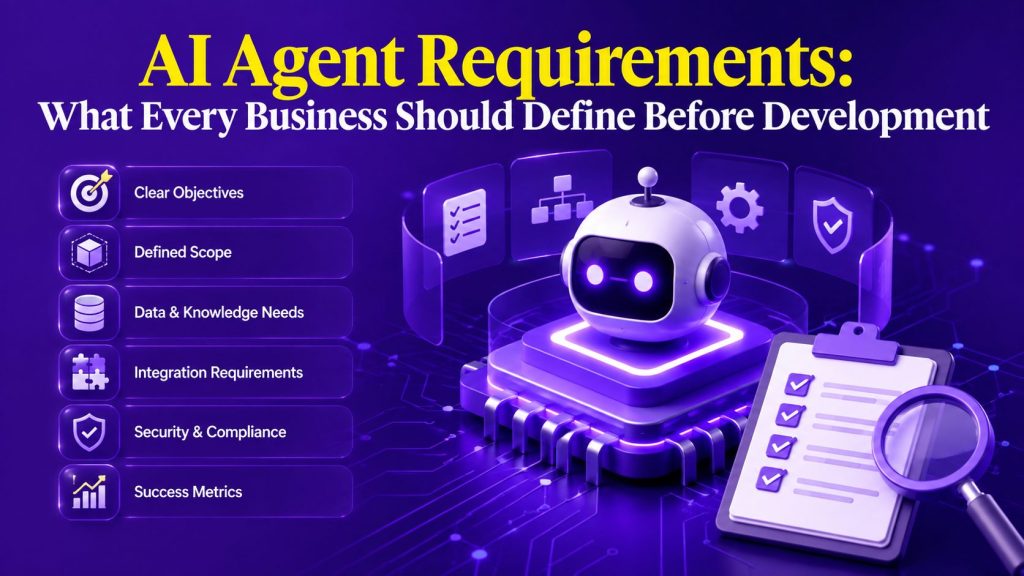
It was a familiar scene. The leadership team had approved the budget. The engineering team was eager to build. The vendor demos were impressive. Six months and $200,000 later, the company had an AI agent that could technically answer customer questions, but it hallucinated pricing, ignored business rules, and frustrated the support team so much they stopped using it after two weeks.
Sound familiar?
This isn’t a story about bad technology. It’s a story about missing AI agent requirements. The team skipped the hard part: defining what the agent needed to do, how it should behave, and what success actually looked like before writing a single line of code.
The AI agent market is projected to grow rapidly, and every week a new company announces they’re “building an AI agent.” But most of these projects will fail, not because the technology isn’t ready, but because the requirements weren’t.
This guide is for founders, CTOs, operations leaders, and decision-makers who want to get AI agent requirements right the first time. We’ll cover the framework, the template, the mistakes to avoid, and the questions most teams forget to ask.
Key Takeaways
- Poor requirements are the #1 cause of AI agent failure. Technical talent can’t fix fuzzy objectives. Most failed AI projects fail before any code is written.
- AI agent requirements span five categories: business, technical, operational, security/governance, and ethical/compliance. Missing any one creates risk.
- Define success criteria before you define features. An AI agent that works but doesn’t move a business metric is a liability, not an asset.
- Your requirements document is a living contract between business and technical teams. It’s not a one-time submission. It evolves as you learn what the agent can and can’t do.
- Governance and memory requirements are not optional. Without them, your agent will make decisions you can’t trace, explain, or override.
- A complete requirements document defines both capabilities and boundaries. It should explain what the agent can do, what it must never do, and when it must involve a human.
- Acceptance criteria make AI behavior testable. Every important requirement should include a measurable condition that determines whether the agent is ready.
Why AI Agent Requirements Matter More Than You Think
Here’s an uncomfortable truth about AI projects: the technology is the easy part. The hard part is deciding what you actually want the technology to do.
Traditional software development has decades of best practices around requirements gathering. We know how to write user stories, define acceptance criteria, and map business processes. But AI agents are different. They don’t execute deterministic logic. They make probabilistic decisions. Unlike traditional software, Agentic AI systems make autonomous decisions within defined boundaries, which makes clear requirements even more important.
This means your AI implementation requirements need to answer questions that traditional software requirements don’t touch:
- When should the agent say “I don’t know” instead of guessing?
- How do you measure the quality of a decision when there’s no single right answer?
- What happens when the agent’s behavior drifts over time as it learns from new data?
- Who’s responsible when the agent makes a mistake?
These aren’t edge cases. They’re the core of what makes AI agent requirements different from any other software project you’ve run. A useful requirements document therefore needs to define not only features, but also uncertainty, failure behavior, permissions, context, and acceptable performance.
Teams that skip this work end up with the same result: a technically functional agent that doesn’t deliver business value. As organizations increasingly rely on an AI Workforce, every agent needs clearly documented responsibilities, permissions, and success metrics. The agent answers questions but misses context. It follows instructions but violates business rules. It performs well in demos but fails in production.
Getting requirements right upfront is the single highest-leverage activity in any AI project. It reduces rework, aligns stakeholders, and gives your technical team the clarity they need to build something that actually works.
Portable AI Agents In Seconds, Use Everywhere
Prompt, Test, and Deploy AI Agents Across Social Platforms and LLMs. Automate Everything.
The AI Agent Requirements Framework
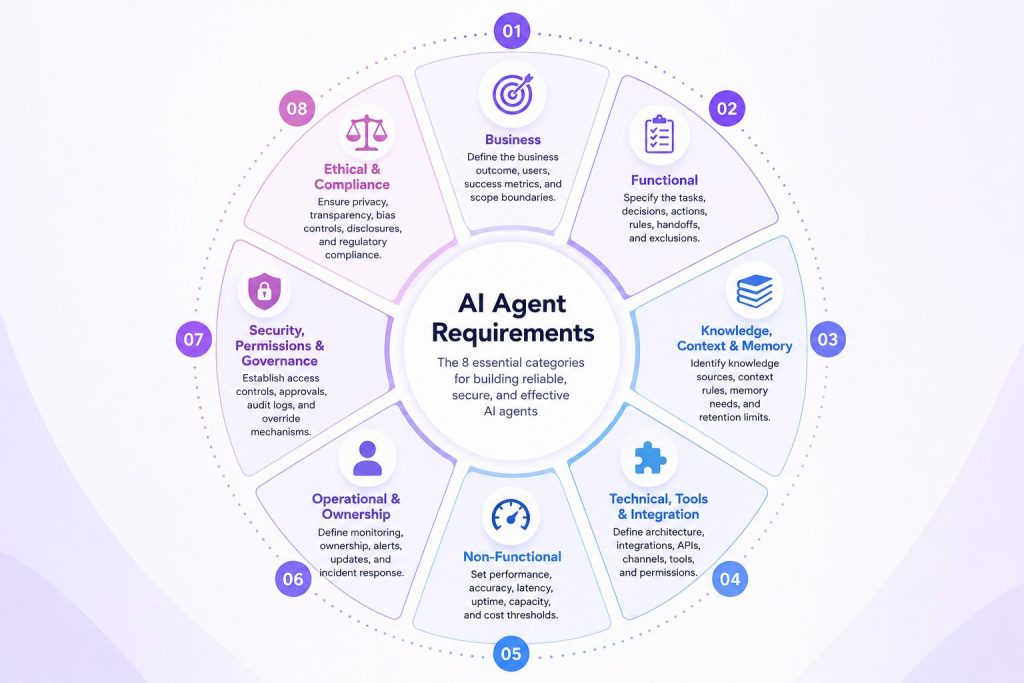
A complete AI agent requirements document should cover eight distinct categories. Together, they define why the agent exists, what it must do, what information it can use, how it connects to business systems, how well it must perform, and how it will be operated, governed, and kept compliant.
| Category | Core question | Key outputs |
| Business | What business outcome should the agent deliver? | Objectives, users, success metrics, scope boundaries |
| Functional | What tasks, decisions, and actions must it perform? | Supported tasks, decision rules, handoffs, exclusions |
| Knowledge, Context & Memory | What must the agent know and remember? | Knowledge sources, context rules, memory, retention limits |
| Technical, Tools & Integration | Which systems, tools, and channels must it use? | Architecture, integrations, APIs, channels, permissions |
| Non-Functional | How well must the agent perform? | Accuracy, latency, uptime, capacity, cost thresholds |
| Operational & Ownership | How will the agent be managed after launch? | Monitoring, ownership, alerts, updates, incident response |
| Security, Permissions & Governance | How will the agent be controlled and audited? | Access controls, approvals, audit logs, override mechanisms |
| Ethical & Compliance | Which legal and behavioral rules must it follow? | Privacy, disclosure, bias controls, regulatory requirements |
Let’s walk through each category.
Business Requirements
This is where most teams start, and where most teams stop too early. A typical business requirement for an AI agent reads like: “The agent should handle customer support inquiries.”
That’s not a requirement. That’s a wish.
A proper business requirement defines:
- The specific business outcome. “The agent should resolve 40% of Level 1 support tickets without human intervention, reducing average response time from 4 hours to 5 minutes.”
- The scope boundary. “The agent handles billing, account management, and technical troubleshooting for existing customers. It does not handle sales inquiries, escalated complaints, or anything involving legal liability.”
- The success criteria. “Resolution rate, customer satisfaction score (CSAT), escalation rate, average handle time, and containment rate.”
- The fallback behavior. “When confidence drops below 80%, the agent transfers to a human agent with full conversation context.”
- The intended users. Define who will interact with the agent, what they are trying to accomplish, and whether different user groups require different permissions, experiences, or outcomes. This is particularly important when designing AI Agents for Small Businesses, where a single agent often performs multiple business functions.
This level of specificity forces alignment. It forces the business team to define what success looks like. It forces the technical team to build against measurable targets. And it gives everyone a shared language for evaluating whether the agent is working. Business requirements should also include an explicit out-of-scope list. Defining what the agent must not handle is often as important as defining what it should do.
| EXPERT TIP
Write your business requirements without using the word “AI.” If the requirement makes sense as a business requirement, it’s solid. If it only makes sense because AI is involved, you’re probably describing a feature, not a requirement. |
Functional Requirements
Functional requirements describe the observable tasks, decisions, and actions the agent must perform. Well-defined AI Agent Workflows ensure every task follows a predictable sequence instead of relying on assumptions during development. They turn broad business goals into specific behaviors that developers can build and test.
For each function, define:
- The event or user request that triggers the agent
- The information the agent needs before acting
- The decision or task it must complete
- The tools or systems it may use
- Whether human approval is required
- The expected output
- The fallback when the task cannot be completed
For example, instead of writing, “The agent should help customers with refunds,” define the behavior more precisely:
When an authenticated customer requests a refund, the agent must retrieve the order, verify eligibility against the refund policy, explain the outcome, and either submit the approved request or transfer the case to a human with full context.
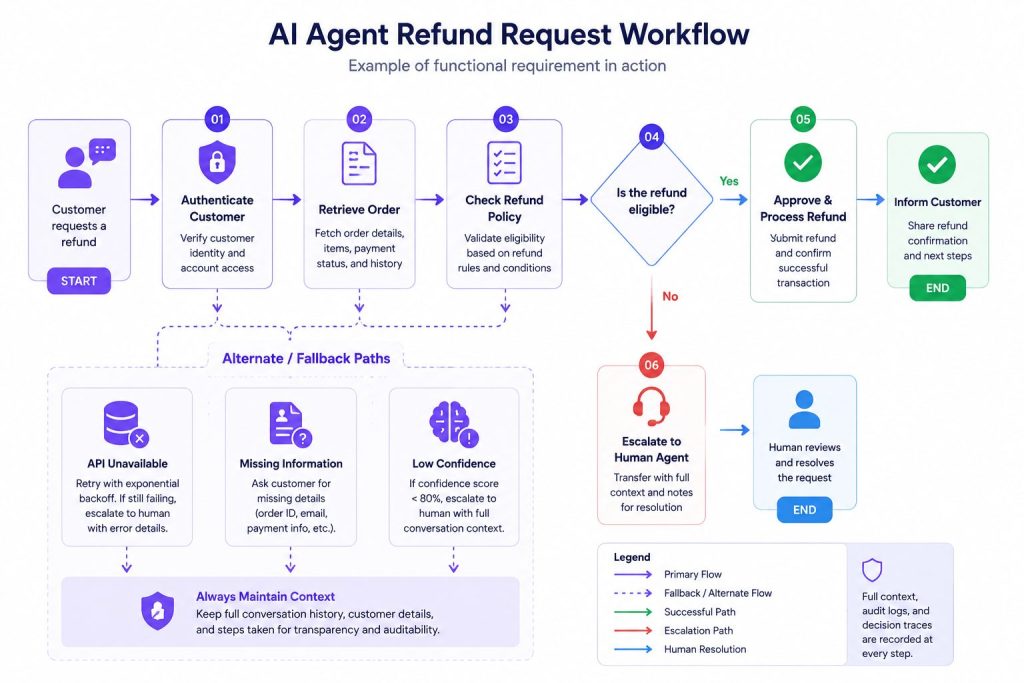
Functional requirements should also define explicit exclusions. If the agent must never approve high-value refunds, change account ownership, or provide legal advice, document those restrictions before development starts.
Knowledge, Context, and Memory Requirements
An AI agent cannot operate reliably unless the team defines which information it may use, which sources are authoritative, and what context it should retain.
Knowledge Sources
- Which documents, databases, and systems may the agent reference?
- Which source takes priority when information conflicts?
- How often must the knowledge be refreshed?
- Who owns the accuracy of each source?
- What should the agent do when no approved answer exists?
Context Requirements
- What information must remain available during a conversation or task?
- Should context move between channels, agents, or human handoffs?
- What information should be included when the agent escalates?
- When should context be discarded?
AI Agent Memory
- What information should the agent remember across conversations?
- Does it need session, user, task, or shared memory?
- How long should information be retained?
- Which information must never be stored?
- Can users review, correct, or delete remembered information?
A clearly defined AI Agent Memory strategy helps the agent retain useful context without keeping outdated, irrelevant, or sensitive information longer than necessary.
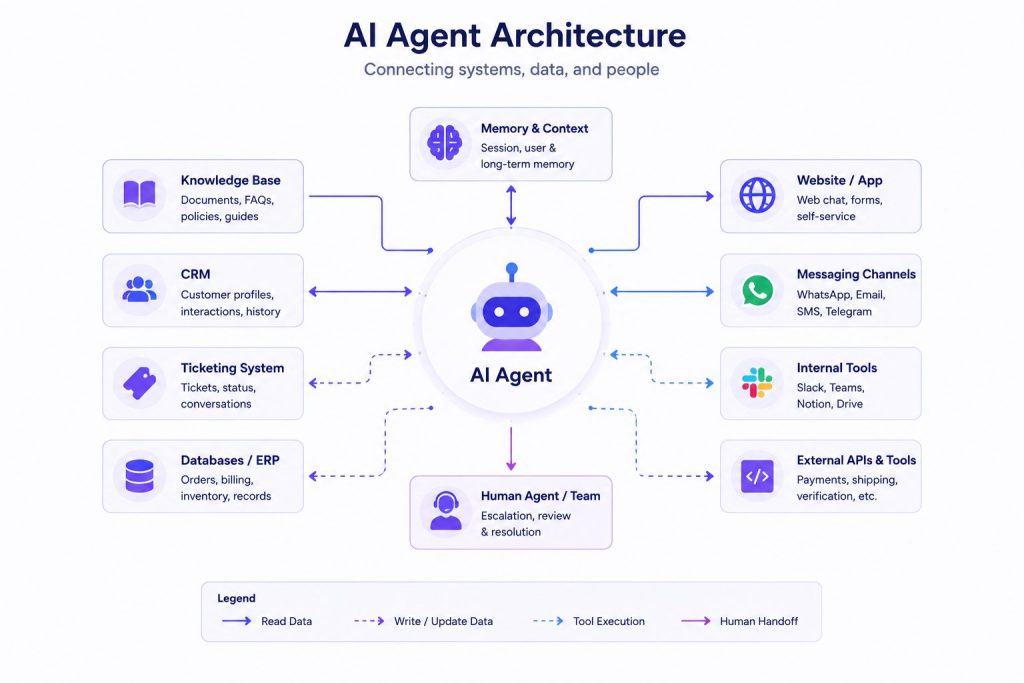
Technical, Tools, and Integration Requirements
Technical requirements define the systems, tools, channels, and infrastructure the agent needs to perform its assigned functions reliably. Regardless of the AI Agent Platform you choose, these requirements should be documented before any configuration or development begins. You need to define:
Systems and Data Integrations
- What systems does the agent need to access? (CRM, knowledge base, ticketing system, ERP).
- How does the agent authenticate to each system?
- What data is the agent allowed to read vs. write?
- How frequently does data need to sync?
- What information moves into and out of each connected system?
- What happens when an API is unavailable or returns incomplete data?
- How should retries, timeouts, and rate limits be handled?
- Which integration actions require confirmation or approval?
Detailed AI agent integration requirements prevent teams from discovering critical dependencies only after development has begun. Projects involving AI Agent Orchestration require even more detailed requirements because multiple agents must share context, coordinate decisions, and recover gracefully when one agent cannot complete its task.
Tool and Action Requirements
- Which tools may the agent call?
- Which actions are read-only, and which actions modify business records?
- Can the agent send messages, create tickets, schedule meetings, or process transactions?
- Which actions require human confirmation?
- What should happen when a tool produces an unexpected result?
Channel Requirements
- Where will users interact with the agent: website, WhatsApp, email, Slack, voice, or another channel?
- Should the agent provide the same capabilities across every channel?
- How should identity and context transfer between channels?
- Are any actions restricted to authenticated channels?
Non-Functional Requirements
An agent can complete the correct task and still fail if it is too slow, unreliable, expensive, or difficult to audit. Non-functional requirements define the quality standards the system must meet.
Performance & Reliability
- What’s the acceptable response time? (e.g., 95% of responses under 2 seconds)
- What’s the uptime requirement? (e.g., 99.5% during business hours)
- How does the agent handle rate limits, API failures, or degraded performance from downstream systems?
- What’s the fallback when the LLM provider has an outage?
- How many simultaneous users or tasks must the agent support?
- What is the maximum acceptable cost per interaction or completed task?
- How quickly must the system recover after a failure?
Output Quality
- What’s the acceptable accuracy rate for different task types?
- How do you measure output quality? (automated evaluation, human review, or both)
- What’s the process for identifying and fixing hallucinations or incorrect responses?
- What minimum threshold must the agent meet before production approval?
- Which outputs require human review?
- Which test dataset will be used to validate performance?
Avoid vague requirements such as “the agent should be fast” or “responses should be accurate.” Define measurable thresholds such as “95% of responses must be delivered within three seconds” or “the agent must correctly complete at least 90% of approved test scenarios.”
Operational and Ownership Requirements
An AI agent doesn’t run itself. Operational requirements define how the agent is managed, monitored, and improved over time.
Human-in-the-Loop
- Which decisions require human approval before execution?
- Which actions does the agent take autonomously?
- What’s the escalation path when the agent encounters something it can’t handle?
- How quickly should a human respond to escalation requests?
Monitoring & Alerting
- What metrics trigger an alert? (accuracy drops, unusual response patterns, high escalation rates)
- Who receives alerts and during what hours?
- What’s the incident response process for agent failures?
Continuous Improvement
- How often is the agent’s knowledge base updated?
- What’s the process for reviewing and improving responses?
- How do you track changes to the agent’s behavior over time?
Ownership
- Who owns agent performance after launch?
- Who investigates incidents and approves fixes?
- Who maintains the agent’s knowledge sources?
- Who decides whether the scope should expand or contract?
Change Management and Versioning
- How will changes to prompts, tools, and rules be documented?
- Must updates be tested in a staging environment?
- Who approves production changes?
- Can the team restore a previous version after a failed update?
Security, Permissions, and Governance Requirements
This is the category most teams rush through, and it’s the one that creates the most problems later.
Access Control
- Who can configure the agent’s prompts and behavior?
- Who can view conversation logs?
- What data is the agent allowed to expose to users?
- How do you prevent prompt injection and other security exploits?
Audit and Traceability
- Every decision the agent makes should be logged and traceable.
- Who can override the agent’s decisions, and how is that logged?
- How do you handle data retention and privacy requirements?
- Can the team reproduce the context behind a specific decision?
- How are failed actions, escalations, and overrides reviewed?
- Which events should trigger a security or governance alert?
Oversight
- What’s the approval process for deploying changes to the agent?
- Who has the authority to shut down the agent if something goes wrong?
- How do you test changes before deploying to production?
These controls should align with the broader AI Agent Governance framework used across the organization.
Ethical & Compliance Requirements
Depending on your industry, compliance requirements can be extensive. Even if you’re not in a regulated industry, ethical requirements protect your brand and your customers.
- Accuracy disclosure: Does the agent need to disclose it’s AI?
- Bias guardrails: How do you prevent the agent from producing biased or harmful responses?
- Data privacy: What data is the agent allowed to collect and store?
- Regulatory compliance: Does your industry have specific regulations around AI usage? (GDPR, HIPAA, SOC 2, etc.)
- High-impact decisions: Are there decisions the agent must never make autonomously?
- Human appeal: Can users challenge or request human review of an agent’s decision?
- Regional restrictions: Do different laws or policies apply depending on the user’s location?
- Recordkeeping: What evidence must be retained to demonstrate compliance?
Compliance requirements should be translated into testable rules, not left as broad principles. For example, instead of writing “the agent must protect privacy,” specify which data it may access, what it may retain, and which information must be masked or excluded from model inputs.
These eight categories work together. Business requirements explain why the agent exists, while functional requirements define what it must do. Knowledge, technical, and non-functional requirements determine what information it uses, how it operates, and the performance standards it must meet. Operational requirements establish how the agent will be owned and maintained, while governance and compliance requirements keep its behavior secure, traceable, and aligned with legal and organizational rules. If one category is missing, the requirements document is incomplete.
Confirm Readiness Before Finalizing Requirements
Requirements cannot compensate for missing data, undocumented processes, or unclear ownership. Before approving the document, use an AI Readiness Assessment to confirm that the organization can realistically support the proposed agent.
If major readiness gaps remain, record them as project dependencies rather than ignoring them. For example, a requirement to retrieve accurate inventory data depends on having a reliable inventory source and accessible API.
How to Build an AI Agent Requirements Document
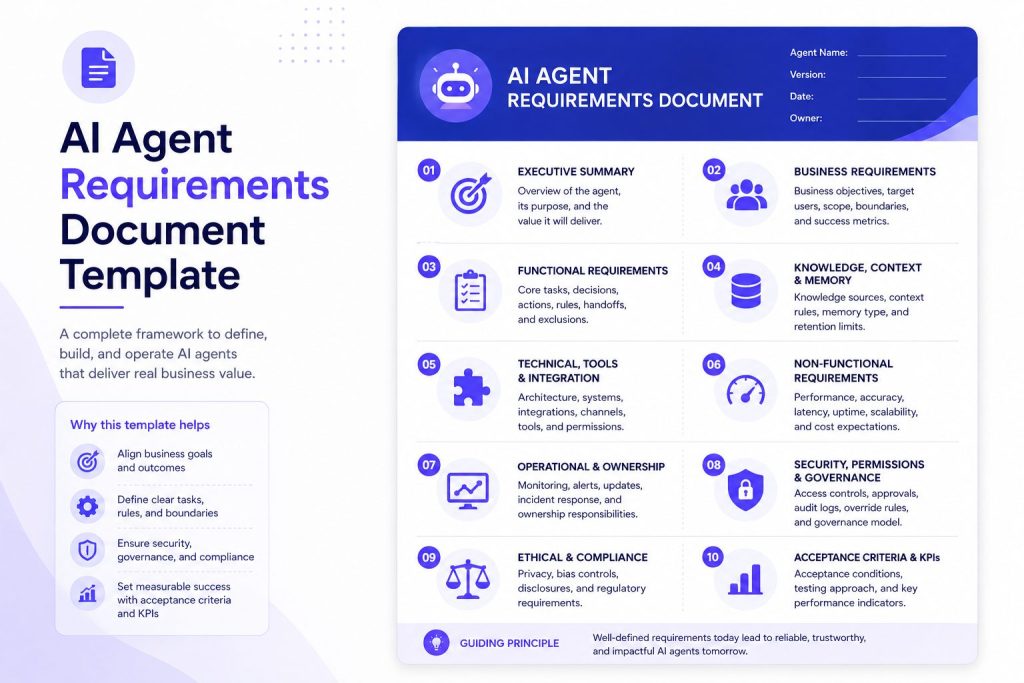
A requirements document is the single most important artifact in your AI project. Here’s a template you can use.
AI Agent Requirements Document Template
- Executive Summary
- Business problem being solved
- Expected business impact
- Key stakeholders and their roles
- Business Requirements
- Primary business outcomes and success metrics
- Scope boundaries (what the agent does and doesn’t do)
- Target users and use cases
- Fallback and escalation behavior
- Primary users and stakeholders
- Jobs to be done
- In-scope and out-of-scope use cases
- Functional Requirements
- Supported tasks
- Allowed actions
- Approval requirements
- Escalation triggers
- Failure behavior
- Technical Requirements
- System integrations and data sources
- AI Agent Memory architecture
- Performance SLAs (response time, uptime, accuracy)
- Error handling and fallback protocols
- Knowledge and Context Requirements
- Authoritative knowledge sources
- Memory type and retention
- Context-sharing rules
- Knowledge update process
- Operational Requirements
- Human-in-the-loop workflows
- Monitoring and alerting setup
- Knowledge management and update frequency
- Continuous improvement process
- Security & Governance Requirements
- Access control model
- Audit logging requirements
- AI Agent Governance policies
- Change management and deployment approval
- Ethical & Compliance Requirements
- Regulatory obligations
- Bias and fairness guardrails
- Transparency and disclosure requirements
- Data retention and privacy policies
- Implementation Approach
- AI Agent Implementation Checklist with milestones
- Timeline and resource requirements
- Build in-house vs. partner decision
- Testing and validation plan
- Acceptance Criteria
- Test scenario
- Expected behavior
- Minimum quality threshold
- Pass/fail condition
- Responsible reviewer
- Success Criteria & KPIs
- Primary success metrics
- Minimum acceptable performance thresholds
- Review cadence and governance checkpoints
Real Example: Customer Support AI Agent
Here’s a condensed example of what a real requirements document looks like for a mid-market SaaS company deploying a customer support AI agent.
| Requirement Category | Example Entry |
| Business Outcome | Reduce Level 1 ticket volume by 35% within 90 days of launch |
| Scope | Billing, account management, and technical troubleshooting for existing customers only |
| Data Sources | Intercom, Stripe, knowledge base, internal wiki |
| Agent Memory | Remember user’s plan type, past issues, and preferred contact method per session |
| Performance | 95% of responses under 3 seconds, 99% uptime during business hours |
| Security | Agent can read customer data but cannot make changes to accounts or billing |
| Governance | All escalated conversations reviewed weekly; agent behavior audited monthly |
| Compliance | Must disclose AI identity in first response; GDPR-compliant data handling |
Turning a Requirement Into Acceptance Criteria
A requirement is incomplete until the team can test it.
For example:
Requirement: The agent must escalate refund requests that fall outside the standard refund policy.
Acceptance criteria:
- Refunds within policy are processed through the approved workflow.
- Refunds outside policy are never approved automatically.
- The complete conversation and customer record are transferred to the correct team.
- The customer does not need to repeat information after handoff.
- Every escalation is recorded in the audit log.
This format transforms subjective expectations into testable behavior. Repeat it for every high-impact function before development begins.
Common AI Agent Requirement Mistakes
Even experienced teams make these mistakes. Here are the most common ones we’ve seen, and how to avoid them.
Mistake 1: Requirements That Describe a Human, Not an Agent
What it looks like: “The agent should understand customer sentiment and respond empathetically.”
The problem: This describes how a human should behave, not how an AI agent should be built. It’s not actionable.
The fix: Translate human behaviors into technical requirements. “The agent should detect sentiment keywords and adjust tone. When sentiment is negative, the agent should offer escalation to a human agent within 2 responses.”
Mistake 2: Skipping the “What If” Scenarios
What it looks like: Requirements only cover the happy path. Everything works perfectly. The customer asks a clear question. The agent has the right answer. The integration works.
The problem: AI agents live in a world of edge cases. The customer asks a confusing question. The knowledge base is outdated. The API is down. The agent is 60% confident instead of 95%.
The fix: Spend as much time defining what the agent does when things go wrong as when things go right. Write requirements for the edge cases.
Mistake 3: No Performance Baseline
What it looks like: “The agent should be better than our current support team.”
The problem: Better than what? How do you measure current performance? Without a baseline, you can’t prove improvement.
The fix: Measure your current metrics (response time, resolution rate, CSAT) before you start building. Your requirements should target specific improvements over these baselines.
Mistake 4: Requirements Frozen in Time
What it looks like: Requirements are written, approved, and never revisited.
The problem: AI agents are iterative by nature. You’ll discover things about the agent’s behavior in production that you couldn’t predict in planning.
The fix: Treat your requirements document as a living artifact. Requirements should evolve throughout the AI Agent Lifecycle, from planning and testing to deployment and continuous optimization. Schedule regular reviews to update requirements based on real-world performance data.
For more pitfalls to avoid, our guide on AI Agent Deployment Mistakes covers the most common deployment failures and how to prevent them.
Mistake 5: No Explicit Out-of-Scope List
What it looks like: The document explains what the agent should handle but never states what it must refuse or escalate.
The problem: Teams and users assume the agent supports more than it does, creating scope creep and unsafe behavior.
The fix: Add an explicit exclusion list covering unsupported topics, restricted actions, sensitive decisions, and requests that always require human involvement.
Mistake 6: Requirements Without Acceptance Criteria
What it looks like: Requirements use phrases such as “accurate,” “helpful,” or “personalized” without defining how those qualities will be measured.
The problem: Business and technical teams can interpret the same requirement differently, making approval subjective.
The fix: Attach measurable thresholds and test scenarios to every important requirement.
Stakeholder Checklist
AI agent projects require input from more stakeholders than traditional software projects. Here’s who needs to be involved:
| Stakeholder | Role | Key Input |
| Business Owner | Defines outcomes and success metrics | Business requirements, budget, scope |
| End Users | Represents the people who will interact with the agent | Use cases, pain points, expectations |
| Subject Matter Experts | Provides domain knowledge the agent needs | Knowledge base, business rules, edge cases |
| Engineering Team | Builds and integrates the agent | Technical requirements, architecture, performance |
| Security Team | Ensures safe deployment | Access controls, audit, compliance |
| Legal/Compliance | Reviews regulatory obligations | Privacy, disclosure, regulatory requirements |
| Operations Team | Manages the agent post-launch | Monitoring, escalation, continuous improvement |
| Customers (if applicable) | Represents the people the agent serves | Expectations, preferences, trust requirements |
| EXPERT TIP
Interview end users and customers before you write a single requirement. The gap between what leadership thinks the agent should do and what users actually need is often the biggest source of rework. |
Use Requirements to Decide How the Agent Should Be Built
Once requirements are documented, they provide a clearer basis for deciding whether the project fits an internal team or requires specialist support.
A relatively contained agent with common integrations and clear workflows may be suitable for an internal team or an existing platform. A project involving complex permissions, proprietary systems, multiple agents, strict compliance, or high-risk actions may require an experienced AI Agent Development Company.
The decision should follow the requirements. Do not reduce the requirements to fit a preferred development approach. Well-defined requirements also make the build-in-house vs. development partner decision far more objective because every proposal can be evaluated against the same documented criteria.
Translate Requirements Into a Delivery Approach
Your requirements should make it clear whether the agent can be created through an AI Agent Builder, requires Custom AI Agents, or needs a hybrid approach.
A builder is usually suitable when workflows, channels, and integrations align with supported platform capabilities. Custom AI development becomes more appropriate when the project depends on proprietary tools, specialized decision logic, unusual security controls, or capabilities unavailable in standard platforms.
Do not choose the delivery approach first and rewrite the requirements around it. Define the desired behavior, constraints, and outcomes, then select the approach that can support them reliably.
How to Review and Approve the Requirements Document
Before development begins, run a formal review with business, technical, operational, security, and compliance stakeholders.
Each requirement should be checked for:
- Clarity: Can two readers interpret it differently?
- Necessity: Does it support a real business or user need?
- Feasibility: Can the proposed architecture satisfy it?
- Testability: Is there a measurable acceptance condition?
- Ownership: Is someone responsible for approving and maintaining it?
- Traceability: Can it be connected to a business objective, risk, or user need?
Mark unresolved assumptions and dependencies explicitly. The document is ready only when stakeholders agree on scope, exclusions, success criteria, and approval responsibilities. Once the requirements are approved, the next logical step is creating an AI Agent Implementation Roadmap that translates these decisions into phased execution and measurable milestones.
Conclusion
AI agent projects rarely fail because nobody could build the technology. They fail because business expectations, agent behavior, technical constraints, and operational responsibilities were never defined clearly enough.
A strong requirements document creates alignment before development begins. It defines the outcome, users, functions, knowledge, tools, integrations, permissions, failure behavior, and acceptance criteria that will guide every later decision.
Treat the document as a living product specification rather than a one-time administrative exercise. Businesses delivering AI solutions to multiple clients should also evaluate whether a White Label AI Agent Platform fits their long-term product and service strategy. Validate it with the people who will use, manage, secure, and evaluate the agent. When those requirements are specific and testable, development becomes faster, vendor proposals become easier to compare, and the finished agent is far more likely to solve the problem it was created for.
AI Agentic Platform For Building Portable AI Agents
Say Hello To Agentic AI That Connects With Your CRM And Even Other Agents
Frequently Asked Questions
What are AI agent requirements?
AI agent requirements are the documented specifications that define what an AI agent should do, how it should behave, what data it can access, how it handles errors, and how its performance is measured. They cover business outcomes, technical architecture, operational processes, security governance, and compliance obligations.
How do I write requirements for an AI agent?
Start by defining the business outcome, not the technology. Use a structured template covering business, technical, operational, security/governance, and ethical/compliance requirements. Include specific success metrics, scope boundaries, and edge case handling. Validate requirements with all stakeholders before development begins.
What’s the difference between AI agent requirements and traditional software requirements?
AI agent requirements must account for probabilistic behavior, decision-making quality, hallucination risks, continuous learning, and governance in ways traditional software requirements don’t. They also need to define when the agent should defer to humans, how to measure non-deterministic outputs, and how to handle behavioral drift over time.
How long does it take to define AI agent requirements?
For a well-scoped single agent, expect 2-4 weeks of requirements gathering with dedicated stakeholder interviews. Complex projects involving multiple agents, regulated industries, or deep system integrations can take 4-8 weeks. Rushing this phase is the most common cause of project failure.
What stakeholders should be involved in defining AI agent requirements?
Business owners, end users, subject matter experts, engineering, security, legal/compliance, operations, and sometimes customers. Each group brings a different perspective that’s critical to building a complete requirements document.
What happens if I skip the requirements phase?
Projects that skip requirements gathering typically fail within 6 months. The agent works technically but doesn’t deliver business value, causes security or compliance issues, or frustrates users and operators. The cost of rework and lost trust far exceeds the time invested in proper requirements.