
Businesses are not exploring AI agents because they want another software tool. They are doing it because routine work is getting harder to manage with people, apps, and manual handoffs alone.
A support team wants faster answers without adding night staff. A sales leader wants every inbound lead qualified before a rep opens the CRM. An operations manager wants approvals, reports, and customer updates to move without someone chasing people all day.
That is why AI agent development services are getting attention. The right partner helps you design custom AI agents that understand context, connect to systems, take controlled actions, and improve over time. The hard part is knowing what should be custom, what a platform can handle, and when to hire an AI agent development company.
Key takeaways
- AI agent development services cover strategy, design, integrations, deployment, governance, and improvement.
- Custom AI agent development helps when standard tools cannot support your workflows, data, or permissions.
- The best projects start with one high-value workflow, not a company-wide rollout.
- A strong partner understands operations, integrations, testing, security, and adoption.
- In-house development gives more control, while an AI agent development company usually speeds up delivery.
- Buyers should evaluate partners by process, architecture, governance, and ability to explain trade-offs clearly.
Portable AI Agents In Seconds, Use Everywhere
Prompt, Test, and Deploy AI Agents Across Social Platforms and LLMs. Automate Everything.
What are AI agent development services?
AI agent development services help businesses plan, build, connect, launch, and improve AI agents for real work. They usually combine AI consulting, workflow design, integrations, data setup, testing, and support.
An AI agent is different from a basic chatbot. A chatbot usually answers questions or follows a fixed path. An AI agent can understand intent, use memory, retrieve information, call tools, and complete multi-step tasks within defined boundaries.
For example, a support agent might check a customer record, search a knowledge base, and create a ticket. A sales agent might qualify a lead, update the CRM, and book a meeting. An operations agent might monitor order delays before they become customer issues.
The value of AI agents is not conversation. It is follow-through. They help work move from input to outcome without every step needing manual attention.
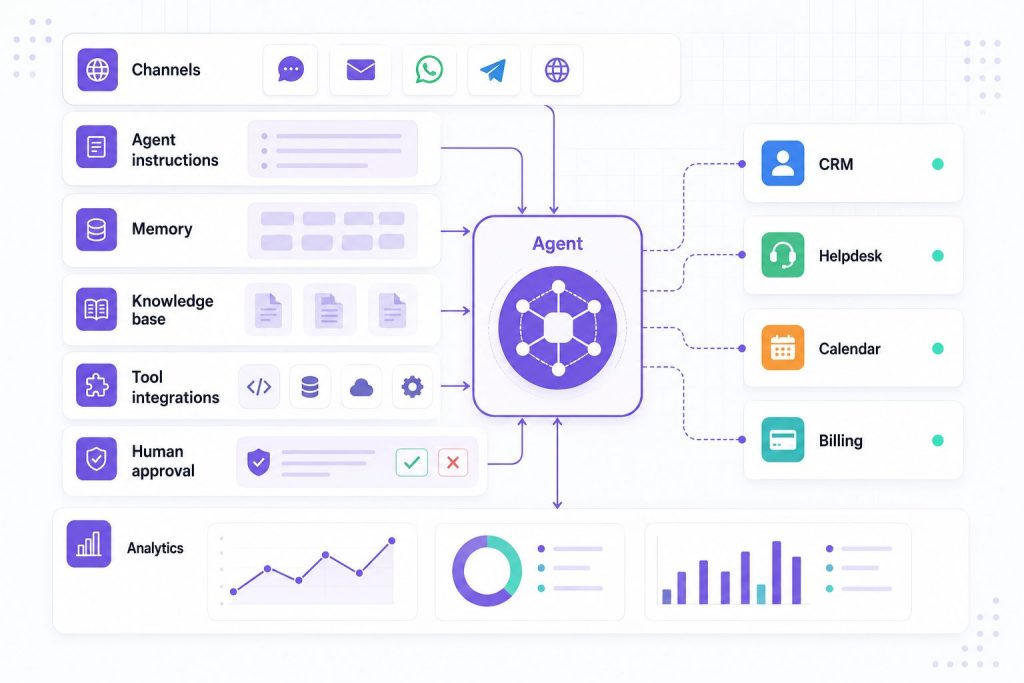
The agent is only part of the system. You also need secure data access, business rules, human approvals, analytics, and clear ownership.
When does a business need custom AI agent development?
Not every company needs custom AI agents. If your goal is basic FAQs, lead capture, or simple routing, an AI Agent Builder may be enough.
Custom development makes sense when the workflow touches real business logic.
Your process spans multiple systems
Most businesses do not work inside one app. Sales teams use CRMs, support teams use helpdesks, finance uses billing tools, and operations teams use dashboards.
If an agent needs to move across those systems, AI integration services matter. A lead qualification agent may need to read form data, check CRM history, score the lead, and notify the correct rep.
Your rules are specific to your business
Generic agents struggle when decisions depend on your policies. A healthcare provider may need strict escalation rules. A real estate agency may qualify buyers differently by market. A SaaS company may need agents that understand plan limits and renewal status.
AI agent consulting helps translate those rules into instructions, boundaries, data sources, and handoffs.
You need governance and accountability
As agents get closer to customer data, approvals, payments, or internal tools, oversight becomes essential. You need clear permissions, approval points, and action logs.
Businesses planning production deployments should think about AI Agent Governance early. NIST’s AI Risk Management Framework is also useful for understanding responsible AI controls.
What is included in AI agent development services?
Scope depends on the provider, but serious AI development services usually include these areas.
| Service area | What it includes | Buyer question |
| Discovery | Workflow mapping, use case selection, success metrics | Which workflow should we automate first? |
| Agent design | Role, tone, instructions, boundaries, handoffs | What decisions can the agent make safely? |
| Data setup | FAQs, SOPs, policies, CRM fields, knowledge bases | Is our data reliable enough? |
| Integrations | CRM, helpdesk, calendar, database, billing, APIs | Which tools must the agent read or update? |
| Testing | Scenario testing, edge cases, approval checks | How will we know it is ready? |
| Deployment | Launch channels, analytics, monitoring, support | Who owns improvement after launch? |
For many teams, the best option is hybrid: use a platform for the foundation and services for workflows that need deeper setup.
AI agent development process from planning to deployment
An AI agent project should feel like an implementation, not an experiment.
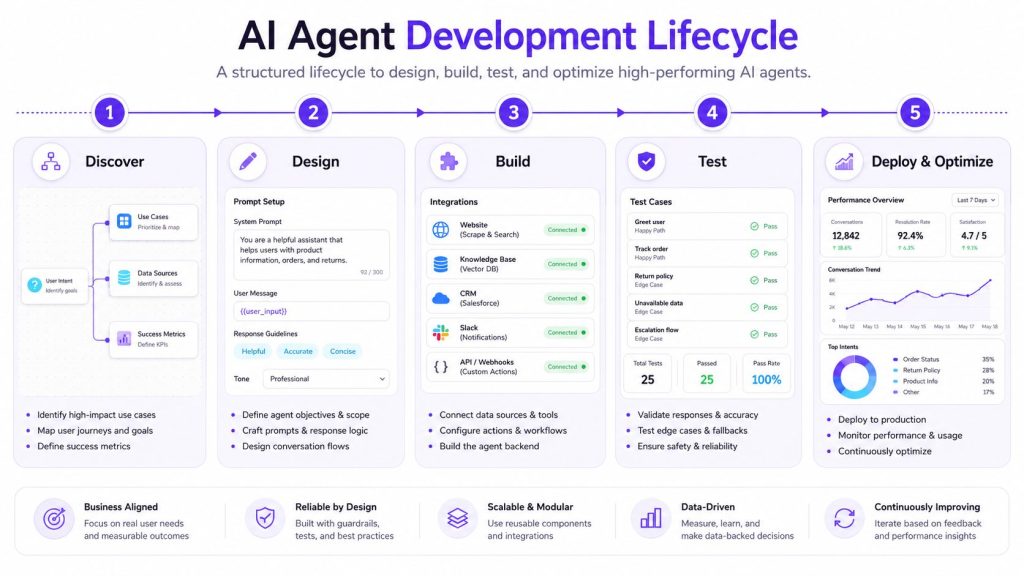
1. Define the business outcome
Start with the result. “Build an AI support agent” is too vague. “Reduce first-response time while keeping refunds under human review” gives the project direction.
2. Map the workflow and exceptions
Every workflow has the happy path and the messy path. What if the calendar is full? What if the CRM record already exists? A good partner maps these cases before development.
3. Build the agent and integrations
This is where instructions, knowledge, memory, and tools come together. AI Agent Memory lets the agent keep context instead of treating every interaction as new.
For enterprise AI development, this may also include permissions, audit logs, sandbox testing, and security reviews.
4. Test with real scenarios
Do not test only perfect prompts. Test vague requests, incomplete data, duplicate records, unsupported questions, and system failures. IBM’s guide to agentic AI explains how agents pursue goals with limited supervision. That is why testing matters.
5. Deploy, monitor, and improve
AI agent deployment is not the finish line. Review conversations, track task completion, identify failure points, and improve the agent over time.
This is where AI Agent Orchestration becomes useful. As you add agents, you need coordination across intake, scheduling, and follow-up.
Build in-house vs hire an AI agent development company
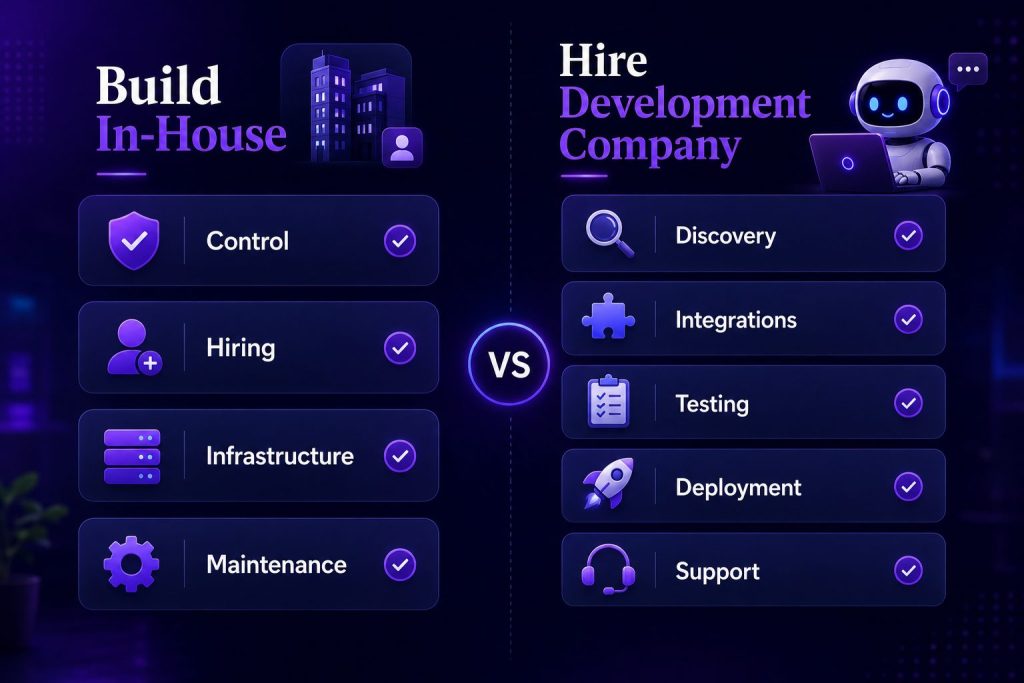
The build vs buy AI agent decision comes down to capability, speed, risk, and ownership.
| Option | Best for | Advantage | Risk |
| Build in-house | Companies with strong AI, data, and product teams | Maximum control | Slower delivery and ongoing maintenance |
| Hire a development company | Businesses that need production-ready agents fast | Faster execution and broader experience | Vendor quality varies |
| Platform plus consulting | SMBs, agencies, and operations teams | Lower complexity and quicker time to value | Less suitable for highly specialized engineering |
If AI is core to your product, in-house talent may be worth it. If AI is meant to improve support, sales, marketing, or operations, hiring an AI agent development company can reduce trial and error.
McKinsey’s State of AI 2025 notes that many organizations are still working through the gap between adoption and scaled impact. That is where implementation discipline matters.
Factors that affect AI agent development cost
AI agent development cost varies because “an agent” can mean many things. A website FAQ agent is very different from a multi-agent system that updates customer records and handles approvals.
The main cost drivers are workflow complexity, integrations, data preparation, security requirements, deployment channels, testing depth, and support.
Control cost by starting with one workflow that has visible value. Measure AI agent ROI from that first workflow, then expand based on evidence.
Common mistakes businesses make
The most expensive AI agent mistakes usually happen before development begins.
Automating a broken process
If your workflow is unclear, AI will make the confusion faster. Clean up ownership, data, and escalation rules first.
Giving one agent too much scope
One agent should not own sales, support, operations, and reporting on day one. Focused agents perform better.
Ignoring human handoffs
Good agents know when to stop. Refunds, complaints, legal questions, and high-value opportunities often need a person involved.
Measuring activity instead of outcomes
Message count is not ROI. Track hours saved, tickets resolved, meetings booked, response time, and fewer manual updates.
How to choose the right AI agent development partner
Choosing a partner is less about technical language and more about who can explain the path from business problem to working system.
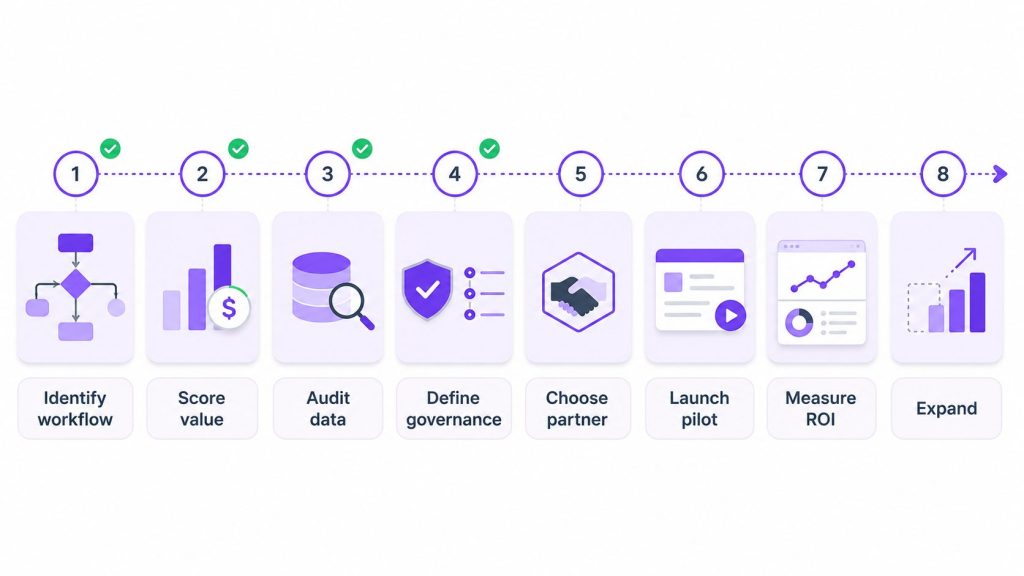
Ask these questions before signing:
- What workflow should we start with and why?
- Which parts should be custom and which can use an existing platform?
- How will the agent access data securely?
- What happens when the agent is unsure?
- How will human approvals work?
- What testing process proves the agent is ready?
- What support is included after launch?
- How do we measure ROI after 30, 60, and 90 days?
Be careful with generic demos. Good partners ask about your process, systems, risks, and success metrics before talking about models.
For smaller teams, AI Agents for Small Businesses is a useful next topic because it shows what can launch without enterprise complexity.
Final thoughts
AI agent development services are the right investment when a business needs more than a basic assistant. If your agent must understand company context, connect to tools, follow policies, escalate safely, and improve over time, professional support can reduce risk and speed up results.
Start with one workflow that has clear value. Define success before development begins. Choose a partner who explains trade-offs honestly and treats AI agent implementation as an operations project, not a one-time build. The best custom AI agents quietly move work forward, protect team focus, and make the business easier to run every day.
FAQs about AI agent development services
What are AI agent development services?
They help businesses plan, build, integrate, deploy, and improve AI agents for real workflows. This includes consulting, data setup, prompt design, integrations, testing, governance, and optimization.
How long does AI agent development take?
Timeline depends on scope. A simple agent can launch in days or weeks. Complex enterprise projects can take several months.
How much do AI agent development services cost?
Cost depends on complexity, integrations, data quality, channels, compliance, and support. Define one clear use case before asking vendors for scope.
Should we build AI agents in-house or hire a company?
Build in-house if AI is central to your product and you have strong engineering, data, and security teams. Hire a company for faster implementation.
What is the difference between an AI agent builder and custom AI agent development?
An AI agent builder helps teams create agents, often without coding. Custom development adds workflow design, integrations, business logic, testing, and governance.
What should we prepare before hiring an AI development services partner?
Prepare your target workflow, success metrics, key systems, data sources, approval rules, and known exceptions. You should understand the business problem clearly.
How do we measure AI agent ROI?
Track outcomes such as hours saved, faster response times, fewer missed leads, more meetings booked, reduced ticket volume, and lower manual workload.
AI Agentic Platform For Building Portable AI Agents
Say Hello To Agentic AI That Connects With Your CRM And Even Other Agents