
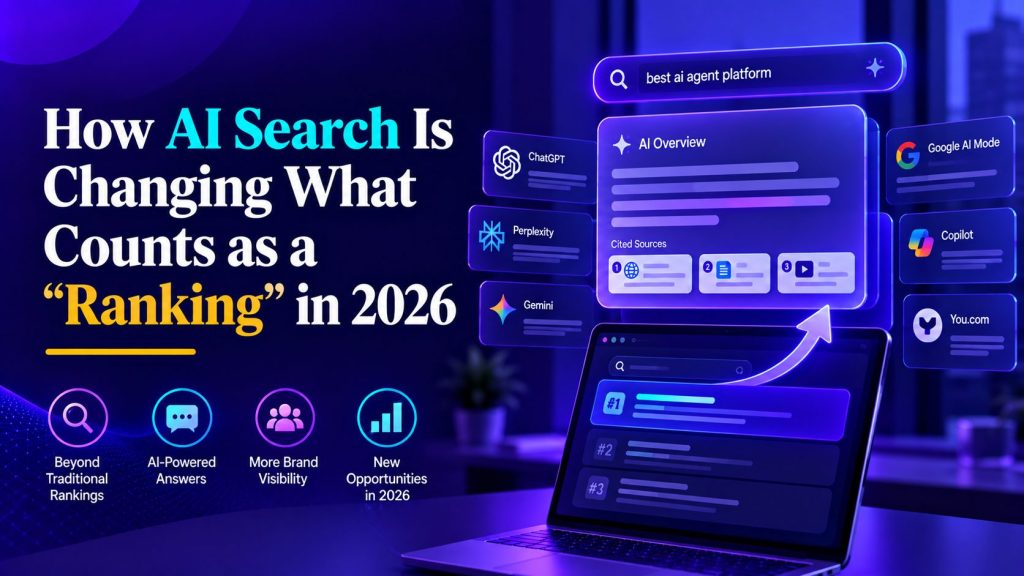
Search is no longer only about earning the top blue link. In 2026, people are getting answers directly from AI-powered search experiences, changing how businesses, professionals, and brands measure online visibility.
For years, ranking on page one of Google was the primary goal. A top position usually meant more clicks, more traffic, and more opportunities. Today, that relationship is changing. AI search rankings in 2026 are not defined only by where a page appears in traditional search results. They are increasingly influenced by whether content is selected, summarized, cited, or trusted by AI systems.
This shift affects every industry, including professional services. Law firms, financial professionals, healthcare providers, and advisors must understand that visibility now depends on being the source AI systems rely on when answering user questions.
Why are traditional search rankings changing in the AI era?
Search behavior has moved from finding links to receiving direct answers.
This change is part of the broader adoption of AI Automation, where AI is increasingly used to process information and deliver relevant outputs with less manual interaction.
Traditional search worked like this:
- A user searched for a question.
- Search engines displayed a list of pages.
- Users clicked a result to find information.

AI search changes the experience:
- A user asks a detailed question.
- AI systems analyze multiple sources.
- The user receives a summarized answer with selected references.
This means a website can influence a search result even when the user never visits the page.
The rise of answer-based search
Search engines now focus on understanding:
- User intent
- Context behind questions
- Expertise of the source
- Accuracy of information
- Real-world usefulness
A page that simply targets keywords may not perform as well as a page that clearly explains a topic and answers follow-up questions.
Do You Know?
According to SparkToro’s research on search behavior, a significant portion of Google searches end without a click because users receive enough information directly from search results. This trend has become a foundation for understanding the growth of zero-click experiences.
Portable AI Agents In Seconds, Use Everywhere
Prompt, Test, and Deploy AI Agents Across Social Platforms and LLMs. Automate Everything.
What do zero-click search results mean for businesses?
The growth of zero-click search results means users can complete more searches without visiting a website.
This does not mean websites are becoming irrelevant. Instead, the role of websites is changing.
A website now serves as:
- A trusted information source
- A credibility signal for AI systems
- A deeper resource after initial discovery
- A proof point for expertise
For professional services firms, this creates an opportunity. Content that demonstrates experience, answers complex questions, and explains decisions can become part of AI-generated responses.
Why clicks are no longer the only success metric
A traditional SEO report may focus on:
| Traditional SEO Measurement | AI Search Measurement |
| Keyword ranking position | AI citation visibility |
| Organic clicks | Brand mentions in AI answers |
| Page-one rankings | Content selection by AI systems |
| Traffic volume | Qualified audience engagement |
| Backlinks | Authority and trust signals |
The goal is not to abandon rankings. It is to expand what ranking means.
Quick Fact:
Ahrefs reported that AI Overviews can significantly reduce click-through rates for traditional top-ranking pages, with position-one organic CTR reductions reaching up to 58% in some analyses. This shows why ranking first does not always guarantee the same traffic impact it once did.
How do AI systems decide which content appears in answers?
AI search engines look beyond keywords. They evaluate whether content provides reliable and complete information.

What signals help content appear in AI answers?
Content that performs well across AI-powered search experiences often shares several characteristics:
Clear expertise
- Author credentials
- Industry experience
- Accurate explanations
- Trusted references
Strong topical coverage
- Complete answers
- Related questions
- Practical examples
- Helpful context
Structured information
- Organized headings
- FAQs
- Lists
- Tables
- Schema markup
User-focused explanations
- Simple language
- Direct answers
- Solutions to common concerns
For firms like Hook Law, this means content should move beyond only explaining legal services. It should address broader questions families face, such as protecting wealth, preparing for life transitions, and creating long-term plans.
Why expertise matters more in legal and financial topics
AI systems are increasingly careful with topics that impact people’s finances, health, or legal decisions.
For these subjects, content should demonstrate:
- Professional experience
- Accurate legal information
- Clear explanations
- Responsible guidance
A helpful article about estate planning, family wealth, or long-term preparation should feel like guidance from an experienced advisor, not a collection of search terms.
Pro Tip: Create content that answers the next question a reader may ask. AI systems often build answers by connecting related questions, so covering the complete decision journey improves visibility.
How should businesses measure success in AI search?
Success in AI search requires broader performance tracking.
A business may appear successful even when traditional traffic numbers change because visibility can happen before a website visit.
Important AI search visibility metrics
Businesses should monitor:
| Metric | Why It Matters |
| AI mentions | Shows whether systems recognize the brand |
| Featured citations | Indicates content authority |
| Branded searches | Measures increased awareness |
| Engagement quality | Shows whether visitors are valuable |
| Conversion actions | Connects visibility to business goals |
For professional firms, the quality of attention matters more than simple traffic volume.
A person researching estate planning, elder care decisions, or family wealth protection may not click immediately. However, repeated exposure through AI-generated answers can influence future decisions.
How can businesses prepare content for AI search in 2026?
Preparing for AI search requires a shift from ranking pages to building trusted knowledge. Building an AI Knowledge Base can also help businesses organize useful information around customer questions, making their expertise easier to access across different digital experiences.
1. Create content around real questions
People rarely search only with keywords. They ask complete questions.
Examples:
- What happens if parents need long-term care?
- How can families protect inherited wealth?
- When should estate planning begin?
- How do multiple generations prepare financially?
Content should answer these questions directly.
The same question-first approach is increasingly used by AI Agents for Customer Support, where useful responses depend on understanding what a customer actually wants rather than simply matching keywords.
2. Build connected topic clusters
A single article rarely establishes authority.
A stronger approach connects related topics:
- Estate planning
- Legacy planning
- Family wealth strategies
- Tax considerations
- Healthcare planning
- Multigenerational preparation
This helps search engines and AI systems understand expertise across a subject area.
3. Support collaboration-focused messaging
Modern professional services content should also explain relationships.
For example, legal and financial planning professionals can emphasize collaboration with:
- Financial advisors
- CPAs
- Tax professionals
- Family offices
The goal is not replacing existing relationships. It is creating coordinated planning that supports families.
Businesses looking to improve visibility through modern search strategies can consider structured approaches such as AI seo services that focus on content quality, technical optimization, and AI-driven discovery patterns.
How is AEO changing content strategies?
Answer Engine Optimization (AEO) focuses on creating content designed to provide direct answers.
Traditional SEO asks:
“Which keyword should this page rank for?”
AEO asks:
“What question does the user need answered?”
Effective AEO content includes:
- Short direct answers
- Supporting explanations
- Frequently asked questions
- Structured sections
- Clear examples
Note:
AEO does not replace SEO. It expands SEO by preparing content for search engines, AI assistants, and changing user behaviors.
Organizations investing in answer engine optimization services often focus on improving how their expertise is understood across different search experiences.
What does ranking look like in 2026 compared with the past?
The definition of ranking has expanded.
| Before AI Search | With AI Search |
| Rank higher than competitors | Become a trusted source |
| Earn clicks | Earn recognition |
| Optimize keywords | Answer user needs |
| Focus on pages | Build knowledge ecosystems |
| Measure position | Measure influence |
This change creates opportunities for businesses willing to adapt.
A firm that consistently provides useful, accurate, and well-structured information can remain visible even when users interact differently with search.
Key Takeaways
- AI search is changing the meaning of online visibility.
- A top Google position is no longer the only measure of success.
- AI systems reward expertise, clarity, and trustworthy information.
- AI search rankings in 2026 depend on being recognized as a reliable answer source.
- Zero-click search results require businesses to think beyond website visits.
- Helpful, structured content has a stronger chance of appearing across modern search experiences.
Building Visibility Beyond Traditional Rankings
The future of search is not about replacing SEO. It is about expanding the definition of visibility.
Businesses that create useful answers, demonstrate expertise, and organize information clearly will be better positioned as search continues to evolve.
For professional firms, the opportunity is significant. Content can introduce expertise before a conversation begins, support informed decisions, and build confidence among future clients and professional partners.
The firms that succeed in 2026 will not only compete for rankings. They will build trusted digital resources that people and AI systems recognize as valuable.
FAQs
What is changing about SEO in 2026?
SEO is moving from focusing only on rankings and clicks toward building authority, answering questions, and earning visibility across AI-powered search platforms.
Can a website succeed without getting many clicks?
Yes. A website can still build awareness if its information appears in AI answers, summaries, or citations that influence user decisions.
Are keywords still important for AI search?
Keywords remain useful, but AI systems also evaluate context, expertise, content quality, and how well a page answers user needs.
Why are professional services affected by AI search?
Legal, financial, and healthcare decisions require trusted information. AI systems prioritize sources that demonstrate accuracy and expertise.
How can businesses improve AI search visibility?
Businesses can improve visibility by creating detailed, helpful content, answering common questions, using structured data, and demonstrating industry knowledge.
As search continues to evolve, organizations can focus on creating clearer, more meaningful resources that help people make informed decisions.
AI Agentic Platform For Building Portable AI Agents
Say Hello To Agentic AI That Connects With Your CRM And Even Other Agents
