

AI agents are no longer a novelty.
A year ago, most teams were experimenting with prompts, chatbots, or simple automation. Today, the conversation has shifted toward systems that can actually carry work forward. That shift is why AI agent frameworks are suddenly everywhere.
When AI is expected to plan, make decisions, use tools, and adapt across workflows, the underlying framework matters more than the model itself. The right framework determines whether agents stay reliable in production, or quietly break when things change.
This guide breaks down the best AI agent frameworks in 2026, what each one is good at, and how to choose the right approach based on how you plan to use AI agents in the real world.
What Are AI Agent Frameworks?
An AI agent framework is not just a library or a chatbot engine. It’s the infrastructure layer that allows AI agents to observe inputs, make decisions, and take actions across multiple steps.
If you’re still unclear on What is an AI agent, the simplest way to think about it is this:
an AI agent doesn’t stop at generating an answer, it continues working until a task reaches an outcome.
Frameworks exist to support that continuity.
Most modern frameworks handle:
- state and memory across steps
- tool and API execution
- decision logic and branching
- retries, fallbacks, and escalation
- visibility into what the agent did and why
This is where agentic ai comes into play. Agentic systems aren’t about smarter responses; they’re about responsibility. The framework defines how much responsibility an agent can take, where it must stop, and how it interacts with the rest of the system.
In practice, this is what separates experimental ai agents from production systems businesses can actually rely on.
How to Evaluate AI Agent Frameworks (What Actually Matters)
Feature lists can be misleading. Almost every framework claims to support agents, tools, and memory. The difference shows up after deployment.
Here are six factors that actually separate strong agentic AI frameworks from fragile ones:
- Execution and tool control
Can the agent reliably update systems, call APIs, and trigger workflows? Or does it break the moment inputs vary? This is also where many teams realize that AI agents outperform traditional chatbots, not because they talk better, but because they can actually complete work instead of stopping at a reply. - Memory and context handling
Does the framework support both short-term state and longer-term memory? This is essential for agents that operate over time. - Workflow orchestration
Can you define clear paths, retries, and stopping points? Or does the agent run linearly and hope things work out? Strong orchestration is especially important when using an AI agent builder to manage branching logic, retries, and handoffs at scale. - Multi-agent coordination
If your system grows beyond one agent, can agents delegate, collaborate, or specialize? - Observability and debugging
Can you inspect what happened when something goes wrong? Without this, agents become impossible to trust. - Deployment reality
Does the framework support reuse, permissions, and scale? This is where many tools fail when teams try to build AI agents that run continuously instead of as one-off demos.
These questions matter more than whether a framework is “popular” or “open source.”
Portable AI Agents In Seconds, Use Everywhere
Prompt, Test, and Deploy AI Agents Across Social Platforms and LLMs. Automate Everything.
Top AI Agent Frameworks in 2026
Below are the seven AI agent frameworks most commonly evaluated by teams building real-world agent systems in 2026. Each platform is assessed using the same criteria so you can compare them objectively.
1. Botsify
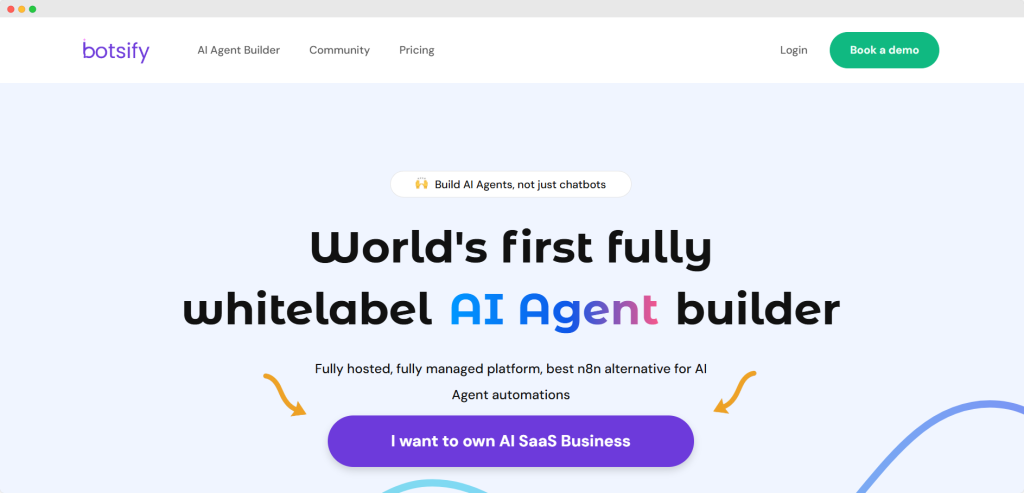
Botsify is best described as a production-first AI agent framework.
Instead of focusing purely on experimentation, Botsify is built for teams that want AI agents running consistently inside business workflows, support, sales, internal operations, and multi-client environments.
Where many frameworks give developers low-level components, Botsify focuses on execution: agent orchestration, monitoring, reuse, and lifecycle management. Agents aren’t treated as disposable experiments. They’re treated as long-running systems.
This approach is especially valuable for agencies and service providers offering branded AI agent builders. Agent workflows can be created once, customized per client, and managed centrally. Over time, this naturally leads teams toward a whitelabel AI agent builder setup, where agents become reusable assets instead of one-off builds.
That’s why Botsify is often chosen by teams operating as a chatbot agency, delivering AI solutions under their own brand while maintaining control over behavior, permissions, and deployment.
How Botsify performs across key evaluation factors
| Evaluation factor | Rating | What this means |
| Execution & tool control | High | The agent can trigger actions, update systems, and call tools without breaking when inputs change. |
| Memory & context handling | High | The agent remembers what already happened instead of starting from scratch each step. |
| Workflow orchestration | High | The agent can handle failures, retry steps, and hand work to a human without breaking the workflow. |
| Multi-agent coordination | Medium | Botsify focuses more on orchestrated workflows than free-form agent collaboration. |
| Observability & debugging | High | Teams can see what the agent did, understand why, and fix issues quickly. |
| Deployment reality | High | Agents can be reused, managed across teams or clients, and scaled safely. |
Summary: Among modern AI agent frameworks, Botsify performs strongest when agents must run continuously, scale across teams, and stay reliable in production.
2. LangChain
LangChain is one of the most popular AI agent frameworks among developers who want maximum flexibility. It provides building blocks for connecting prompts, tools, memory, and data sources into custom AI agent systems.
LangChain works well when teams want to experiment with reasoning, retrieval, or custom logic. However, production reliability depends heavily on how well teams design guardrails, retries, and monitoring themselves.
How LangChain performs across key evaluation factors
| Evaluation factor | Rating | What this means |
| Execution & tool control | Medium | The agent can use tools, but stability depends on how well the system is engineered. |
| Memory & context handling | Medium | Memory is flexible, but consistency depends on architecture choices. |
| Workflow orchestration | Medium | Teams must design retries, branches, and handoffs manually. |
| Multi-agent coordination | Low | Multi-agent systems are possible but not a core strength. |
| Observability & debugging | Medium | Debugging exists, but production-grade visibility requires extra tooling. |
| Deployment reality | Medium | Suitable for custom systems, but scaling requires engineering effort. |
Summary: LangChain is ideal for developer-led teams building highly customized agents and experimenting with agentic AI concepts.
3. Botpress
Botpress is an AI agent framework focused on structured conversational workflows. It provides a visual builder that helps teams design predictable agent behavior across conversations and actions.
Botpress is often chosen when teams want agents that feel conversational but follow clearly defined logic, making it popular for customer support and onboarding use cases.
How Botpress performs across key evaluation factors
| Evaluation factor | Rating | What this means |
| Execution & tool control | Medium | Agents can perform actions, but complex logic requires careful design. |
| Memory & context handling | Medium | The agent remembers context within defined conversations. |
| Workflow orchestration | High | Teams can clearly define what happens at each step and when to escalate. |
| Multi-agent coordination | Medium | Multiple agents can exist, but collaboration is limited. |
| Observability & debugging | Medium | Visual flows make behavior easier to understand and fix. |
| Deployment reality | Medium | Works well for defined use cases, less flexible at scale. |
Summary: Botpress is strong for structured, conversation-led agents where predictability matters more than autonomy.
4. CrewAI
CrewAI focuses on multi-agent collaboration through role-based design.
Instead of one agent handling everything, you define a “crew” where each agent has a specific responsibility. This mirrors how human teams work and can be effective for breaking down complex tasks.
CrewAI is easy to start with and works well for linear or moderately complex workflows. This structure is often applied to content operations, where specialized roles resemble systems like an SEO blog writer AI agent that plans, drafts, and refines output across multiple steps. As coordination needs grow, teams often add additional structure to manage dependencies.
How CrewAI performs across key evaluation factors
| Evaluation factor | Rating | What this means |
| Execution & tool control | Medium | Agents can act, but reliability depends on configuration. |
| Memory & context handling | Low | Long-term memory requires additional setup. |
| Workflow orchestration | Medium | Role-based flows work best for linear tasks. |
| Multi-agent coordination | High | Designed for agents working together by role. |
| Observability & debugging | Low | Understanding why agents acted can be difficult. |
| Deployment reality | Low | Best suited for experiments and prototypes. |
Summary: CrewAI excels at collaboration but needs extra structure for production reliability.
5. Landbot
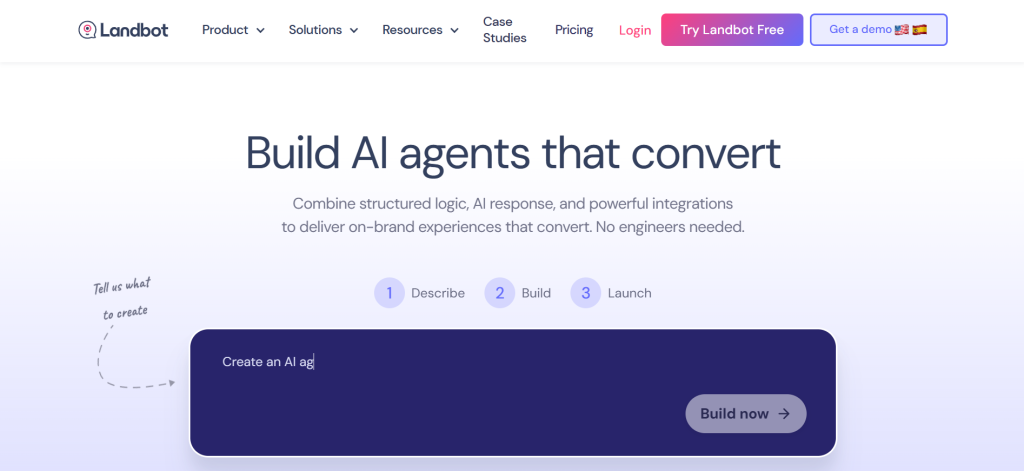
Landbot is a no-code platform designed for building guided conversational workflows. It is often used for lead capture, qualification, and early-stage customer interactions.
Landbot works best when conversations follow predictable paths and outcomes, such as in an automated sales campaign where timing and routing matter more than autonomous decision-making. It is less suited for long-running agentic workflows.
How Landbot performs across key evaluation factors
| Evaluation factor | Rating | What this means |
| Execution & tool control | Medium | Agents can trigger actions in defined flows. |
| Memory & context handling | Low | Context is mostly limited to the current session. |
| Workflow orchestration | High | Strong control over step-by-step conversations. |
| Multi-agent coordination | Low | Not designed for agent collaboration. |
| Observability & debugging | Medium | Visual builder makes fixes straightforward. |
| Deployment reality | Medium | Easy to deploy, limited autonomy. |
Summary: Landbot is best for structured conversational experiences rather than agentic systems.
6. Rasa
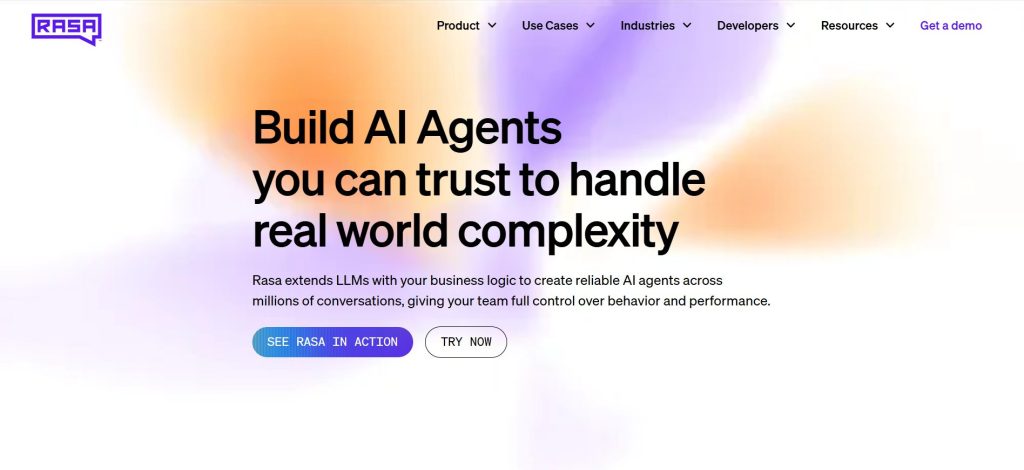
Rasa is a developer-controlled conversational AI agent framework known for deep customization and full data ownership. It is often chosen by teams that require self-hosting, privacy, and complete control over conversational behavior.
Rasa performs well in complex, multi-turn conversations where context must be preserved accurately. Teams offering AI chatbot development services in USA often use Rasa when compliance and customization are higher priorities than speed.
How Rasa performs across key evaluation factors
| Evaluation factor | Rating | What this means |
| Execution & tool control | Medium | Actions are reliable but require engineering effort. |
| Memory & context handling | High | Strong dialogue state and context management. |
| Workflow orchestration | Medium | Logic is flexible but code-driven. |
| Multi-agent coordination | Low | Not a primary focus. |
| Observability & debugging | Medium | Developers can trace issues with effort. |
| Deployment reality | High | Strong control for regulated or private environments. |
Summary: Rasa is ideal when control and ownership matter more than speed.
7. Flowise
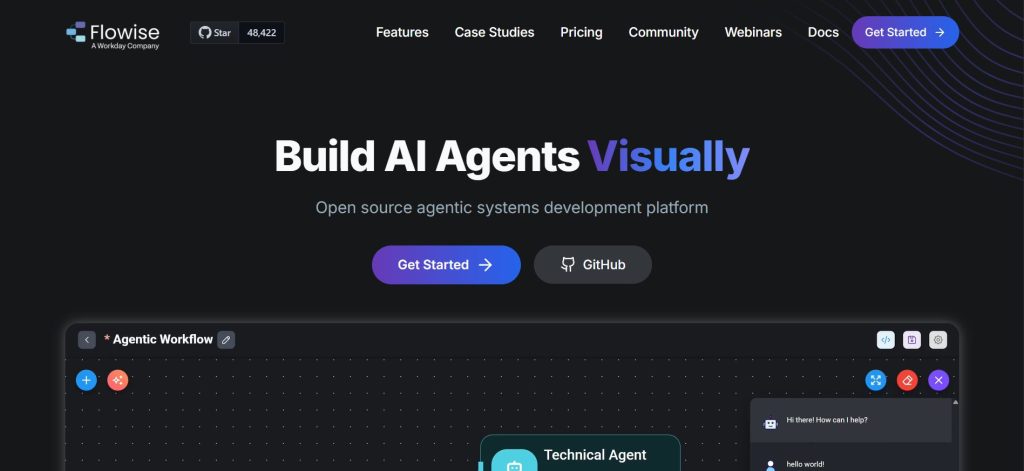
Flowise is a visual builder used to create LLM-based workflows and lightweight AI agent systems. It lowers the barrier to experimentation by allowing teams to connect models, tools, and logic with minimal setup.
Flowise is commonly used for internal tools, prototypes, and early concepts such as a property scraper AI agent. For production use, reliability depends on how well execution, monitoring, and failure handling are implemented around the workflow.
How Flowise performs across key evaluation factors
| Evaluation factor | Rating | What this means |
| Execution & tool control | Medium | Tools work well if flows are designed carefully. |
| Memory & context handling | Medium | Memory is configurable but manual. |
| Workflow orchestration | Medium | Visual flows simplify setup. |
| Multi-agent coordination | Low | Not designed for collaborative agents. |
| Observability & debugging | Medium | Visual clarity helps, deeper monitoring is limited. |
| Deployment reality | Medium | Best for prototypes and internal tools. |
Summary: Flowise is excellent for speed, less suited for long-running production agents.
Recap: How the Top AI Agent Frameworks Compare
Looking across the evaluation criteria, each AI agent framework shows clear strengths depending on how much responsibility the agent is expected to carry.
- Botsify performs strongest overall for teams running AI agents in production. It stands out in execution control, orchestration, observability, and deployment, making it well-suited for long-running, reusable agent systems.
- LangChain remains the most flexible option for developer-led teams that want to design custom agent logic from the ground up, with the tradeoff of higher engineering effort in production.
- Botpress is a solid choice for structured, conversation-led agents where predictable behavior and flow control matter more than autonomy.
- CrewAI excels in role-based, multi-agent collaboration, but requires additional structure to reach production reliability.
- Rasa is ideal for organizations that prioritize data ownership, privacy, and deep conversational control over speed.
- Landbot works best for guided, no-code conversational workflows with clear paths and outcomes.
- Flowise is effective for rapid prototyping and internal tools, but less suited for agents that must run continuously without supervision.
Rather than one universal winner, the comparison highlights where each framework fits best based on real operational needs.
How to Choose the Right AI Agent Framework (Without Limiting Yourself)
A common mistake is assuming each framework only fits one narrow use case. In reality, most frameworks can support a range of scenarios, the difference is how much effort and risk that requires.
Instead of asking “What can this framework do?”, ask:
- How much control do I need over agent behavior?
- How important is reliability versus flexibility?
- Will this agent run occasionally or continuously?
- Do I need to manage one agent, or many?
For example:
- Sales workflows, data collection, and internal coordination can be built with multiple frameworks. The difference is whether you want to engineer everything yourself or work within a system designed for long-running agents.
- Data-heavy agents, like those pulling information from external sources, can be implemented across platforms, but production reliability depends on orchestration and monitoring, not just model capability.
- Agencies often prioritize reuse, branding, and manageability, while research teams prioritize experimentation. So, they should also consider whether the framework supports a whitelabel AI agent builder model, especially when serving multiple clients with similar needs.
The right framework is the one that aligns with how your agents will be used six months from now, not just how fast you can prototype today. This flexibility is especially important for teams experimenting with new workflows or internal tools, including concepts like a business idea generator, where speed and adaptability matter more than perfect structure.
Final Thoughts
AI agent frameworks are no longer evaluated by how impressive an agent sounds, but by how reliably it can keep work moving.
The comparison makes one thing clear: frameworks differ not in intelligence, but in responsibility. Some prioritize flexibility and experimentation, others focus on structure, control, and long-term reliability.
Teams building AI agents should choose a framework based on how often agents run, how much autonomy they have, and how costly failure would be once the system is live. The right framework is the one that still works when workflows change, inputs vary, and real-world complexity shows up.
That’s the difference between an AI agent that demos well and one that actually lasts.
AI Agentic Platform For Building Portable AI Agents
Say Hello To Agentic AI That Connects With Your CRM And Even Other Agents