
A year ago, most teams were talking about chatbots or automation.
Now, everything seems to be about AI agents.
Part of the reason is frustration. Chatbots answer questions, but the work still falls back on people. Automation handles steps, but breaks the moment something unexpected happens. In real business workflows, that gap shows up fast, follow-ups don’t happen, handoffs fail, and tasks stall.
AI agents are being talked about because they sit in that gap.
At the same time, the term is being used loosely. Some tools label themselves “AI agents” when they’re really just chat interfaces. Others mean something much more capable. For someone new to this space, it’s hard to tell the difference.
Before deciding whether AI agents are useful, or just another buzzword, it helps to slow down and be clear about what an AI agent actually is, especially when comparing different top branded AI agent builder platforms entering the market.
What Is an AI Agent?
At its core, an AI agent is software that can notice what’s happening, decide what to do next, and take action to move a task forward.
That’s it.
The important part isn’t how advanced the AI model is. It’s what happens after the decision. An AI agent doesn’t stop at producing an answer. It can update a system, trigger a workflow, schedule a follow-up, or pass control to a human when it reaches a limit.
Think of it this way:
If a system responds and stops, it’s probably not an AI agent.
If it responds and then does something, it might be.
Most AI agents share three basic capabilities:
- They observe inputs from users, tools, or events
- They decide on a next step based on context
- They act inside a real workflow
These capabilities apply across formats, including text-based systems as well as voice AI agents that handle calls, prompts, and spoken workflows.
The action doesn’t have to be complex. Sometimes it’s as simple as tagging a lead or routing a request. What matters is continuity, the agent stays involved until the task reaches a meaningful point.
If you want to see how this idea expands beyond individual agents into full systems, this is covered in more depth in the Agentic AI guide.
For now, remember this one distinction:
An AI agent isn’t defined by conversation.
It’s defined by follow-through.
How AI Agents Work (At a Basic Level)

You don’t need to understand models, prompts, or architecture diagrams to understand how an AI agent works. At a basic level, most AI agents follow the same simple loop.
First, something happens.
That “something” might be a user message, a form submission, a system update, or a scheduled event. This is how the agent perceives what’s going on. It doesn’t matter whether the input comes from a chat window or a backend system, the agent treats it as a signal that work may need to be done.
In practice, this input is often handled through an AI agent builder that connects user actions with tools, data sources, and workflows behind the scenes.
Next comes the decision.
Based on the input and the context available, the agent decides what to do next. Sometimes that decision is obvious. Sometimes it involves choosing between a few possible actions. This is where AI agents differ from traditional automation. Instead of following a fixed rule every time, the agent evaluates the situation and picks a response that fits.
Then comes the action.
The agent does something in the real workflow. It might update a record, trigger a process, send a message, assign a task, or escalate the issue to a human. The important part is that the agent doesn’t stop at thinking, it acts.
Finally, the agent checks what happened.
Did the action succeed? Did it fail? Did it require human input? This feedback matters because it influences what happens next. In some cases, the task is done. In others, the agent continues with another step or waits for more input.
This observe → decide → act → check loop is what gives AI agents continuity. Instead of treating each interaction as a one-off, the agent stays involved until the task reaches a natural stopping point.
For practical tools and platforms where you can experiment with AI agent workflows without coding, check out 10 websites to build AI agents.
For beginners, it’s helpful to think of an AI agent less like a smart reply system and more like a junior operator. It pays attention, makes a call, takes action, and adjusts if needed. It doesn’t replace judgment, but it reduces the amount of manual follow-up required to keep things moving.
That basic loop is what all AI agents share, whether they’re used in customer support, sales, marketing, or internal operations.
Portable AI Agents In Seconds, Use Everywhere
Prompt, Test, and Deploy AI Agents Across Social Platforms and LLMs. Automate Everything.
AI Agent vs Chatbot vs Automation (What’s the Difference, Really?)
A lot of confusion around AI agents comes from the fact that they’re often compared to tools people already recognize, chatbots and automation. On the surface, they can look similar. In practice, they behave very differently.
Chatbots: Good at Talking, Limited at Doing
A chatbot’s main job is conversation. It listens to an input and replies with an answer. Modern chatbots can sound fluent and handle a wide range of questions, but their responsibility usually ends there.
Once the response is sent, the interaction is over, which is why a traditional chatbot for website setups often struggles to support full workflows without human follow-up.
If something needs to happen next, updating a CRM, scheduling a follow-up, escalating an issue, that work is handled elsewhere, either by a human or another system. This is why many teams eventually start questioning whether their chatbot setup can support real business workflows, especially when evaluating options like choosing the right whitelabel chatbot platform for long-term use.
Automation: Reliable, but Rigid
Automation focuses on actions, not conversation. It follows predefined rules: if this happens, do that. For stable, repetitive processes, this works well.
The limitation shows up when conditions change.
If an input doesn’t match expectations, automation either fails or requires manual intervention. It doesn’t pause to evaluate context or choose an alternative path. Over time, this rigidity turns into maintenance work, especially as workflows grow more complex.
Automation is useful, but it assumes the world behaves predictably, which is why teams often debate whether to build their own systems or rely on existing platforms.
AI Agents: Bridging the Gap
An AI agent sits between chatbots and automation.
Like a chatbot, it can interact with people.
Like automation, it can take action inside systems.
What makes it different is decision-making. An AI agent evaluates context and chooses what to do next instead of blindly following a rule. It can handle variation, adjust steps, and continue working until a task reaches a meaningful point.
For example, instead of simply replying to an inquiry, an AI agent might qualify the request, update records, trigger follow-ups, and coordinate outreach, similar to how teams use a cold emailing AI agent to manage follow-ups without relying on manual oversight.
A Simple Way to Think About It
If a system answers and stops, it’s probably a chatbot.
If it acts but can’t adapt, it’s automation.
If it responds, decides, and keeps working, it’s an AI agent.
Understanding this distinction helps set realistic expectations. AI agents aren’t magic. They’re useful because they reduce the gap between conversation and execution.
This distinction also explains why teams comparing conversational AI platforms often struggle to differentiate between chat-driven tools and true agent-based systems.
Real-World Examples of AI Agents
AI agents make the most sense when you look at them in context. Not as abstract systems, but as tools solving everyday problems where work doesn’t stop after a single response.
Below are a few common examples where AI agents are already being used in practical ways.
Customer Support AI Agents
The goal of a support agent isn’t to answer questions. It’s to resolve issues.
A customer support AI agent is designed to stay involved until that happens. It can gather details, check account information, update internal systems, and escalate when the situation goes beyond its limits. Instead of ending the interaction after one reply, it tracks the issue across steps.
A chatbot can answer FAQs. Automation can route tickets. This is why many businesses evaluating a chatbot service in the USA eventually look beyond basic bots toward AI agents that can manage full resolution workflows. But neither handles the full flow when something goes wrong or changes mid-process. That’s where an AI agent fits better; it keeps the issue moving instead of handing it off and disappearing.
Sales and Lead-Qualification Agents

In sales, the biggest leaks happen between touchpoints, especially for ecommerce businesses using tools like a Shopify chatbot to capture and qualify incoming leads in real time. Someone shows interest, but follow-ups slip or context gets lost.
A sales-focused AI agent is built around a simple goal: move a lead toward a clear outcome. It can ask qualifying questions, route the lead correctly, schedule next steps, and keep track of what’s already been done.
In some cases, this research is handled before outreach even begins, using a lead researcher AI agent to gather context and prioritize prospects automatically.
In industries where lead qualification depends on external data, such as real estate or marketplaces, agents are also used for upfront research, like pulling property details automatically through a property scraper AI agent before a salesperson ever gets involved.
Chatbots can capture interest. Automation can send predefined emails. An AI agent combines both and adapts when timing, responses, or intent change.
Marketing Operations Agents
Marketing teams spend a surprising amount of time coordinating work rather than creating it.
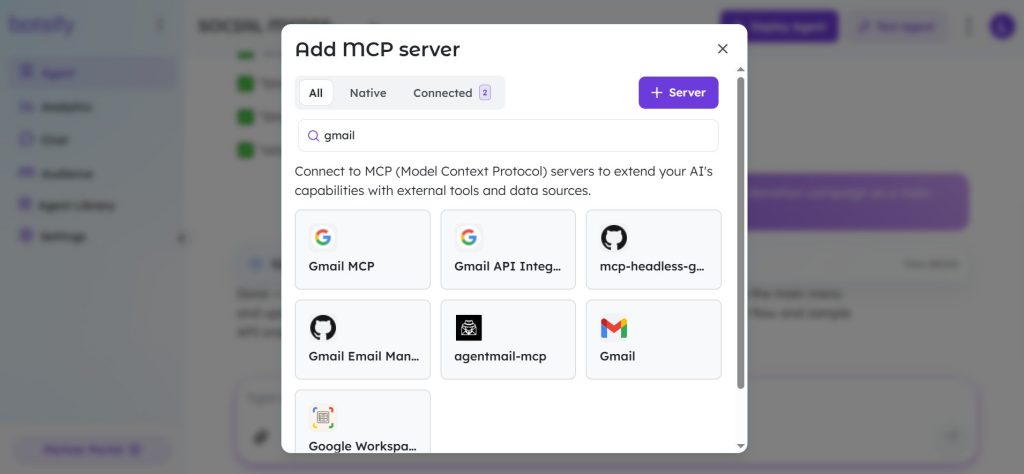
An AI agent in marketing operations might manage segmentation, trigger follow-ups, organize campaign steps, or monitor responses across tools. The goal isn’t creativity, it’s execution.
Automation handles fixed rules well, but marketing workflows change often. An AI agent can adjust based on context instead of breaking when inputs don’t match expectations.
Marketing teams spend a surprising amount of time coordinating work rather than creating it.
An AI agent in marketing operations might manage segmentation, trigger follow-ups, organize campaign steps, or monitor responses across tools. The goal isn’t creativity, it’s execution. In some cases, that execution includes scheduling and publishing content consistently, such as using an agent to handle routine social updates through a Twitter post generator and publisher AI agent instead of relying on manual posting.
Automation handles fixed rules well, but marketing workflows change often. An AI agent can adjust based on context instead of breaking when inputs don’t match expectations.
Internal Admin and Scheduling Agents
Some of the most useful AI agents never face customers.
Internal agents handle scheduling, routing requests, syncing tools, or generating reports. For example, teams often rely on a Slack automation agent to manage internal requests, approvals, and reminders directly where work already happens. Their goal is simple: keep routine work from stalling. If something fails, they retry or surface the issue instead of silently breaking.
This kind of work is too variable for rigid automation and too repetitive for people to manage consistently.
Agency and Multi-Client Use Cases
Agencies often repeat the same type of work across clients, including deploying region-specific solutions such as a Portuguese chatbot for multilingual customer support across different markets. The challenge isn’t complexity, it’s consistency.
AI agents help by standardizing how tasks are handled while still allowing room for adjustment. Over time, this leads agencies to look for a whitelabel AI agent builder platform that allows them to reuse and manage agent setups across clients without rebuilding everything from scratch, especially when serving industries already adopting HR platforms with AI automations.
Common Misconceptions About AI Agents
As AI agents get more attention, a few assumptions keep coming up, most of them based on how older tools worked rather than how agents are actually used today.
“AI agents replace people.”
In practice, they replace waiting, not judgment. Most agents are designed to handle routine follow-through and escalation, not final decisions. When stakes are high or inputs are unclear, agents are usually expected to pause and hand control to a human.
“Once you deploy an AI agent, it runs on its own.”
This is rarely true. Effective agents operate within clear boundaries. They’re monitored, reviewed, and adjusted as workflows change. The idea that an agent can be set loose without oversight is more marketing than reality.
“AI agents work without rules.”
They’re more flexible than automation, but they’re not unstructured. Constraints, permissions, and stop conditions matter. This aligns with how intelligent agents are traditionally defined, where bounded behavior is essential. Without them, agents don’t become smarter, they become risky.
“You need complex systems to use AI agents.”
Many teams start small. A single, well-scoped agent can deliver value without turning the organization into an AI lab. That’s often the first step toward broader agentic AI systems, where multiple agents operate together under defined limits.
Understanding these misconceptions helps set realistic expectations. AI agents aren’t magic. They’re tools, and like any tool, they work best when used deliberately.
Conclusion: Do AI Agents Actually Matter?
AI agents matter because they change where work stops.
Instead of answering and handing things off, an AI agent can stay involved until a task reaches a clear outcome. That doesn’t replace people. It reduces the gaps where things usually slow down or fall apart.
For beginners, the key takeaway isn’t to adopt AI agents everywhere. It’s to recognize where work already follows patterns but still needs follow-through. That’s where agents tend to fit first.
Understanding what an AI agent is, and what it isn’t, makes it easier to decide when it’s useful, when it’s not, and where humans should stay firmly in control.
AI Agentic Platform For Building Portable AI Agents
Say Hello To Agentic AI That Connects With Your CRM And Even Other Agents