

Price monitoring in 2026 runs on the same mechanics as competitive ecommerce itself: constant catalog changes, frequent promos, and market-by-market pricing shifts that can move margins in hours. As reported by Shopify, global ecommerce sales are forecast to grow from $6.42 trillion in 2025 to $7.89 trillion by 2028, and in 2026, online transaction revenue is set to reach $6.88 trillion.
In that environment, monitoring fails less from missing scrapers and more from missing access. Blocks, geo drift, inconsistent routing, and unstable sessions create gaps that hide real price moves or mislabel them as “out of stock” or “unavailable.” Strong proxies keep checks repeatable across time windows and locations, so alerts reflect the market, not the network.
What Is Price Monitoring?
Price monitoring is the systematic collection and comparison of product prices across multiple sources to track changes, detect trends, and respond to market movements. In 2026, price transparency across online markets will keep increasing, while pricing strategies become more dynamic and automated.
Accurate competitor pricing matters because retailers, marketplaces, and travel platforms update prices far more frequently than in previous years. Dynamic pricing engines adjust offers based on demand, inventory, location, and user signals, so weak data leads to underpricing, margin erosion, and delayed reactions to market shifts.
Why Use Proxies for Price Monitoring?
Proxies are used for price monitoring to avoid blocks triggered by IP reputation, request patterns, fingerprint signals, and geo mismatches, while keeping localized prices accurate through network diversity and geo coverage.
- How sites detect and block bots: Modern retail and travel sites flag automation using IP reputation, request frequency, fingerprint consistency, and geo mismatches.
- Common issues without proxies: Direct requests from a limited IP range often trigger bans, captchas, soft blocks, account restrictions on business online accounts, or inaccurate localized prices.
- Benefits of proxies: Proxies provide network diversity, geographic coverage, and operational stability needed for continuous monitoring.
How to Choose Proxies for Price Monitoring?
Choose proxies that stay reliable over time with clean IPs, accurate geo, stable latency, and enough concurrency, then match rotation or long-lived sessions to the site’s sensitivity. Use residential or mobile for market-realistic pricing, datacenter or ISP for volume and cost control, and confirm sourcing and acceptable use policies for compliance.
Core Criteria for Monitoring Workloads
Success rate over time, IP quality, geographic accuracy, latency stability, and concurrency limits define whether a proxy pool suits continuous monitoring, where reliability matters more than peak throughput.
Rotating vs Static IPs
Rotating IPs distributes requests and reduces exposure, while static or long-lived sessions keep price views consistent on sites that react poorly to frequent IP changes and repeated logins.
Residential, Datacenter, and Mobile IPs
Retail sites increasingly distinguish between consumer and server traffic. Residential and mobile IPs often provide more accurate pricing views, while datacenter or ISP proxies are used for volume and cost control.
Compliance and Data Ethics
Enterprise teams evaluate proxy providers based on acceptable use policies, sourcing transparency, and alignment with legal and ethical data collection standards. This is critical for always-on monitoring across markets.
Which Proxy Types Work Best for Price Monitoring?
Residential proxies fit e-commerce and marketplace tracking where consumer-like access matters, mobile proxies handle the most protected targets, and datacenter or ISP proxies support high-volume cost-efficient runs, while mixed stacks balance coverage, stability, and spend through failover routing.
- Residential proxies: Suitable for e-commerce and marketplace price tracking where consumer-like access is required.
- Mobile proxies: Used for highly protected targets, mobile-first platforms, or aggressive anti-bot environments.
- Datacenter and ISP proxies: Applied to large-scale monitoring where cost efficiency and throughput matter.
- Mixed proxy stacks: Combine multiple proxy types with failover logic to balance stability, cost, and coverage.
What Do Enterprises Look for in Proxy Services?
Enterprise price monitoring programs prioritize predictability and governance over experimental flexibility. Proxy infrastructure becomes part of core data pipelines rather than ad-hoc tooling.
SLAs and Uptime Guarantees
Consistent availability matters more than peak performance for monitoring workloads. Enterprises look for defined uptime commitments, clear status reporting, and transparent incident handling.
Support Models
Dedicated support channels and responsive customer support teams reduce downtime when monitoring pipelines start failing. Clear escalation paths speed recovery when blocks spike or routing quality drops.
Compliance and Auditability
Enterprise teams screen providers for KYC, acceptable use policies, and enforcement that reduces risky traffic overlap. Audit-friendly controls and documentation make proxy usage easier to govern internally.
Traffic and Security Controls
IP allowlists, routing rules, and access management help integrate proxies into secured environments without opening unnecessary risk. Credential rotation and scoped permissions reduce exposure when teams scale access across tools.
How Do the Best Price Monitoring Proxy Providers Compare in 2026?
The table below compares providers by proxy mix, network scale, uptime claims, and whether they offer a support model suitable for always-on monitoring. It focuses on monitoring readiness, where stable availability and fast escalation matter more than peak throughput.
| Provider | Key Features | Pros | Cons | Price |
| Live Proxies | Session-stable routing for repeat checks, clean rotation between runs, residential + mobile coverage, private IP allocation to reduce cross-tenant overlap, sticky sessions up to 24 hours | Strong for always-on monitoring where consistency matters, good fit for repeatable catalog and regional checks, more predictable acceptance on the same targets due to private allocation | Less “all-in-one” scraping suite tooling than some enterprise stacks | From $70 |
| Proxy-Seller | Support for HTTP(S) and SOCKS5, 220+ countries, 20M+ rotating residential IPs, 1 Gb/s dedicated channel | Strong for tracking prices, stable pricing intelligence, discounts for bulk purchases | No free trial version available | Datacenter: from $0.08/IP; residential: from $2.20/GB; mobile: from $25/IP |
| IPRoyal | Broad proxy mix for separating tasks by risk, flexible scaling for recurring checks | Practical for cost-aware monitoring, easy to run bulk validation alongside higher-trust checks | No fixed public uptime SLA is clearly stated across core pages | From $1.75/GB
|
| CyberYozh | Combined proxy infrastructure with mobile LTE/5G, residential (rotating + ISP), and datacenter proxies, managed IP pools, built-in fraud checks for IP/phone/card, API integration, sticky sessions and controlled rotation for monitoring workflows | Strong for price monitoring where session stability and geo accuracy matter, reduces false price signals and blocked requests, all-in-one setup removes need for multiple tools, easy to use with scalable infrastructure | No free trial available | From $1.7/day (mobile), $5.29/month (ISP), $0.9/GB (rotating), $1.9/month (datacenter) |
| SOAX | Geo-focused controls and controlled rotation, residential + mobile + US datacenter options | Strong for market-accurate views where geo drift breaks price comparability | Monitoring at scale can become expensive for high-frequency programs | Starter from $3.60/GB |
| Infatica | Mixed stack under one vendor, IPv6 residential option, ISP + datacenter + mobile coverage | Good for mixed portfolios that need both cost-efficient bulk and higher-trust routing | Targeting depth and pool specifics can be less explicit than enterprise-first stacks | PAYG from $4/GB |
| Decodo (formerly Smartproxy) | Large multi-type network, straightforward controls for scaling regional monitoring | Good price-to-coverage for growing monitoring programs, broad proxy mix for failover logic | Public uptime SLA is not consistently presented as a single headline figure | Residential listed from $3.00/GB (plan-dependent) |
Top 7 Proxies for Price Monitoring in 2026
The providers below were selected based on their suitability for long-running price monitoring workloads rather than generic scraping benchmarks.
1. Live Proxies
Live Proxies fit monitoring-style price checks that need steady session behaviour and clean routing changes between runs. For repeatable catalog and regional checks, a best rotating residential proxy helps keep access consistent during active runs and resets cleanly between schedules, while sticky sessions up to 24 hours support long-running checks, and private IP allocation reduces cross-tenant overlap on the same targets, which is critical for always-on monitoring where stability matters as much as pool size.
- Proxy Types: Rotating residential, static residential, rotating mobile.
- Proxy Network: Millions of IPs across 55 countries.
- Uptime: 99.9% uptime guarantee.
- Dedicated Support: 24/7 customer support and support channels for business use cases.
2. Proxy-Seller
Proxy-Seller provides ethically sourced proxies for price monitoring, eCommerce analytics, and public web scraping. The proxy provider offers dedicated addresses perfectly suited for data collection when companies need separate channels for continuous analytics. Users often choose this service because it offers one of the best proxies for online research. The practical benefit is that your proxies for marketing research ensure round-the-clock competitor monitoring, while business analytics remains precise.
- Proxy Types: IPv4, IPv6, mobile, residential, ISP.
- Proxy Network: 400 networks and 800 subnets.
- Uptime: A score of 99.9%.
- Dedicated Support: Operators are available 24/7 (assistance in remote setup).
3. IPRoyal

IPRoyal fits cost-aware monitoring where teams want flexible proxy families under one vendor for steady competitor checks. It works well for portfolios that mix lower-risk catalog monitoring with occasional stricter pages, as long as routing stays disciplined. The practical benefit comes from keeping pricing views consistent while controlling spend.
- Proxy Types: Residential, mobile, ISP, datacenter.
- Proxy Network: 32M+ residential IPs in 195+ countries.
- Uptime: No fixed public uptime SLA is prominently stated on the main residential documentation and product pages.
- Dedicated Support: Round-the-clock support is stated on the residential product page.
4. CyberYozh
CyberYozh fits price monitoring workflows where consistent data depends on stable sessions, accurate geo routing, and clean IP usage over time. Instead of relying only on rotation, the platform combines residential, mobile, ISP, and datacenter proxies with session control and built-in fraud checks, helping reduce blocked requests, geo mismatches, and incorrect price signals. This makes it suitable for continuous monitoring setups where repeated checks must return reliable and comparable results across different regions and time intervals.
Proxy Types: Residential (rotating), Mobile LTE/5G, Residential ISP (static), Datacenter
Proxy Network: 50M+ IPs across 100+ countries with managed and monitored pools
Uptime: 99.9% uptime across core proxy infrastructure
Dedicated Support: 24/7 support available in 7 languages via Telegram and email, with practical assistance for setup and scaling
5. SOAX
SOAX fits geo-sensitive monitoring where location accuracy changes the price outcome, not just reachability. It suits workflows that need controlled rotation policies so repeated checks stay comparable across crawlers and time windows. This positioning is strongest when city-level or ISP-level consistency reduces geo drift.
- Proxy Types: Residential, mobile, US datacenter.
- Proxy Network: 155M+ residential proxies, with 195+ locations positioned.
- Uptime: 99.9% network uptime is stated for the residential proxy network.
- Dedicated Support: Enterprise-level support with dedicated account managers is stated.
6. Infatica
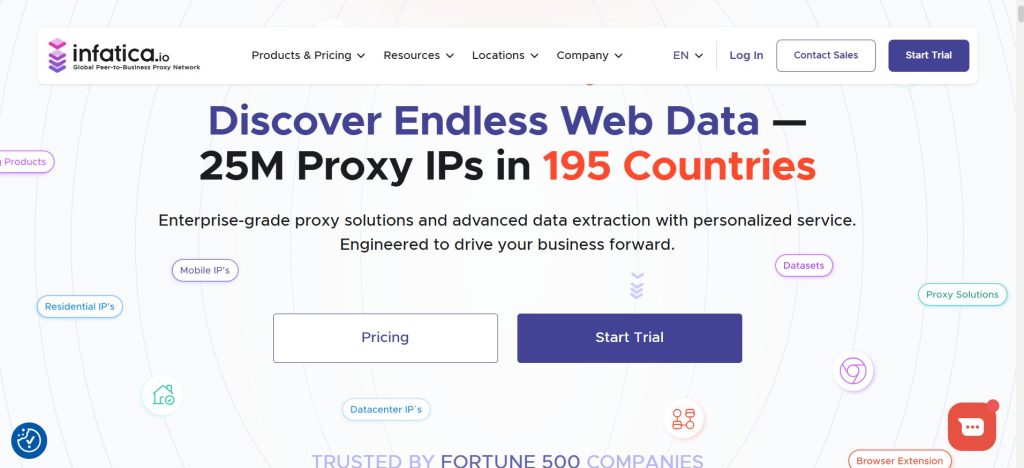
Infatica supports mixed monitoring portfolios that combine residential reach with data center throughput under one vendor. It suits teams that want a practical proxy mix for sources that vary in difficulty across regions and categories. The value lies in routing flexibility without requiring the rebuilding of tooling for different proxy families.
- Proxy Types: Residential IPs, premium IPv6 residential IPs, static ISP IPs, datacenter IPs, mobile IPs.
- Proxy Network: 25M+ proxy pool is stated, with global coverage messaging across product pages.
- Uptime: 99.9% uptime guarantee is stated for its rotating proxy network.
- Dedicated Support: 24/7 support is stated on Infatica’s contact and policy pages.
7. Decodo (formerly Smartproxy)

Decodo fits teams that want a broad proxy mix with straightforward controls for scaling monitoring coverage across regions. It suits programs that run frequent checks where reliability and quick troubleshooting matter more than one-off success spikes. The strongest use case is balancing coverage and stability while keeping operations simple.
- Proxy Types: Residential, mobile, ISP, datacenter.
- Proxy Network: 125M+ IPs is stated on the official site, with 195 global locations referenced by independent reviews.
- Uptime: No single public SLA value is stated on the official support page, though independent reviews describe strong reliability.
- Dedicated Support: 24/7 tech support via LiveChat is stated in Decodo documentation.
What Is the Best Proxy Setup for Price Monitoring?
Optimal proxy setups depend on monitoring frequency, geographic scope, and target sensitivity, particularly for lean teams using ai agents for small businesses to automate competitive tracking. There is no single configuration that fits all price tracking workloads. The most reliable setups align session behaviour and geo controls to how often checks run and how strict the target is.
Stable Daily Monitoring
Session persistence with limited rotation keeps identity signals consistent and reduces sudden price view shifts on sensitive targets. It suits scheduled checks where comparability matters more than rapid churn.
High-Frequency Tracking
Controlled rotation spreads exposure while keeping coverage steady when checks run many times per day, especially when powered by agentic ai systems that adapt routing dynamically. Retry logic helps absorb transient blocks without creating gaps in price histories.
Multi-Country Monitoring
Strict geo validation reduces drift that can distort localized prices, taxes, or availability signals. It works best when routing stays pinned to the intended market view across repeated runs.
Fallback Chains
Tiered failover routes reduce data gaps when a pool degrades or a subset of exits gets blocked. They keep monitoring continuously during partial outages and sudden challenge waves.
How to Integrate Proxies With Price Monitoring Tools?
Integrate proxies by routing traffic with credentials and geo rules, then control rotation, retries, and failover in scripts, while tuning timeouts, headers, and sessions and monitoring health checks for early pool degradation.
- Off-the-shelf platforms: Use credential-based proxy routing plus geo rules to keep market views consistent.
- Custom scripts: Add finer control over rotation, retries, and failover logic for sensitive targets.
- Core configuration: Tune timeouts, keep headers consistent, and manage sessions to avoid mid-flow breaks.
- Health checks: Monitor success rate and error spikes to detect degraded pools before data quality drops.
How to Avoid Blocks in 2026?
Avoid blocks by pacing requests with a stable cadence, using lightweight HTTP clients for static pricing pages, rate-limiting and logging captcha retries, and applying adaptive rendering only on strict dynamic targets and regions.
Smart Scheduling
Spread requests across realistic intervals to avoid burst signatures that trigger throttling and challenge waves. Stable cadence usually outperforms aggressive spikes followed by heavy retries.
Lightweight HTTP Clients
Use lightweight HTTP clients for static pricing pages because they reduce overhead and lower the chance of fingerprint-driven friction. Headless browsers fit only when rendering is required for the specific target.
Captcha Retry Discipline
Rate-limit captcha retries and log outcomes so enforcement patterns become measurable instead of random noise. Excessive retries often amplify risk by creating rapid repeats from the same session context.
Adaptive Rendering for Strict Targets
Dynamic content and strict regions often require adaptive rendering or selective browser use to keep views market-accurate. Switching strategies by target type helps maintain coverage without inflating cost.
What Legal and Ethical Considerations Matter for Price Monitoring?
Price monitoring stays safer when site rules are followed, and personal data is excluded. Internal governance should set approved targets, monitoring frequency, and escalation rules before scaling.
- Robots.txt and site terms: Following site rules at a policy level reduces legal exposure and operational risk.
- Data minimisation: Avoid collecting personal or user-identifiable data during price tracking workflows.
- Internal governance: Define approved targets, monitoring frequency, and escalation rules before scaling coverage.
What Common Mistakes Do Teams Need to Avoid?
Teams need to avoid using one geo for all checks, relying on free or public proxies, ignoring silent failures like partial pages, and trusting single snapshots without verification, because these issues distort prices and trigger false alerts.
Single Geo for Everything
One narrow routing profile concentrates reputation risk and increases block sensitivity over time. It can also distort pricing when sites personalise results by region, currency, taxes, or shipping rules.
Free or Public Proxies
Public pools often have noisy histories and high reuse, which raises captcha rates and soft blocks, unlike the best vpns, which are designed primarily for privacy rather than structured price monitoring workloads. Unstable routing also makes price histories harder to compare across runs, especially during promos and stock swings.
Ignoring Silent Failures
Many monitoring failures show up as partial HTML, empty fields, or changed templates rather than hard errors. Without tracking these patterns, teams can store corrupted prices as real data and trigger false alerts.
No Verification Pass
Single snapshots can reflect promos, A/B variants, or challenged views. A verification pass reduces false alerts and improves trend reliability, particularly on volatile categories and competitive listings.
Conclusion
Price monitoring in 2026 works best when proxies are treated as a reliability layer, not a scaling trick. Clean IP supply, stable sessions, and accurate geo routing reduce gaps, soft blocks, and distorted “out of stock” or “unavailable” signals that break price histories.
Provider fit depends on how the monitoring program runs. Session-stable routing supports repeat checks, geo controls keep market views consistent, and mixed stacks with failover protect coverage when targets harden, or exits degrade.
AI Agentic Platform For Building Portable AI Agents
Say Hello To Agentic AI That Connects With Your CRM And Even Other Agents
