


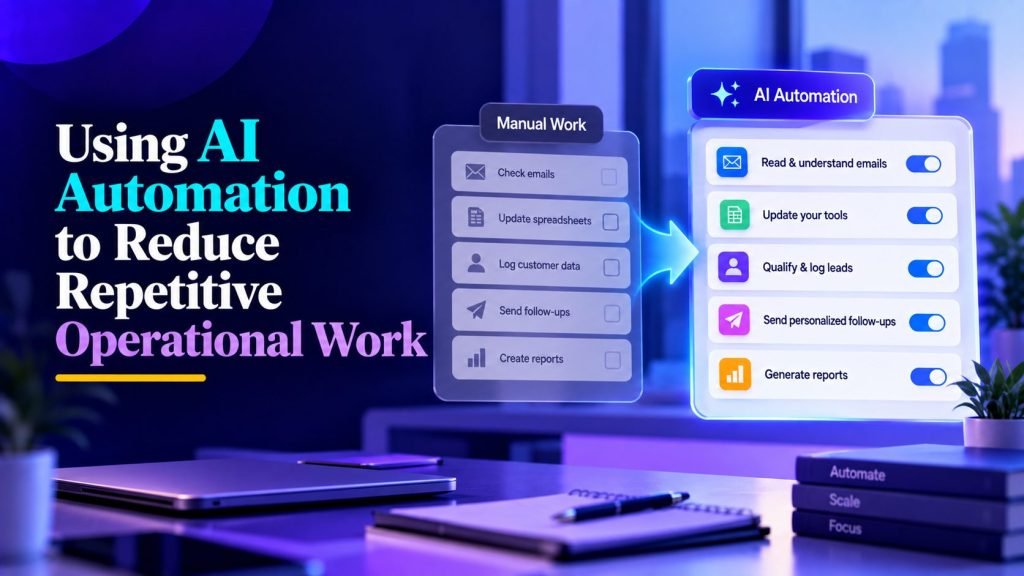
A company can actually spend quite a bit of time on repetitive activities. Employees could be copying data across different systems, sorting through requests, writing routine reports, updating records, or even sending out follow-ups. Each task on its own might not take too much effort, but when put together, it can decrease efficiency.
The application of AI in the process could make it easier to address such activities. Companies could apply AI to perform some tasks that are repetitive in nature, require a lot of data, and have predictable decisions. This allows businesses to reduce manual effort and improve consistency while keeping employees responsible for decisions that require judgment.
What Is AI Automation?
AI automation combines artificial intelligence with software workflows to complete tasks that would otherwise require manual effort. Unlike traditional rule-based systems, AI automation can also interpret text, documents, and other inputs that don’t always follow a fixed format.
Traditional forms of automation usually follow set parameters whereas AI automation works on inputs like text and documents and other structured as well as unstructured queries.
Where Repetitive Operational Work Usually Appears
Repetitive work takes place in virtually all departments. Administrative staff may deal with form processing and record updating, and customer service staff may deal with sorting out support requests and preparing answers.
Sales personnel might spend a while working with lead information and updating info about customers with contacts. Finance departments might check the invoices, process documents, and draft reports. The operational units can synchronize the requests, log the activities, and validate the data within various systems.
Such kind of processes may be automated since they are repetitive in nature with predictable process flow. But companies need to analyze the process itself before automating it. It is better to simplify the process if it is not clear or constantly changing.
Application of AI Technologies for Performing Routine Work
Using AI for operations purposes allows for performing a wide range of functions for companies, which in turn makes them run smoothly and efficiently. These functions include processing requests, recognizing data, summarizing documents, and recalling relevant cases by the company’s AI systems. This allows combining the efficiency of machines and the accountability of people in business.
Enhancing Customer Support Workflow
AI agents for customer support can help teams answer routine questions, categorize incoming tickets, retrieve information from previous conversations, and prepare summaries when an issue needs to be escalated to a human representative. Artificial intelligence technology can be used to determine the topic of the question posed by the customer, summarize his past conversations, and present information related to the same. Workers will thereafter analyze the output, paying attention to areas of conversation that demand their attention.
Connecting AI With Business Software
The automation that AI brings about will be more efficient if it is integrated with the software that companies use. The companies employ software that suits them for accounting, customer relationship management, project management, communication, and inventory management. Rather than replacing their existing systems, businesses can use AI agent integration to connect automation with the tools employees already rely on, allowing information to move between applications with less manual intervention.
AI-Powered Internal Tools for Repetitive Workflows
There may be certain processes that are too specific for off-the-shelf automation solutions. There might be some custom approval procedures, some internal requirements for reporting, or a combination of information from different departments.
In this case, it will be possible to use internal AI-powered tools to develop a solution that is tailored specifically for these processes. Depending on the organization’s needs, a custom internal application could combine dashboards, data management, and AI workflow automation to coordinate repetitive tasks across departments while keeping employees involved in important decisions. What should be noted is not just the possibility of completing some operations with the help of AI but also how useful, clear, and dependable this process is for employees.
Choosing Objectives for Automation
It is not always required to automate the same actions over and over again. Companies need to think about the process itself before introducing any AI-based solutions.
First, it is necessary to know how frequently the process occurs, how long it takes, and whether the process is predictable. Moreover, it is important to determine the possible costs of errors and the presence of confidential data in the process.
Automating high-frequency repetitive processes with clearly defined outcomes tends to be easier than other cases. Processes involving negotiation, sensitive communication, or complex decisions may benefit from AI assistance, but they generally require more human oversight than straightforward administrative tasks.
Running a small-scale pilot would help obtain valuable insights. A company could try automating one process, measure the results obtained, and take into account employees’ opinions.


Accuracy Management and Human Oversight
AI automation is not something businesses can configure once and leave unattended. Systems need regular monitoring because AI can misinterpret information, produce incomplete summaries, or extract incorrect data. There could be cases where AI technologies might misinterpret something, create only partial summaries, and even make incorrect extractions. In particular, since the result of such automation will affect the financial transactions, the obligations of the customer, employment, or decisions based on compliance.
The business can protect itself from such dangers by setting the confidence level of certain decisions, the approval process of certain actions, and documenting the decisions taken automatically. Employees must be capable of recognizing such errors.
Measuring the Impact of AI Automation
Organizations must find out if there is really an enhancement from using automation. Indicators may include processing time, manual steps, error rate, reaction time, and workload of employees.
Employee feedback may also be considered. Although something is automatically done through the use of AI, confusion brought about by review may make it useless. Monitoring allows for better workflow, better prompts and even reduction of unnecessary automation.
Development of Sustainable Automated Processes
AI-driven processes are best implemented through a process improvement project. Organizations should know about the process, get rid of any unnecessary stages, delegate their duties, and discover where AI is applicable.
The most effective automated processes would not try to eliminate all of the human input. They will handle repetitive data processing and standard processes and leave humans more time for thinking, communication, and strategy. As AI software evolves, companies will have more chances to automate business processes. The companies that will reap the greatest benefit will be those that implement useful technologies, along with data, processes, people, and metrics.
AI Agentic Platform For Building Portable AI Agents
Say Hello To Agentic AI That Connects With Your CRM And Even Other Agents