



A client pays for an AI agent to solve a specific workflow. After launch, its source information changes, users discover edge cases, and the business may ask for another channel or task. If nobody owns those changes, the agent can drift away from the work it was meant to support. If the agency does own them, it needs a clear way to scope, deliver, and charge for that ongoing work.
A recurring revenue offer for AI agents is not simply a one-time build split into monthly invoices. It is an ongoing service with defined responsibilities, a delivery rhythm, and evidence the client can use to decide whether to renew. This guide shows how to package that service without promising passive income, fixed savings, or results you cannot substantiate.
Botsify’s broader guide to selling AI agents to businesses covers positioning, prospecting, and sales conversations. This article focuses on what happens after a buyer is interested: how to turn implementation and ongoing care into a repeatable agreement that remains useful to both sides.
What recurring revenue from AI agents actually means
A recurring fee should correspond to recurring work or an ongoing service obligation. For an AI agent, that work could include reviewing performance, updating approved knowledge, testing changes, handling support requests, maintaining a connected workflow, or preparing a client review. The exact service depends on the agent, the customer’s operating needs, and what your team is equipped to deliver.
A monthly fee does not become justified merely because the software remains available. A client should be able to see what the agency is responsible for during the billing period, what is outside the agreement, and how the service responds when the business changes.
A useful distinction is:
| Offer component | What it covers | How to describe it |
|---|---|---|
| Implementation | Discovery, configuration, integration, testing, and launch | A defined project with a start, scope, and acceptance point |
| Ongoing service | Monitoring, review, support, updates, and agreed improvements | A recurring commitment with a service cadence and limits |
| Platform access | The software, channels, usage allowance, or account infrastructure | A product entitlement that may be billed monthly or annually |
| Expansion work | A new use case, system, channel, or substantial change | A separately scoped project or an explicitly included allowance |
These components can be sold together, but they should remain clear in the proposal. Otherwise, a client may assume that every future integration or custom request is included in a small monthly support fee.
An AI automation agency business model can combine project fees, per-client or per-agent pricing, and managed retainers. The right blend depends on how much delivery responsibility the agency keeps after the initial implementation.
Choose the recurring service model you can support
There is no single best recurring offer for every agency. Start by deciding which work you want to own and what kind of ongoing value you can reliably provide.
Managed agent service
The agency operates the agreed workflow after launch. It may review exceptions, answer client questions, update source materials when the client supplies approved changes, test relevant behavior, and report on agreed measures. This model suits agencies with the people and process to support ongoing delivery.
Be specific about response windows, review frequency, and the number or type of changes included. “Ongoing management” can mean very different things to the buyer and the delivery team.
Platform and support subscription
The client receives ongoing access to an agent platform and a defined level of help. The client may manage content and day-to-day operations, while the provider handles platform access and support within its published terms. This model can be easier to scale, but it should not be presented as full-service management if the client still owns the operational work.
Hybrid offer
The agency combines a setup project with a monthly service plan. The project covers discovery and launch. The plan covers a stated cadence of maintenance, support, measurement, or bounded improvements. Larger enhancements are quoted separately or draw from a clearly limited change allowance.
White-label reseller offer
The agency sells a branded service to its own clients and uses a third-party platform as infrastructure. In this model, the agency owns its client packaging and relationship, while the platform provider supplies the capabilities described in its current terms. A white-label AI offer for agencies should state which party handles implementation, support, billing, data questions, and product availability.
Before committing to a reseller platform, compare the client experience, account structure, support, channels, billing controls, and any usage limits against your service plan. A white-label AI agent platform comparison can help organize the provider evaluation, but confirm current details directly with each vendor before you make an offer.
Package the service in tiers without hiding the scope
Tiers can make choices easier when each one represents a real difference in service. Avoid naming levels “Starter,” “Growth,” and “Scale” if they only differ by a vague promise to improve results. Define the work, cadence, and boundaries in each package.
| Service area | Care | Managed | Partner |
|---|---|---|---|
| Agent availability | Platform access under the applicable plan | Platform access plus named support route | Platform access plus agreed account review |
| Knowledge changes | Client-managed or a small, defined update allowance | Scheduled review of client-approved changes | Scheduled review plus a documented content owner and change process |
| Testing | Initial acceptance tests; retest after a scoped change | Recurring checks for agreed high-priority cases | Broader test plan tied to the client’s workflows and release changes |
| Reporting | Basic usage or service summary where available | Agreed outcome and quality measures | Outcome review with risks, decisions, and next-scope recommendations |
| Enhancements | New work quoted separately | Limited, defined improvement allowance | Quarterly planning; larger work separately estimated |
| Client responsibilities | Provide access, approved content, and escalation contacts | Same, plus timely approval of changes | Same, plus business owner participation in service reviews |
The table is a starting structure, not a guarantee that every software platform supports every reporting or access feature. Mark which items are included in your service and verify platform capabilities before promising them.
A tier should also communicate who is a poor fit. A small package may not suit a client that expects instant responses around the clock, frequent custom development, or a guarantee of a specific revenue increase. Disqualifying an unsuitable engagement can protect delivery quality and make the offer easier to trust.
Write an offer card clients can understand
For each tier, prepare a short description that answers:
- What workflow does the service support?
- What does the agency do each month?
- What response or review cadence is included?
- What inputs and approvals must the client provide?
- What kinds of work are excluded or quoted separately?
- Which measures are reported, and where does their data come from?
- How can either side change, pause, or end the service?
Keep the language concrete. “We optimize your agent every month” is hard to evaluate. “Each month we review the agreed test cases, check client-approved content changes, and report exceptions and requested improvements” gives both parties something to verify.
Define the monthly scope before you set a fee
A retainer should name the recurring work and its limits. Common service activities include:
- Knowledge maintenance: Review approved source changes and update the agreed agent content. State who supplies and approves the authoritative information.
- Conversation or task review: Inspect a defined sample or set of exceptions, subject to privacy, access, and platform capabilities.
- Testing: Run agreed cases after relevant changes and record whether the expected behavior occurred.
- Workflow support: Respond to questions about the included workflow within the stated support window.
- Monitoring: Review available service signals, failures, or usage thresholds where the platform exposes them.
- Reporting: Summarize agreed measures, known limitations, unresolved issues, and next steps.
- Change planning: Identify potential improvements, estimate work, and secure approval before expanding scope.
The agency should not promise that every interaction will be reviewed or that every issue will be detected automatically unless it has a process and system that actually provides that coverage. State when review is sampled, when it is client-requested, and when it is triggered by an identified event.
Define client responsibilities alongside agency work. The client may need to keep policies current, approve content, assign escalation owners, provide system access, and notify the agency of product or process changes. The agreement should explain what happens when required inputs or approvals are delayed.
A clear AI agent requirements checklist helps define the task, inputs, actions, success measures, and handoff conditions before the ongoing service is priced.
Turn ongoing AI work into a defined monthly service
Discuss service scope, ownership, and delivery cadence.
Build a repeatable monthly delivery cycle
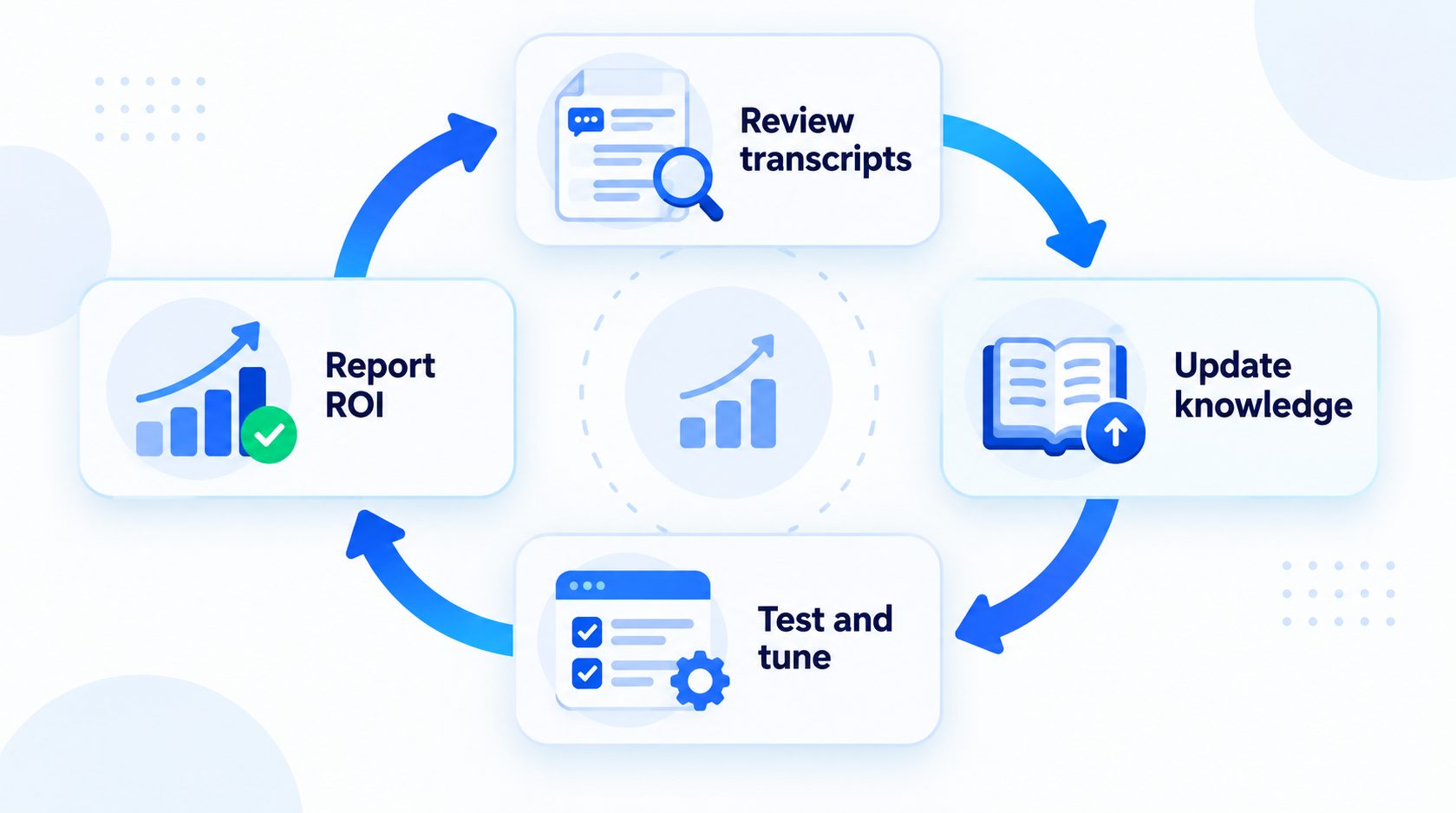
A reliable monthly service should not depend on one person remembering what to check. Turn the work into a simple operating cycle that can be repeated, documented, and adapted to the client’s needs.
1. Review the service signals
Start with the measures and exceptions the client has agreed to share. Look for changes in eligible volume, task completion, handoffs, repeat work, user feedback, or system errors. The right signals depend on the use case. Do not assume a dashboard metric by itself explains the quality of the work.
2. Identify the cause before changing the agent
A poor result may come from stale source content, unclear instructions, an integration problem, a changed business policy, or a workflow that should not be automated. Separate the cause from the symptom. Record evidence and ask the client to confirm any policy or process change before revising the agent’s behavior.
3. Prioritize a bounded improvement
Choose a small number of changes based on client impact, risk, and effort. Avoid promising that every reported issue will be fixed within the monthly fee. If the request introduces a new task, system, channel, or decision authority, treat it as a scope change and estimate it separately.
4. Test the change against agreed cases
Use the same relevant test cases before and after the change. Include ordinary and exception scenarios, such as missing information, an unsupported request, a handoff, or an unavailable connected system. Record what was tested and any failure that remains.
5. Report the outcome and next decision
Share what changed, what the evidence shows, what remains uncertain, and whether a client decision is needed. A report should make renewal easier to evaluate, not pressure the client with an inflated success claim.
This recurring cycle is one stage of the broader AI agent lifecycle. It should connect to the original business process and release plan, so that monitoring and maintenance do not drift into untracked custom work.

Use a service calendar, not a vague promise
A sample calendar can help define the work without promising the same sequence for every account:
| Cadence | Example activity | What is recorded |
|---|---|---|
| Weekly or as agreed | Review urgent issues or service failures | Issue, owner, impact, and next action |
| Monthly | Review agreed measures and approved content changes | Summary, data period, exclusions, decisions needed |
| Quarterly | Revisit use case fit, responsibilities, and expansion requests | Updated scope, priorities, risks, and commercial estimate |
| When a material change occurs | Retest affected behavior or integration | Change description, test cases, result, and sign-off |
The agreement should define an actual cadence for each client. A table like this is a planning aid, not a promise of a guaranteed response time or outcome.
Measure value and service quality honestly
Recurring clients need enough information to understand what the service is doing. Choose measures that reflect the job, and explain what each one can and cannot prove.
For a support agent, possible measures include verified resolution, customer feedback, repeat contact, escalation quality, time to resolution, and total cost per verified resolution. The AI customer support metrics guide explains why the number of conversations handled does not, by itself, show that customers received a correct resolution.
For a lead qualification agent, useful measures might include the share of eligible inquiries receiving a response, required fields captured, qualified leads routed correctly, and time to human follow-up. For an internal assistant, a team may track task completion, rework, or employee effort. Define the data source and the eligible denominator before launch.
A monthly client report can include:
- Service scope: Which workflow, channels, and dates the report covers.
- Activity: Eligible cases, completed tasks, handoffs, and known failures.
- Quality: A defined review result, customer or employee feedback, and repeat-work signals where available.
- Human contribution: Review, correction, exception handling, and approval work that remains.
- Operating cost: Relevant platform, usage, integration, support, and maintenance costs.
- Changes made: What changed, why it changed, and which tests were run.
- Open items: Dependencies, risks, decisions, and work outside the current scope.
Do not treat a lower handoff rate as success automatically. An agent that avoids escalation by guessing may create downstream work or customer harm. Likewise, count a task as resolved only when the success condition was met, not merely because the conversation ended.
If you report an estimate of time saved or revenue influenced, state the calculation and assumptions. Time made available is not always payroll savings. Revenue associated with a lead is not necessarily revenue caused by the agent. Keep observed results, estimated value, and forecast scenarios in separate columns.
Price the retainer from delivery cost and capacity
Set a fee by understanding the work and economics of your service, not by copying an industry figure or promising that the client will receive a fixed multiple back.
A practical calculation has four parts:
- Estimate direct delivery effort: Include scheduled review, client calls, changes, testing, reporting, and support.
- Add operating costs: Include the platform, model or channel usage, integrations, contractors, and other costs that vary with the account.
- Allocate shared costs: Include the part of training, service management, tooling, and administration needed to deliver the offer.
- Set a sustainable price: Compare the proposed recurring fee with direct and allocated costs, the work’s complexity, and the service level you are taking responsibility for.
Use your own figures:
Monthly contribution per account = recurring fee − direct account costs − allocated delivery cost
Capacity needed = monthly hours per account × active accounts
For example, if a service requires several hours of review, support, and reporting per account each month, estimate that work before setting a fee or client limit. The hours in the example should come from your own delivery records, not a generic claim about how many accounts one operator can manage.
Separate the initial setup fee from the recurring charge when the setup requires discovery, integration, data preparation, or a substantial first test. A one-time implementation fee can cover work that does not repeat each month. The recurring fee can then describe the work that continues. If you include a number of improvement hours, define rollover, overage, and approval rules.
Be careful with “value-based” pricing language. A potential reduction in labor or increase in sales is not guaranteed cash savings. Use the client’s baseline and pilot results to discuss possible value, while pricing the service based on its actual scope, cost, responsibility, and commercial terms.
When evaluating a white-label platform’s economics, include the platform cost, client billing process, usage charges, support responsibilities, and the time needed to operate the service. A reseller margin is only one part of account profitability.
How Botsify can fit into the offer
Agencies that want to resell under their own brand can evaluate Botsify’s current white-label AI agent plan, which lists white-label dashboard and reselling rights, client and usage options, channel support, document and web search, and partner support. Those are platform details, not a promise that every agency service or outcome is included. Confirm current plan terms and map the platform’s responsibilities against your own support, implementation, and billing commitments.
For a business that wants an outside provider to handle implementation, Botsify’s Done-For-You AI agent service describes strategy, agent design and testing, deployment, support, and iteration. Be clear about whether your offer uses a reseller platform, a managed service, or a provider-delivered project. The customer should know who owns each task after launch.
Improve client retention through visible service
A recurring agreement should be easy to evaluate and easy to discuss. Renewals are more likely to be informed when a client can see what was delivered, what changed, and what decision comes next. Do not promise a particular renewal rate or claim that a report guarantees retention.
Use a quarterly review to discuss:
- Whether the original workflow still matters to the business.
- Whether the agent is still receiving current and approved information.
- What the agreed quality and outcome measures show.
- Which exceptions or support needs remain unresolved.
- Whether the workload and monthly fee still match the service being delivered.
- Whether to continue, revise, pause, or end the arrangement.
Clients may decide not to renew even when the agent performs as agreed. Their priorities, budgets, volumes, or internal processes may change. A fair service makes these conversations explicit and gives the client choices rather than hiding the terms in a long contract.
For an agency that wants to sell under its own brand, the white-label service model can help clarify the difference between branded infrastructure and the agency’s own client service. Set expectations about support and ownership before the client signs.
Expand only when the evidence and scope support it
Once the initial workflow is stable enough for its intended use, a client may ask for another channel, task, or team. Treat expansion as a new decision, not an automatic consequence of a subscription.
Use a short expansion brief:
- What business problem is the new workflow meant to address?
- What information, permissions, integrations, and human decisions will it require?
- What could go wrong, and how would the work be recovered?
- Which test cases and success measures will apply?
- What recurring work will the new scope add?
- Does the current tier include this work, or should it be quoted separately?
A practical AI agent implementation roadmap can support broader planning when a client wants to move from one tested workflow to a larger program. Keep the next use case grounded in the client’s evidence and capacity rather than selling a roadmap as a guaranteed growth result.
If the agent’s access, authority, or business impact changes, revisit its oversight and controls. The AI agent governance guide can help teams think through responsibilities, permissions, and review as the service evolves.
FAQs about recurring AI agent offers
Should the recurring fee include every future improvement?
Usually, no. Define an included allowance or list the routine changes that are covered. New workflows, substantial integrations, material channel changes, or policy redesign may need separate discovery and pricing. The contract should explain how either side identifies and approves scope changes.
Can I charge monthly if the client mainly wants platform access?
You can offer platform access under the applicable product terms, but describe it accurately. Do not imply that the agency is actively managing the workflow if the client handles updates, review, testing, and support. If your own service is included, name those tasks separately.
How do I decide between a retainer and one-time project fee?
Use a project fee for work with a defined start and end, such as discovery and initial deployment. A retainer fits when you have a recurring obligation such as support, testing, content review, or reporting. Many offers use both, with clear boundaries between setup and ongoing work.
What should I promise about revenue or client earnings?
Avoid promising that a buyer or reseller will earn a particular amount unless the claim is supported and presented with all required context. The FTC explains that objective advertising claims should have an evidentiary basis; requirements can vary by jurisdiction and business model. Have qualified counsel review specific earnings or business opportunity claims. The FTC guidance on advertising substantiation is a useful primary reference for U.S. advertising claims.
How many clients can one operator support?
There is no universal client count. It depends on the complexity of each workflow, the support promise, the volume of exceptions, the tools available, and how much work is standardized. Track time and issue volume across real accounts, then set capacity from those records.
A practical recurring offer checklist
Before presenting a monthly AI agent service, confirm that you can answer these questions:
- What work does the agency perform every month?
- Which items are platform entitlements and which are agency services?
- What inputs, approvals, and access does the client provide?
- What response, review, or testing cadence is included?
- How are usage, support, and improvement limits handled?
- Which outcomes are measured, and what evidence supports the report?
- What work requires a new estimate or written approval?
- How can the client change, pause, or end the agreement?
- Can your team deliver the promised service at the proposed account volume?
Recurring revenue from AI agents comes from doing useful ongoing work and explaining it clearly. Package a service your team can deliver, measure what actually happens, and make the client’s responsibilities and choices visible. If you are evaluating an agency model or white-label platform, a strategy call can help you map the offer, delivery workflow, and economics before you take it to market.
Build a recurring AI agent service you can deliver
Plan the offer, operations, and economics before launch.