



Agencies increasingly want to offer AI-powered services without sending every client to a third-party platform or building the underlying technology themselves.
That is where white label AI fits.
A white label AI platform gives an agency the infrastructure to build and manage AI solutions while presenting the service under its own brand. The provider maintains the underlying technology, while the agency controls how the solution is packaged, branded, delivered, and supported for clients.
For agencies, this creates a middle ground between simply reselling another company’s software and becoming a full AI development company.
This guide explains what white label AI actually means, how the model works, what agencies can offer with it, which platform capabilities matter, and when the approach makes sense.
Key Takeaways
- White label AI lets agencies deliver AI services under their own brand while using infrastructure maintained by another provider.
- It is different from basic software reselling because the agency controls more of the client relationship, branding, service delivery, and pricing model.
- It is also different from custom AI development because the agency does not need to build and maintain the entire technical stack from scratch.
- Multi-client management, branding controls, AI agent building, integrations, permissions, monitoring, and deployment options are important platform capabilities to evaluate.
- White label AI works best when the agency’s value comes from solving client problems and managing the service rather than building proprietary AI infrastructure.
What “White Label AI” Actually Means (And What It Doesn’t)
The term gets thrown around loosely, so it’s worth being precise.
It’s Not Just Reselling Software
Reselling software means referring clients to a tool and earning a margin. The client logs into someone else’s dashboard. Pricing is often constrained. Branding belongs to the vendor.
White label AI is different.
The infrastructure may be powered by a provider, but the agency controls much more of the client-facing experience, including branding, communication, service delivery, and in some cases pricing and access. The dashboard reflects your brand. Communication flows through your team. Instead of simply referring clients to another product, the agency operates the service as part of its own offering.
It’s Not Custom AI Development
At the other extreme, an agency can build its own AI infrastructure using developer frameworks, custom integrations, hosting, and engineering resources. That approach offers greater technical control, but it also creates ongoing development and maintenance responsibilities.
That route can make sense for product companies. For agencies focused on service delivery, it often creates unnecessary overhead. Engineering infrastructure diverts time and capital away from client strategy and execution.
White label AI sits between those extremes. It allows agencies to deploy advanced capabilities, including conversational AI and automation, without owning the technical burden.
It’s Operating on Proven Infrastructure
At its core, white label AI means running your services on an AI platform for agencies that is designed for multi-client use.
In Botsify’s case, agencies can operate through a branded environment while Botsify maintains the underlying platform. The agency controls the client relationship, branding, and service model without having to build the backend itself.
The agency is using established infrastructure to deliver its own branded AI service.
Why Agencies Are Moving Toward White Label AI
White label AI is attractive to agencies because it changes both how the service is delivered and how the agency manages the client relationship.
A few structural changes are driving it:
- AI access is commoditized. Anyone can sign up for tools. Differentiation no longer comes from access.
- Clients may not want another standalone tool to manage. In many cases, they care more about the outcome and the service around it than the underlying vendor.
- Brand consistency matters. A service delivered through the agency’s own branded experience can feel more integrated with the broader client relationship than a separate third-party tool.
- Tool churn is real. AI platforms evolve quickly. Agencies need stability even when vendors change features.
White label AI addresses these pressures directly. Instead of chasing every new tool release, agencies anchor themselves to a stable backend and build long-term service offerings on top.
What Operating Under Your Own AI Brand Actually Looks Like
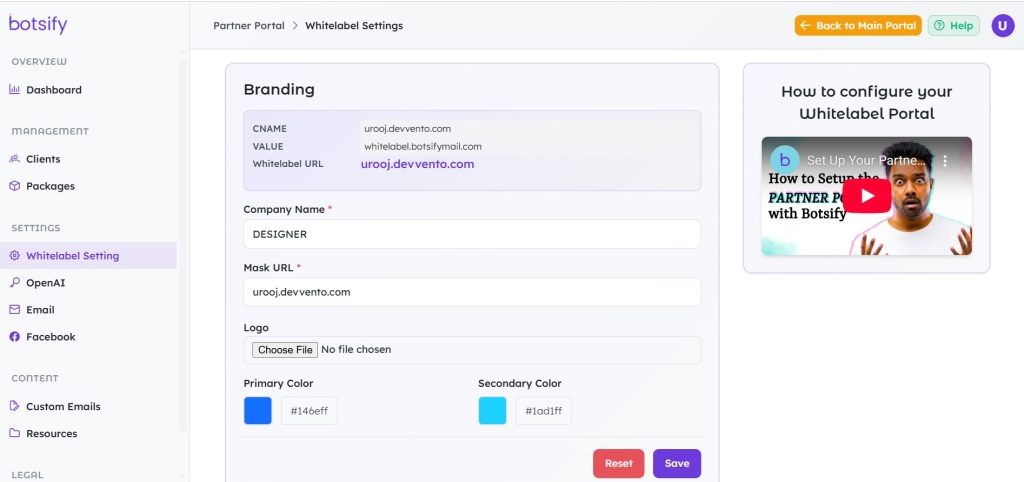

It’s easier to understand this model by visualizing the client experience.
A client signs with your agency to improve support, automate lead handling, or streamline internal coordination. Instead of directing them to an external SaaS login, you provide access to a branded dashboard under your domain.
Behind that environment:
- You use an AI agent builder to configure and manage automation.
- You create white label AI agents tailored to each client’s workflow.
- You deploy chatbots across web, WhatsApp, or messaging channels.
- You configure agent behavior, knowledge, workflows, and integrations without exposing unnecessary backend complexity to the client.
From the client’s perspective, the AI service is delivered through the agency’s own offering instead of feeling like an unrelated third-party product.
Over time, this shifts perception. The agency moves from simply implementing software toward managing an ongoing AI service for the client.
The Infrastructure Advantage: Why Multi-Client Control Changes Everything
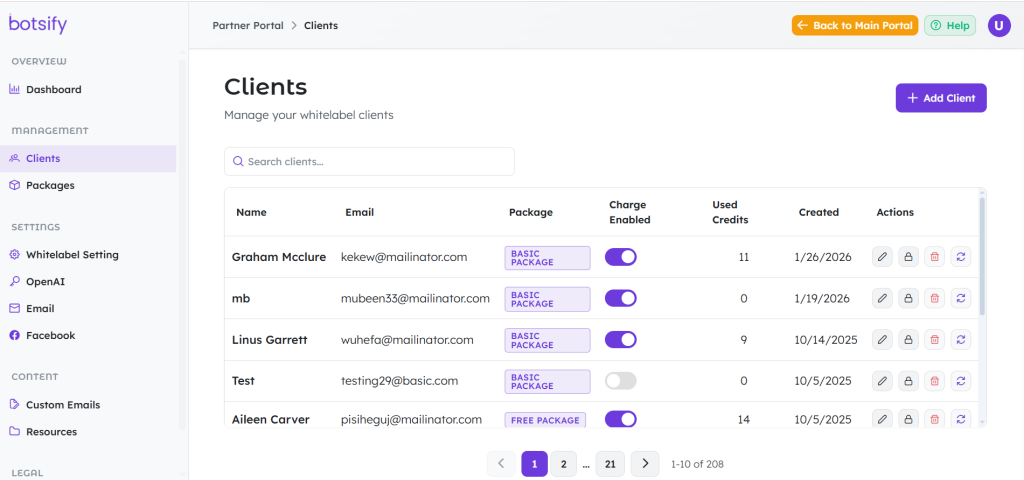

Many agencies underestimate how quickly complexity compounds.
Managing one client implementation is relatively simple. As the number of clients grows, separate accounts, permissions, data, reporting, and configurations become harder to manage without a multi-client structure.
Clean AI Agent Multi-Client Management
A white label platform designed for agencies should provide clear separation between client workspaces, accounts, permissions, and data access. It should also support appropriate internal access controls so team members can manage client environments without mixing accounts.
Managing online accounts inside a single ecosystem reduces friction dramatically. Instead of juggling unrelated logins, you operate within one structured environment.
Scaling Without Chaos
When infrastructure is centralized:
- Updates can be pushed without breaking unrelated clients.
- Reporting becomes consistent.
- Permissions are controlled systematically.
- New clients can be onboarded without reinventing processes.
For agencies that already operate as an AI agent agency, this kind of structure is what allows expansion without burnout.
White Label AI vs Building AI From Scratch
Agencies can either build the underlying AI infrastructure themselves or use an established platform and focus on configuring the solution around client needs.
Building from scratch gives an agency greater control over architecture, hosting, integrations, deployment, and technical decisions. That flexibility can be valuable when the agency is developing proprietary technology or working with clients that require deep customization, but it also brings ongoing engineering, maintenance, security, and infrastructure responsibilities.
White label AI takes a different approach. The provider maintains the core platform while the agency focuses on configuring agents, connecting business systems, defining workflows, deploying the solution, and managing the client relationship.
For agencies whose main value comes from implementation, automation, strategy, and ongoing service rather than software engineering, this can reduce the amount of infrastructure they need to build and maintain themselves. Custom development still has a place, but it should be chosen because the use case requires it rather than because every AI service needs to be built from scratch.
What Agencies Can Sell With White Label AI
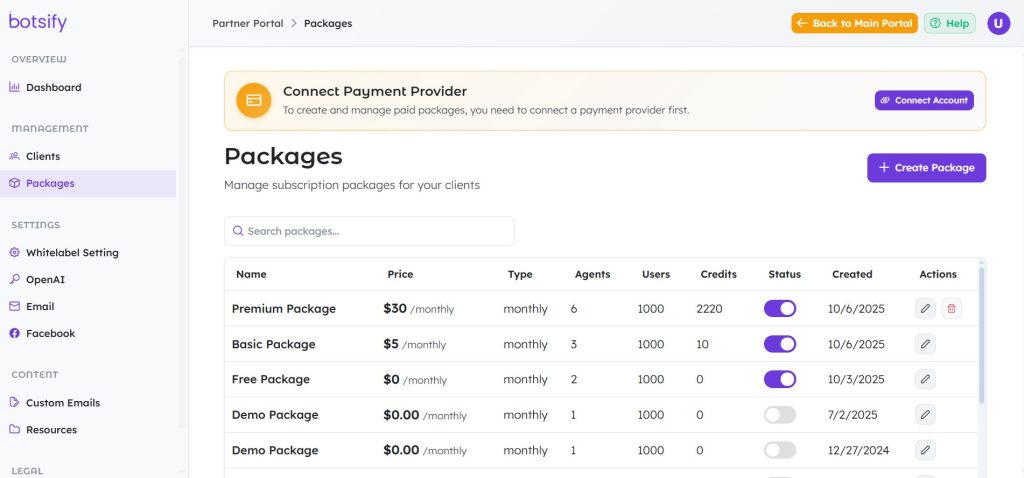

White label infrastructure is not the service itself. Agencies still need to package it around a client problem or outcome.
Common models include:
Managed AI agent services. The agency configures, deploys, monitors, and improves an AI agent for the client.
Industry-specific AI solutions. The agency creates a repeatable offer for a particular niche, such as lead handling for real estate firms or customer support for service businesses.
Ongoing AI management. The agency provides monitoring, optimization, integrations, reporting, and support after deployment.
The platform provides the infrastructure, while the agency defines the use case and manages the client relationship.
Turning that capability into a clear offer is only one part of the commercial process. Agencies also need to understand how to sell AI agents to businesses, from creating a proof of concept to pricing and proving ongoing value.
For businesses building an agency around these services, the next question is how to structure an AI automation agency, including its services, delivery model, technology stack, and recurring operations.
What to Look for in a White Label AI Platform
Not every platform that supports AI is suitable for an agency model. A white label platform needs to support both the AI capabilities the client requires and the operational needs of the agency managing multiple accounts.
White-label branding
Look for control over the client-facing brand, such as logos, domains, interface elements, and other branding options relevant to the service you want to provide.
Pricing and client ownership
Agencies should understand how much control they have over client pricing, billing, account ownership, and the commercial relationship. A platform can be technically white-labelled while still limiting how the agency packages or sells the service.
Multi-client management
Agencies need a practical way to separate client environments, permissions, agents, usage, and access.
AI agent building
The platform should make it possible to configure different agents around different client knowledge, instructions, workflows, and use cases.
Integrations and tool access
AI agents become more useful when they can work with existing business systems rather than operate in isolation.
Channel deployment
Depending on the client, deployment may need to support websites, messaging channels, internal collaboration tools, voice, or other customer-facing environments.
Permissions and governance
Agencies should understand what agents can access, which actions they can take, and how human approval or escalation is handled.
Monitoring and ongoing management
The agency still needs visibility after deployment so it can review performance, update configurations, and manage client issues.
Provider support and platform continuity
The underlying provider becomes part of your delivery infrastructure, so support quality, product stability, updates, and the ability to manage issues across client accounts matter as the agency scales.
These criteria also make it easier to compare the best white label AI platforms based on agency requirements rather than simply comparing feature lists.
Why Botsify Is Designed for This Model
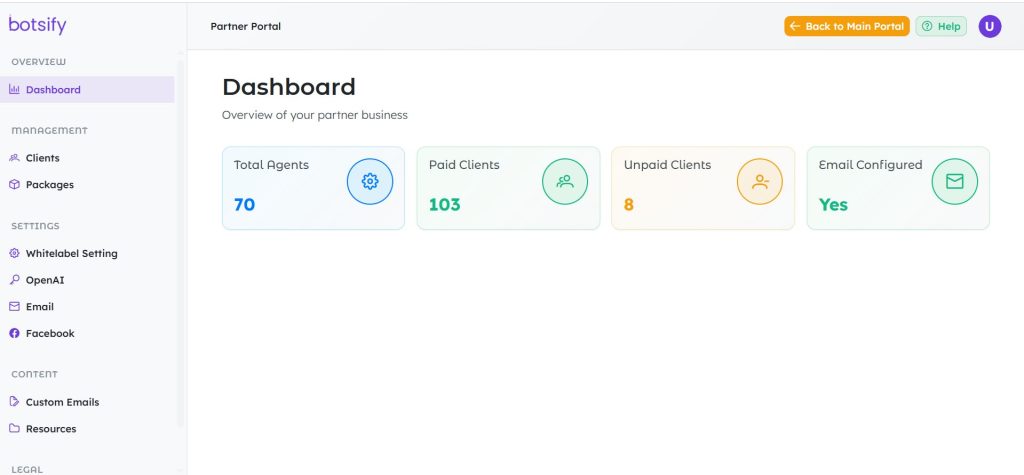

Many AI platforms are designed for a single company managing its own agents. Agencies serving several clients need additional capabilities around branding, client separation, management, and repeatable deployment.
Botsify’s white-label offering is built around this agency model. Agencies can create branded environments, manage client-specific implementations, build AI agents for different use cases, and deploy them across supported channels while Botsify maintains the underlying platform.
This lets the agency focus more of its effort on implementation, client management, optimization, and service delivery rather than developing the entire backend itself.
When White Label AI Makes Strategic Sense — And When It Doesn’t
It’s important to be honest.
White label AI makes sense when:
-
- Your agency wants to deliver AI services under its own brand.
- You manage multiple clients or expect to do so.
- Your advantage is implementation and client service rather than infrastructure engineering.
- You want to create recurring managed AI services.
- You need a repeatable platform instead of rebuilding the stack for each client.
It may not make sense when:
- You are developing proprietary AI software as the product itself.
- You require full control over the underlying architecture and hosting.
- You have engineering resources and a strategic reason to own the complete technical stack.
- Your work is primarily custom research or experimental AI development.
The key question is where your agency creates the most value: building AI infrastructure or using that infrastructure to solve client problems.
If the second matters more, white label AI can be a practical operating model.
Building an AI Service Without Building the Entire Platform
White label AI gives agencies a way to offer AI services under their own brand without developing every part of the underlying technology themselves.
The model sits between simple software reselling and full custom development. The provider maintains the infrastructure, while the agency focuses on configuring the solution, managing the client relationship, and creating value around the service.
Whether that model makes sense depends on what the agency wants to own. Teams building proprietary AI technology may need deeper technical control, while agencies focused on implementation, automation, and recurring client services may benefit more from using an established platform.
The platform is only the foundation. The agency still needs to choose the right client problems, package the service effectively, and prove that the AI solution creates enough value to justify an ongoing relationship.
AI Agentic Platform For Building Portable AI Agents
Say Hello To Agentic AI That Connects With Your CRM And Even Other Agents