

Spend enough time on social media, and you’ll eventually run into inconsistent branding. This is where the same company looks super polished and thoughtful on one platform and like a completely separate business somewhere else, with different logo treatments, and even different promises.
That feels chaotic, no matter who you are, but imagine the kind of impression it leaves on a potential customer trying to decide whether that brand is worth their hard-earned money.
Thankfully, brand consistency is not too complicated. All it takes is building a simple, reusable system so your brand feels like the same “person” wherever people meet it.
At some point, you’ll decide whether you want to build that system entirely in-house or bring in custom branding solutions to help you turn your ideas into a repeatable framework. Either way, the core steps are the same, and they’re practical enough for any growing business to follow.
1. Start with a Clear Core
You can’t be consistent if you’re not sure what you’re being consistent about, so before you worry about formats and templates, define a simple brand core that answers four questions:
- Who are we for?
- What problem do we solve for them?
- How do we want people to feel when they interact with us?
- What do we stand for that doesn’t change from platform to platform?
West Virginia University’s marketing communications program defines brand consistency as delivering a coherent, uniform experience across all touchpoints, and your brand core is the one-paragraph version of that idea.
That one paragraph should feel equally “at home” at the top of your website and on your LinkedIn page, and you should be able to repeat it out loud to a customer without cringing.
Many brands also use ai agents behind the scenes to help maintain message consistency across different digital touchpoints.
2. Come up with Shareable Guidelines
Once the core is clear in your own head, you need to get it out of your head and into a document that others can use. For most small and mid-sized teams, a 3-5 page brand guide covering visuals, voice and tone, and message pillars is enough. A professional team, delivering specialized branding services can help you here.
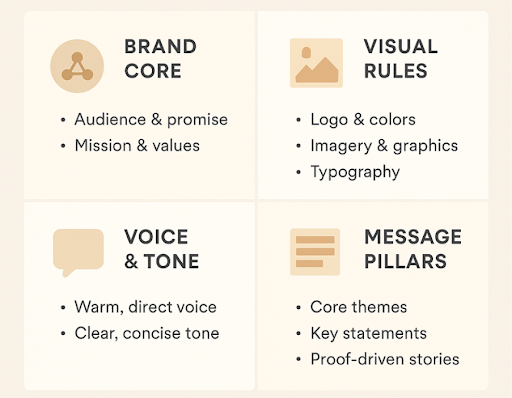
When you onboard a new designer, social media manager, or freelancer, this guide becomes their starting point. Instead of reinventing your brand for each campaign, they plug into a shared system.
As teams scale, some businesses adopt a whitelabel agentic platform to ensure their branding systems remain consistent across departments and external collaborators.
Portable AI Agents In Seconds, Use Everywhere
Prompt, Test, and Deploy AI Agents Across Social Platforms and LLMs. Automate Everything.
3. Adapt per Platform
Consistency obviously does not mean posting the exact same thing everywhere. Even in our personal lives, we present a different side of ourselves on LinkedIn and TikTok. The same can be true in the corporate world. You can also choose to leverage AI tools like uBrand to create viral brand content with AI and automatically publish it across multiple social networks, maintaining a consistent brand voice while still allowing for creative variations tailored to each platform.
Each platform has its own culture and format. Your job is to translate your brand core and guidelines into that context while keeping the same identity. Decide what type of content makes sense on each channel and what an on-brand post would look like for you. You can also use logo tools, to make it easy and simple to maintain brand consistency.
Customer-experience research shows that around three-quarters of consumers expect a consistent experience across channels, and brands with strong omnichannel strategies retain far more customers than those with weak, disjointed ones.
Again, that doesn’t mean your Instagram Reels should read like your investor memo, but people should recognize your brand’s personality instantly.
4. Build Consistent Workflows
Even with good guidelines, your brand will drift if you rely on everyone remembering the rules every time they post. Instead, build systems that make the right choice the easy choice.
Create reusable templates for social posts and email headers that lock in your fonts and spacing. That way, people only customize the content. Then decide who has final say on brand issues. If all new landing pages must be reviewed by someone before launch, there’s much less chance of mistakes slipping by. Some companies even use a brand auditor ai agent to regularly review their assets and flag inconsistencies before they go live.
5. Audit and Measure
You can’t improve what you never look at, so once a quarter, run a simple brand audit. Pick your main platforms and evaluate them against your brand guide.
For each touchpoint, make sure that the visuals match your rules, that the tone sounds right, and that the experience is aligned with the overall message and promises. On the quantitative side, track a few brand-related metrics over time:
- Direct traffic and branded search queries.
- Social saves, shares, and replies (indicators of resonance).
- Email engagement for storytelling campaigns versus promo-only blasts.
- Customer feedback mentioning your values or brand themes in their own words.
Over the long term, studies in marketing and psychology show that strong, consistent brand experiences positively influence both satisfaction and loyalty, so people are more likely to stick with a brand if they feel like they know it. That’s what you’re aiming for.
Is It Worth the Effort?
Studies on brand consistency have found that companies presenting their brand in a uniform way across channels can see revenue lifts of around 20–33% compared with those that struggle with off-brand content.
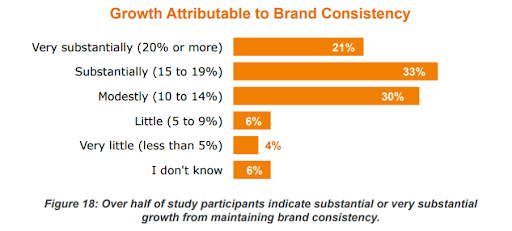
[Source: Demand Metric]
At the same time, your customers are increasingly moving between channels during a single buying journey. Harvard Business Review reports that the majority of shoppers use multiple channels before making a purchase, and omnichannel shoppers tend to spend more than single-channel shoppers.
It’s also pretty clear that a consistent, predictable brand message builds trust and loyalty because people know what to expect from you, directly affecting whether they feel comfortable buying from you.
TL;DR
Brand consistency across platforms is an ongoing habit made up of a few repeatable actions. To begin:
- Write (or refine) your one-paragraph brand core and 3–5 principles.
- Turn that into a short, practical brand guide and share it with anyone who creates content.
- Run a quick audit of your main channels and fix the most obvious inconsistencies in fonts, colors, and tone across your top-traffic pages or posts.
From there, keep iterating, and over time, you’ll end up with a brand that feels trustworthy and aligned with what you actually stand for wherever people encounter it.
AI Agentic Platform For Building Portable AI Agents
Say Hello To Agentic AI That Connects With Your CRM And Even Other Agents