
AI agents are becoming a big part of how modern businesses operate. Instead of just answering questions, today’s AI systems can complete tasks, follow multi-step workflows, connect with internal tools, and support real business processes.
But building AI agents that actually work in production is not simple. Companies need security, governance, system integrations, and clear control over how these agents operate. It’s not enough to experiment with a model – enterprises need platforms that help them design, deploy, and manage AI agents safely and reliably.
That’s where enterprise AI agent platforms come in. These tools provide the infrastructure needed to move from testing ideas to running production-ready agentic workflows at scale.
Top 3 Enterprise AI Agent Platforms
In this article, we will be taking a look at the 10 platforms that are helping enterprises build and deploy some of the best AI agents in real-world environments.
1. Lyzr
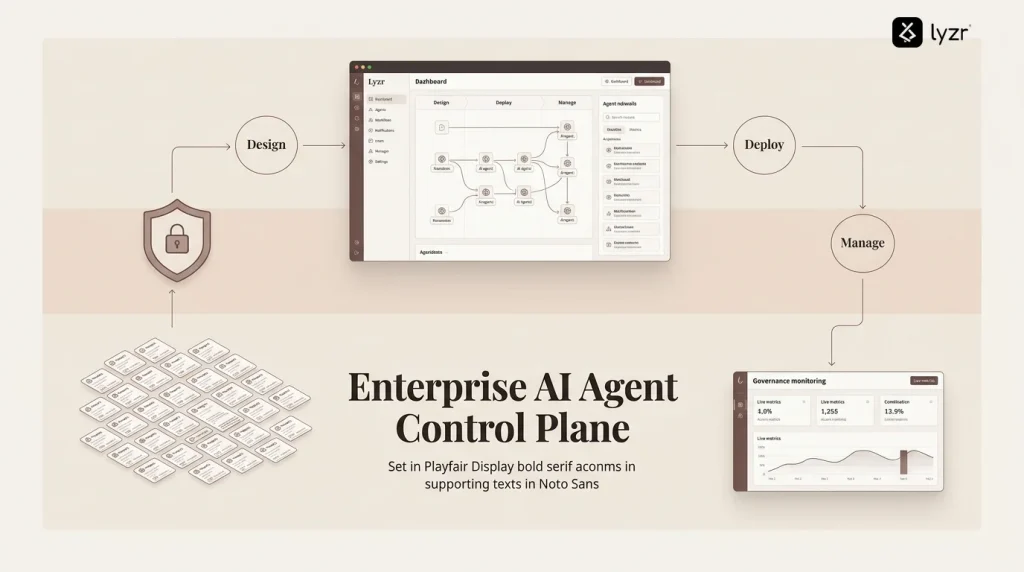
Lyzr describes itself as a control plane for enterprise AI agents. In simpler terms, it’s built to help companies design, deploy, and manage AI agents safely.
Instead of just offering tools to build agents, Lyzr focuses on helping enterprises take AI agents all the way to production. It’s designed for secure deployment and effective workflow integration, especially in industries where compliance and data security matter.
Key Capabilities
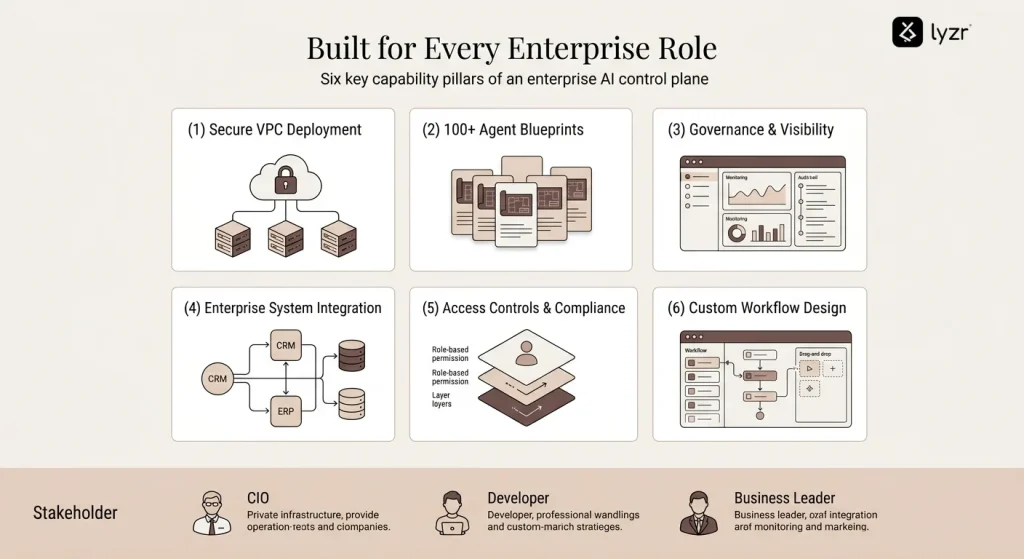
- Secure Deployment in Your Environment: Lyzr can be deployed on SaaS or inside a company’s private VPC (virtual private cloud). This gives enterprises more control over their data and security, which is important for regulated industries like banking and insurance.
- Pre-Built Agent Blueprints: Lyzr offers 100+ agent blueprints designed for real business workflows. These include agents for customer onboarding, loan processing, KYC verification, AML monitoring, and more. These blueprints help companies get started faster instead of building everything from scratch.
- Governance and Visibility: The platform provides oversight into how agents operate. Enterprise teams can monitor workflows, track performance, and ensure agents follow internal policies. This is especially important when AI is being used in high-stakes processes.
- Integration with Business Systems: Lyzr agents can connect to existing enterprise systems and data sources. This allows them to work inside real processes instead of operating as isolated chatbots.
- Access Controls and Compliance Support: Lyzr includes enterprise-grade access controls so organizations can manage who builds, deploys, or updates agents. This helps maintain security and accountability across teams.
- Custom Workflow Design: While the platform offers templates, it also allows teams to design custom workflows that match their specific business logic. This flexibility is important for complex enterprise environments.
- Built for Different Enterprise Roles: Lyzr is designed for multiple stakeholders:
- CIOs get governance and security visibility
- Developers get structured infrastructure for building agents
- Business leaders get production-ready workflows aligned with company goals
2. Microsoft Copilot Studio
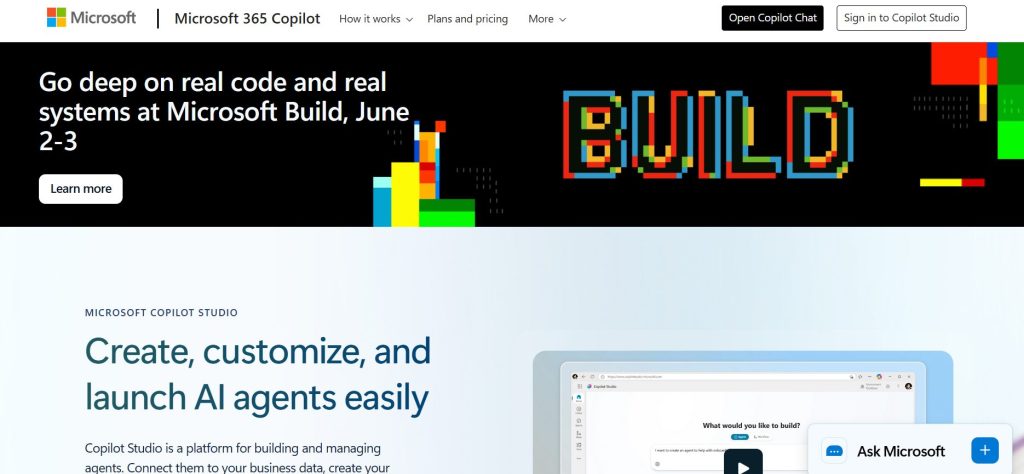
Microsoft Copilot Studio allows businesses to build AI agents that work directly inside Microsoft tools like Microsoft 365, Azure, and Dynamics 365. It’s designed for companies already using Microsoft products who want to add AI-powered workflows without building everything from scratch.
Key Capabilities
- Works Across Microsoft Tools: Copilot Studio connects with apps like Outlook, Teams, SharePoint, and Dynamics. This allows AI agents to access company data and trigger actions inside tools employees already use.
- Low-Code Agent Building: The platform supports low-code development, making it easier for business teams and developers to use an AI agent builder to create and manage AI agents.
- Workflow Automation: It integrates with Power Automate and Power Platform, allowing businesses to automate processes using AI.
- Enterprise Security: Because it runs on Azure, Copilot Studio benefits from Microsoft’s enterprise-grade security and compliance standards.
Portable AI Agents In Seconds, Use Everywhere
Prompt, Test, and Deploy AI Agents Across Social Platforms and LLMs. Automate Everything.
3. Botsify
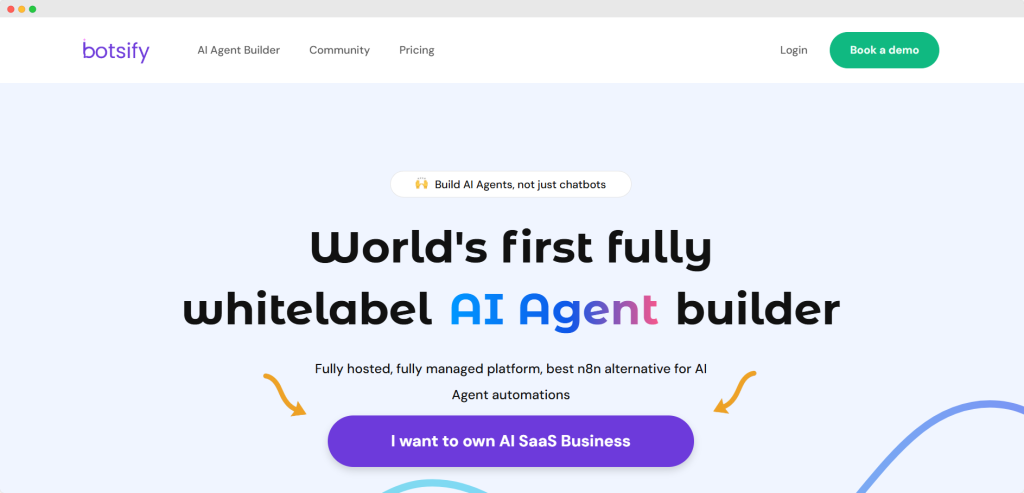
Botsify is a white label AI agent platform that enables businesses to build AI-powered workflows across messaging channels like WhatsApp and websites.It is designed to help companies automate customer interactions, manage conversations at scale, and integrate AI agents into real business processes without heavy development effort.
Key Capabilities
- Multi-Channel Deployment
Botsify allows businesses to deploy AI agents across websites, WhatsApp, and other messaging platforms. This ensures consistent communication and enables teams to manage customer interactions from a unified system. - No-Code Agent and Chatbot Builder
The platform provides a visual, drag-and-drop chatbot builder that allows teams to design conversational workflows and AI agents without requiring coding skills. This makes it accessible for both technical and non-technical users. - Workflow Automation and Integrations
Botsify supports integration with CRMs, APIs, and third-party tools, allowing AI agents to trigger actions, capture leads, and automate business processes across systems. - WhatsApp AI Automation
With strong WhatsApp integration, Botsify enables businesses to automate customer support, lead qualification, and engagement through AI-powered conversations on a widely used messaging channel. - Scalable Deployment
Botsify is built to handle growing volumes of conversations and workflows, making it suitable for AI agents for small businesses as well as enterprises looking to scale their automation efforts efficiently. - Analytics and Performance Tracking
The platform provides insights into conversations, agent performance, and user interactions, helping businesses optimize their workflows and improve results over time.
4. Salesforce Agentforce
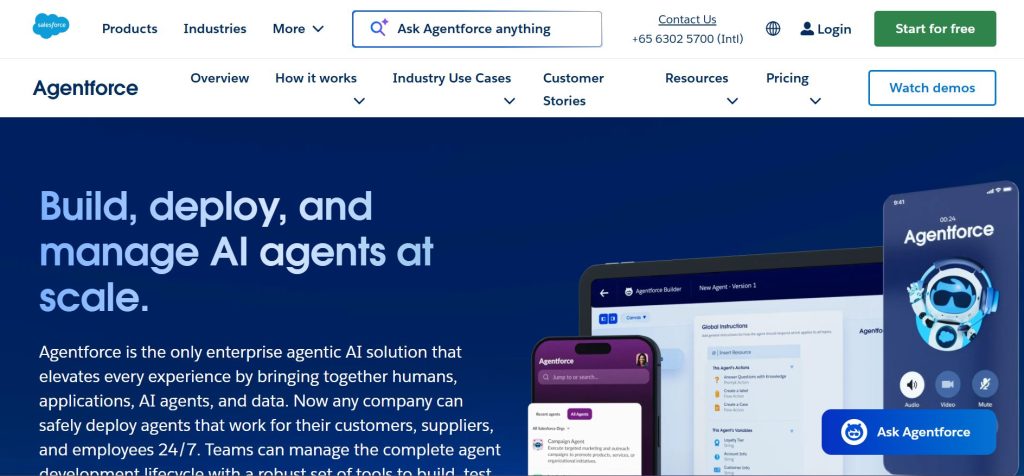
Salesforce Agentforce is part of Salesforce’s AI capabilities, designed to bring AI agents into customer-facing workflows. It allows businesses to use AI inside their CRM processes, especially across sales, service, and support operations.
Key Capabilities
- Native Salesforce Integration: Agentforce works directly inside Salesforce, allowing AI agents to access CRM data and customer records securely.
- Customer Workflow Automation: It supports automation across sales and service processes, helping teams respond faster and handle tasks more efficiently.
- Data-Driven Insights: Because it operates within Salesforce, agents can use real customer data to generate more context-aware responses and actions.
- Enterprise Security: Agentforce operates within Salesforce’s existing security and compliance framework.
5. LangChain
LangChain is an open-source framework widely used to build AI agent systems. It allows developers to connect large language models (LLMs) to tools, APIs, databases, and workflows.
Key Capabilities
- Agent and Tool Orchestration: LangChain allows developers to create agents that can call tools, interact with APIs, and complete multi-step tasks.
- Memory and Context Handling: It supports memory systems that let agents maintain context across conversations or workflow steps.
- Integration with LLMs and Data Sources: LangChain works with multiple language models and can connect to external databases, documents, and retrieval systems. This makes it easier for developers to create custom AI agents that can operate across different data sources and workflows.
- Open-Source Flexibility: Because it is open source, teams can customize it heavily and deploy it within their own infrastructure.
6. CrewAI
CrewAI is an open-source framework designed to build and manage multi-agent systems. Businesses exploring CrewAI alternatives often look for platforms that offer more structured deployment and easier workflow management. It allows developers to assign different roles to AI agents and coordinate them to complete structured tasks.
Key Capabilities
- Role-Based Agent Design: You can define agents with specific roles (for example, researcher, writer, reviewer), each responsible for part of a workflow.
- Task Delegation and Coordination: CrewAI enables agents to collaborate, pass tasks between each other, and execute multi-step processes.
- LLM Integration: It integrates with popular large language models, allowing flexibility in model selection.
- Developer-Centric Control: As an open-source project, CrewAI gives developers full control over logic, structure, and deployment.
7. AutoGen (by Microsoft Research)
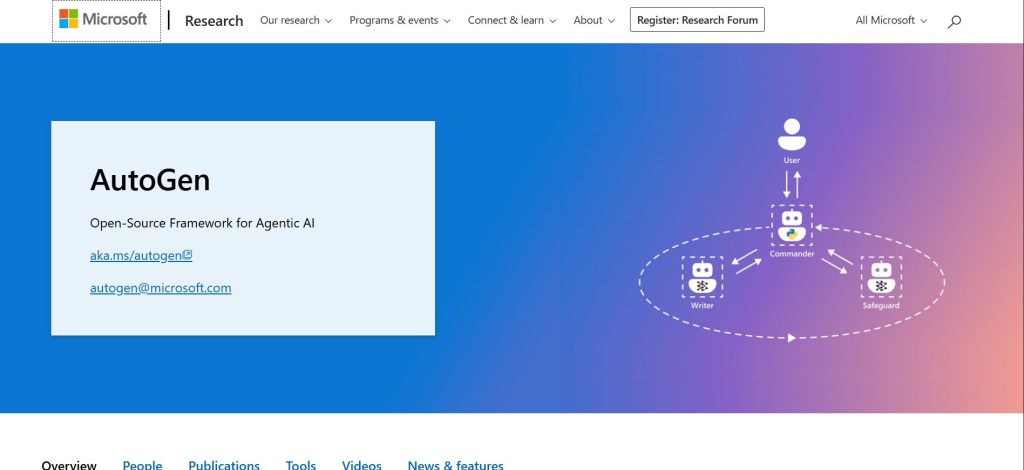
AutoGen is an open-source framework developed by Microsoft Research for building multi-agent systems powered by large language models. It focuses on enabling agents to communicate with each other to complete complex tasks.
Key Capabilities
- Multi-Agent Conversations: AutoGen allows multiple agents to interact, debate, and collaborate to solve tasks. This makes it useful for structured reasoning and multi-step workflows.
- Human-in-the-Loop Support: It supports scenarios where humans can step in during agent workflows for supervision or correction.
- Flexible Model Integration: AutoGen works with different language models and can be adapted to various enterprise use cases.
- Open-Source Foundation: Since it is open source, teams can customize how agents communicate, coordinate, and execute tasks.
8. n8n
n8n is an open-source workflow automation platform that allows teams to connect apps, APIs, and services. While it started as an automation tool, it is increasingly used to orchestrate AI-powered workflows and agent-like systems.
Key Capabilities
- Visual Workflow Builder: n8n provides a drag-and-drop interface where you can design workflows that connect tools, databases, APIs, and AI models.
- AI Model Integration: It supports integration with large language models and can be used to create AI-driven automations and task flows.
- Self-Hosted or Cloud Deployment: n8n can be self-hosted or run in the cloud, giving enterprises control over data and infrastructure.
- Extensive App Integrations: It connects with hundreds of services, making it easy to embed AI agents into existing business systems.
9. IBM watsonx
IBM WatsonX is IBM’s AI and data platform designed for enterprise use. It combines foundation models, data governance, and AI tooling to help organizations build and deploy AI systems, including agent-style workflows.
Key Capabilities
- Enterprise AI Studio: watsonx.ai provides tools to build, train, and deploy AI models and agent-like systems in enterprise environments.
- Governance and Risk Management: watsonx.governance focuses on monitoring, explainability, compliance, and responsible AI — critical for regulated industries.
- Hybrid Deployment Options: IBM supports deployment across cloud and on-premise environments, giving enterprises flexibility.
- Data Integration: Watsonx integrates structured and unstructured enterprise data for AI-driven workflows.
10. Amazon Bedrock Agents
Amazon Bedrock is AWS’s fully managed service for building generative AI applications using foundation models. It includes capabilities for building and deploying AI agents that can perform tasks across enterprise systems.
Key Capabilities
- Foundation Model Access: Bedrock provides access to multiple foundation models through a managed service, allowing enterprises to build AI-powered applications and agents without managing infrastructure.
- Agent for Amazon Bedrock: AWS provides agent functionality that can orchestrate tasks, call APIs, and interact with business systems.
- Deep AWS Integration: Agents can connect with other AWS services such as Lambda, S3, databases, and enterprise applications.
- Security and Compliance: Since it runs within AWS, Bedrock follows AWS security, identity management, and compliance standards.
Conclusion
Enterprise AI agents are becoming a practical tool for real business workflows, not just experiments. Companies are now focused on building systems that are secure, scalable, and ready for production.
The best choice depends on your infrastructure, team, and goals when selecting the right AI agent platform for your needs. In the end, what matters most is selecting a solution that can reliably turn AI ideas into real, working systems.
AI Agentic Platform For Building Portable AI Agents
Say Hello To Agentic AI That Connects With Your CRM And Even Other Agents