
Running a small business usually means running out of time before you run out of ideas. Customer questions pile up, leads don’t get followed up fast enough, admin work eats into productive hours, and marketing execution keeps slipping behind intent.
For years, teams tried to solve this with chatbots and automation. That helped, but only up to a point. Chatbots answered questions and stopped. Automation followed rules and broke when reality didn’t cooperate.
That’s why AI agents for small businesses are getting attention now. Not because they’re flashy, but because they address a very specific problem: work that needs follow-through.
AI agents don’t just respond. They stay involved. And for small teams with limited people, that difference changes how much work actually gets done.
What AI Agents Mean for Small Businesses
For a small business, an AI agent isn’t a futuristic system or a research concept. It’s software that takes responsibility for a task and carries it forward until something actually happens.
That’s the key difference. Most tools small businesses have relied on in the past stop too early. A chatbot replies and waits. Automation runs a rule and assumes success. AI agents for small businesses behave differently. They observe what’s happening, decide what should come next, and act, often across multiple steps. To effectively manage these advanced workflows, many founders are turning to offshoring, utilizing a specialized staffing agency to build remote teams that supervise and refine these AI processes, ensuring technology and human talent work in perfect sync.
This is why people increasingly talk about AI agents over traditional chatbots. Chatbots are useful for answering questions. AI agents are useful for completing work. They can follow up on leads, route support requests, schedule tasks, or escalate issues when they reach a limit.
Many small teams are introduced to this idea through AI agent builder platforms, which allow agents to be set up without heavy technical work. Instead of writing code, businesses define goals, boundaries, and handoff points.
In practice, AI agents for small businesses aren’t about replacing people. They’re about making sure routine work doesn’t stall just because the same few people are busy.
Portable AI Agents In Seconds, Use Everywhere
Prompt, Test, and Deploy AI Agents Across Social Platforms and LLMs. Automate Everything.
Why Small Businesses Feel the Pain More Than Anyone
Inefficiency affects small businesses differently than large ones. There’s no buffer. When a follow-up slips, revenue is lost. When a support request waits, a customer notices. When admin work piles up, growth work gets pushed aside.
This is why AI agents for small businesses are gaining traction faster with small teams than with enterprises. The problems are immediate, and so are the benefits.
Most small businesses deal with the same pressure points:
- Leads come in, but responses aren’t always fast
- Support questions wait while the team is busy
- Scheduling and reminders fall through
- Internal requests bounce between people
These aren’t strategic problems. They’re consistency problems.
This is where an AI agent for business becomes useful in a very practical way. An agent can own repetitive follow-through, sending reminders, routing requests, updating systems, and making sure nothing quietly dies in someone’s inbox.
Some teams even use agents inside internal tools, similar to a Slack automation agent, to keep approvals and tasks moving without constant manual nudging.
For small businesses, the appeal isn’t novelty. It’s relief.
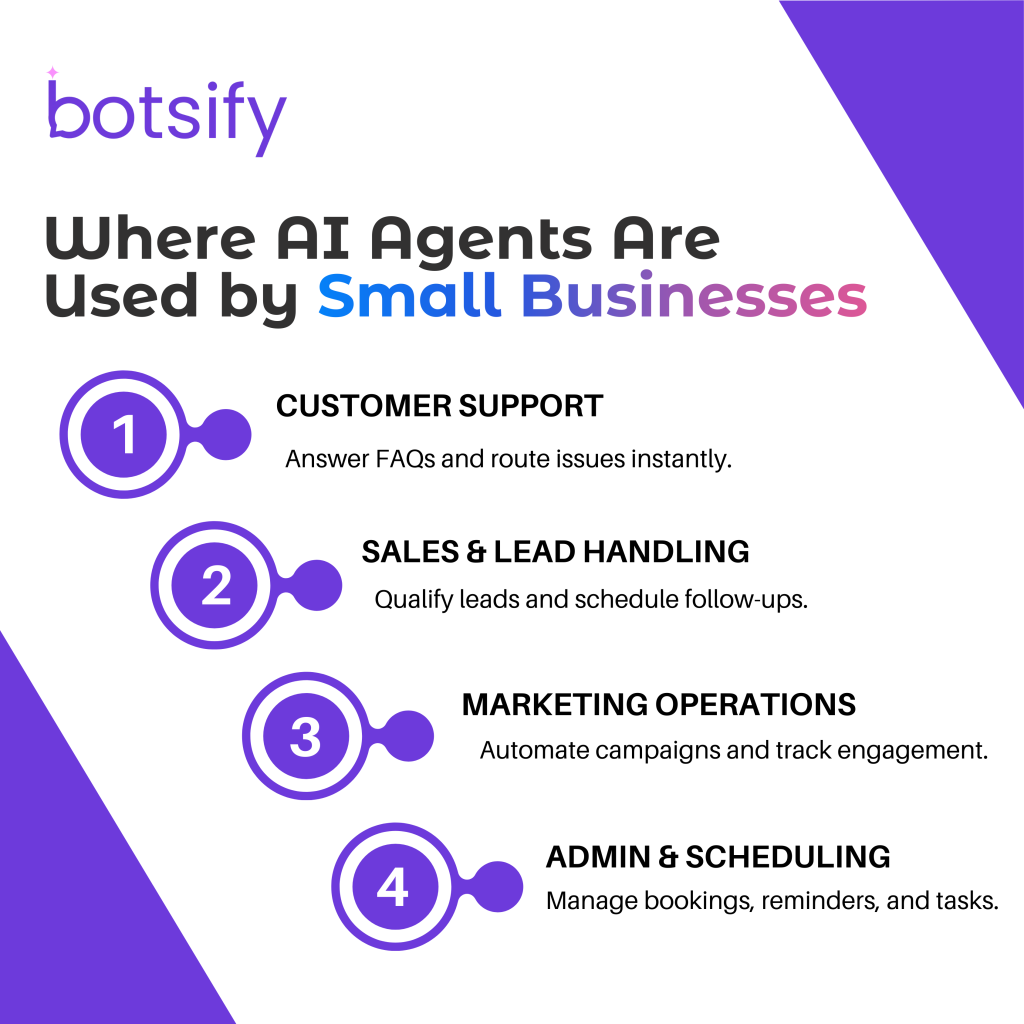
Where AI Agents Are Used Today in Small Businesses
Customer Support That Doesn’t Stall
Support is often the first place small businesses try AI agents.
An agent can handle common questions, collect details, check records, and escalate when needed. Unlike traditional bots, it doesn’t vanish after one reply. It tracks the issue until something actually happens.
Some teams also run internal agents, similar to a Slack automation agent, that route issues, notify the right people, or update ticket status automatically so nothing gets stuck.
The result isn’t fewer humans. It’s fewer unresolved issues.
Sales and Lead Handling Without Dropped Balls
Sales problems in small businesses rarely come from bad conversations. They come from slow or missed follow-ups.
AI agents help by qualifying leads, asking the right questions, scheduling next steps, and keeping track of context. In industries like real estate or marketplaces, agents may even pull external data using tools such as a property scraper AI agent before a salesperson steps in.
This ensures interest doesn’t fade just because someone was busy.
Marketing Operations That Actually Execute
Small teams usually don’t struggle with ideas. They struggle with execution.
Marketing agents help manage segmentation, trigger follow-ups, publish content, and monitor responses across tools. Some businesses use agents similar to a SEO blog writer AI agent to assist with drafts, while others focus on scheduling and publishing consistency.
Some teams also use lightweight tools as a business idea generator to explore new campaign angles or content themes before an AI agent handles publishing and follow-through.
The goal isn’t creativity. It’s making sure planned work actually goes live.
Admin and Scheduling in the Background
Scheduling, reminders, routing requests, and reporting don’t drive growth, but they consume time.
AI agents quietly handle these tasks, retry actions when something fails, and surface issues instead of letting them break silently. This kind of work is too variable for rigid automation and too repetitive for people to manage well.
What a Typical AI Agent Workflow Looks Like
To understand why AI agents for small businesses work, it helps to look at a real workflow instead of abstract features.
Imagine a common scenario:
A visitor fills out a contact form late at night.
An AI agent responds immediately, asks a few qualifying questions, and checks availability.
It schedules a call, updates the CRM, and sends a confirmation.
If the lead replies with a change, the agent adjusts or flags it for a human.
No one has to monitor this manually.
Another example is support. A customer submits an issue. The agent categorizes it, checks known solutions, applies fixes where possible, and escalates only when necessary. If something fails, it retries or alerts staff instead of stopping.
These workflows are typically built using branded AI agent builder platforms, which handle memory, integrations, and execution so small teams don’t have to wire systems together themselves.
This is where agents differ from automation. Automation assumes success. Agents handle outcomes.
Top AI Agents for Small Businesses (Practical Tools)
Small businesses don’t need dozens of tools. They need a few that fit their workflows and maturity level. Below are some of the most practical options in use today.
1. Botsify — Multi-Step Agents Across Support, Sales, and Ops
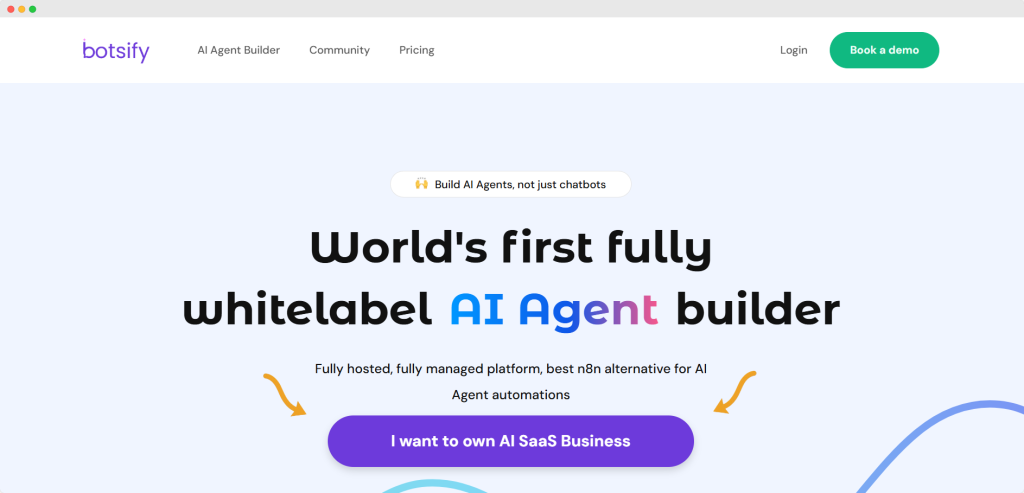
Botsify is often chosen by small businesses that want agents doing real work, not just chatting. It supports multi-step workflows across customer support, lead handling, scheduling, and internal operations.
It’s particularly useful for teams that want flexibility without heavy development, and for agencies planning to launch business with whitelabel ai agents under their own brand.
Best for: service businesses, agencies, SMBs with mixed workflows
Less ideal for: teams needing deep custom code from day one
2. Lindy — Conversational Engagement and Fast Responses
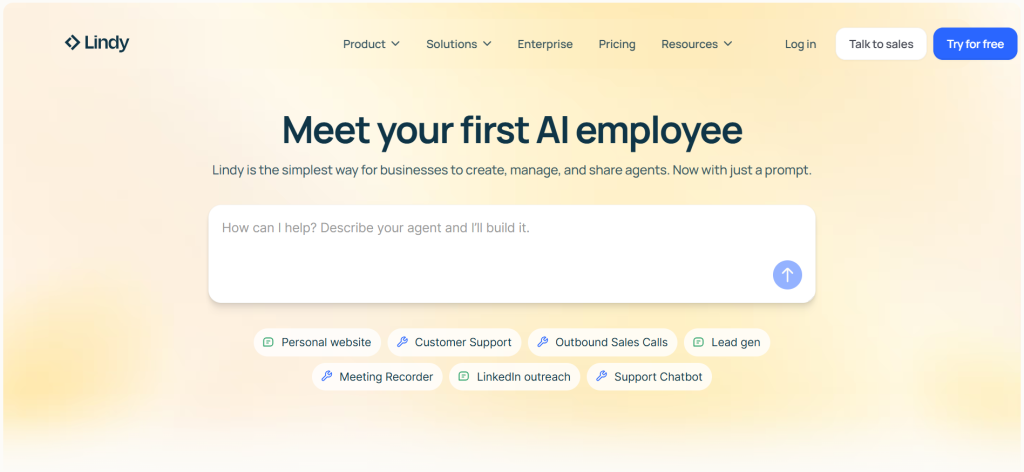
Lindy focuses heavily on conversational agents that handle real-time interactions well. It’s strong for quick engagement, lead interaction, and initial conversations.
For small businesses that rely on speed and conversation, especially inbound, it can be a good fit.
Best for: lead engagement, conversational workflows
Less ideal for: complex multi-step internal operations
3. Botpress — Flexible, Developer-Friendly Agents
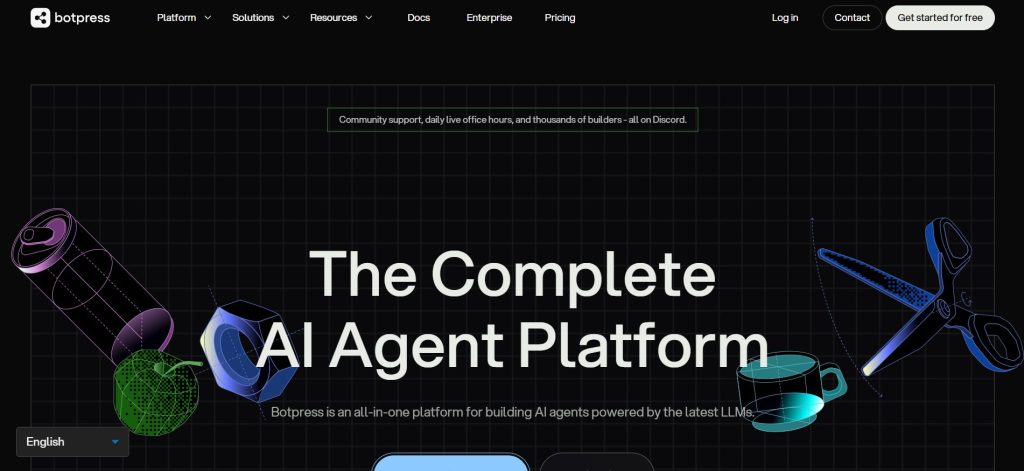
Botpress offers more control for teams comfortable with technical setup. It’s often paired with custom logic and deeper integrations, especially where businesses want to build highly specific workflows.
This flexibility comes with complexity, which may not suit every small team.
Best for: technical teams, custom workflows
Less ideal for: non-technical users wanting fast setup
4. HelpLy — Task-Focused Productivity Agents
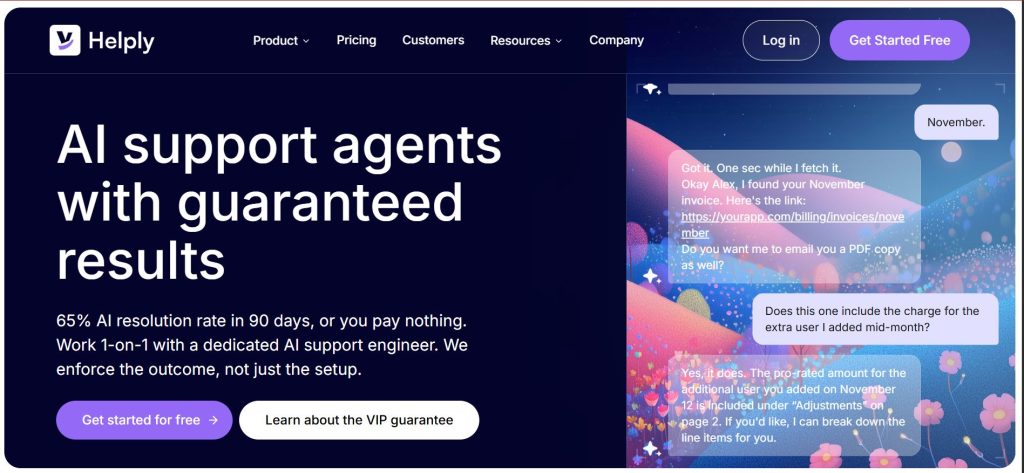
HelpLy positions itself around task automation and productivity. It’s useful for small teams that want to automate specific workflows without building large systems.
These agents are often simpler but effective for narrow use cases.
Best for: quick wins, task-specific automation
Less ideal for: broader, cross-department workflows
5. Relevance AI — Data-Driven and Internal Workflow Agents
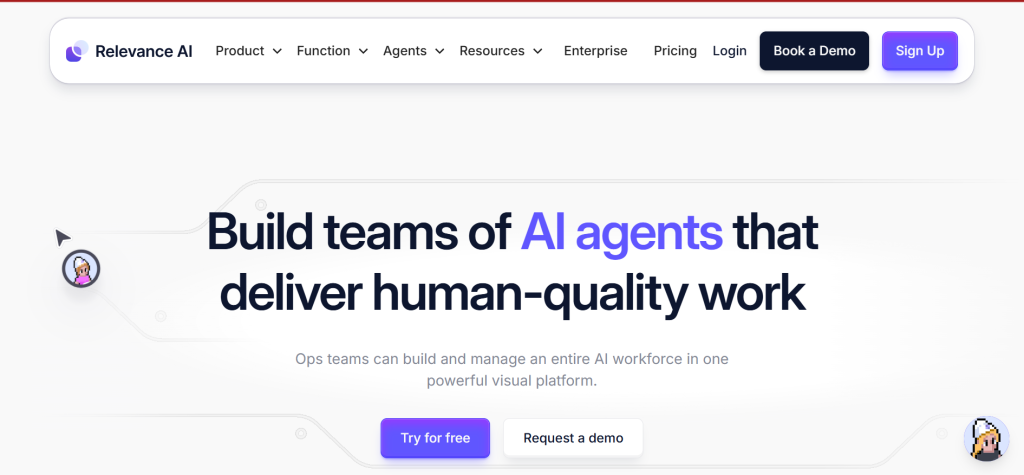
Relevance AI is often used for internal workflows, data processing, and operational intelligence. It works well where agents need to analyze information, route tasks, or support decision-making behind the scenes.
For small businesses dealing with internal data, reporting, or coordination across tools, it can be a strong option.
Best for: internal ops, data-driven workflows
Less ideal for: customer-facing conversational use
Why AI Agents Make Sense for Small Businesses
The value of AI agents for small businesses isn’t theoretical. It shows up in daily operations.
They provide:
- Faster response times without hiring
- Availability outside business hours
- Fewer missed follow-ups
- Reduced admin load
- More consistent execution
Instead of adding headcount to cover routine work, businesses use agents to absorb volume. This frees people to focus on judgment, relationships, and growth.
For consultants and agencies, this advantage compounds. Using a whitelabel ai agent builder allows the same agent logic to be reused across clients instead of rebuilt each time.
How Small Businesses Should Start With AI Agents
The biggest mistake is trying to automate everything.
A better approach:
- Pick one repetitive, high-impact workflow
- Define clear boundaries and stop points
- Keep humans in the loop
- Measure outcomes
- Expand gradually
Many teams start by experimenting with websites to build ai agents or lightweight setups before committing to a broader system. Others explore different AI agent frameworks to understand what level of control they need.
What matters is fit, not sophistication.
Choosing the Right AI Agent for Your Small Business
There’s no universal “best” setup. What works depends on how your business runs today and how much complexity you want to manage.
Some teams start with no-code tools to get value quickly. Others need more flexibility as workflows grow across systems and tools. Channel focus also plays a role. Businesses that rely heavily on messaging may prioritize an AI agent for WhatsApp, while others prefer more portable AI agents that can operate across platforms without being locked into one channel.
Before choosing a setup, small businesses should consider:
- Team size and who will monitor the agent
- Comfort with technical setup
- Budget constraints
- Long-term growth plans
At the end of the day, an AI agent builder should adapt to the business, not force the business to adapt to the tool.
Final Thoughts
AI agents for small businesses aren’t about replacing people. They’re about removing friction between intention and execution.
When designed responsibly, agents help small teams operate with the consistency of much larger organizations, without losing control or flexibility.
The businesses seeing real value aren’t chasing trends. They’re using agents to make sure important work actually gets done.
And for small teams, that often makes all the difference.
AI Agentic Platform For Building Portable AI Agents
Say Hello To Agentic AI That Connects With Your CRM And Even Other Agents