

For years, businesses have used automation and chatbots to handle repetitive tasks, answering questions, routing messages, triggering workflows. That worked, until expectations changed.
Today, companies don’t just want systems that respond, they want conversational AI that can understand intent and context.
This is where Agentic AI enters the picture.
Agentic AI refers to a new class of AI systems built around AI agents, autonomous software entities designed to pursue goals, adapt to context, and take meaningful action. Instead of following rigid scripts, these agents can plan steps, use tools, and adjust their behavior based on outcomes.
The shift is subtle but important.
As organizations explore AI agents for customer support, sales, marketing, and operations, terms like multi-agent AI and general-purpose AI agents are becoming more common, but also more confusing. What actually qualifies as an AI agent? How are these systems different from traditional automation? And what does this change mean for real businesses trying to scale?
This article breaks Agentic AI down to its core ideas, clearly, practically, and without hype. You’ll see how AI agents work, how they collaborate, where they’re being used today, and how businesses are already experimenting with different AI agent platforms and tools.
Agentic AI isn’t about replacing people.
It’s about building systems that can operate with intent.
What Is Agentic AI?
Agentic AI describes a way of building AI systems, not a specific tool or model.
Instead of designing AI to produce isolated outputs, Agentic AI focuses on systems that can pursue goals over time. These systems are given objectives, constraints, and access to tools, then allowed to decide how to move toward an outcome.
What makes an AI system “agentic” is agency, the ability to choose actions based on context rather than following a fixed script. That includes deciding when to act, what to do next, and when to stop or escalate.
This marks a shift from earlier approaches to automation. Traditional AI systems operate in short loops: input arrives, output is returned, the process ends. Agentic AI systems operate in longer loops, where each step informs the next.
In business terms, this means AI is no longer limited to assisting at the edges of work. It can participate inside workflows, handling follow-through, managing dependencies, and adapting when conditions change.
Agentic AI isn’t about replacing existing tools.
It’s about changing the role AI plays inside real operations. This shift is already visible in how modern agentic AI platforms are being built for business use, not just experimentation.
What Is an AI Agent?
An AI agent is the unit that makes agentic systems possible.
At a practical level, an AI agent is a software entity that can:
- Interpret inputs from users or systems
- Decide what action to take
- Execute that action using available tools
The action doesn’t have to be conversational. It might be updating a database, triggering a workflow, scheduling a task, or handing control to a human when needed.
What separates an AI agent from most AI-powered tools is continuity. An agent doesn’t exist for a single response, it persists across steps. It keeps track of what has happened, what still needs to happen, and what the next move should be.
AI agents can be designed for different scopes. General-purpose AI agents handle a wide range of tasks across contexts, while specialized agents focus on specific responsibilities where reliability matters more than flexibility. In real deployments, both are used together.
As organizations scale their use of AI agents, the challenge quickly shifts from capability to management. Creating agents one by one doesn’t scale. This is why businesses and agencies increasingly rely on platforms that act as a whitelabel AI agent builder platform, allowing agents to be configured, reused, branded, and deployed across multiple use cases without rebuilding core logic.
An AI agent isn’t defined by how advanced the model is.
It’s defined by whether it can carry work forward.
How AI Agents Work: Core Building Blocks
AI agents don’t work because they “sound intelligent.” They work because they’re built around a small set of practical components that let them operate inside real systems.
While implementations vary, most agentic AI systems rely on the same underlying structure.
Context and Memory
Every AI agent needs context. Without it, actions become disconnected and unreliable.
This usually takes the form of AI agent memory, which can include short-term context (what’s happening right now) and longer-term information (past interactions, preferences, rules). Memory allows an agent to avoid repeating steps, recognize patterns, and make decisions that reflect what has already happened.
In business settings, this is what enables continuity, knowing whether a lead has already been contacted, a ticket has been escalated, or a task is still pending.
Decision-Making and Planning
Once an agent has context, it needs a way to decide what to do next.
Planning doesn’t mean complex reasoning in every case. Often it’s simple prioritisation: what action moves this task forward? In more advanced setups, agents break goals into steps and choose actions based on constraints, timing, or available resources. This becomes especially effective when supported by proper data collection for AI-driven analysis.
This planning layer is what separates AI agents from basic automation. Instead of following a fixed workflow, the agent adapts when conditions change.
Tools and Integrations
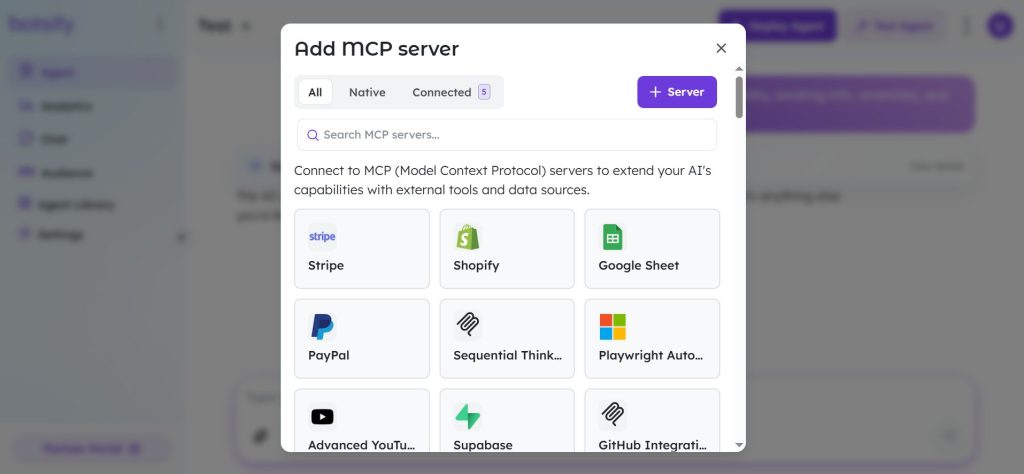
Agents become useful when they can act outside their own environment.
That’s why access to tools, CRMs, databases, calendars, messaging platforms, internal APIs, is critical. An agent that can only generate text is limited. An agent that can read and write to systems can actually complete work. This is why businesses are starting to use AI agents for tasks like keyword research and data analysis, where external tools and datasets are part of the workflow.
In multi-agent AI environments, different agents may specialize in different tools, coordinating actions rather than relying on a single monolithic workflow.
Execution and Feedback
After choosing an action, the agent executes it and observes the result. This feedback loop is what keeps the system grounded. If an action fails, the agent can retry, choose an alternative, or escalate to a human.
This doesn’t require constant learning or retraining. In many cases, it’s simply about handling outcomes instead of assuming success.
Why This Structure Matters
Taken together, these components, memory, planning, tools, and feedback, are what make AI agents operational. Remove any one of them, and the system falls back into being reactive or brittle.
At this point, teams usually face a decision between building everything themselves or using a whitelabel platform that abstracts this complexity.
AI agents don’t need to be complicated to be effective. They need to be well-structured.
Types of AI Agents Businesses Use Today
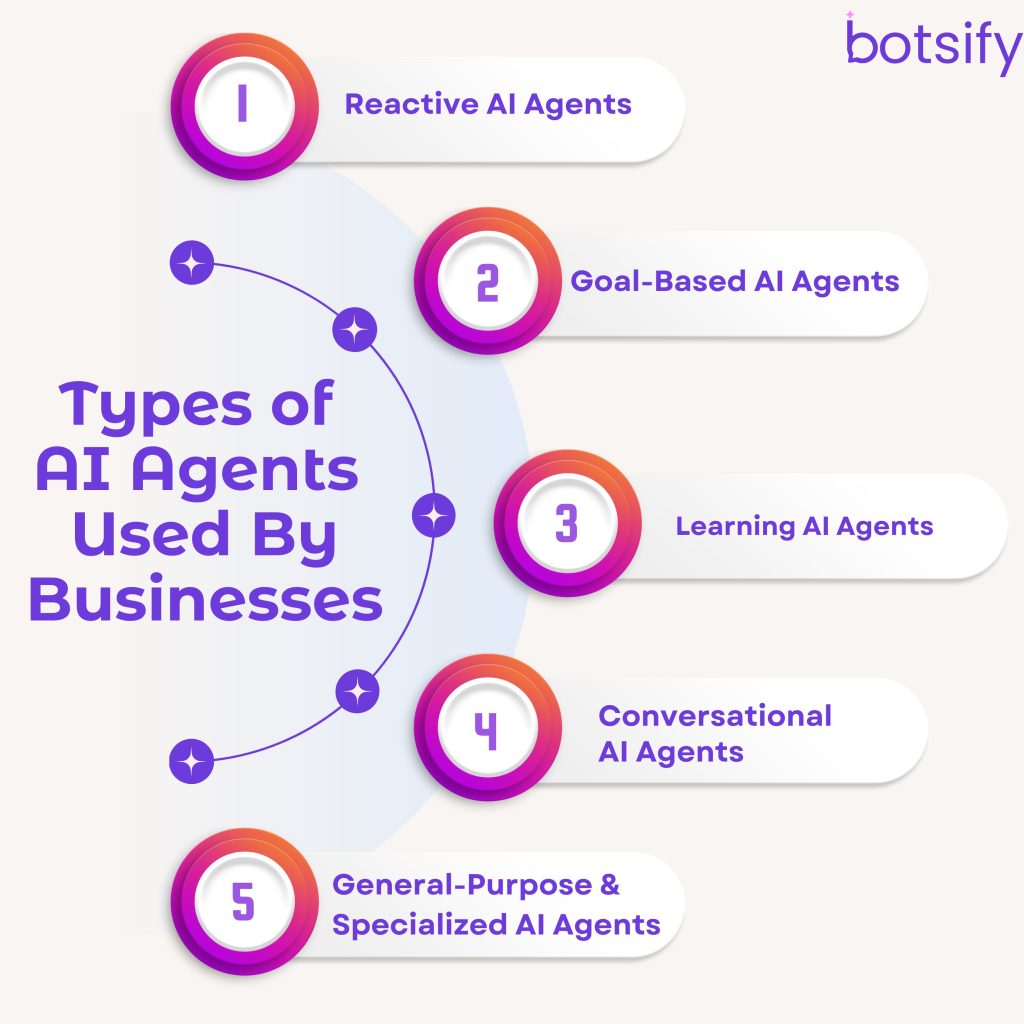
Not all AI agents behave the same way, and treating them as interchangeable usually leads to poor results. In practice, businesses use different types of AI agents depending on how much autonomy, flexibility, and control a task requires.
Here are the main categories you’ll encounter in real deployments.
Reactive Agents
Reactive agents operate in the moment. They respond to inputs based on current context but don’t plan ahead or maintain long-term goals.
These agents are useful for straightforward scenarios, answering common questions, routing requests, or handling simple triggers. They’re fast and predictable, but limited. If the situation changes or requires multi-step reasoning, reactive agents hit their ceiling quickly.
Goal-Based Agents
Goal-based agents are designed around outcomes rather than responses. They receive an objective, such as resolving a support issue or qualifying a lead, and choose actions that move toward completion.
This is where AI agents start to feel practical for business use. Instead of following a fixed path, they can adjust steps based on what happens next. If one approach fails, they try another. Most operational use cases sit in this category.
Learning Agents
Learning agents improve over time based on feedback. They analyze outcomes, identify patterns, and adjust future behavior accordingly.
In business environments, these agents are often used where optimization matters, recommendations, prioritization, or performance tuning. They require stronger guardrails, but when deployed carefully, they reduce manual refinement and constant rule updates.
Conversational Agents
Conversational agents interact primarily through language, but their value doesn’t come from conversation alone, especially when deployed as chatbots for websites that connect directly to internal systems.. What matters is whether the agent can act beyond the exchange, updating systems, triggering workflows, or coordinating follow-ups.
This category is often confused with chatbots. The difference is that conversational AI agents don’t stop at replies. The conversation is just the interface, not the job.
General-Purpose vs Specialized Agents
Some AI agents are built to handle a wide range of tasks across contexts. These general-purpose AI agents are useful in dynamic environments where requirements change frequently.
Specialized agents, on the other hand, are designed for narrow responsibilities, billing queries, appointment scheduling, internal reporting. They’re less flexible but more reliable.
Most mature systems use both. General-purpose agents handle variability, while specialized agents ensure consistency where precision matters.
Why Classification Matters
Choosing the wrong type of agent creates friction. Overpowered agents add risk. Underpowered ones create bottlenecks.
This is why businesses increasingly rely on platforms that allow multiple agent types to be configured and managed together. A whitelabel Agentic AI platform makes this easier by supporting different agent behaviors under a single operational setup.
AI agents work best when their role is clearly defined.
What Is Multi-Agent AI? How AI Agents Work Together
Single AI agents are useful. Multi-agent AI systems are where things start to scale.
A multi-agent system is built around the idea that different agents handle different responsibilities, working together toward a shared outcome. Instead of one agent trying to do everything, tasks are distributed. Each agent focuses on what it does best.
This mirrors how real teams work.
In a simple setup, one agent might gather information, another evaluates options, and a third executes actions. These agents don’t operate in isolation, they pass context, results, and constraints to one another. Coordination replaces rigid workflows.
The value of multi-agent AI becomes clear when tasks grow beyond single steps. Consider a common business scenario: handling an inbound request. One agent interprets intent, another checks internal systems, and another takes action, updating records, scheduling follow-ups, or escalating when necessary, even across channels like WhatsApp chatbots. No single agent needs full control, but together they move the task forward.
This approach reduces bottlenecks. It also reduces risk. When responsibilities are separated, errors are easier to contain and behavior is easier to monitor. Businesses don’t need one highly complex agent, they need several simpler ones that collaborate.
Multi-agent systems are especially effective in automation-heavy environments, where tasks involve multiple tools and decisions. That’s why AI agents for automation increasingly rely on agent collaboration rather than linear workflows. When conditions change mid-process, agents can adapt instead of failing silently.
From an operational perspective, managing multiple agents manually doesn’t scale. This is where platforms matter. A whitelabel agent builder platform allows teams to define roles, assign permissions, and deploy coordinated agents without rebuilding logic each time. For agencies, this also makes it possible to reuse proven agent setups across clients, especially when using branded AI agent builder platforms for agencies.
Multi-agent AI isn’t about complexity for its own sake. It’s about dividing work so systems stay reliable as they grow.
Agentic AI vs Traditional Chatbots
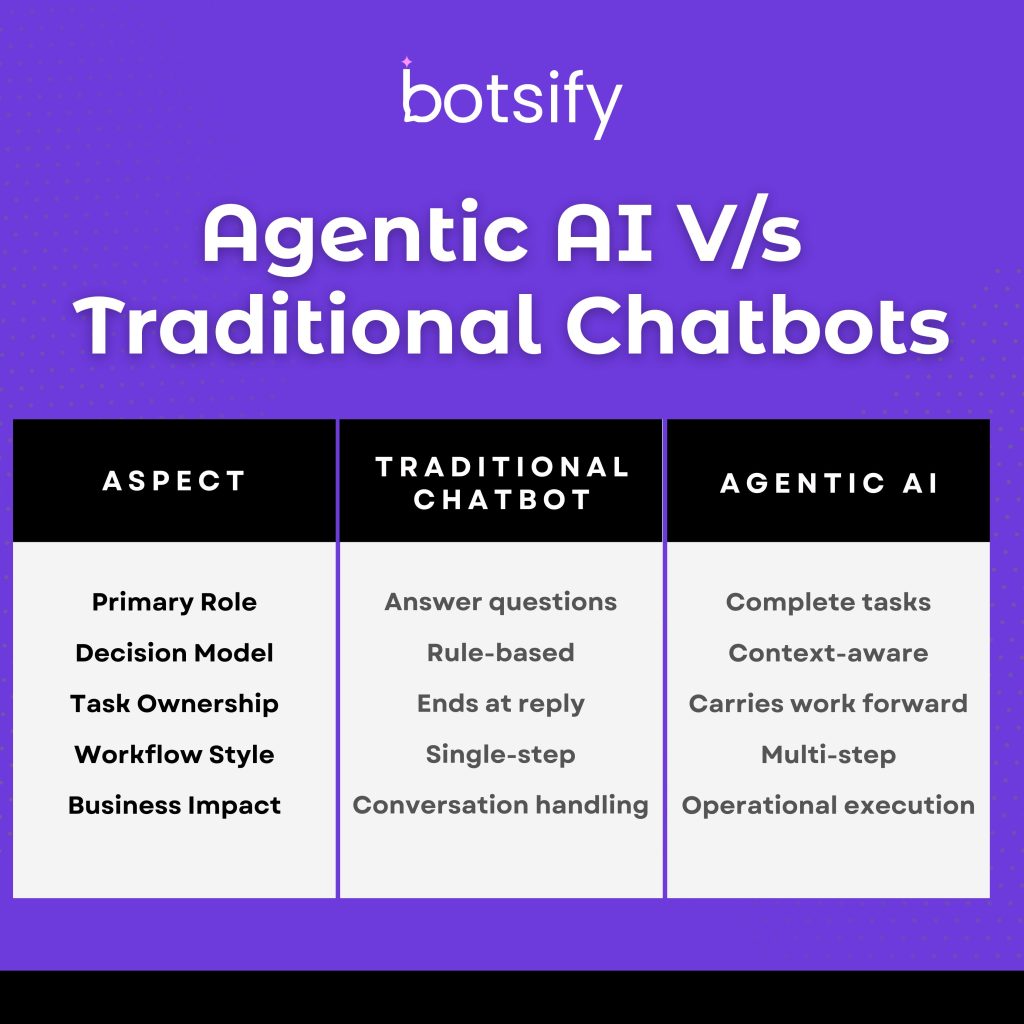
Traditional chatbots are built to respond. An input comes in, an answer goes out, and the interaction ends.
That works for FAQs and simple routing. It breaks down when work needs to continue, when data must be updated, follow-ups scheduled, or decisions carried forward across systems.
Agentic AI operates differently.
An AI agent chatbot treats conversation as a signal, not the finish line. It can interpret intent, decide what needs to happen next, and take action, triggering workflows, updating tools, or escalating when required. The chat interface remains, but it’s no longer the core capability.
This distinction becomes clear in real operations. Chatbots acknowledge requests. Conversational AI agents move tasks forward. The difference isn’t tone or intelligence, it’s responsibility.
That’s why many businesses are shifting away from standalone chatbots and spending more time choosing the right chatbot or agent platform for long-term use. Platforms built as a whitelabel AI agent builder make this shift manageable by centralizing agent behavior, integrations, and deployment.
Portable AI Agents In Seconds, Use Everywhere
Prompt, Test, and Deploy AI Agents Across Social Platforms and LLMs. Automate Everything.
Real Business Use Cases of Agentic AI
Agentic AI becomes valuable when work doesn’t end with a response. In most businesses, the real cost isn’t answering questions, it’s what happens after the answer. That’s where AI agents are being applied today.
Customer Support That Doesn’t Stall
In support teams, delays usually happen between steps: a question is answered, but the issue isn’t resolved. An AI agent can track the state of a request, pull relevant data, update systems, and escalate when needed. The result isn’t faster replies, it’s fewer unresolved tickets, one of the key benefits of using an AI assistant for customer service.
This is why many companies now use conversational AI agents as the first operational layer, not just a front-line chatbot.
Sales and Lead Handling
For sales teams, speed and follow-through matter more than perfect messaging. AI agents are used to qualify leads, route them correctly, and ensure no inquiry goes unanswered, whether it comes from websites or channels like Instagram Chatbots. A general-purpose agent can handle early conversations, while more specialized agents manage scheduling or CRM updates.
The agent doesn’t replace sales, it removes gaps where leads are lost.
Marketing Operations
Marketing teams increasingly rely on AI agents for execution, not just content, particularly in ecommerce workflows powered by Shopify chatbots. Agents can manage follow-ups, segment audiences, coordinate campaigns across channels, and monitor responses. In these cases, agentic AI reduces manual coordination rather than replacing strategy.
Internal Operations and Admin Work
Many internal tasks are repetitive but fragile, such as handoffs between tools, status updates, scheduling, and reporting, which are often handled through internal tools like Chatbot for Slack. AI agents handle these well because they don’t rely on perfect inputs. If a step fails, the agent can retry, choose an alternative, or flag the issue.
This is where AI agents for automation quietly save time without changing how teams work.
Agencies and Multi-Client Environments
Agencies face a different challenge: repeating the same workflows across clients. Here, agentic systems shine when deployed through a whitelabel AI agent builder platform. This is also how many agencies are beginning to offer white label AI agents as a repeatable service, rather than custom one-off builds.
For agencies, this turns AI agents from experiments into scalable services.
How Businesses Build and Deploy AI Agents Today
Once companies move past experimentation, the question stops being what is an AI agent and becomes how do we put one into real use without breaking things.
In practice, businesses take one of two paths.
Building AI Agents from Scratch
Some teams choose to build AI agents entirely in-house. This usually involves developers stitching together models, APIs, memory layers, and integrations using frameworks or custom code.
This approach offers maximum control. Teams can define exactly how agents behave, which tools they can access, and how decisions are made. It’s often used in highly regulated environments or where agents must operate inside complex, proprietary systems.
The downside is time and maintenance. Even a simple AI agent requires ongoing tuning, monitoring, and infrastructure work. As soon as multiple agents or workflows are involved, complexity grows quickly. For many businesses, this approach only makes sense if AI is already a core engineering focus.
Using No-Code and Platform-Based Approaches
Most organizations don’t want to become AI infrastructure companies. They want outcomes.
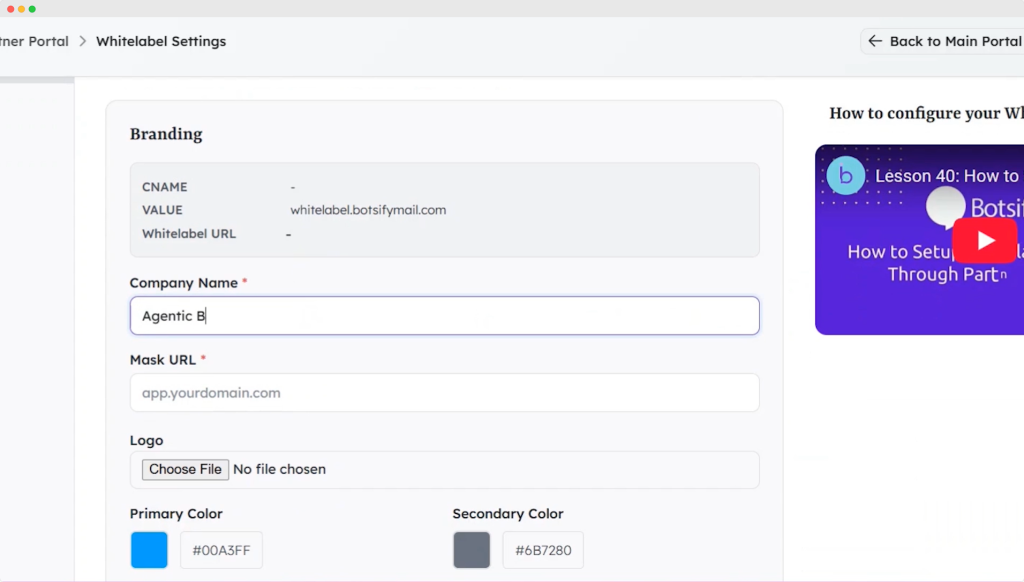
That’s why many teams turn to platforms that abstract the technical layers and let them focus on defining goals, rules, and integrations instead of writing code. These platforms handle memory, execution, and coordination behind the scenes, making it possible to deploy AI agents faster and iterate without rebuilding systems. These tools also allow teams to test business ideas using AI agents before committing engineering resources.
For agencies and service providers, this becomes even more important. Managing AI agents across multiple clients manually doesn’t scale. Platforms designed as a whitelabel AI agent builder allow agents to be configured once, branded, and reused across accounts,without duplicating effort.
Deployment Is Where Most Efforts Fail
Building an AI agent is only half the work. Deployment is where things usually break.
Successful teams start small. They assign agents narrow responsibilities, monitor behavior closely, and expand scope only after reliability is proven. Human handoff points are defined early, not as an afterthought.
This approach reduces risk and builds trust, internally and with customers.
How businesses build AI agents matters less than how responsibly they deploy them. The tools are available. The difference comes down to structure, boundaries, and follow-through.
Benefits of Agentic AI for Businesses
The value of agentic AI isn’t theoretical. Businesses adopt AI agents for a few practical reasons, and they’re mostly about reducing friction rather than chasing novelty.
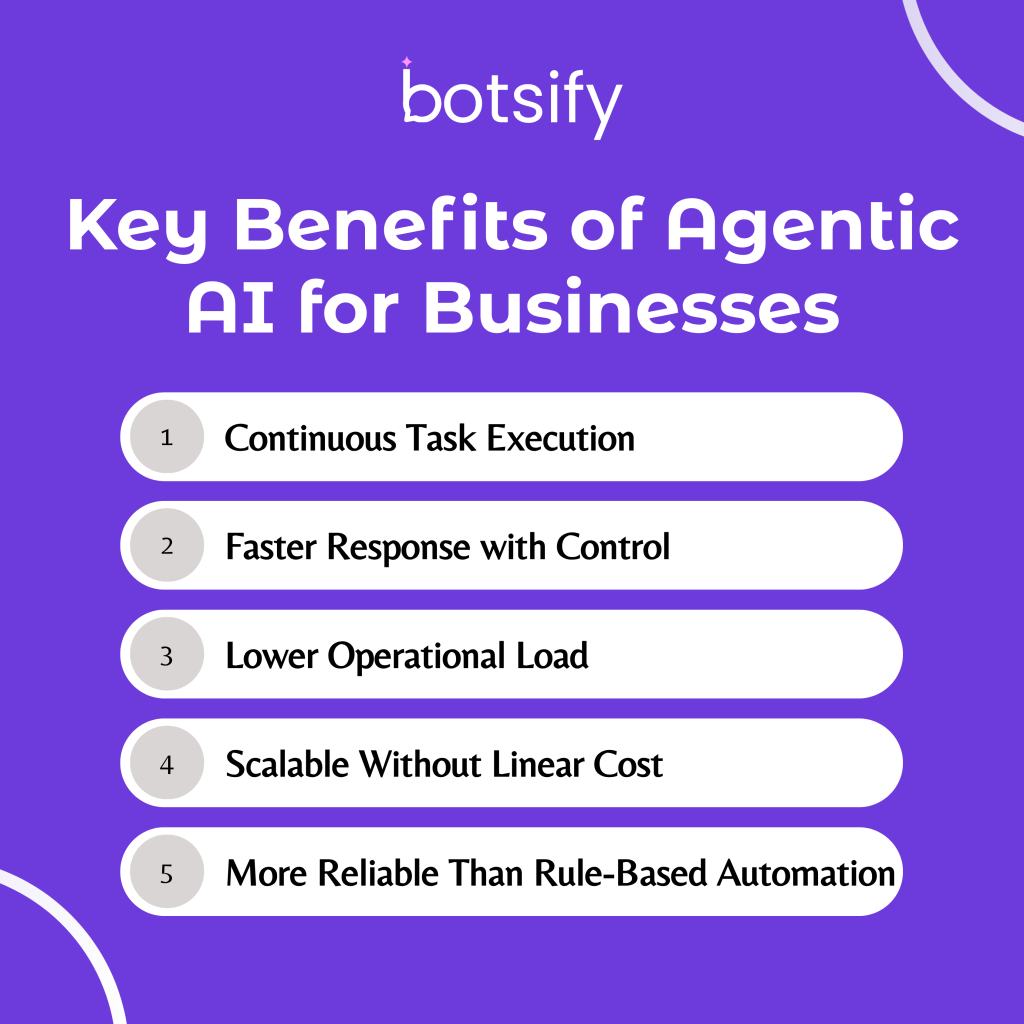
Work Keeps Moving Without Supervision
Many business processes fail in the gaps: follow-ups don’t happen, tickets stall, tasks wait on handoffs. AI agents reduce this drag by owning the next step. Once a task starts, the agent can continue working within defined boundaries instead of stopping after a single interaction.
This doesn’t eliminate human oversight, it reduces unnecessary waiting, especially in high-urgency channels such as Chatbot for SMS.
Faster Response Without Sacrificing Control
Speed matters, especially in customer-facing workflows. AI agents respond instantly, but unlike basic automation, they can adapt when conditions change. If a step fails, they retry, choose an alternative, or escalate.
For teams handling volume, support, sales, operations, this consistency often matters more than raw intelligence.
Lower Operational Load
When AI agents handle routine decisions and follow-through, teams spend less time on repetitive coordination work. That doesn’t always show up as headcount reduction. More often, it shows up as fewer interruptions, cleaner workflows, and less context switching.
This is where AI agents quietly improve productivity without forcing teams to change how they work.
Scalability Without Linear Cost
As volume increases, manual processes scale poorly, a common challenge in ecommerce chatbots handling high-frequency customer interactions. Agentic systems scale differently. One well-defined agent can handle ten tasks or ten thousand, as long as boundaries are clear.
For agencies and service providers, this benefit is amplified. Using a whitelabel AI agent builder platform, the same agent logic can be reused across clients without rebuilding systems each time.
Better Reliability Than Rule-Based Automation
Traditional automation breaks when assumptions fail. AI agents are more tolerant of variation. They don’t require every scenario to be mapped in advance, which makes them more resilient in real environments where inputs aren’t clean.
That flexibility reduces maintenance over time.
Risks, Challenges, and Responsible Use of Agentic AI
Agentic AI is powerful precisely because AI agents can act. That’s also where the risk comes from. When systems move beyond responses into execution, mistakes don’t just sound wrong, they create real consequences.
Most problems with AI agents don’t come from bad models. They come from poor boundaries.
Overreach and Unclear Responsibility
When AI agents are given broad freedom without clear limits, they can attempt tasks they shouldn’t handle. This is especially common with general-purpose agents deployed too early or without proper constraints.
In business settings, especially in regulated environments like chatbots for healthcare, the question isn’t whether an agent can act; it’s whether it should. Clear scopes, permissions, and stop conditions matter more than intelligence.
Data Quality and Context Gaps
AI agents rely on the information they’re given. If the underlying data is outdated, incomplete, or inconsistent across systems, decisions suffer.
This shows up most often in multi-step workflows. An agent may act correctly based on one system’s data while missing context from another. The issue isn’t autonomy, it’s visibility.
Reliable agentic systems are built on clean inputs and well-defined sources of truth.
Hallucinations and Assumptions
Even well-designed AI agents can make confident but incorrect assumptions, especially when asked to operate in ambiguous situations. In operational workflows, this can mean taking the wrong action instead of asking for clarification.
That’s why human handoff points aren’t optional. They’re a safety feature. Responsible deployments define when an agent must pause, escalate, or request confirmation.
Compliance, Privacy, and Trust
In industries like healthcare, finance, or education, where enterprise AI chatbots are often deployed, the margin for error is small. AI agents interacting with sensitive data must follow strict access rules and logging practices.
This isn’t a technical limitation, it’s a governance one. Agentic AI systems need auditability: knowing what the agent did, why it did it, and who approved its scope.
The Future of Agentic AI
The future of agentic AI isn’t about more intelligence, it’s about more reliability.
As AI agents move deeper into business operations, especially for companies adopting chatbot services in the USA, the focus is shifting from experimentation to control.. Companies want systems that can act, but only within clearly defined boundaries. Auditability, permissions, and human handoff points are becoming standard requirements, not optional safeguards.
Another clear direction is collaboration. Instead of relying on a single do-everything agent, businesses are adopting multi-agent AI setups where responsibilities are split across smaller, focused agents. This makes systems easier to manage and easier to trust.
For agencies and service providers, scale will depend less on customization and more on reuse. Platforms built as a whitelabel agentic AI platforms allow proven agent setups to be deployed across clients without rebuilding them each time.
Agentic AI won’t replace human judgment. It will replace the friction between decisions and execution.
Conclusion
Agentic AI isn’t about smarter answers. It’s about systems that can carry work forward.
As AI agents move into real business workflows, the focus shifts from experimentation to execution, clear roles, defined limits, and reliable follow-through. The teams that get value from agentic AI aren’t the ones chasing novelty, but the ones using it to reduce friction and missed steps.
Whether deployed internally or delivered through a whitelabel AI agent builder platform, AI agents work best when they’re designed to support decisions, not replace them.
That’s the shift agentic AI brings, and why it’s sticking.
AI Agentic Platform For Building Portable AI Agents
Say Hello To Agentic AI That Connects With Your CRM And Even Other Agents