

Note:
The AI agent ecosystem is evolving quickly, with new platforms emerging almost every month. To keep this guide useful, we update this article regularly to include new and noteworthy AI agent platforms.
If you’re building an AI agent platform and believe it should be included in this list, feel free to reach out to us at [email protected] with details about your product.
AI agents are quickly moving from experimental technology to real operational tools used by businesses around the world. Instead of simple chatbots that only answer questions, modern agents can analyze data, connect to software tools, and complete multi-step workflows automatically.
Companies now use AI agents to automate customer support, qualify leads, assist internal teams, and manage repetitive tasks. The technology behind these systems is often delivered through an AI agent platform, which provides the infrastructure for building, deploying, and managing intelligent agents across business environments.
But choosing the right platform can be difficult. Some tools focus on enterprise-scale customer service automation, while others emphasize workflow automation, multi-agent collaboration, or no-code deployment.
In this guide, we’ll explore the best AI agent platforms in 2026, looking at their capabilities, integrations, and ideal use cases so you can decide which platform best fits your organization.
What Are AI Agents?
An AI agent is a software system designed to complete tasks autonomously by analyzing information, making decisions, and interacting with external tools or data sources.
Unlike traditional automation scripts, AI agents can adapt to changing inputs and context. They typically rely on large language models (LLMs), data integrations, and tool connections to carry out complex workflows.
Businesses now use agents to:
- Automate support conversations
- Conduct research and generate reports
- Route leads to sales teams
- Manage scheduling and internal workflows
- Analyze customer data and insights
As Agentic AI continues evolving, these systems increasingly act as digital teammates that can collaborate with other agents and software tools to complete work more efficiently.
What Is an AI Agent Platform?
An AI agent platform is the software environment used to build, deploy, and manage AI agents across different channels and workflows.
Instead of writing custom code for each automation, these platforms provide tools such as:
- AI agent builders
- integrations with APIs and business software
- workflow automation systems
- analytics and monitoring tools
- multi-channel deployment options
The goal is to help organizations create custom AI agents that can operate across multiple systems without requiring extensive engineering resources.
These platforms are now widely used by startups, enterprises, and agencies looking to automate operations while maintaining flexibility and scalability.
7 Best AI Agent Platforms in 2026
The AI agent ecosystem is evolving quickly. Below are the seven best AI agent platforms that are widely used to build and deploy AI agents across different industries.
1. Botsify
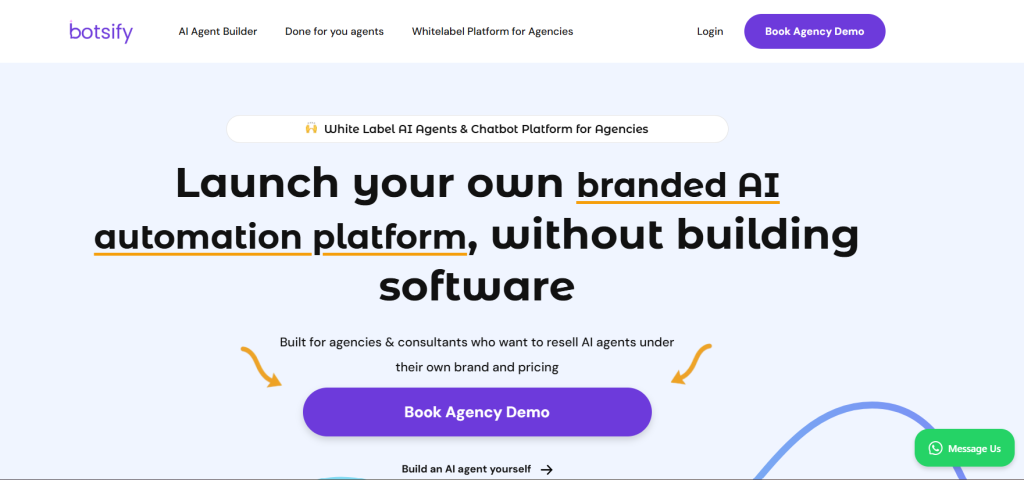
Best for: Businesses and agencies deploying AI agents across multiple channels
Botsify has evolved from a chatbot platform into a full AI agent platform designed to help companies automate conversations, workflows, and internal processes.
The platform allows businesses to build AI agents that operate across websites, messaging channels, and collaboration tools. Botsify focuses heavily on accessibility, offering a no-code environment where teams can create agents without deep technical knowledge.
Organizations often use Botsify to deploy agents for customer engagement, sales automation, onboarding assistance, and internal knowledge management.
Botsify’s recent upgrades introduced an LLM-powered conversational interface that lets users create agents simply by describing their goals in natural language, replacing older flow-based builders.
Key Features
- No-code AI agent builder
- Knowledge-base training for agents
- Human handoff to live support teams
- Multi-channel deployment
- Workflow automation and integrations
Integrations
Botsify agents can connect with a wide range of tools and messaging platforms. The system supports integrations across websites, messaging apps, and collaboration tools including Slack and Telegram, enabling automation across customer and internal workflows.
Agents can also connect to external systems through APIs and connectors, allowing integration with CRM systems, helpdesk platforms, and business databases.
Use Cases
Common Botsify deployments include:
- customer support automation
- lead generation and qualification
- onboarding assistance for new customers
- internal knowledge assistants
- sales automation workflows
The platform is also widely used by agencies that build automation solutions for clients, often reselling AI deployments under their own branding.
Pricing
Botsify offers tiered pricing with enterprise options, allowing organizations to scale agent usage and integrations based on business requirements.
2. Botpress
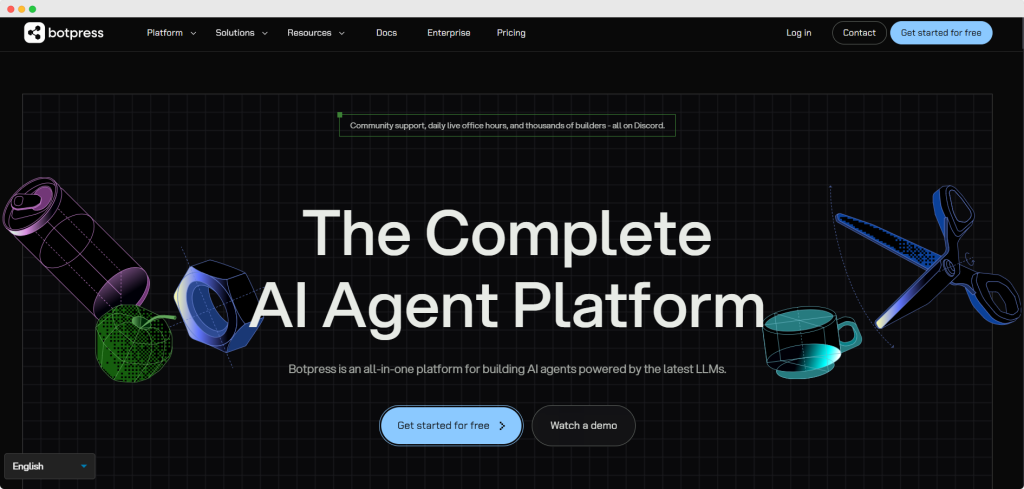
Best for: Developers building advanced conversational AI agents
Botpress is a popular platform for building conversational AI systems using modern language models.
Unlike many no-code tools, Botpress offers deeper customization capabilities for development teams that want more control over agent behavior and workflows.
The platform provides a visual builder along with the ability to inject custom code and monitor agent behavior in production environments.
Botpress uses an isolated runtime architecture, meaning each deployed agent runs in its own environment while maintaining full observability over actions and execution.
Key Features
- Visual conversation builder
- Customizable agent workflows
- support for modern LLMs
- analytics and observability tools
- API-driven integrations
Integrations
Botpress agents can integrate with various external tools including messaging platforms, databases, and APIs.
The platform also supports multi-channel deployment, allowing agents to interact with customers across web interfaces, messaging apps, and support systems.
Use Cases
Organizations often deploy Botpress for:
- conversational AI assistants
- internal knowledge bots
- customer support automation
- AI-powered helpdesk assistants
Pricing
Botpress offers a free tier along with usage-based and enterprise plans depending on deployment scale and infrastructure requirements.
3. Yellow.ai
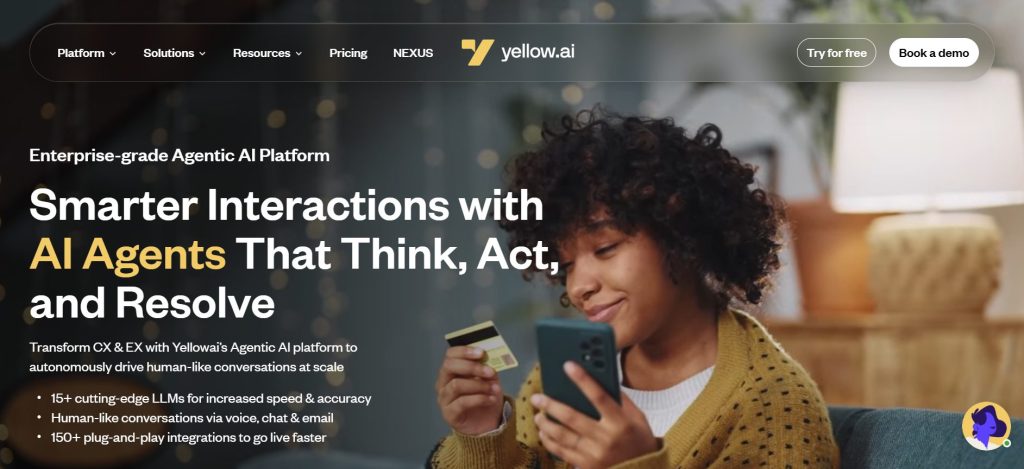
Best for: Enterprise conversational automation
Yellow.ai is a conversational AI company focused on automating customer service experiences at scale, and it’s a Botpress alternative.
Founded in 2016, the company provides AI platforms designed to automate interactions across chat and voice channels for large enterprises.
One of the platform’s key strengths is multilingual support. Yellow.ai can operate in more than 135 languages and across dozens of communication channels, making it suitable for global businesses.
Key Features
- AI-driven conversational automation
- Chat and voice AI agents
- enterprise-grade analytics
- multilingual support
- workflow automation for support operations
Integrations
Yellow.ai integrates with enterprise systems including:
- CRM platforms
- customer support software
- messaging platforms
- voice infrastructure
These integrations allow AI agents to retrieve data, automate support workflows, and assist human support teams.
Use Cases
Organizations typically deploy Yellow.ai for:
- large-scale customer support automation
- contact center AI assistants
- conversational commerce
- enterprise helpdesk automation
Pricing
Yellow.ai pricing typically depends on enterprise deployment size and usage, with custom plans for large organizations.
4. WotNot
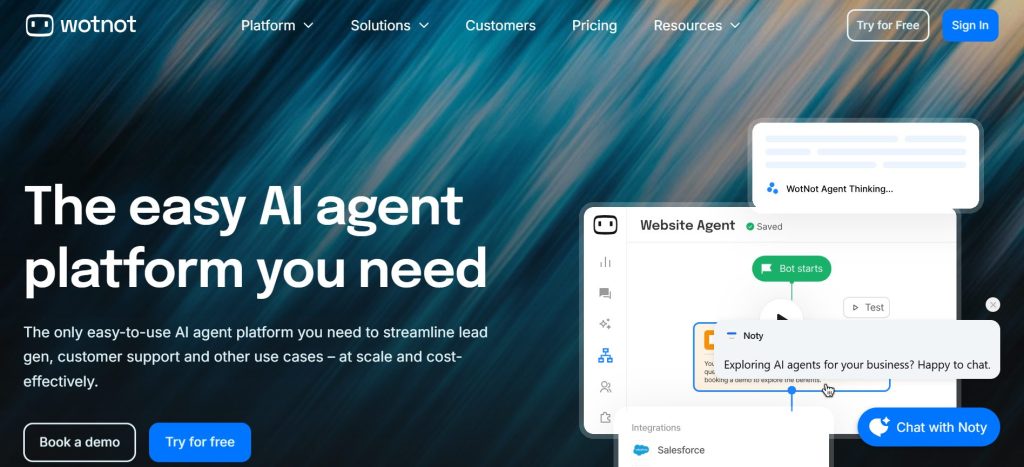
Best for: No-code AI agents for marketing and support
WotNot provides a no-code environment for building AI chatbots and conversational agents focused on customer engagement and marketing automation.
The platform is designed for businesses that want to automate interactions without requiring technical expertise. Using its visual builder, teams can design workflows that capture leads, respond to customer queries, and route requests to human teams when necessary.
Key Features
- drag-and-drop chatbot builder
- lead capture workflows
- marketing automation triggers
- conversational AI templates
- analytics dashboard
Integrations
WotNot integrates with several popular business tools including:
- HubSpot
- Zapier
- email marketing platforms
- CRM systems
These integrations allow agents to capture leads and automatically update marketing or sales systems.
Use Cases
Common WotNot deployments include:
- lead qualification bots
- marketing automation
- website chat assistants
- customer service automation
Pricing
WotNot offers subscription plans with enterprise options depending on deployment size and features.
5. Relevance AI
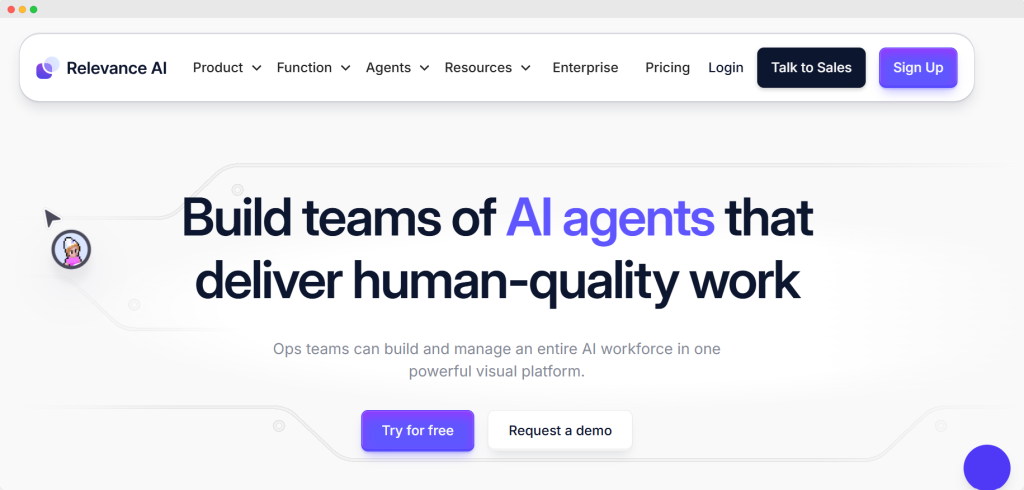
Best for: Multi-agent workflows and automation
Relevance AI focuses on building systems where multiple AI agents collaborate to complete complex workflows.
The platform allows organizations to create agents that perform different roles in a workflow, for example research agents, analysis agents, and reporting agents that work together on the same task.
Relevance AI also supports analytics and monitoring tools that track how agents perform across tasks.
Key Features
- custom AI agent creation
- visual workflow automation
- multi-agent collaboration
- built-in analytics and monitoring
- knowledge base integration
Integrations
Relevance AI agents can connect with APIs, data platforms, and internal business tools.
These integrations allow agents to retrieve data, automate reports, and trigger actions across different systems.
Use Cases
Typical deployments include:
- research automation
- marketing data analysis
- content generation pipelines
- sales prospecting workflows
6. Lindy AI
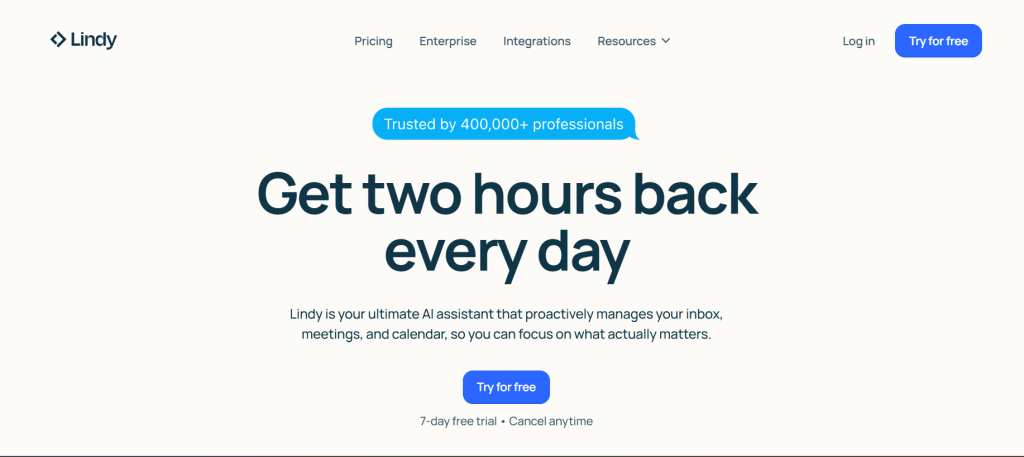
Best for: AI employees and business automation
Lindy AI positions itself as a platform for building “AI employees” capable of handling routine business tasks.
Instead of focusing solely on conversations, Lindy agents are designed to automate workflows across software tools used by business teams.
These agents can perform tasks such as scheduling meetings, updating CRM records, and managing communications.
According to industry comparisons, Lindy integrates with thousands of business tools and is particularly strong in workflow automation for operations teams.
Key Features
- AI workflow automation
- natural language agent creation
- integration with business tools
- task management automation
Integrations
Lindy integrates with tools commonly used by business teams such as:
- Gmail
- Slack
- Notion
- Salesforce
Use Cases
Typical Lindy deployments include:
- scheduling assistants
- CRM automation
- support workflow automation
- internal business task management
7. CrewAI
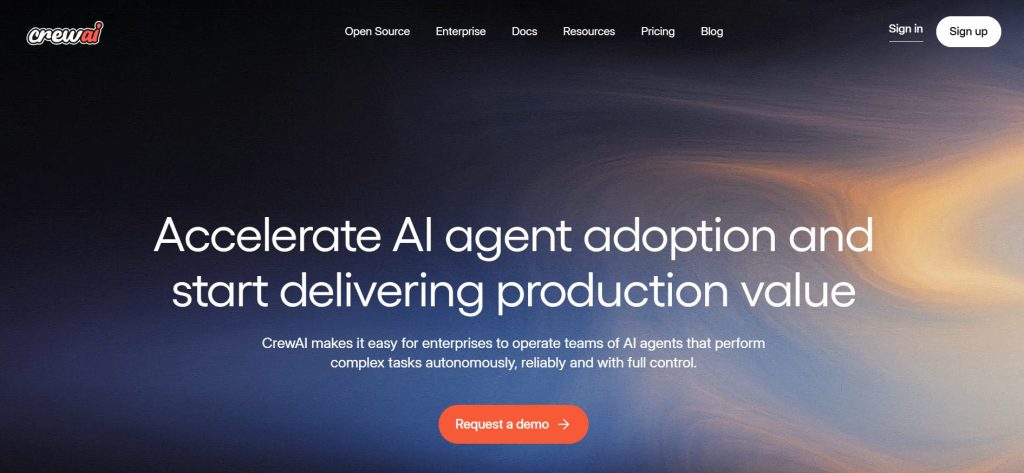
Best for: Developers building multi-agent systems
CrewAI is designed for building collaborative groups of AI agents that work together on complex tasks.
Instead of relying on a single AI model, the platform allows organizations to create multiple agents that take on specialized roles within a workflow.
For example, one agent may gather data while another analyzes results and a third generates reports.
CrewAI supports both developer-focused workflows and no-code environments, allowing different teams to build automation pipelines depending on their technical expertise.
The platform enables multiple agents to collaborate on tasks and automate complex workflows across organizations.
Key Features
- multi-agent orchestration
- role-based agent collaboration
- flexible deployment options
- support for automation pipelines
Integrations
CrewAI agents can connect to APIs, databases, and cloud services, enabling them to retrieve data and trigger actions in external systems.
Use Cases
Common use cases include:
- research pipelines
- complex data analysis workflows
- enterprise automation systems
- collaborative AI agent teams
Bonus Mentions
While the platforms above represent some of the most widely used AI agent platforms today, several other tools are also gaining traction in the ecosystem. Depending on your use case and technical requirements, these platforms may also be worth exploring.
Activepieces
Activepieces is an open-source automation platform that allows users to build AI-powered workflows and agents using a visual interface. It integrates with hundreds of applications and is particularly useful for automating operational tasks across business tools.
Google Vertex AI Agent Builder
Google Vertex AI provides infrastructure for building AI-powered agents and applications using Google Cloud. It is designed for enterprises that want to integrate AI automation with large-scale data systems and cloud infrastructure.
Microsoft Copilot Studio
Copilot Studio enables organizations to create AI assistants integrated with Microsoft 365 tools such as Teams, SharePoint, and Outlook. It is particularly useful for enterprises already operating within the Microsoft ecosystem.
StackAI
StackAI is a visual platform for building AI agents that connect language models, APIs, and internal data sources. The platform focuses on enabling teams to prototype and deploy AI workflows quickly without building custom infrastructure.
Make (formerly Integromat)
Make is a workflow automation platform that can be used to orchestrate AI agents across thousands of applications. While not strictly an AI agent platform, it provides powerful automation capabilities for integrating AI-driven workflows
How to Choose the Right AI Agent Platform
Selecting the best AI agent platforms depends on your organization’s goals and technical resources.
Here are a few factors to consider.
Ease of Use
Some platforms prioritize no-code development, while others require engineering expertise.
Businesses with non-technical teams often benefit from platforms with visual builders and prebuilt templates.
Integration Ecosystem
AI agents are only useful if they can interact with existing business tools.
Look for platforms that integrate with CRM systems, messaging apps, and internal databases.
Customization
The best platforms allow organizations to design flexible workflows rather than forcing them into rigid templates.
Scalability
As companies deploy more AI agents for small businesses or enterprise environments, the platform must support scaling across multiple workflows and teams.
Final Thoughts
AI agents are transforming how organizations automate operations and deliver services.
From conversational customer support to complex multi-agent workflows, these systems are becoming a core layer of modern software infrastructure.
The best AI agent platforms combine flexibility, integrations, and scalability so businesses can deploy intelligent automation without maintaining complex systems.
Whether your goal is customer engagement, workflow automation, or building advanced agent systems, choosing the right platform will determine how effectively your organization can adopt this new generation of AI technology.
AI Agentic Platform For Building Portable AI Agents
Say Hello To Agentic AI That Connects With Your CRM And Even Other Agents