


Instagram is where your buyers hang out, not where they fill in forms.
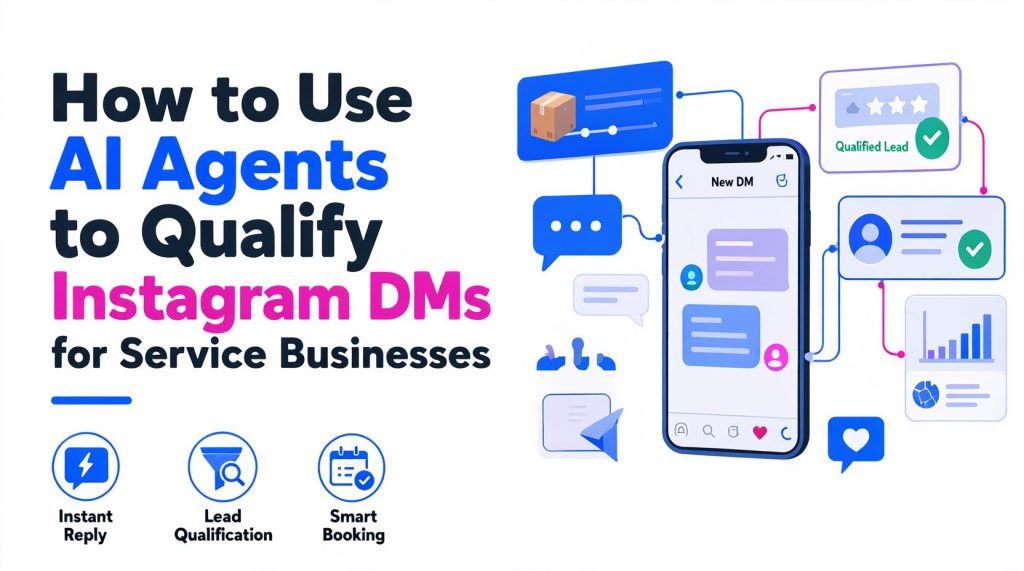
For service businesses, coaches, consultants, agencies, creatives, local service providers, Instagram DMs are where intent shows up first. Someone sees a post, sends a DM, and if the response is fast and helpful, that DM becomes a conversation, and that conversation becomes a client.
The problem is that most service businesses manage DMs manually, leading to slow replies and missed opportunities. Instagram DM lead qualification helps identify interested prospects before they lose interest or move on.
An AI agent that responds to DMs instantly, asks the right questions, and books the call when the lead is ready turns Instagram from a marketing channel into a pipeline, without the owner having to live in their inbox.

Why Instagram DMs are different from web chat leads
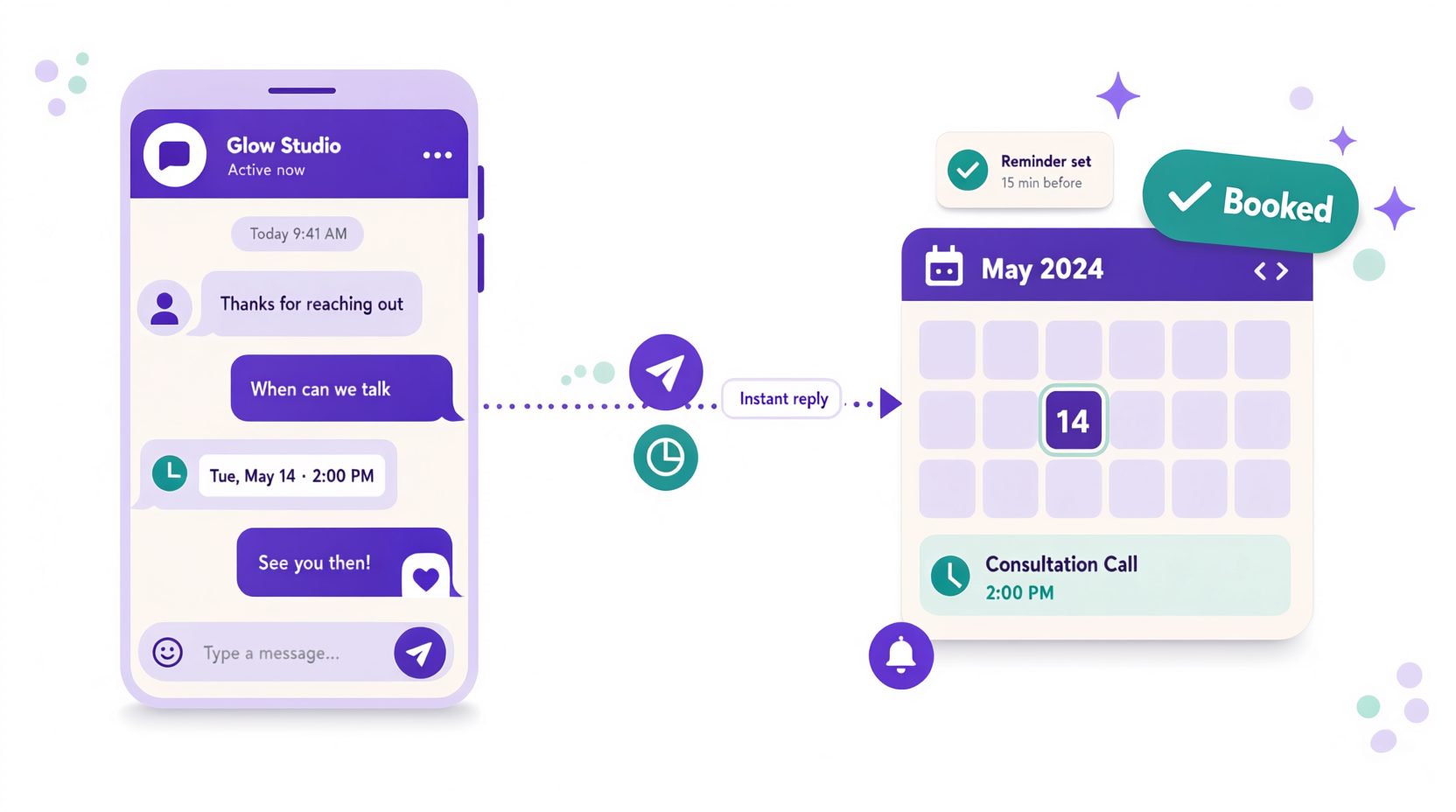
Instagram DMs have a different rhythm:
| Channel | Buyer mindset | What works |
|---|---|---|
| Website chat | They’re researching, often comparing | Structured qualification, clear CTAs |
| Instagram DM | They’re fans or followers who are curious | Conversational, casual, personality-forward |
| They expect formality and structure | Longer-form, detailed | |
| They want a direct conversation | Personal, quick responses |
The mistake most service businesses make: treating Instagram DMs like a web chat widget and deploying a formal, corporate-sounding bot. Instagram users expect a different tone, casual, human, responsive. A bot that says “Thank you for your inquiry. Please provide your company details” will get ignored.
An Instagram AI chatbot should sound like a helpful assistant, not a support ticket system. It should ask questions naturally, respond to what the person says, and suggest booking only when there’s genuine interest.
How Instagram DM Lead Qualification Works
Here is a working DM flow for a service business (replace the specifics for your niche):
1. Initial response (within seconds):
Hey! Thanks for reaching out 👋 I’m [name]’s AI assistant. Quick question so I can point you in the right direction — are you looking for [primary service] for yourself or for a team/business?
Why this works:It acknowledges them immediately, signals that this is an AI (honesty matters on Instagram — people get annoyed by bots pretending to be human), and asks a simple either/or question that’s easy to answer.
2. Understanding their need (2–3 questions max):
Got it! And what’s the main thing you’re hoping to [solve/achieve]? Just so I can share the right info with you.
Then, based on their answer:
Makes sense. Have you worked with anyone on this before, or would this be your first time?
Why this works:Two questions is enough to understand context. More than three questions before offering something useful feels like an interrogation, and people abandon.
3. The fit check (one question):
Based on what you’ve described, [specific offering] sounds like it could be a good fit. Quick one — are you looking to start in the next month or so, or more exploring for later?
This single question does three things: it qualifies timing, it identifies tire-kickers, and it gives the AI a natural reason to either book a call or share resources for later.
4. The booking ask:
Perfect — [owner/consultant name] has a few spots open this week. Here are times that work: [specific slots]. Does one of those work for you?
What NOT to do: Don’t ask for their email, phone number, company size, and budget before you’ve even told them what you offer. On Instagram, people expect a conversation, not an intake form. Gather details on the call, not in the DMs.
How AI Agents Identify Qualified Instagram Leads
Behind the casual tone, the AI follows a simple AI lead qualification workflow to identify potential customers based on their needs, interest, and timing.
| Signal | What it tells you | How the AI uses it |
|---|---|---|
| Asks about pricing immediately | Price-sensitive, possibly price-shopping | Share starting price range honestly; don’t hide it |
| Describes a specific problem | Higher intent — real need | Move toward booking faster |
| Asks about process/timeline | Serious buyer doing research | Offer a call to go deeper |
| Asks “how much?” before saying what they need | Price shopper or comparing | Answer honestly, qualify gently |
| Mentions a referral | Warmer lead, move faster to booking | Reference the referrer by name |
| Long, detailed DM about their situation | High engagement, prioritize | Fast-track to booking |
| One-word messages (“price?”, “info?”) | Early stage or tire-kicker | Give a helpful short answer plus one question |
The AI doesn’t need to interrogate. It needs to have a natural conversation that reveals enough to make a judgment: is this person a potential client, a curious browser, or someone looking for free advice?
The goal of Instagram DM qualification is not to disqualify people. It’s to identify who’s serious fast enough that you can have a real conversation with them, without spending three days going back and forth with someone who was never going to book.
Stop Losing Leads in Your Instagram DMs
Let AI identify interested prospects while you focus on growing your business.
DM Scripts for Common Instagram Scenarios
Not every Instagram message indicates buying intent. Some people want pricing, others have questions, and many are simply engaging with your content.
Your AI agent should respond according to the person’s actual request.
| DM Scenario | Suggested Response |
|---|---|
| Asking about pricing | Share a starting price or range, then ask one relevant question |
| Asking about a service | Explain briefly what you offer and ask about their needs |
| Requesting free advice | Provide a helpful answer or resource without immediately pitching |
| Complimenting content | Thank them naturally without starting a sales conversation |
| Asking about collaboration | Route the inquiry to the appropriate team member |
| Not a suitable client | Explain politely and suggest a relevant alternative when possible |
Example: Pricing inquiry
Prospect: “How much do you charge?”
AI: “It depends on what you need, but our [service] usually starts at [price]. What are you looking to get done?”
Example: Service inquiry
Prospect: “Do you help with [service]?”
AI: “Yes, we do! We usually help with [brief explanation]. What are you trying to achieve?”
Example: Someone just browsing
Prospect: “Loved your latest post!”
AI: “Thank you! Glad you found it helpful.”
Effective Instagram DM lead qualification means recognizing buying signals while responding helpfully, without treating every conversation as a sales opportunity.
How to Book Calls and Hand Off Qualified Instagram Leads
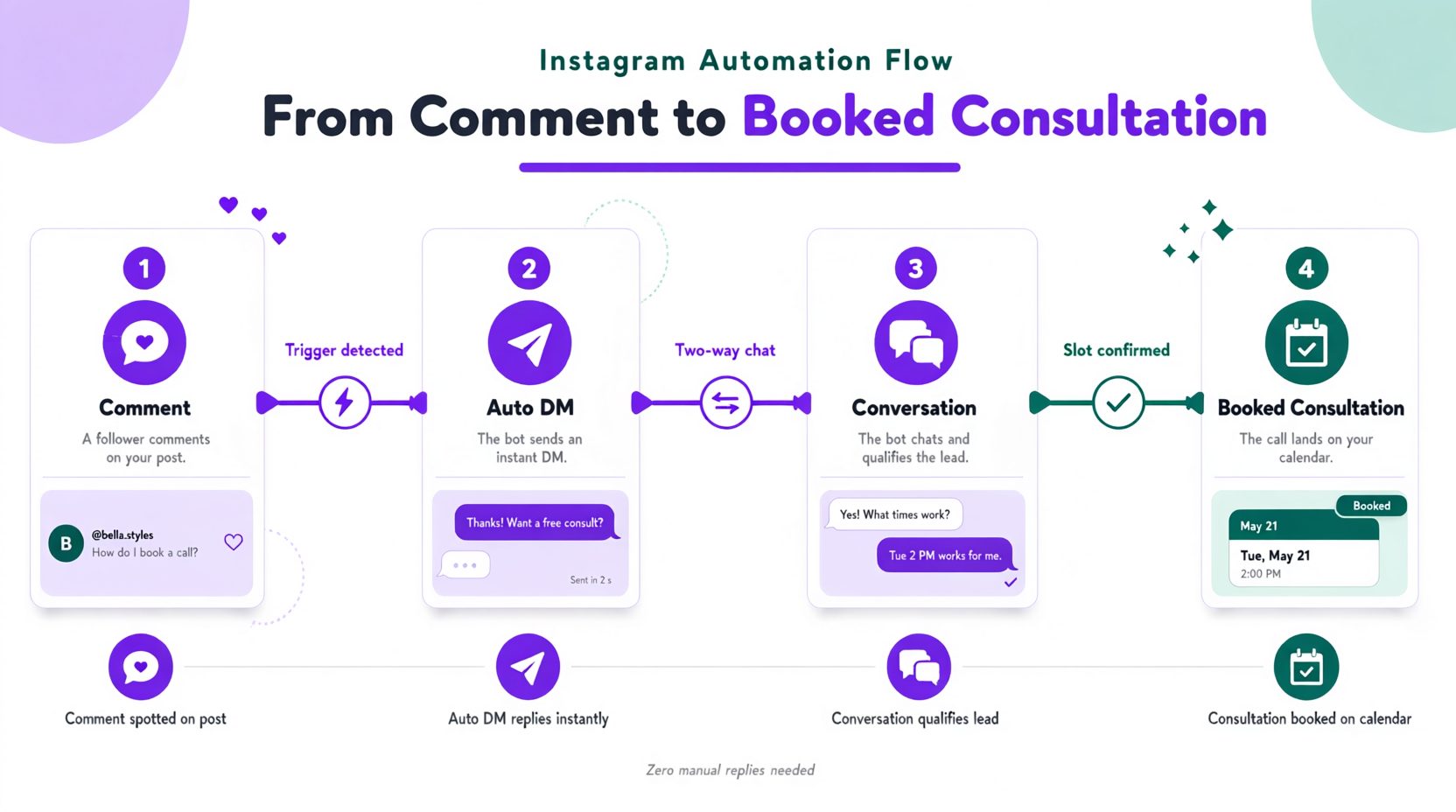
Once a prospect shows genuine interest, the AI agent should make booking simple while keeping the business owner informed.
Offer available appointment times
An AI appointment booking agent can check a connected calendar and offer available appointment times directly in the conversation.
For example:
“Would Tuesday at 2 PM or Thursday at 11 AM work better for you?”
Only offer times that have been verified as available.
Confirm the booking details
Before scheduling, confirm the prospect’s time zone, appointment purpose, and necessary contact details.
Send a confirmation containing the meeting time, joining instructions, and what to expect.
Know when to involve a human
The agent should request human assistance when:
-
The prospect asks to speak directly with the owner.
-
A question requires specialist knowledge.
-
The conversation becomes sensitive or complicated.
-
The prospect needs a custom proposal or consultation.
-
The agent cannot confidently answer a question.
Pass conversation context to the team
With proper AI agent integration, the handoff can include the prospect’s name, requirements, timeline, questions, and any concerns discussed.
For example:
“Sarah is interested in social media management for her restaurant. She wants to start next month and asked about pricing and monthly deliverables.”
This helps the owner continue the conversation without asking the prospect to repeat everything.
Turn Instagram Conversations Into Booked Calls
See how AI can qualify leads and simplify appointment booking.
Common Instagram DM Automation Mistakes and How to Avoid Them
Even a well-configured AI agent can create frustrating experiences if it responds incorrectly.
| Mistake or Situation | Better Approach |
|---|---|
| Pretending to be human | Clearly identify the assistant as AI |
| Asking too many questions | Ask one relevant question at a time |
| Ignoring story replies | Respond according to the message and context |
| Using overly formal language | Match the business’s natural Instagram tone |
| Giving incorrect pricing | Use approved pricing information or escalate |
| Receiving a voice message | Process it only if supported, otherwise request text or human assistance |
| Receiving an image or screenshot | Interpret it only when image understanding is available |
| Receiving an unfamiliar question | Explain the limitation and offer human assistance |
| Receiving inappropriate messages | Follow moderation rules and escalate when necessary |
The AI should also avoid making assumptions about someone’s identity, budget, or buying intent based only on their Instagram profile.
Whether you’re building the workflow yourself or using done-for-you AI agents, test these situations before launch and refine the instructions as new conversation patterns appear.
How to Measure Instagram DM Lead Qualification Performance
| Metric | What it tells you | Healthy range |
|---|---|---|
| Response rate to DMs | How often people engage after the first reply | >60% |
| Qualification completion rate | How many complete the 2–3 questions | >50% |
| Booking rate from qualified DMs | DM-to-call conversion | >10–15% is good for warm DMs |
| Show-up rate for booked calls | >70% | Confirmation sequence working |
| Human handoff rate | How often the AI escalates | 15–30% — too low means the AI is over-reaching; too high means the AI is underpowered |
The last metric matters: if the AI is escalating more than 30–40% of conversations, it’s not doing its job, either the prompts are too limited or the qualification criteria are too complex for a DM context. Instagram DMs should feel like talking to a helpful person, not filling out a form.
Building the DM prompt: giving the AI your voice
When using an AI agent builder, the prompt plays an important role in making Instagram conversations feel natural. Here’s how to create one that matches your business’s voice:
Step 1: Collect your actual DM replies. Go through your last 20–30 DM conversations. Copy the replies you’re proud of, the ones where the person replied back, engaged, and booked. These are your training examples.
Step 2: Define your voice rules.– How formal or casual are you? (Most service businesses on Instagram: casual, warm, use first names.) – Do you use emojis? How many? – What phrases do you use that are distinctly yours? – What do you never say? (Corporate jargon, “Dear valued customer,” anything that sounds like a template.)
Step 3: Write the system prompt with real examples.
You are [owner name]’s Instagram DM assistant for [business]. Respond like [owner] would — [describe tone: warm, casual, uses humor, direct].
Examples of how [owner] actually replies: – When someone asks about pricing: “[paste actual reply]” – When someone asks about availability: “[paste actual reply]” – When someone asks something outside your services: “[paste how you’d redirect]”
Rules: – Be honest that you’re an AI assistant — never pretend to be [owner]. – Ask one question at a time. – Keep replies short — Instagram is a chat, not an email. – If someone wants to book, offer specific times rather than a link. – If someone needs something you can’t help with, say so and point them somewhere useful. – Match the energy of the message. A “🔥 love this!” comment doesn’t need a paragraph in response.
Step 4: Test with real message patterns. Pull 20 real DMs from your inbox and run them through the prompt. Where the AI’s response doesn’t sound like something you’d actually say, fix the prompt, add the phrase you would have used, remove the jargon it added.
This process takes an hour and is the difference between a bot that people enjoy talking to and one that gets ignored after the first reply.
Handling comments: the public-facing layer
Instagram comments are a separate qualification surface from DMs:
| Comment type | AI response |
|---|---|
| “How much?” on a post | Reply with starting price range + offer to DM for details |
| “Love this!” | Genuine short reply, no pitch |
| “Do you work with [X type of business]?” | Answer directly + invite to DM for details |
| “Interested!” | Move to DM for the qualification conversation |
| Negative or critical comment | Acknowledge, don’t argue, offer to discuss in DMs |
| Spam or bot comments | Ignore or hide — don’t engage |
The comment layer is public, every response is visible to everyone who sees the post. A helpful, non-salesy comment reply builds social proof; a hard pitch in comments damages it. The AI should be configured to be genuinely helpful in comments and reserve the selling for DMs where there’s an actual conversation.
The Instagram DM automation guide covers the technical setup for comment-to-DM flows, while the qualification logic above determines what happens once someone starts a conversation.
FAQ
Will people know it’s a bot?
If you tell them upfront and the conversation is genuinely useful, most people don’t mind. What they mind is being deceived. “I’m [name]’s AI assistant, happy to help or connect you with her” is honest and works.
What about comments on posts — can the AI handle those?
Yes, and they’re often higher-intent than DMs. Someone commenting “how much?” on a pricing post is showing intent. The AI can respond in comments and move the conversation to DMs for the personal part.
How do I keep the bot from sounding robotic?
Write the prompt in your voice. Give it examples of how you’d actually respond. Include your typical phrases, your level of formality, and the things you would never say. The AI mirrors your voice when you give it real examples to learn from.
What if someone sends a voice message or a photo?
Modern AI agents can process both, voice messages get transcribed and responded to, and images get understood in context. Test this with real messages before going live, because edge cases (blurry photos, heavy accents, background noise) are where AI responses fail.
Final thought
Instagram DM lead qualification helps service businesses recognize genuine opportunities while building trust with potential clients. A fast, helpful response can turn a simple conversation into the beginning of a customer relationship.
An AI agent that responds instantly, asks good questions, and hands off to the human at the right moment turns Instagram from a marketing channel into a client-acquisition channel.
The service businesses that figure this out will have a pipeline that runs while they sleep. The ones who keep answering DMs manually between client work will keep wondering why their Instagram presence doesn’t translate to revenue.
Your Next Client Could Be in Your DMs
Discover how Botsify can help turn Instagram inquiries into real opportunities.