


Bringing an Internet of Things (IoT) product from an idea to a commercial launch is an exciting journey, but it is rarely inexpensive. One of the biggest misconceptions is that the cost of building an IoT product is determined primarily by the hardware. In reality, successful IoT solutions combine hardware, embedded software, cloud infrastructure, connectivity, security, and user applications into a single ecosystem that must operate reliably for years.
For startups and established businesses alike, understanding where the investment goes is essential. A realistic budget not only helps prevent unexpected expenses but also increases the likelihood of delivering a scalable product that performs well after launch.
Rather than asking, “How much does an IoT product cost?” a better question is, “Which areas contribute most to the total investment?” Once those cost drivers are understood, planning becomes much more predictable.
The Major Cost Components of an IoT Product
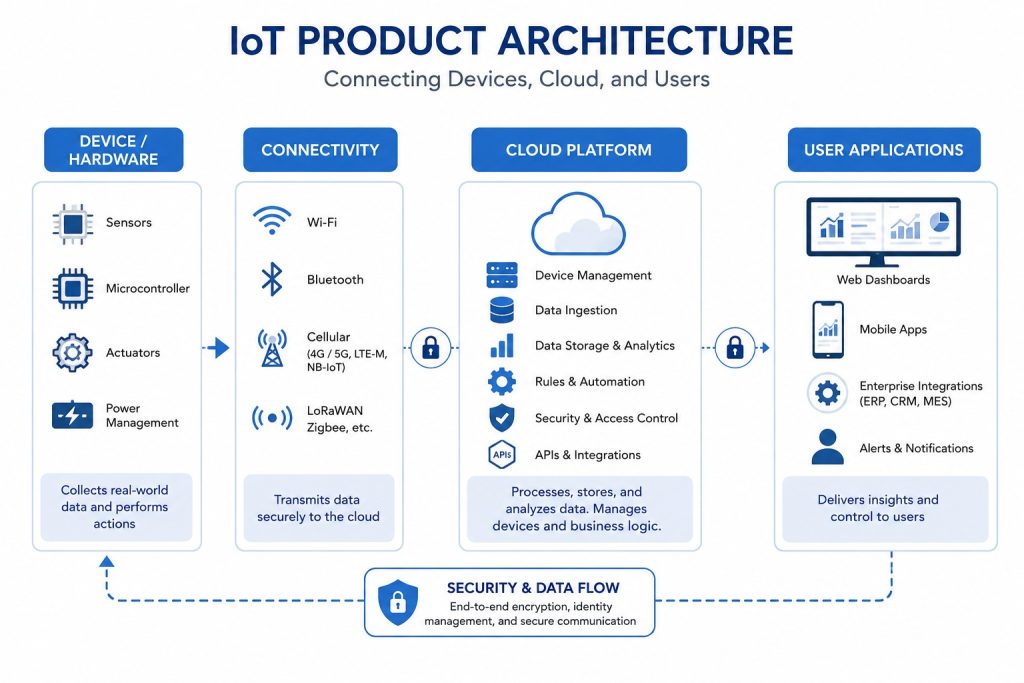
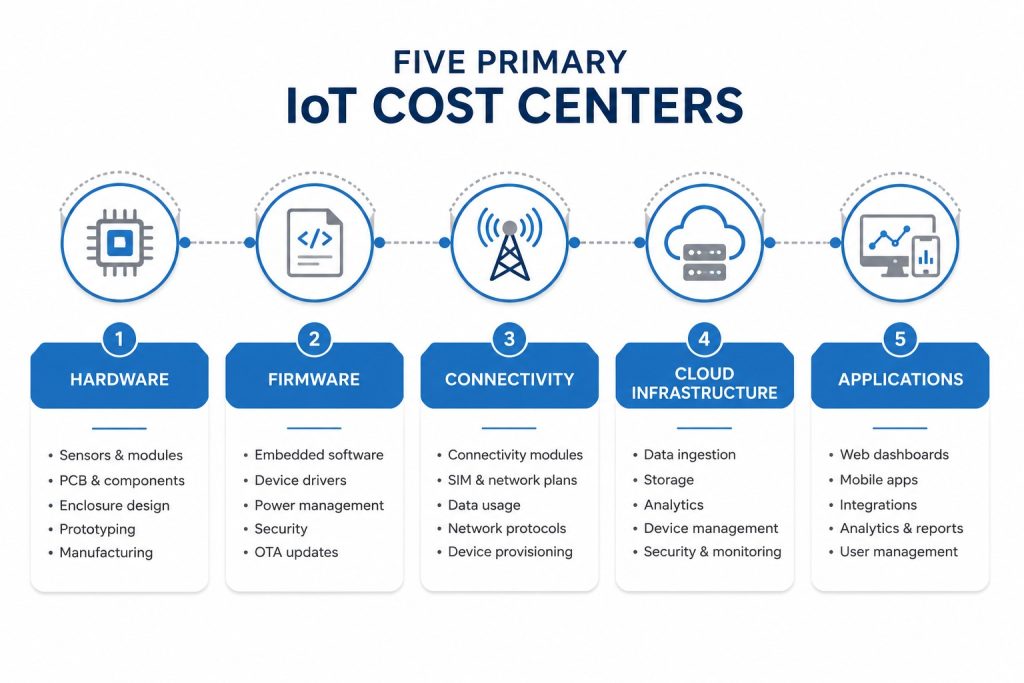
Building a successful IoT product requires much more than developing connected hardware. A complete solution consists of multiple interconnected layers, including hardware, embedded firmware, connectivity, cloud infrastructure, and user applications, that must work together reliably. Each layer demands specialized expertise, dedicated development effort, and ongoing maintenance, all of which contribute to the overall project budget.
Organizations often reduce development risks by partnering with experienced specialists. Companies like Crunch-IS, an IoT Development company, help businesses identify potential cost drivers early, prioritize development activities, and build scalable solutions that minimize expensive redesigns later in the project.

Hardware Design and Engineering
Every IoT device begins with hardware.
This stage includes selecting electronic components, designing printed circuit boards (PCBs), integrating sensors, choosing communication modules, designing enclosures, and manufacturing prototypes.
Although hardware is highly visible, it usually represents only one part of the total development cost. Multiple prototype iterations are often required before the final design is ready for manufacturing.
Key activities include:
- PCB design
- Component selection
- Sensor integration
- Prototype fabrication
- Mechanical enclosure design
- Hardware testing
- Manufacturing preparation
Choosing high-quality components early may increase the initial investment but often reduces maintenance costs and improves long-term reliability.
Portable AI Agents In Seconds, Use Everywhere
Prompt, Test, and Deploy AI Agents Across Social Platforms and LLMs. Automate Everything.
Embedded Firmware Development
Firmware is the software that runs directly on the device and controls how the hardware behaves.
Unlike traditional software applications, firmware must operate efficiently on limited processing power while remaining stable under real-world conditions.
Typical firmware development includes:
- Device drivers
- Sensor communication
- Memory optimization
- Power management
- Communication protocols
- Secure boot
- Over-the-Air (OTA) update support
OTA updates deserve special attention because they allow manufacturers to deploy security patches, bug fixes, and new features without physically accessing deployed devices.
Reliable firmware reduces maintenance costs throughout the product’s lifecycle.
Connectivity Infrastructure
Once devices are operational, they must communicate with external systems.
The communication technology selected depends on product requirements, deployment environment, battery life, and coverage needs.
Common options include:
- Wi-Fi
- Bluetooth Low Energy (BLE)
- Zigbee
- LoRaWAN
- NB-IoT
- LTE-M
- 4G/5G Cellular
- Ethernet
Each technology carries different costs.
For example, cellular connectivity introduces recurring subscription fees, SIM management, and ongoing data usage charges. While these monthly costs may appear small initially, they become significant as the number of deployed devices increases.
Selecting the right communication technology early helps optimize both development costs and long-term operational expenses.
Cloud Platform Development
An IoT device becomes truly valuable only when the data it generates can be processed, analyzed, and managed effectively.
Cloud infrastructure typically handles:
- Device authentication
- Secure communication
- Data ingestion
- Database management
- Analytics
- Reporting
- Device management
- User authentication
- Remote configuration
As IoT deployments become more sophisticated, many organizations also use AI agent workflows to automate monitoring, analyze incoming device data, and trigger actions without constant human intervention.
Many businesses choose managed platforms such as AWS IoT or Microsoft Azure IoT because they accelerate development.
However, cloud services typically charge based on usage, including connected devices, transmitted messages, storage, and compute resources. As deployments scale, these operational costs should be considered part of the overall budget rather than unexpected future expenses.
User Applications
The final layer is what customers and business users interact with daily.
Depending on the product, this may include:
- Web dashboards
- Mobile applications
- Administrative portals
- Reporting systems
- API integrations
- Notification services
While these applications may appear straightforward, they often evolve continuously after launch as users request new features, integrations, and workflow improvements.
Building applications using scalable architectures helps accommodate future growth without requiring complete redevelopment. Businesses exploring intelligent automation often complement their IoT ecosystem with an AI agent builder, allowing teams to create task-specific assistants that work alongside connected devices and business applications.
Security Is an Investment, Not an Optional Feature
Security is one of the most important, and frequently underestimated, parts of an IoT project.
Because IoT devices continuously exchange information between hardware, cloud services, and applications, every communication channel must be protected.
Typical security measures include:
- End-to-end encryption
- Secure authentication
- Role-based access control
- Certificate management
- Secure firmware updates
- Continuous monitoring
- Vulnerability management
Adding these protections during the initial development phase is considerably less expensive than addressing security issues after products have already been deployed.
Certification and Regulatory Compliance
Before an IoT product can be sold commercially, it often needs to comply with regional regulations and industry standards. These requirements vary depending on the product type and target market, but they should never be treated as an afterthought.
Examples include:
- FCC certification (United States)
- CE marking (European Union)
- RoHS compliance
- Industry-specific certifications for healthcare, automotive, or industrial equipment
Certification usually involves laboratory testing, documentation, and, in some cases, design modifications to meet regulatory requirements.
Failing to budget for compliance early can delay product launches and significantly increase development costs.
Manufacturing and Production Preparation
Developing a working prototype is only one milestone. Preparing a product for manufacturing introduces another set of costs that many teams underestimate.
Production preparation typically includes:
- Manufacturing partner selection
- Supply chain planning
- Component sourcing
- Production testing
- Quality assurance
- Packaging design
- Production documentation
Component availability is another important consideration. Parts that are readily available during prototyping may become difficult to source later, requiring redesigns or alternative suppliers.
Businesses that plan manufacturing alongside product development are generally better prepared for large-scale production.
Deployment and Long-Term Maintenance
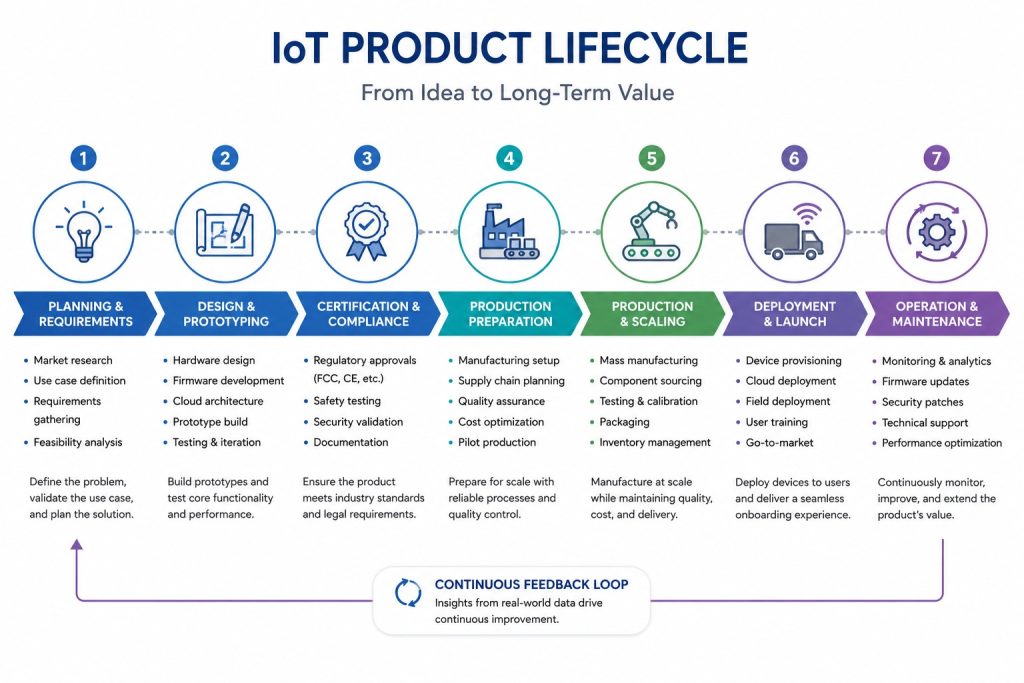
Unlike traditional hardware products, IoT solutions continue evolving long after they are shipped.
Once devices are deployed, businesses should budget for ongoing operational costs such as:
- Cloud hosting
- Device monitoring
- Firmware updates
- Security patches
- Technical support
- Performance optimization
- Infrastructure maintenance
These recurring expenses are part of the product’s total cost of ownership and should be considered during the initial planning phase.
Organizations that invest in proactive monitoring and maintenance often experience fewer service interruptions and lower support costs over time.
Common Reasons IoT Projects Exceed Budget
Many IoT projects become more expensive than expected because certain cost factors are overlooked during planning.
Some of the most common reasons include:
Expanding Project Scope
As development progresses, additional features are frequently requested by stakeholders or customers. While each new feature may appear relatively small, collectively they can extend both timelines and budgets.
Underestimating Software Complexity
Many organizations focus heavily on hardware while overlooking the engineering effort required for embedded software, backend infrastructure, APIs, and mobile applications.
Ignoring Operational Expenses
Cloud services, connectivity subscriptions, monitoring platforms, and customer support continue throughout the product’s lifecycle. These recurring costs should be included in financial planning from the beginning.
Delaying Security
Implementing security after development is substantially more expensive than incorporating it into the product architecture from day one.
Practical Ways to Control Development Costs
Although IoT projects involve many moving parts, several strategies can help businesses manage budgets more effectively.
Start with a Minimum Viable Product (MVP)
Launching with essential functionality allows organizations to validate market demand before investing in advanced features. Once the product gains traction, businesses can gradually introduce custom AI agents to automate customer support, internal operations, or device management based on real-world usage patterns.
Design for Scalability
A scalable architecture reduces the need for expensive redesigns as the number of connected devices increases.
Select the Right Connectivity
Choosing the most appropriate communication technology based on the use case can significantly reduce both deployment and operational costs.
Plan the Entire Product Lifecycle
A realistic budget should include not only development but also manufacturing, certification, deployment, cloud infrastructure, maintenance, and future software updates.
Work with Experienced Specialists
Experienced development teams can identify technical risks early, recommend suitable technologies, and reduce costly mistakes throughout the project.
Industry reports published by IoT Analytics regularly provide insights into IoT adoption trends and deployment challenges, while platforms such as AWS IoT and Microsoft Azure IoT offer extensive documentation on scalable cloud architectures and device management best practices.
Conclusion
Estimating the cost of an IoT product requires looking beyond the initial prototype. While hardware is often the most visible expense, embedded software, cloud infrastructure, connectivity, applications, security, certification, manufacturing, and ongoing maintenance all contribute significantly to the total investment.
Businesses that understand these cost drivers early are better equipped to create realistic budgets, reduce project risks, and deliver products that remain reliable and scalable long after launch.
Rather than viewing IoT development as a one-time engineering project, organizations should approach it as a long-term investment that continues throughout the product’s lifecycle. As IoT ecosystems mature, integrating an AI agent can further improve automation, decision-making, and operational efficiency without significantly increasing manual workloads. With careful planning, informed technology choices, and experienced technical guidance, companies can successfully transform innovative concepts into commercially successful IoT solutions.
AI Agentic Platform For Building Portable AI Agents
Say Hello To Agentic AI That Connects With Your CRM And Even Other Agents