


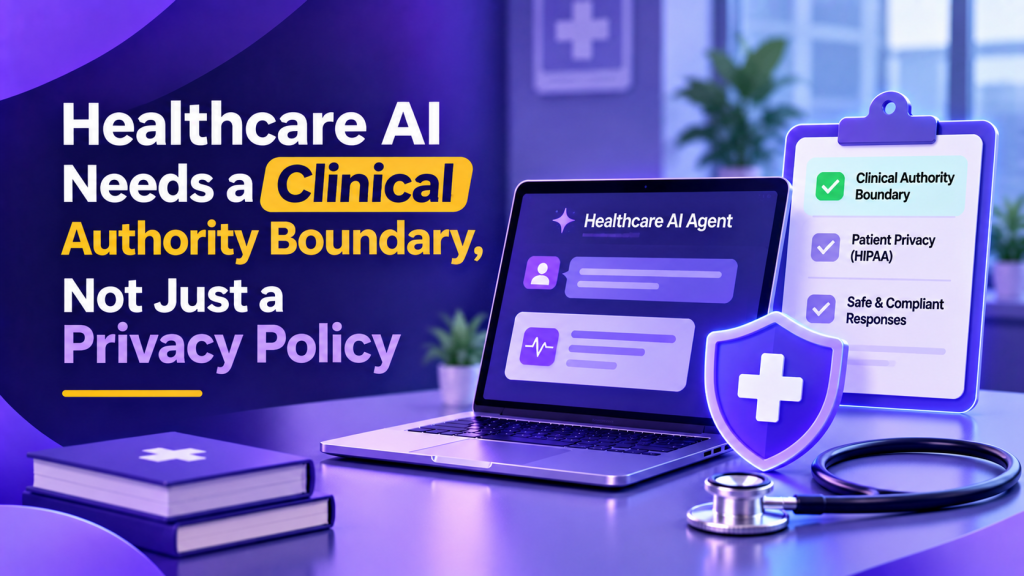
Healthcare organizations are adopting AI assistants for scheduling, patient communication, documentation, triage support, coding, and internal knowledge retrieval. Most governance conversations begin with privacy because health information is highly sensitive. Privacy is essential, but it does not fully describe the risk created when an AI system can influence a clinical or administrative workflow.
The deeper question is authority. What can the system see, what can it recommend, what can it change, and when must a human take over? Healthcare AI becomes safer when those boundaries are explicit enough that a model error cannot silently become a clinical or operational action.
Clinical context changes the cost of an AI error
In many industries, an incorrect AI answer creates inconvenience. In healthcare, the same failure can affect patient safety, treatment decisions, billing, access, or legal obligations. That means the security model has to account for consequence, not just data confidentiality.
A 2026 clinical AI resilience playbook recommends preparing cross-functional teams to detect, analyze, and respond to threats affecting AI-integrated clinical operations. That framing is important because AI incidents do not fit neatly into either cybersecurity or patient-safety processes. A model can behave incorrectly without being compromised, and a cyberattack can manipulate an AI workflow without obviously breaching a database.
The operating boundary should therefore be narrow by design. A system used for scheduling does not need authority to make clinical judgments. A documentation assistant does not automatically need access to every patient record. Scope is a security control.
Data access is only one half of the problem
Healthcare AI discussions naturally focus on protected health information. Teams ask whether data is encrypted, where it is stored, whether prompts are retained, and which vendors can access it. Those are necessary questions, but they focus on what enters the system.
The other half is what the system can cause. A model with read-only access to records has a different risk profile from an agent that can update an appointment, submit a claim, send a patient message, or modify a workflow. The transition from interpretation to action is where AI security becomes operational.
This is why AI security for healthcare should be treated as a combination of data protection, identity, application controls, model behavior, and workflow authorization. A strong privacy policy cannot compensate for an assistant that has excessive tool permissions. The system needs limits that remain enforceable even when the model is wrong or manipulated.

Separate support automation from clinical authority
The safest pattern is to separate recommendation from authorization. An AI assistant can draft a response, summarize records, classify a request, or suggest the next workflow step. The application then decides whether the proposed action is permitted.
This principle is especially useful for patient-facing automation. Guidance on safe healthcare AI agents recommends keeping non-clinical functions narrow and escalating sensitive or clinical matters quickly. That design choice reduces the number of situations in which a probabilistic model becomes the final decision-maker.
The same approach applies internally. A coding assistant can propose a billing code, but a deterministic rule or qualified reviewer can validate it before submission. A clinical summarizer can identify relevant information without receiving permission to change the source record.
Escalation is a security control
Escalation is often treated as a customer-experience feature, but in healthcare it is part of the security boundary. The system needs clear human handoff rules that determine when control should transfer to a qualified staff member, particularly when confidence is low, a request involves clinical judgment, or the workflow moves outside the agent’s defined scope.
The escalation path should also preserve context. A human reviewer needs to know what the patient asked, what information the model used, what it proposed, and why the system escalated. Otherwise, the human becomes a rubber stamp rather than an independent control.
Organizations should include AI agent prompt injection testing in their security reviews. What happens if a patient message contains malicious instructions, a retrieved document attempts to override the agent’s rules, or an attacker tries to push the assistant toward clinical advice? The system should fail toward human review rather than expanded authority.
Design for evidence after the interaction
Healthcare AI systems need auditability that extends beyond conventional access logs. Teams should be able to reconstruct which model version ran, what context it received, which tools were available, what action it proposed, and what ultimately happened. This evidence is necessary for both cybersecurity investigation and clinical review.
Logging also improves governance over time. Patterns of repeated escalation can reveal where the system’s scope is poorly defined, while unusual tool use can expose security problems before they become incidents. The goal is not to record every token indefinitely, but to preserve the evidence required to explain consequential decisions.
Healthcare AI can deliver meaningful operational benefits, particularly in administrative workflows where staff are overloaded. The safest deployments recognize that privacy is only one dimension of trust. The more important question is whether the system’s authority remains narrow, explainable, and reversible when something goes wrong.
Clinical recovery must be designed before failure
Healthcare teams should also design recovery before an AI failure occurs. If an assistant is disabled during an incident, staff need to know which workflows return to manual operation, which records require review, and how to identify actions the system already completed. A kill switch without a recovery process can create a new patient-safety problem by interrupting scheduling, communication, or documentation without a controlled fallback.
This is why resilience belongs inside AI security rather than after it. Teams should rehearse the loss of the model, the connector, and the agent identity separately, because each failure creates a different operational consequence. The objective is not only to stop unsafe AI behavior, but to restore a trustworthy clinical workflow without losing accountability.
AI Agentic Platform For Building Portable AI Agents
Say Hello To Agentic AI That Connects With Your CRM And Even Other Agents